




Art of Vedas — Authentic Ayurvedic Products
If you are looking for Ayurvedic products that are genuinely traditional in their formulation and preparation, you are in the right place.
Art of Vedas is built on classical Ayurveda, following primary texts including the Ashtanga Hridayam, Sahasrayogam, and Charaka Samhita. Our Thailams are prepared using traditional Sneha Paka Vidhi. Our Kansa tools are hand-cast in genuine bronze. Our herbal supplements, Churnams, Arishtams, Kashayams, and Lehyams follow the same classical preparation standards — held to the same level of quality across the entire range.
The collection covers the full breadth of Ayurvedic care: traditional Thailams and Abhyanga oils, Kansa and copper tools for face, scalp and body rituals, Nasya oils, Ayurvedic skincare, oral care, haircare, single herbs like Ashwagandha, Brahmi, Amla and Triphala, and a wide selection of classical formulations.
Used daily by Ayurveda practitioners, Panchakarma centres, and wellness professionals across Europe and equally suited to anyone building a serious Ayurvedic home practice.

Experience deep moisturization and hydration, leaving your hands soft, smooth, and rejuvenated. The comforting aroma promotes relaxation, while the protective barrier shields your skin from environmental stressors. Suitable for all skin types, including sensitive skin, this chemical-free hand cream enhances your daily self-care ritual, providing effective skincare for nourished and revitalized hands. Embrace the power of nature and experience the ultimate Ayurveda-inspired, vegan skincare journey with our exquisite hand cream.

Art of Vedas Tri Dosha Massage Oil is a balanced, harmonising Abhyanga blend formulated to suit all three constitutional types: Vata, Pitta and Kapha. While the Vata and Pitta oils are tailored to specific constitutional tendencies, this Tridoshic blend occupies the classical middle ground -- neither too warming nor too cooling, neither too heavy nor too light. It is the practical choice when you are unsure of your constitution, when your preferences shift with the seasons, or when multiple family members share one oil.
The Charaka Samhita and Ashtanga Hridayam describe Abhyanga (traditional warm oil self-massage) as one of the most important daily practices in Dinacharya, valued for every person regardless of constitution. This oil honours that universal principle with a carefully balanced formulation that nourishes the skin, supports a sense of calm and groundedness, and creates a pleasant, centering aromatic experience. The aromatic profile is warm yet gentle, designed to be agreeable across all constitutional types and seasons.
For external use only. Not intended to diagnose, treat, cure or prevent any disease. Not a substitute for professional medical advice. Patch test before first use. Discontinue if irritation occurs. Store in a cool, dry place away from direct sunlight.

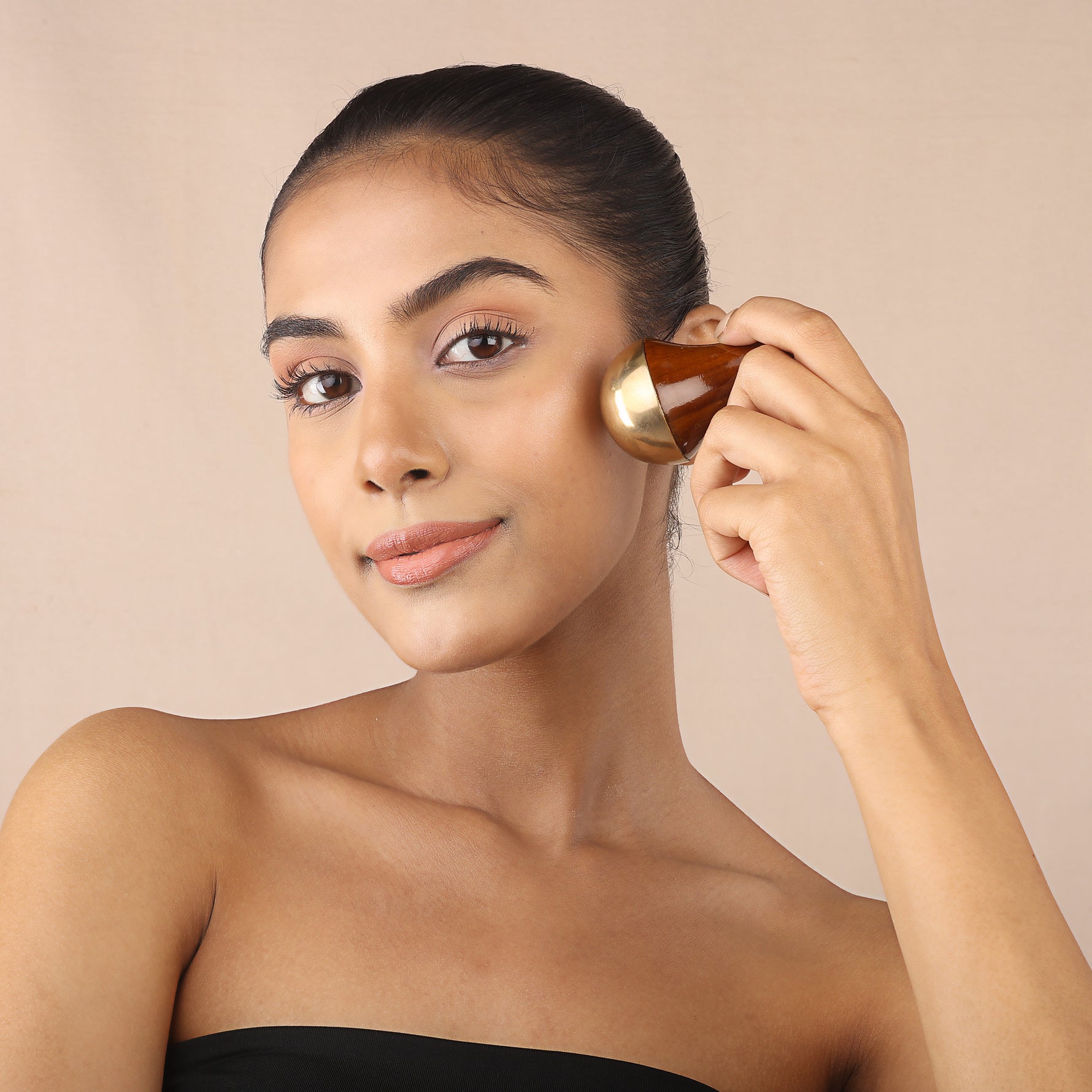
The Kansa Abhyanga Wand is a body massage tool hand-cast from Kansa bronze with a large, smooth dome and an ergonomic hardwood handle. The dome is sized and shaped for broad, sweeping strokes along the limbs, back and shoulders during Abhyanga (traditional Ayurvedic oil massage). Kansa has a naturally cooling quality, valued in Ayurvedic bodywork for its smooth glide on oiled skin.
Apply a generous amount of massage oil before use. Work in long strokes along the limbs (from extremities toward the centre) and circular motions on the joints. Spend extra time on areas of tension such as the shoulders, lower back and calves. Clean and dry thoroughly after each use. Store away from moisture.
For external use only. Not a substitute for professional medical advice.

Murivenna Oil is a classical Ayurvedic formulation traditionally used for external application after physical exertion, fresh bruises, sprains, minor burns, and muscle strains. Unlike most Ayurvedic oils that use warming sesame oil, Murivenna features a cooling coconut oil base that immediately soothes hot, tender tissue following physical impact.
This traditional formula combines 9 herbs in precise proportions, creating comprehensive support for the body's natural recovery process. The cooling herbs (Aloe Vera, Shatavari, coconut oil) balance excess heat, while warming herbs (Betel Leaf, Moringa Bark) support healthy circulation to affected areas. This thermal balance makes Murivenna uniquely suited for the acute phase after impact, when heat and swelling are present.
Primary indications: Fresh bruises, sprains, strains, minor burns, muscle overexertion, acute physical impact
Application: External use only, 2-3 times daily during acute phase.

Prabhanjanam Thailam is a traditional Ayurvedic oil formulation prepared according to classical methods. The name derives from Prabhanjana, the Vedic term for the force of Vata, reflecting this oil's classical association with Vata-balancing support.
The formulation combines 24 traditionally selected herbs and roots including Dashamoola (a classical ten-root group), Bala (Sida cordifolia), Ashwagandha (Withania somnifera), Ginger, Cardamom and Pine resin, processed in a traditional sesame oil base. Classical Ayurvedic literature associates this combination with deep tissue nourishment, warmth and grounding qualities characteristic of Vata-pacifying preparations.
Used in traditional Panchakarma settings and home Abhyanga practice. Available in 200ml, 1 litre and 5 litre formats to suit both personal self-care routines and professional clinical use.
For external use only. Not intended to diagnose, treat, cure or prevent any disease. Not a substitute for professional medical advice.

Triphala Capsules deliver the most widely used formulation in Ayurveda in a convenient, precisely dosed format. Each capsule contains the classical blend of three fruits: Haritaki (Terminalia chebula), Bibhitaki (Terminalia bellirica) and Amalaki (Emblica officinalis), described in the Charaka Samhita as a Rasayana of the highest order.
Triphala is Tridoshic: Haritaki balances Vata, Bibhitaki supports Kapha, and Amalaki cools Pitta. Together they act gently without creating dependence or excess heat. Take 2 capsules daily with warm water, or as advised by your Ayurvedic practitioner.
This product is a food supplement. Not intended to diagnose, treat, cure or prevent any disease. Not recommended during pregnancy or breastfeeding.

Ashwagandha (Withania somnifera) is one of the most revered Rasayana herbs in Ayurveda, referenced in the Charaka Samhita and Ashtanga Hridayam. The name means "the smell of a horse," reflecting the vitality and stamina it traditionally imparts. With a warming Virya and sweet post-digestive effect, it is especially suited for Vata and Kapha constitutions.
Classical texts describe Ashwagandha as Balya (strength-promoting), Rasayana (rejuvenative) and Vrishya (vitality-enhancing). One of the finest adaptogenic herbs in the Ayurvedic pharmacopoeia, ideal for autumn and winter routines. Take 2 capsules daily with warm water, or as advised by your healthcare professional.
This product is a food supplement. Not intended to diagnose, treat, cure or prevent any disease. Not suitable for children, pregnant or breastfeeding women.

Jathyadi Thailam is a classical Ayurvedic formulation documented in the Sushruta Samhita, one of the foundational texts of Ayurveda. This traditional oil combines 9 medicinal plants led by Jati (Jasmine), an important herb in Ayurvedic skin care traditions in a pure sesame oil base. The formulation is traditionally valued in Ayurveda for its Vrana Shodhana (skin cleansing) and Vrana Ropana (skin recovery support) properties. It is used as an external application in classical Ayurvedic practice and continues to be one of the most widely referenced formulations for supporting the skin's natural renewal process.

Thikthakam Ghritham is a classical bitter ghee from the Ashtanga Hridayam, belonging to the same Tikta Ghrita (bitter ghee) family as Mahathiktakam Ghritham. Where Mahathiktakam uses a large, broad group of herbs, Thikthakam uses a smaller, more focused group of 9 herb extracts with a specific classical emphasis on the Asthi Dhatu (bone tissue) and Majja Dhatu (marrow) channels.
The Tikta (bitter) taste has a particular affinity for Asthi Dhatu in the classical texts, making bitter ghee preparations the preferred vehicle for supporting the bone tissue level. The herb group centres on Nimba (Neem), Guduchi, Patola and Triphala, processed into purified cow's ghee. Classical texts describe it as Pittahara, Asthiposhaka (bone tissue-nourishing) and Majja Dhatu Poshaka. More targeted than Mahathiktakam for deeper tissue presentations.
Take 1-2g daily on an empty stomach, warmed to liquid consistency, with warm water, or as directed by your Ayurvedic practitioner.
This product is a food supplement. Not intended to diagnose, treat, cure or prevent any disease. Do not exceed the recommended daily dose. Consult a qualified practitioner before use if pregnant, breastfeeding or taking medication.

In the classical Ayurvedic tradition, sesame oil holds a singular place. Known as Tila Taila, it is referred to in the Charaka Samhita as the foremost among oils, valued above all others for its ability to nourish tissues, calm the nervous system and support the body's natural equilibrium. The Sushruta Samhita and Ashtanga Hridayam confirm it as the primary oil for Abhyanga (traditional warm oil body massage), citing its unique capacity to penetrate all seven tissue layers when applied with steady, rhythmic strokes.
Art of Vedas Organic Sesame Oil is cold-pressed from certified organic sesame seeds, preserving the full spectrum of natural fatty acids, antioxidants and sesame lignans. No chemical solvents, hexane processing or artificial refinement. Its inherently warming quality (Ushna Virya) makes it the classical choice for pacifying Vata Dosha, the principle most easily disturbed by cold weather, stress and irregular routines.
For practitioners, this oil serves as the traditional base for Abhyanga, Shirodhara preparation and Snehana protocols. For personal self-care, warm a small amount in your palms, massage from head to toe using long strokes on the limbs and circular movements over the joints, and allow fifteen to twenty minutes of absorption before bathing.
For external use only. Not a substitute for professional medical advice.

Kaisora Guggulu Gulika is the 1000mg Kerala Gulika form of the classical Kaisora Guggulu compound, prepared according to the Sahasrayogam and traditional Kerala pharmaceutical methods. While sharing the same classical formulation as the 250mg Vati, this Gulika version undergoes the distinct Kerala Bhavana (trituration) process that concentrates the active principles for enhanced potency.
The formulation combines purified Guggulu with Triphala, Guduchi (Tinospora cordifolia) and supporting herbs. Classical texts describe it as Raktashodhaka (a traditional Ayurvedic property associated with Rakta Dhatu), Rasayana (rejuvenative in the classical Ayurvedic sense) and Amapachana (supporting the digestion of Ama). The higher 1000mg dose per tablet makes this Gulika form particularly suited for practitioner-directed protocols.
Take 1 tablet, 2 times daily with water. Daily intake (2 tablets) provides: herbal blend 1,436 mg, ghee 188 mg. Store in a cool, dry place.
This product is a food supplement. Not intended to diagnose, treat, cure or prevent any disease. Do not exceed the recommended daily dose. Not recommended during pregnancy or breastfeeding. Keep out of reach of children.

Mahathiktakam Ghritham is the great bitter ghee of the classical Ayurvedic pharmacopoeia, documented in the Ashtanga Hridayam (Chikitsa Sthana). The name is literal: Maha (great) + Tikta (bitter) + Ghritham (ghee). This formulation combines 26 bitter and astringent herbs including Nimba (Neem), Guduchi, Triphala and Patola, processed into purified cow's ghee through the traditional Sneha Kalpana method.
In the classical framework, the Tikta (bitter) taste is the primary tool for Pitta reduction and Rakta Dhatu (blood tissue) support. Mahathiktakam provides a broad, deep Tikta action across multiple tissue levels simultaneously. Classical texts describe it as Pittahara, Kushthaghna (skin-clarifying) and Raktashodhaka (blood-supporting). The "Maha" prefix distinguishes it from Thikthakam Ghritham by the greater breadth of herbs in the formula.
Take 2g daily on an empty stomach, warmed to liquid consistency, with warm water, or as directed by your Ayurvedic practitioner.
This product is a food supplement. Not intended to diagnose, treat, cure or prevent any disease. Do not exceed the recommended daily dose. Consult a qualified practitioner before use if pregnant, breastfeeding or taking medication.

Dhanwantharam Ghritham is the classical ghee form of the Dhanwantharam formulation, documented in the Ashtanga Hridayam and Sahasrayogam. Named after Lord Dhanwantari, the patron deity of Ayurveda, this preparation carries over 33 herbs led by Bala (Sida cordifolia) and the Dashamula (ten-root) group, processed into purified cow's ghee through the traditional Sneha Kalpana method. As a Ghritham, it nourishes Vata-affected tissues directly through the digestive channels.
The Dashamula group forms the foundational Vata-pacifying base, while Bala adds the primary Brimhana (tissue-building) dimension that distinguishes this formulation. Classical texts describe it as Vatahara, Balya and Brimhana, with particular emphasis in the prenatal and postnatal context (Garbhini and Sutika Paricharya). It complements external application of Dhanwantharam Thailam: the Ghritham works internally, the Thailam externally.
Take 2-3g daily on an empty stomach, warmed to liquid consistency, with warm water, or as directed by your Ayurvedic practitioner.
This product is a food supplement. Not intended to diagnose, treat, cure or prevent any disease. Do not exceed the recommended daily dose. Consult a qualified practitioner before use if pregnant, breastfeeding or taking medication.

Triphala Churnam is the most widely used formulation in classical Ayurveda, a synergistic blend of three fruits: Haritaki (Terminalia chebula), Bibhitaki (Terminalia bellirica) and Amalaki (Emblica officinalis). Described in the Charaka Samhita as a Rasayana of the highest order, Triphala is valued for its gentle yet comprehensive action on digestion and overall vitality.
Each fruit brings a distinct quality. Haritaki balances Vata, Bibhitaki supports Kapha, and Amalaki cools and nourishes Pitta. Together they form a Tridoshic Rasayana that supports healthy digestion, gentle elimination and tissue nourishment without creating dependence or excess heat.
Take 1/2 to 1 teaspoon (2-3g) mixed with warm water, ideally before bed or on an empty stomach in the morning. Can also be used externally as a mild cleansing wash for skin and hair.
This product is a food supplement. Not intended to diagnose, treat, cure or prevent any disease. Consult a qualified practitioner before use if pregnant, breastfeeding or taking medication.

Ashwagandha Churnam (Withania somnifera) is one of the most revered herbs in classical Ayurveda, celebrated as a premier Rasayana and Balya (strength-promoting) formulation. The Charaka Samhita classifies it as a Medhya Rasayana, and the name literally means "the smell of a horse," referring to the vitality and stamina it traditionally imparts.
With a warming Virya and sweet post-digestive effect, Ashwagandha is especially suited for Vata and Kapha imbalances. It is traditionally valued for its grounding, nourishing qualities and is one of the finest adaptogenic herbs in the Ayurvedic pharmacopoeia. Ideal for autumn and winter routines when the body seeks deeper nourishment.
Take 1/2 to 1 teaspoon (2-3g) mixed with warm milk or water, preferably in the evening or before bed. May also be taken with ghee and honey (in unequal proportions) for enhanced absorption.
This product is a food supplement. Not intended to diagnose, treat, cure or prevent any disease. Consult a qualified practitioner before use if pregnant, breastfeeding or taking medication.

Brahmi Churnam (Bacopa monnieri) is one of the four Medhya Rasayanas described in the Charaka Samhita, herbs specifically classified for their affinity with the mind, intellect and nervous system. The name derives from Brahma, the creative principle, reflecting its traditional role in supporting the highest faculties of awareness.
Brahmi is Tridoshic with a predominantly cooling Virya, making it suitable year-round for all constitutional types. It is especially valued for Pitta-predominant conditions of the mind. Classical texts describe it as Ayushya (life-promoting), Balya (strength-giving) and Swarya (voice-enhancing).
Take 1/2 to 1 teaspoon (2-3g) mixed with warm milk, ghee or water, preferably in the morning. Can also be applied externally as a hair and scalp paste mixed with a suitable carrier oil.
This product is a food supplement. Not intended to diagnose, treat, cure or prevent any disease. Consult a qualified practitioner before use if pregnant, breastfeeding or taking medication.

Avipattikar Choornam is a classical compound formulation described in the Bhaishajya Ratnavali and Sharangadhara Samhita. It is among the most widely prescribed Pitta-balancing digestive powders, combining cooling, carminative and gently laxative herbs into a single harmonious blend. The name suggests a formulation that prevents "Vipatti" (disorder) in the digestive tract.
The compound includes Trikatu (ginger, black pepper, long pepper), Triphala, Musta, Vidanga and Ela (cardamom) with Mishri (rock sugar). The warming Trikatu stimulates Agni while the cooling majority of the formula pacifies excess Pitta. Both Deepana (appetite-kindling) and Anulomana (gently downward-moving).
Take 1/2 to 1 teaspoon (2-3g) with warm water or buttermilk, after meals. Traditionally taken after lunch and dinner for optimal digestive support.
This product is a food supplement. Not intended to diagnose, treat, cure or prevent any disease. Consult a qualified practitioner before use if pregnant, breastfeeding or taking medication.

Amla Churnam (Emblica officinalis), also known as Amalaki, is described in the Charaka Samhita as the single most important Rasayana fruit in Ayurveda. It possesses five of the six tastes (all except salty), giving it an extraordinarily broad and balanced action across all three Doshas.
Amalaki is the primary ingredient in Triphala and the base of Chyavanaprasha. Its cooling Virya and sweet Vipaka make it one of the rare Rasayanas that nourishes deeply without aggravating Pitta. Classical texts classify it as Vayasthapana (age-defying), Chakshushya (vision-supporting) and one of the richest natural sources of Vitamin C.
Take 1/2 to 1 teaspoon (2-3g) mixed with warm water or honey, once or twice daily. Can also be used externally as a hair mask when mixed with water to form a paste.
This product is a food supplement. Not intended to diagnose, treat, cure or prevent any disease. Consult a qualified practitioner before use if pregnant, breastfeeding or taking medication.
Showing 72/105
Let customers speak for us

I was struggling to find authentic Ayurvedic items, i am glad to make my order


I ordered several supplements and oils from there and they are great quality

In advice of a good friend, I ordered and received my goods in really good condition. Wands are beautiful and nice to handle. I'm ready to learn more of Ayurveda and looking forward to see what is does with my body & soul. Service (responding to mail) is friendly and correct. Thx so much for that !


The order was quickly, all items in best conditions, massage oils smooth and healthy. I fully recommend.

Love the Art of Vedas high quality products and there follow up with emails. Highly reliable. Highly recommended.
