This article is part of our Ashwagandha: The Classical Ayurvedic Rasayana for Strength and Vitality guide series.
The information in this article is provided for educational purposes and reflects traditional Ayurvedic knowledge. It is not intended as medical advice and should not replace consultation with a qualified healthcare professional.
In brief: Ashwagandha (Withania somnifera) is one of the most thoroughly documented herbs in classical Ayurveda, referenced extensively in the Charaka Samhita, Ashtanga Hridayam, and Sahasrayogam. This guide explains what the classical texts actually say, how modern research relates to traditional knowledge, and what to look for when choosing a supplement. The goal is accuracy, not marketing.
Ashwagandha Benefits: The Complete Classical Guide (Not Just Marketing)
Ashwagandha is the most searched Ayurvedic herb in France and among the top five most searched supplements in the EU. It is also one of the most misrepresented. The wellness market has taken a herb with three thousand years of precise, documented use and reduced it to a few buzzwords: "adaptogen," "stress support," "hormone balance." These phrases are not wrong, but they are incomplete to the point of being misleading.
The classical record is more specific and more interesting than the marketing suggests. Understanding what Ashwagandha actually is in the Ayurvedic system, what conditions and constitutions the classical texts describe it as being suited for, and how modern clinical research relates to that traditional framework is the starting point for using this herb intelligently.
Ashwagandha in Classical Ayurveda: What the Texts Actually Say
In the Charaka Samhita, Ashwagandha (Withania somnifera) is classified under the category of Balya herbs - those that support strength, vitality, and the integrity of the body's tissues. The Charaka Samhita's Sutrasthana describes it as Rasayana, a term with a specific and technically precise meaning in Ayurveda: preparations and practices that support the quality of all seven dhatus (body tissues), renew the body's resources over time, and promote longevity and resilience. Rasayana is not simply "anti-aging" in the modern marketing sense - it is a sophisticated pharmacological and therapeutic category described in the Rasayana chapter of the Chikitsa Sthana of the Charaka Samhita.
The Ashtanga Hridayam, written by Vagbhata in the seventh century CE, classifies Ashwagandha more specifically within the context of Vata-balancing preparations. Its virya (potency) is ushna (warming), its rasa (taste) includes tikta (bitter) and katu (pungent) notes alongside a madhura (sweet) aftertaste. This combination of qualities makes it particularly relevant to conditions and constitutions where Vata is elevated - characterised in Ayurvedic terms by dryness, lightness, mobility, and difficulty maintaining stable energy over time.
The Sahasrayogam, the classical text, references Ashwagandha in a number of compound preparations targeting Vata-related degeneration, weakness in the musculoskeletal system, and what the text describes as kshaya - the gradual depletion of the body's vitality and tissues. This context is important because it places Ashwagandha not simply as a stress supplement, but as a herb for rebuilding depleted resources over a sustained period.
Classical dosage guidance in Ayurvedic texts references Ashwagandha in doses of between three and six grams of churna (powder) per day, typically taken with warm water and honey - a preparation called Ashwagandha Ksheerapaka in some classical formulations. The use of milk as an anupana (carrier substance) is significant: milk is considered in Ayurveda to be a Vata-balancing, nourishing medium that enhances the assimilation of Ashwagandha's Rasayana properties.
What Modern Research Shows About Ashwagandha
Ashwagandha is among the most researched herbs in the Ayurvedic tradition from a modern clinical standpoint. The research base is more substantive than for most adaptogens, though it is important to read it with appropriate critical attention to study size, duration, and outcome measurement.
The most consistently replicated findings across multiple randomised controlled trials involve self-reported stress, anxiety, and perceived wellbeing. A number of double-blind studies have demonstrated reductions in perceived stress scores and cortisol levels in participants taking standardised Ashwagandha root extracts compared to placebo. These are the findings most frequently cited in marketing, and they are genuinely supported by the evidence - though effect sizes vary and the research involves healthy adults under moderate stress, not clinical anxiety populations.
A separate area of research involves physical performance and recovery. Several studies have examined Ashwagandha's effect on muscle strength, aerobic capacity, and recovery from exercise. The results are moderately positive, with some trials showing improvements in maximal oxygen uptake and muscle endurance in trained individuals taking Ashwagandha over periods of eight to twelve weeks. These findings align reasonably well with the classical classification of Ashwagandha as Balya - a herb that supports physical strength and vitality.
Research on thyroid function has generated interest in the supplement community. A small number of studies have examined Ashwagandha's effect on thyroid hormone levels in subclinical hypothyroidism, with some finding modest increases in T3 and T4. These findings are preliminary and should not be extrapolated into general claims about Ashwagandha "supporting thyroid health" - the evidence base is too limited and the populations studied too specific to support broad recommendations.
The compounds most studied in Ashwagandha research are the withanolides - a class of steroidal lactones concentrated primarily in the root. Most standardised extracts are characterised by withanolide content, typically between two and five percent. The relationship between withanolide percentage and clinical effect is not fully established, which creates complexity when comparing products.
Ashwagandha and the Vata-Kapha Constitution: Who Benefits Most?
Classical Ayurveda does not treat herbs as appropriate for everyone in the same dose and form. Ashwagandha's warming potency and Vata-balancing qualities mean it is most directly relevant to those whose primary imbalance involves Vata aggravation - characterised by difficulty maintaining stable energy, physical and mental dryness, scattered attention, poor sleep quality, and a tendency to feel cold and depleted.
For those with a predominantly Pitta constitution or with current signs of excess heat - inflammation, skin sensitivity, loose stools, or irritability - Ashwagandha's ushna virya requires more attention. It is not contraindicated for Pitta types, but the classical approach would typically modify the preparation to temper its heating quality, often by adjusting the anupana or combining it with cooling herbs.
For Kapha-dominant individuals, Ashwagandha can be used but requires attention to the heating quality being balanced with appropriate lifestyle and dietary practices. The herb's Balya and Rasayana properties are relevant across constitutions, but the context of use should be informed by individual assessment.
To better understand your own constitutional tendencies and how they relate to herb choice, the Art of Vedas Dosha assessment provides a starting point, and our guide to the practical management of Vata imbalance provides broader context for the constitution most directly addressed by Ashwagandha.
Choosing Ashwagandha: Powder, Capsule, Root Extract, and What to Look For
The Ashwagandha supplement market offers an enormous range of products: standardised root extracts, whole root powder, KSM-66 and Sensoril branded ingredients, capsules, tablets, and powders. The differences between them are meaningful and poorly communicated by most brands.
Whole root powder is the form closest to the classical churna preparation referenced in the texts. It contains the full spectrum of the plant's compounds in their natural ratios, including the withanolides, alkaloids, and other bioactive constituents. The trade-off is that withanolide content varies between batches and is typically lower per gram than in a standardised extract.
Standardised root extracts concentrate withanolides to a defined percentage through an extraction process. This provides more consistency in the active compound content but involves processing that moves away from the classical preparation. The most widely researched branded ingredients - KSM-66 and Sensoril - use different extraction methods and parts of the plant (KSM-66 uses roots only; Sensoril uses roots and leaves) and have different research profiles.
The classical anupana (carrier) remains relevant even when using modern capsule forms. Taking Ashwagandha capsules with or with warm water, is more consistent with the classical approach than taking them with cold water or a protein shake. The fat-soluble compounds in Ashwagandha may be better absorbed in the presence of the fats in milk, which may be part of the reason classical texts specified this anupana.
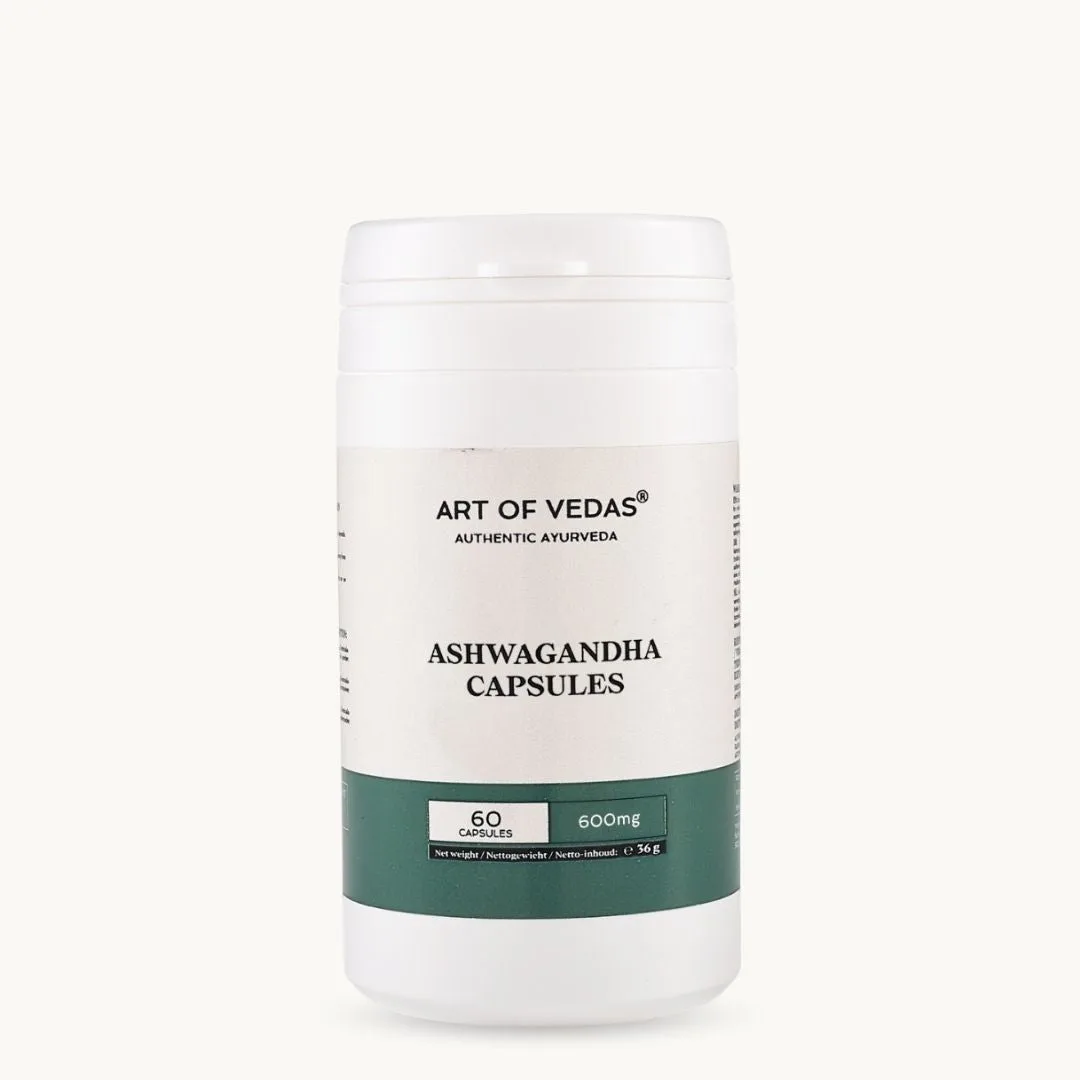
At Art of Vedas, our Ashwagandha supplements are carefully selected. See the product pages for specific details on form and preparation.
Frequently Asked Questions
What are the main benefits of Ashwagandha according to Ayurveda?
In classical Ayurveda, Ashwagandha is classified as both Balya and Rasayana. The Charaka Samhita and Ashtanga Hridayam describe it as particularly relevant to Vata-related depletion, weakness, and difficulty maintaining stable energy over time. It is traditionally used to support physical strength, resilience, and the integrity of the musculoskeletal system. Modern clinical research has focused on its effects on perceived stress, cortisol levels, and physical performance, with reasonably consistent findings in these areas.
How should I take Ashwagandha?
The classical Ayurvedic preparation involves taking Ashwagandha churna (powder) with warm water and a small amount of honey - a preparation that supports absorption and tempers the herb's drying qualities. Doses referenced in classical texts range from approximately three to six grams per day. Modern capsule forms are convenient and widely used; taking them with warm water rather than cold water is more consistent with the classical approach. It is generally advisable to take Ashwagandha consistently for a sustained period - classical Rasayana protocols typically run for several weeks to months - rather than as an occasional supplement.
Is Ashwagandha safe to take every day?
Ashwagandha has a well-established safety profile based on both its long history of use in classical Ayurveda and a growing number of clinical studies. Most research trials lasting eight to twelve weeks have not identified significant adverse effects at standard doses. Some individuals experience mild digestive discomfort when beginning supplementation, which typically resolves with continued use or dose adjustment. Those with thyroid conditions, autoimmune conditions, or who are pregnant or breastfeeding should consult a qualified healthcare professional before beginning Ashwagandha supplementation.
What is the difference between KSM-66, Sensoril, and regular Ashwagandha root powder?
KSM-66 and Sensoril are branded, standardised Ashwagandha extracts that concentrate specific compounds to defined percentages through proprietary extraction processes. KSM-66 uses roots only and has a larger clinical research base. Sensoril uses both roots and leaves. Regular whole root powder contains the full spectrum of the plant's compounds in natural ratios, is the form closest to classical Ayurvedic preparations, and has lower and more variable withanolide content per gram. Each form has different cost and consistency profiles, and the choice depends on whether standardised active compound content or classical preparation proximity is the priority.
Explore Ashwagandha Supplements at Art of Vedas
Browse Ashwagandha and Rasayana supplements at Art of Vedas, carefully selected. Related reading: our guides to classical Rasayana, managing Vata imbalance, Ashwagandha powder vs capsule, and Ayurvedic supplements for stress support.
This product is a food supplement and not intended to diagnose, treat, cure or prevent any disease.