Before Ayurveda prescribes any oil, any herb, or any daily practice, it asks one question: who are you? Your individual nature - in classical Sanskrit, your Prakriti - determines which foods, oils, rituals and seasonal approaches support your wellbeing most effectively.
This free Dosha assessment is based on the classical Prakriti Pariksha (constitutional examination) parameters used in Ayurvedic practice for centuries. It covers the key physical, mental and behavioural characteristics that classical texts use to determine the dominant Dosha - the constitutional force most active in your individual nature.
The assessment takes approximately five minutes. Answer each question based on how you have been for most of your life - not how you feel right now, and not how you would like to be. Honesty with yourself produces the most useful result.
What Is a Dosha?
In Ayurveda, the three Doshas - Vata, Pitta and Kapha - are the functional principles that govern the body and mind. Each is composed of elements from the natural world:
- Vata is composed of air and space - governing movement, creativity and the nervous system
- Pitta is composed of fire and water - governing transformation, digestion and perception
- Kapha is composed of earth and water - governing structure, stability and immune resilience
Every person contains all three Doshas. Your Prakriti is the unique ratio of all three that you were born with and that remains your constitutional baseline throughout life. Understanding your dominant Dosha - or dual-Dosha constitution - allows you to make choices in daily care, diet and practice that work with your nature rather than against it.
Learn more about the three Doshas and what they mean →
How to Take the Assessment
The questions below cover ten areas used in classical Ayurvedic constitutional assessment: body frame and physical build; skin texture and natural condition; hair type and natural condition; appetite and eating patterns; sleep patterns; emotional tendencies and responses to stress; memory and thinking style; speech patterns and communication style; energy levels and stamina; and climate sensitivity.
For each question, choose the option that most accurately describes your typical, lifelong pattern. If you are genuinely in-between two options, note both - your result may show a dual-Dosha constitution.
Your Result: Vata Constitution
This section is shown to users who receive a Vata result.
You Are Vata-Dominant
Vata (air and space) is your strongest constitutional principle. In classical Ayurveda, Vata governs movement - physical movement through the body, and the movement of thoughts and ideas through the mind. Vata-dominant people tend to be naturally creative, quick-thinking, expressive and adaptable. They often move and speak quickly, and thrive when they have variety and stimulation.
Your strengths: Creative thinking, fast learning, enthusiasm, flexibility, natural expressiveness.
Where Vata types benefit from support: Regularity, grounding and deep nourishment. Vata is aggravated by dryness, irregularity, cold and excess stimulation. The Ayurvedic approach for Vata focuses on warmth, routine, and rich nourishing oils and foods.
For your skin: Vata skin tends toward dryness or dehydration, particularly in cold and windy weather. It benefits from heavier, warming and deeply nourishing oils applied with a slow, grounding Abhyanga (warm oil massage) practice.
Recommended Art of Vedas products for Vata:
- Dhanwantharam Thailam - a classical warming Vatahara (Vata-supporting) oil widely used in traditional Abhyanga practice
- Mahanarayana Thailam - a complex classical formulation traditionally used in Vata care, particularly for the muscles and joints
- Browse all Ayurvedic Thailams →
Read more: Complete Vata Dosha Guide - Signs, Causes and How to Support Balance →
For a personalised Vata protocol - covering oil selection, massage practice, diet and a daily routine tailored to your specific Vata constitution - our qualified Ayurvedic doctors offer online consultations for just €19.
Book your €19 personalised consultation →
Your Result: Pitta Constitution
This section is shown to users who receive a Pitta result.
You Are Pitta-Dominant
Pitta (fire and water) is your strongest constitutional principle. In classical Ayurveda, Pitta governs transformation - the digestion of food, the metabolism of ideas, and the focused attention that drives understanding. Pitta-dominant people tend to be naturally sharp, focused, articulate and warm in their engagement with others. They are often natural leaders with a strong capacity for analysis and precision.
Your strengths: Focus, precision, intelligence, warmth, leadership, clear communication.
Where Pitta types benefit from support: Cooling, calming and moderation. Pitta is aggravated by heat, intensity, overwork and competitive pressure. The Ayurvedic approach for Pitta focuses on cooling foods and oils, restorative practices, and choosing approaches that calm rather than stimulate.
For your skin: Pitta skin tends to be sensitive, warm and reactive - particularly to heat, harsh ingredients or stress. It benefits from cooling, gentle oils with calming properties, applied lightly and without friction.
Recommended Art of Vedas products for Pitta:
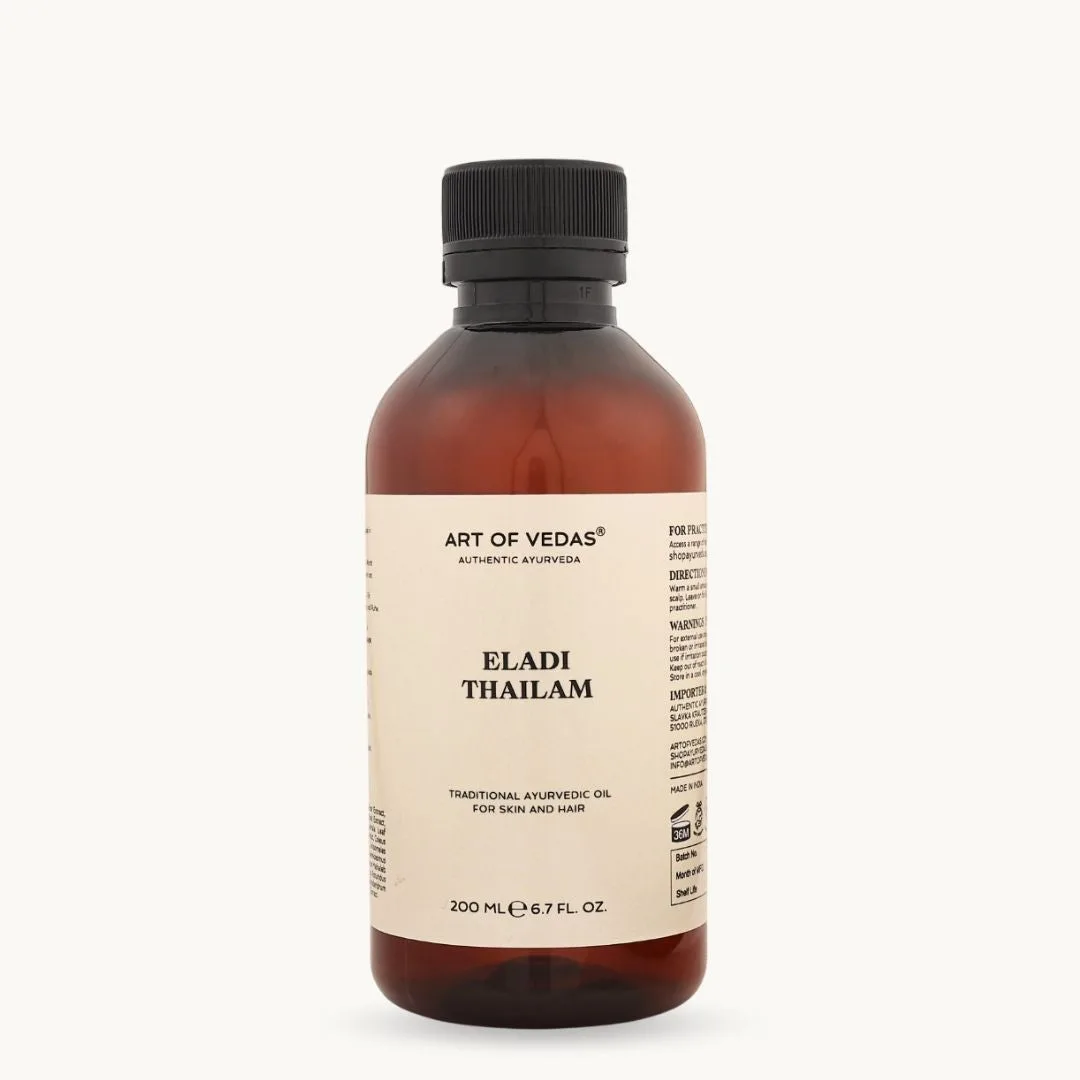
- Eladi Thailam - a classical face oil formulated around cooling herbs including cardamom, vetiver and sandalwood, in a coconut base traditionally suited to Pitta-type skin
- Browse all Ayurvedic Thailams →
Read more: Complete Pitta Dosha Guide - Signs, Causes and How to Support Balance →
For a personalised Pitta protocol - covering oil selection, skincare approach, diet and a daily routine adapted to your constitution - our qualified Ayurvedic doctors offer online consultations for just €19.
Book your €19 personalised consultation →
Your Result: Kapha Constitution
This section is shown to users who receive a Kapha result.
You Are Kapha-Dominant
Kapha (earth and water) is your strongest constitutional principle. In classical Ayurveda, Kapha governs structure - the physical form of the body, its lubrication, its natural immunity and its deep capacity for steadiness and calm. Kapha-dominant people tend to be naturally grounded, patient, loyal and deeply nurturing. They often have great physical endurance and a memory that retains information for a long time.
Your strengths: Steadiness, patience, loyalty, physical endurance, deep calm, excellent long-term memory.
Where Kapha types benefit from support: Stimulation, movement and lightness. Kapha is aggravated by heaviness, damp, cold, excess sleep and inactivity. The Ayurvedic approach for Kapha focuses on invigorating practices, lighter oils and foods, and consistent morning rituals that build energy.
For your skin: Kapha skin tends to be naturally smooth and well-lubricated, but may be prone to congestion or heaviness. It benefits from lighter, more stimulating oils applied with an invigorating, warming Abhyanga (massage) practice.
Recommended Art of Vedas products for Kapha:
Read more: Complete Kapha Dosha Guide - Signs, Causes and How to Support Balance →
For a personalised Kapha protocol - covering oil and food recommendations, daily routine and seasonal adjustments - our qualified Ayurvedic doctors offer online consultations for just €19.
Book your €19 personalised consultation →
Your Result: Dual-Dosha Constitution
This section is shown to users with a near-equal result across two Doshas.
You Are a Dual-Dosha Type
If your result shows two Doshas in close balance - Vata-Pitta, Pitta-Kapha or Vata-Kapha - you have a dual-Dosha constitution. This is the most common constitutional type. You will recognise characteristics from both of your dominant Doshas, and you may notice that one or the other becomes more prominent in different seasons or life circumstances.
For a dual-Dosha constitution, the Ayurvedic approach involves: identifying which Dosha is currently most elevated or most in need of support (your Vikriti); adjusting your approach seasonally - supporting Vata in autumn and winter, Pitta in summer, Kapha in late winter and spring; and choosing products and practices that support both Doshas without unduly aggravating either.
The most useful next step for a dual-Dosha constitution is a personalised consultation. Our qualified Ayurvedic doctors can assess both your Prakriti and your current Vikriti, and give you a clear, practical protocol that addresses both aspects of your constitution.
Book your €19 personalised Ayurvedic consultation →
What to Do With Your Result
Your Dosha type is a starting point - not a fixed prescription. Here is how to use it:
Start with one daily practice. The Abhyanga (warm oil self-massage) is one of the most universally recommended practices in classical Ayurveda, adapted to each Dosha through the choice of oil, temperature and technique. Choose a Thailam suited to your type and practice for five to ten minutes each morning before bathing.
Read your Dosha guide in full. Each of the three Dosha guides goes deeper into signs, seasonal patterns, and specific care recommendations for your type.
Consider a professional assessment. A self-assessment gives you a useful working framework. A consultation with a qualified Ayurvedic practitioner gives you a more precise, personalised picture - particularly if you have a dual-Dosha constitution or if your current state (Vikriti) seems significantly different from your baseline.
Frequently Asked Questions
Can my Dosha result change if I take the test again?
A well-designed self-assessment based on lifelong patterns should give a broadly consistent result. If your result shifts significantly between tests, you may have a dual-Dosha constitution, or your current state (Vikriti) may be significantly different from your baseline. A qualified practitioner can help clarify both.
Is a Dosha test a substitute for a medical assessment?
No. The Dosha assessment is a traditional Ayurvedic constitutional tool for understanding your individual nature and guiding wellness and care choices. It is not a medical diagnostic tool. For any health concerns, please consult a qualified medical professional.
How often should I reassess my Dosha?
Your Prakriti does not change. However, it is useful to revisit your current state (Vikriti) seasonally - your day-to-day constitution may shift with the seasons, with significant life changes, or over longer periods of time.
What if I am tridoshic - equal in all three Doshas?
A tridoshic constitution is one in which all three Doshas are roughly equal. It is relatively rare. Tridoshic individuals tend to be robust but also the most sensitive to seasonal shifts, as each season will tend to elevate a different Dosha. A personalised consultation is particularly useful for tridoshic types.
How can I get a more accurate assessment?
Our qualified Ayurvedic doctors offer personalised online consultations for €19, covering a full Prakriti assessment, your current state (Vikriti), product recommendations and a personalised daily routine. Book here →