Guduchi in Ayurveda: Classical Properties and Traditional Uses
Among the herbs that appear most consistently across the classical Ayurvedic texts, Guduchi (Tinospora cordifolia) holds a position of particular importance. Known also as Amrita - literally "that which is immortal" or "the divine nectar" - Guduchi is one of the few herbs described in the classical literature as a comprehensive Rasayana: a substance that rejuvenates the tissues, strengthens the system, and supports longevity.
This herb is not a modern addition to Ayurvedic practice. Guduchi appears in the Charaka Samhita, the Sushruta Samhita, and the Ashtanga Hridayam - the three pillars of classical Ayurvedic literature - and its uses are described with a breadth that reflects centuries of careful clinical observation.
Guduchi in the Classical Texts
The Charaka Samhita places Guduchi among the Vayasthapana group of herbs - those specifically understood to maintain the vitality and resilience of the body over time. It is also listed among the Balya group and the Jvarahara (supportive in fever conditions) group - an unusual combination that reflects the classical understanding of Guduchi as simultaneously strengthening and clarifying.
The Ashtanga Hridayam of Vagbhata describes Guduchi as Tridosha-hara - capable of addressing all three doshas when used appropriately - with particular emphasis on its capacity to address Pitta-related conditions while simultaneously nourishing the tissues. The Bhavaprakasha Nighantu provides one of the most comprehensive classical descriptions of the herb, noting its Rasayana quality, its support for the immune function of the body (Vyadhikshamatva), and its traditional role in febrile and debilitating conditions.
In Ayurvedic pharmacology, Guduchi is characterised as:
-
Rasa (taste): Tikta (bitter), Kashaya (astringent)
-
Virya (potency): Ushna (warming)
-
Vipaka (post-digestive effect): Madhura (sweet)
-
Guna (qualities): Guru (heavy), Snigdha (unctuous)
-
Dosha effect: Tridosha-shamana - particularly Pitta-shamana and Vata-shamana, with appropriate preparation also addressing Kapha
The combination of a bitter taste with warming potency and sweet post-digestive effect is relatively uncommon in Ayurvedic pharmacology and contributes to Guduchi's classical reputation as a uniquely versatile herb - simultaneously clarifying excess Pitta through its bitter taste while warming and nourishing the system through its Ushna virya and Madhura vipaka.
Guduchi as Rasayana
The Rasayana category in Ayurveda encompasses those herbs and preparations that are specifically understood to rejuvenate the tissue layers (Dhatus), build Ojas (the vital essence underlying immunity and resilience), and support the maintenance of health and vitality over time. Guduchi is one of a relatively small number of single herbs given the full Rasayana designation in the classical texts.
The classical understanding of Guduchi's Rasayana action operates primarily through the Rasa and Rakta Dhatus - the plasma and blood tissue layers that are the foundation of all subsequent tissue nourishment. By supporting the quality and clarity of these foundational layers, Guduchi's Rasayana action is understood to extend naturally to all downstream tissue layers.
This is why Guduchi appears in so many classical compound formulations - from Trikatu-based digestive preparations to Triphala-Guduchi combinations for comprehensive tissue support to complex multi-herb Rasayana formulations like Chyawanprash, where Guduchi is often one of the supporting herbs alongside the primary Amalaki base.
Traditional Uses of Guduchi in Ayurvedic Practice
Support for Agni (Digestive Strength)
Despite its bitter taste - which might suggest a cooling, Pitta-calming action primarily - Guduchi's Ushna virya (warming potency) means it supports rather than suppresses Agni (the digestive fire). Classical texts describe Guduchi as Deepana and Pachana. This combination of Ama-clearing and Agni-supporting action is one of Guduchi's most clinically important classical attributes.
Pitta Disorders and Clarity of Blood Tissues
Guduchi is consistently described across the classical texts as Pitta-shamana - addressing the excess of Pitta that may manifest in heat, inflammation, or irritability in the classical framework. Its Tikta rasa (bitter taste) and its affinity for the Rakta Dhatu (blood tissue) make it particularly relevant in classical protocols for Pitta-related blood tissue conditions. The Charaka Samhita lists Guduchi among the Raktashodhana (blood-clarifying) herbs.
Vyadhikshamatva - The Classical Concept of Immunological Resilience
One of the most important classical concepts relevant to Guduchi is Vyadhikshamatva - literally "the power of the body to resist disease." This concept, described in the Charaka Samhita (Sutrasthana Ch 28), refers to the body's innate capacity to resist the entry of pathogenic factors and to recover from disturbances to its balance. Guduchi is among the herbs most consistently cited in classical literature as supporting this quality - building the deep resilience of the tissues and the overall adaptive capacity of the system.
Support After Depletion
The classical texts describe Guduchi as particularly valuable in periods of recovery and convalescence - after illness, excessive effort, or prolonged exposure to depleting influences. Its Balya and Brimhana properties, combined with its Rasayana action, make it a classical choice for rebuilding strength and vitality during recovery.
Classical Forms of Guduchi in Ayurvedic Practice
Guduchi is used in several classical forms, each with its own tradition of application:
-
Guduchi sattva (starch extract): The purest classical preparation - a starch extracted from the stem of fresh Guduchi, dried and powdered. Considered by classical texts to be the most potent and easily absorbed form of Guduchi, particularly relevant for Pitta conditions and for post-illness recovery.
-
Guduchi churna (powder): The dried and powdered stem - the most widely available and commonly used classical form, taken with honey, ghee, or warm water depending on the condition being addressed.
-
Guduchi Kashayam (decoction): Classical water-based extraction - used extensively in Panchakarma and classical clinical practice for acute conditions.
-
Guduchi in compound formulations: Guduchi appears in numerous classical compound preparations - Guduchyadi Kashayam, Amritashtaka Churna, and as a component in various Arishtam and Asavam formulations.
Guduchi and the Three Doshas
The Tridosha-hara quality of Guduchi is one of its most distinctive classical attributes. Few herbs are described as genuinely balancing for all three doshas - most have a primary affinity for one or two doshas and a secondary or conditional effect on the others. Guduchi's unusual pharmacological profile - bitter and astringent taste, warming potency, sweet post-digestive effect - allows it to address different dosha imbalances through different mechanisms:
-
For Vata: The warming potency and sweet post-digestive effect nourish and ground Vata - particularly when Vata is elevated in the context of general debility or depletion.
-
For Pitta: The bitter Tikta rasa and Raktashodhana (blood-clarifying) action directly address Pitta - particularly in the Rakta Dhatu.
-
For Kapha: The bitter and astringent tastes and the Deepana-Pachana action address Kapha accumulation - particularly in the context of Ama (metabolic residue) and sluggish digestion.
Guduchi in the Context of the Art of Vedas Supplement Range
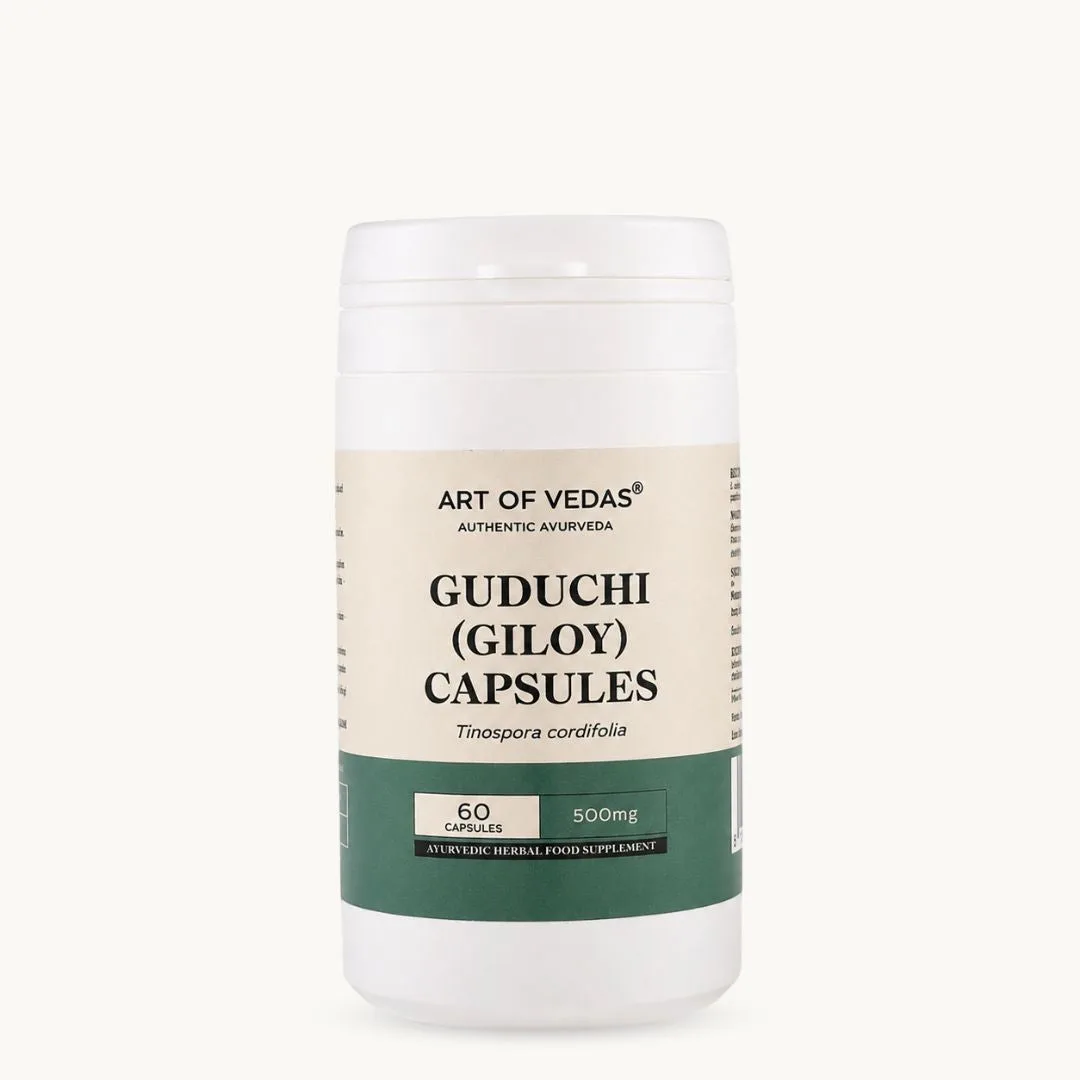
Art of Vedas sources Guduchi in its authentic classical forms - dried stem powder prepared in the traditional manner, suitable for the classical applications described in the texts. See our Guduchi Capsules and explore the full range of classical Ayurvedic supplements at Art of Vedas Supplements.
For the broader Rasayana context, see our complete guide to Rasayana in Ayurveda and our Ashwagandha guide - another of the primary classical Rasayana herbs. For the seven tissue layers that underlie the Rasayana concept, see our guide to the seven Dhatus.
Frequently Asked Questions
What is Guduchi used for in Ayurveda?
Guduchi is used in Ayurveda primarily as a Rasayana herb - supporting the rejuvenation of the tissue layers, building Ojas (vital essence), and supporting Vyadhikshamatva (the body's natural resilience). It is also traditionally used to support Agni (digestive strength), address Pitta-related conditions, and support recovery after depletion or illness.
What does Amrita mean in Ayurveda?
Amrita - one of the classical names for Guduchi - means "the divine nectar" or "that which is immortal." The name reflects the classical regard for Guduchi as a comprehensive Rasayana herb capable of supporting the vitality and longevity of the body. It derives from the mythological concept of Amrita as the nectar of immortality in Indian tradition.
Is Guduchi suitable for all doshas?
Yes. Guduchi is described in classical texts as Tridosha-hara - balancing for all three doshas - an unusual quality that reflects its complex pharmacological profile. It addresses Vata through its warming and nourishing properties, Pitta through its bitter taste and blood-clarifying action, and Kapha through its digestive-stimulating and Ama-clearing properties.
What is the difference between Guduchi sattva and Guduchi churna?
Guduchi sattva is a pure starch extract from the fresh Guduchi stem - considered in classical texts to be the most potent and easily absorbed form, particularly suited to Pitta conditions. Guduchi churna is the dried and powdered stem - more widely available, easier to use, and appropriate for most general applications. Both are authentic classical preparations; the choice depends on the specific indication and the availability of fresh herb for sattva preparation.
Can Guduchi be taken daily?
Classical texts describe Guduchi as appropriate for daily use as part of a Rasayana protocol. As with all Ayurvedic preparations, the appropriate dose, duration, and timing are best determined in consultation with a qualified Ayurvedic practitioner who can assess your individual constitution and current state of balance.
This article is for informational and educational purposes only. Guduchi is a traditional Ayurvedic herb used as a food supplement. It is not a medicine and is not intended to diagnose, treat, cure, or prevent any medical condition. This product is a food supplement and not intended to replace a varied diet. Consult a qualified Ayurvedic practitioner or healthcare professional for personalised guidance.
Explore more in this series