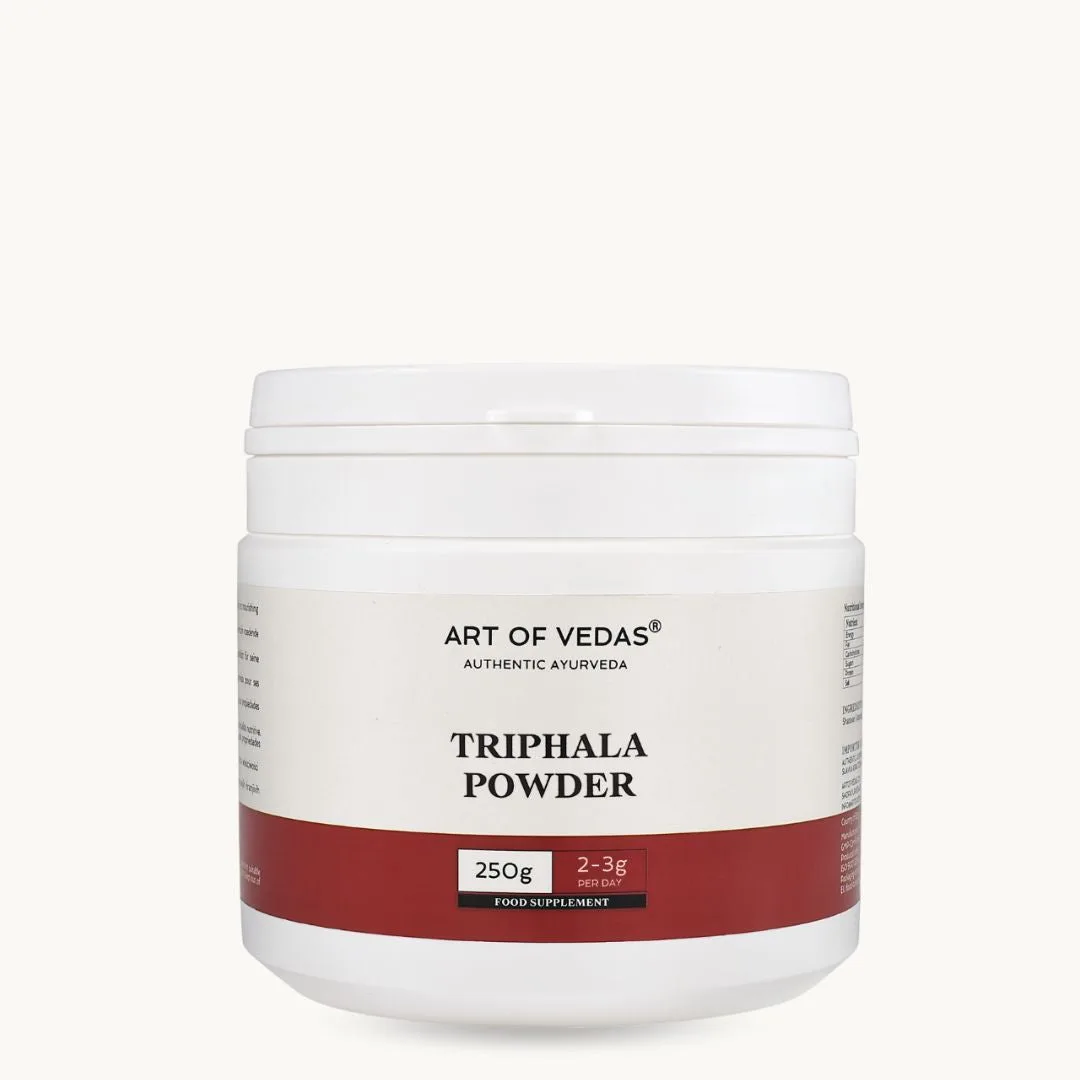
There is a well-known saying in classical Ayurvedic practice: "If you do not know what to prescribe, prescribe Triphala." This is not a statement about Triphala being a cure-all - classical Ayurveda does not deal in cure-alls. It is a statement about the remarkable breadth, safety, and Tridoshic balance of this single preparation. Triphala is the most widely prescribed compound in classical Ayurvedic practice, appearing in hundreds of formulations across the Charaka Samhita, Sushruta Samhita, and Ashtanga Hridayam - both as a standalone preparation and as a base ingredient in more complex formulas.
The name is straightforward: Tri means three, Phala means fruits. Triphala is a combination of three dried fruits in equal proportion:
Amalaki (Emblica officinalis, Indian Gooseberry / Amla) - the Pitta-pacifying fruit, cooling and nourishing
Bibhitaki (Terminalia bellirica) - the Kapha-pacifying fruit, astringent and lightening
Haritaki (Terminalia chebula) - the Vata-pacifying fruit, warming and regulating
This combination is not arbitrary. Each fruit addresses one of the three Doshas, and when combined in equal proportion, the result is a formula that is Tridoshahara - balancing to all three Doshas simultaneously. This Tridoshic quality is rare in Ayurvedic pharmacology and is the primary reason for Triphala's universal applicability.
The Three Fruits: Individual Profiles
Haritaki - "The King of Medicines"
Haritaki holds a position in Ayurveda comparable to what ginseng holds in Chinese medicine - it is called "the king of medicines" and is described as the single most important rejuvenating fruit in the classical pharmacopoeia. The Charaka Samhita devotes extensive description to Haritaki alone, classifying it as a Rasayana of the highest order.
Rasa: All five tastes except salty (Lavana) - a rarity that contributes to its broad action
Virya: Ushna (warming)
Vipaka: Madhura (sweet)
Primary Dosha action: Vata-pacifying - the warming quality and regulating action on the colon (Vata's primary seat) make Haritaki specifically Vata-supportive
Haritaki's classical description emphasises its action on the colon and on downward-moving Vata (Apana Vayu) - the subdosha responsible for elimination, menstruation, and reproductive function. Its regulatory effect on bowel function is neither purely laxative nor purely binding - it normalises, which is a distinctive and clinically important quality.
Bibhitaki - The Kapha Specialist
Rasa: Kashaya (astringent)
Virya: Ushna (warming)
Vipaka: Madhura (sweet)
Primary Dosha action: Kapha-pacifying - the astringent taste and drying quality counteract Kapha's inherent moisture and heaviness
Bibhitaki's classical emphasis is on the respiratory and upper digestive systems - the regions where Kapha predominantly accumulates. Its astringent quality is described as toning the tissues, reducing excess moisture, and supporting the body's natural clearing mechanisms.
Amalaki - The Great Rejuvenator
Amalaki is itself classified as one of the most important Rasayana substances in Ayurveda. It is the base ingredient in Chyavanprash - the classical Rasayana jam - and is described as the single richest natural source of vitamin C in the classical Indian botanical tradition.
Rasa: Five tastes - sour dominant, with sweet, bitter, astringent, and pungent
Virya: Sheeta (cooling)
Vipaka: Madhura (sweet)
Primary Dosha action: Pitta-pacifying - the cooling quality and sweet Vipaka directly moderate Pitta's heat while the sour taste supports digestive function without aggravating Pitta
Amalaki's cooling quality within Triphala counterbalances the warming qualities of Haritaki and Bibhitaki, contributing to the formula's overall Tridoshic equilibrium.
Classical Uses of Triphala
Digestive Support and Agni
Triphala's most prominent traditional application is supporting healthy digestion. In the classical framework, this is not simply about bowel regularity - it is about the quality and completeness of the entire digestive process. Triphala is described as supporting Agni (digestive fire) without aggravating it, gently promoting complete digestion so that the metabolic residue (Ama) that results from incomplete digestion is minimised.
The three fruits work synergistically on the digestive system: Haritaki regulates Vata's erratic influence on the colon, Bibhitaki addresses Kapha-type sluggishness and heaviness in digestion, and Amalaki moderates Pitta's tendency toward excess heat and acidity. The result, in classical description, is a digestive system that functions more completely and comfortably regardless of the individual's dominant Dosha pattern.
Gentle Daily Cleansing
Triphala is not a harsh purgative - classical texts are specific about this distinction. It is described as a Shodhana (cleansing) agent of the mildest category, suitable for daily long-term use rather than acute therapeutic purging. Its cleansing action works through supporting complete digestion and regular elimination rather than through forceful evacuation.
This is the classical basis for Triphala's traditional use as a daily supplement - taken in the evening or before bed, it supports the overnight digestive and eliminatory processes so that the body's natural morning cleansing cycle (which the Dinacharya morning routine supports) proceeds smoothly.
Rasayana
Beyond its digestive role, Triphala is classified as a Rasayana preparation in its own right. The Sushruta Samhita describes long-term Triphala use as supporting tissue nourishment, vitality, and sensory function - particularly vision. The Rasayana classification places Triphala in the company of herbs like Ashwagandha and preparations like Chyavanprash - substances that support the long-term production of Ojas through sustained tissue nourishment.
The classical reasoning is that by optimising Agni and ensuring complete, residue-free digestion, Triphala supports the entire downstream Dhatu (tissue) transformation chain. When digestion is complete, the nourishment reaching each tissue layer is pure and adequate - and the Ojas produced at the end of the chain is abundant and high-quality.
Eye and Vision Support
A traditional use that is less well-known in European contexts: Triphala is extensively described in classical texts as Chakshushya - beneficial for the eyes. Triphala eye wash (a carefully prepared and filtered decoction used to rinse the eyes) is a classical practice, and internal Triphala use is also described as supporting visual acuity and eye health over time. This is attributed particularly to Amalaki's Pitta-pacifying, cooling action on the eyes - the eyes being a primary Pitta organ in classical Ayurvedic anatomy.
How Triphala Is Taken
Churnam (Powder)
The traditional standard. Triphala Churnam stirred into warm water and taken before bed is the classical daily preparation. The taste is astringent, slightly bitter, and not particularly pleasant - but in Ayurvedic reasoning, the taste is itself therapeutic. Classical texts describe a diagnostic use: Triphala should taste predominantly bitter to someone with Kapha imbalance, sour to someone with Pitta imbalance, and sweet to someone with Vata imbalance. As the Doshas rebalance over time, the taste shifts toward sweet - an experiential marker of progress.
Classical dosing guidance: Typically 3, 6 grams of powder in warm water, taken 30 minutes to one hour before bed or on an empty stomach in the morning. Classical texts adjust timing based on purpose - evening for digestive and eliminatory support, morning for Rasayana action.
Capsules
The modern convenience form. Capsules bypass the taste experience but provide standardised dosing and ease of use. For daily maintenance, capsule form is perfectly adequate - the powder form's advantage lies primarily in the diagnostic taste experience and the direct contact with the oral mucosa that initiates the digestive response.
Triphala Guggulu
A classical combination of Triphala with Guggulu resin, used in more targeted applications. This is a practitioner-guided preparation rather than a general daily supplement.
Who Can Take Triphala?
Triphala's Tridoshic quality makes it one of the most broadly suitable preparations in Ayurveda. Classical texts describe very few contraindications:
It suits Vata types (Haritaki's warming, regulating quality addresses Vata's erratic digestion), Pitta types (Amalaki's cooling quality prevents excess heat), and Kapha types (Bibhitaki's drying, astringent quality addresses Kapha's heaviness).
Classical caution is noted during pregnancy (as with most internal herbal preparations), during acute diarrhoea (where the stimulating effect on peristalsis is unwanted), and in extreme Vata depletion (where the lightening quality may be excessive). For individualised guidance, an Ayurvedic consultation determines whether Triphala is appropriate for your specific constitution and current state.
Triphala in the European Context
For European consumers encountering Triphala for the first time, the most important orientation is this: Triphala is not a medicine. It is a traditional daily supplement that has been used in Ayurvedic practice for thousands of years to support the body's own digestive and eliminatory functions. Think of it less as a treatment and more as a daily supportive practice - operating through the specific classical Ayurvedic framework of Dosha balance and Agni support.
Quality matters significantly. Genuine Triphala uses all three fruits in equal proportion, processed according to classical standards. The guide to choosing genuine Ayurvedic supplements covers the quality markers that distinguish authentic preparations from generic formulations.
Start by exploring your constitutional type with our free Dosha test - understanding which Dosha tendencies are most active for you helps contextualise how Triphala's Tridoshic balancing action applies to your individual pattern.
This guide presents classical Ayurvedic knowledge about Triphala for educational purposes. Triphala is a food supplement and is not intended to diagnose, treat, cure or prevent any disease. If you are pregnant, nursing, taking medication, or have a pre-existing medical condition, consult your healthcare professional before beginning supplementation.