


Kansa Tools
Hand-cast Kansa bronze massage tools by Art of Vedas. Kansa (a traditional copper-tin alloy) has been used in Ayurvedic bodywork for centuries for its smooth glide on oiled skin and its naturally cooling quality. Each tool is crafted by skilled artisans in India using traditional metalworking methods and finished to a precise dome surface for massage.
This collection includes face wands, body wands, scalp tools, Gua Sha and the traditional Kansa Vatki for foot massage. Choose by the area you want to work on, or explore the sub-collections for Face, Scalp & Body, and Marma Points.

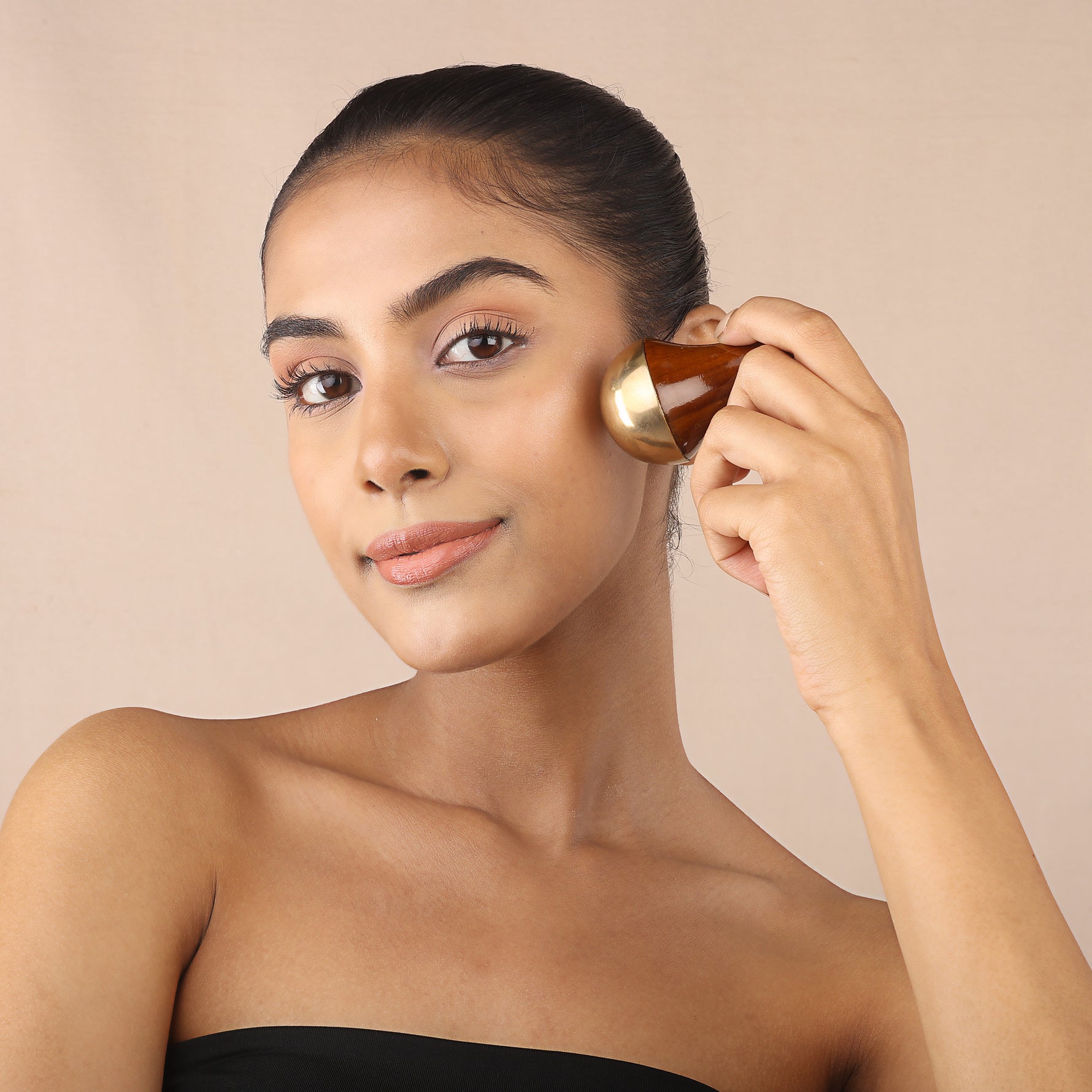
Two domes, each shaped for a different part of the face. The larger dome glides across cheeks, forehead and jawline, covering the broad, open areas in slow circular movements. The smaller dome turns for the precise work: temples, brow, under-eye, the edges of the nose.
The metal has a naturally cooling quality. In Ayurveda, this is traditionally associated with Pitta balance — a calming of warmth and reactivity in the skin. The faint grey-green tint you may notice during use is a natural reaction between the metal, the oil, and your skin's pH. It washes off easily and is not harmful.
Apply 3 to 4 drops of face oil before you begin. Work across both sides of the face, starting from the centre and moving outward. Gentle pressure is enough — the tool does the work. Five to ten minutes daily is ideal.
For external use only. Clean and dry thoroughly after each use. Store away from moisture.

The Kansa Abhyanga Wand is a body massage tool hand-cast from Kansa bronze with a large, smooth dome and an ergonomic hardwood handle. The dome is sized and shaped for broad, sweeping strokes along the limbs, back and shoulders during Abhyanga (traditional Ayurvedic oil massage). Kansa has a naturally cooling quality, valued in Ayurvedic bodywork for its smooth glide on oiled skin.
Apply a generous amount of massage oil before use. Work in long strokes along the limbs (from extremities toward the centre) and circular motions on the joints. Spend extra time on areas of tension such as the shoulders, lower back and calves. Clean and dry thoroughly after each use. Store away from moisture.
For external use only. Not a substitute for professional medical advice.

A Kansa scalp and body massage tool with rounded nodes and a carved hardwood handle. The nodes are designed for two distinct Ayurvedic practices: Shiro Abhyanga (classical scalp massage) and Marma point work on the body. On the scalp, the seven nodes cover a broad area with each stroke. On the body, a single node locates and holds an individual Marma point with sustained pressure. Hand-cast in traditional Kansa bronze, traditionally valued in Ayurveda for its cooling quality on both scalp and body tissue.

The Kansa Marma Wand is a pointed-tip massage tool hand-cast from Kansa bronze with an ergonomic hardwood handle. The tapered tip is designed for precise, sustained contact on individual marma points, the vital energy junctions described in the Sushruta Samhita. Where broader Kansa tools cover wide areas of the face or body, the Marma Wand focuses on one point at a time.
Apply a small amount of oil to the area first. Place the tip on the marma point and hold with gentle, steady pressure for 10 to 30 seconds before moving to the next point. Commonly used on the face (Sthapani, Shankha, Apanga), the hands (Talahridaya) and the feet (Kshipra, Gulpha). Clean and dry thoroughly after each use. Store away from moisture.
For external use only. Not a substitute for professional medical advice.

A hand-cast Kansa bronze bowl wand for Padabhyanga, the classical Ayurvedic foot massage. The bowl dome is mounted on a hardwood handle, giving full control of angle and pressure as it works across the sole. The handle distinguishes this tool from the handheld Vatki bowl, it allows sustained, directed pressure into the plantar Marma points without strain on the hand. Traditionally valued in Ayurveda for pacifying Pitta and grounding Vata through the soles of the feet.

The Mini Kansa Wand is cast from classical Kansa, a copper-tin bronze used in Ayurvedic facial practice for centuries. The dome is intentionally small sized to follow the orbital bone, reach the brow ridge, settle into the temple, and work the four marma points around the eye that a larger tool cannot address with precision.
Kansa has a naturally cooling quality. In Ayurveda, this is associated with calming Pitta, the accumulated heat that shows around the eyes as puffiness, sensitivity, and a dull, uneven complexion. Used with a face oil in slow, deliberate circles, the dome draws that heat outward and helps the oil absorb more completely than applying by hand.
This is the tool used in Netra Abhyanga, the traditional Ayurvedic eye-area ritual. At home, practiced for five minutes each morning or evening, it is one of the more quietly effective habits you can build into a daily routine.

A hand-cast Kansa bronze bowl for Padabhyanga, the classical Ayurvedic foot massage. The bowl's deliberately uneven, textured surface is what sets it apart — as it moves across the sole, it reaches into the natural contours of the foot, applying varied pressure across the arch, heel and Marma points that a smooth surface cannot replicate. Traditionally valued in Ayurveda for pacifying Pitta and grounding Vata through the soles of the feet.

The Kansa Comb is a scalp tool cast from Kansa metal, the copper-tin bronze used in Ayurvedic ritual practice for centuries. The teeth of the comb are pointed and designed to reach the scalp through the hair, making contact with the marma points of the head as the comb moves slowly across the scalp. This is not a massage tool used with pressure. The correct technique is slow, deliberate, and gentle, the pointed teeth do the work; you simply guide the comb.
Kansa has a naturally cooling quality. In Ayurveda, this is associated with calming Pitta in the head, the accumulated heat that shows as scalp sensitivity, irritation, and a restless, overheated mind. The comb draws that heat gently outward as it moves across the scalp.
This is a tool for daily use. Two to three minutes in the evening, used dry or with a light hair oil, is sufficient. Used consistently, it becomes one of the quieter and more grounding habits in a daily Dinacharya practice of Śīrṣa Abhyanga.

A facial massage tool hand-cast in Kansa, the traditional copper-tin bronze used in Ayurvedic practice for centuries. The Gua Sha's curved, flat form is designed for broad, deliberate strokes across the jaw, cheeks, neck and forehead, covering the full face surface in a single fluid practice.
What sets it apart from stone tools is the material. Kansa has a naturally cooling quality, traditionally associated in Ayurveda with calming Pitta, the heat and reactivity in the skin. As the tool moves across the face with a face oil, it draws warmth gently from the surface, leaving the skin looking calm, even and settled.
The grey-green tint that sometimes appears during use is a natural reaction between the Kansa bronze, the oil and the skin's pH. It is not harmful. It is the mark of real, uncoated bronze.

Kansa, The Healing Metal of Ayurveda
Mentioned in classical Ayurvedic texts as "Samvahaka Loham" (the metal that supports wellness through touch), Kansa is a traditional alloy of copper and tin. It is valued in Ayurveda for its smooth quality against the skin and its traditional association with balancing the doshas and supporting pranic flow. When used in massage, Kansa tools stimulate marma points, calm the nervous system, and promote a sense of energetic alignment, bringing harmony to both body and mind.
Getting Started with Kansa Wand — Your Questions Answered
The Kansa Ritual is a traditional Ayurvedic self-care practice using tools made from Kansa bronze (an alloy of copper and tin). It includes facial massage (Mukha Abhyanga), body massage, scalp massage (Shiro Abhyanga), and foot massage (Pada Abhyanga). Each uses a different Kansa tool designed for that specific body area.
Kansa has been valued in Indian culture for over 5,000 years. Ayurvedic texts refer to it as a sattvic (pure) metal. Traditionally, food was served on Kansa plates and water stored in Kansa vessels. In bodywork, the smooth surface of Kansa bronze glides well over oiled skin, and the metal is believed in Ayurveda to have a balancing quality when in contact with the body.
If you are new to Kansa rituals, the Kansa Face Wand is the best starting point. Facial massage is the most accessible practice — it takes only 5–10 minutes, can be done at your vanity or desk, and the results are immediately noticeable in how your skin looks and feels. From there, many people add the Kansa Vatki for foot massage and the Body Wand for full Abhyanga.
A complete daily Kansa ritual follows this sequence: morning — Kansa Face Wand with facial oil (5–10 min), Kansa Scalp Massager with hair oil if washing that day (3–5 min). Evening — Kansa Body Wand with massage oil during Abhyanga (10–15 min), Kansa Vatki on the soles of the feet with warm oil before bed (5 min). Start with one tool and add others as the ritual becomes part of your routine.
Yes. Each Art of Vedas Kansa tool is hand-cast and finished by skilled artisans in India using traditional metalworking methods. The Kansa alloy is prepared in specific copper-to-tin ratios, poured into moulds, and then hand-polished to achieve the smooth dome surface needed for massage. No two pieces are exactly identical.
With proper care, Kansa tools last a lifetime. The metal does not degrade, chip, or break under normal use. Kansa develops a natural patina over time which can be polished away with lemon and salt. Store tools in a dry place and clean after each use. Many Indian families pass Kansa items down through generations.


