



New Arrivals from Art of Vedas
The Art of Vedas range is growing. Every new product follows the same principle as the first: classical Ayurvedic formulation, authentic preparation, no compromise on quality.
Here you will find our latest additions, from newly introduced Thailams and Nasya oils to classical herbal powders, Churnams, traditional Kansa and copper tools, and Ayurvedic supplements. Each one is rooted in primary texts, prepared according to traditional methods, and selected because it belongs in a serious Ayurvedic practice, whether at home or in a professional treatment room.
If you have been with Art of Vedas for a while, this is where you discover what is new. If you are visiting for the first time, this is a good place to see the direction we are heading: deeper into the tradition, wider across the range, and always held to the standard that Ayurveda demands.

Shatavari Churnam (Asparagus racemosus) is one of the most celebrated Rasayana herbs in classical Ayurveda. The name literally means "she who possesses a hundred husbands," a poetic reference to its deep nourishing and rejuvenating qualities. It is classified as a Stri Rasayana (woman's rejuvenative) par excellence in the Charaka Samhita.
With a sweet taste, cooling Virya and sweet Vipaka, Shatavari is the quintessential Pitta-pacifying and Vata-nourishing herb. Classical texts describe it as Balya (strength-promoting), Vrishya (vitality-enhancing) and Jivaniya (life-giving). While traditionally celebrated for women's wellness, it is equally valued as a general Rasayana for all constitutions.
Take 1/2 to 1 teaspoon (2-3g) mixed with warm milk, ghee or water, once or twice daily. The classical carrier of warm milk with a pinch of sugar enhances its Rasayana qualities.
This product is a food supplement. Not intended to diagnose, treat, cure or prevent any disease. Consult a qualified practitioner before use if pregnant, breastfeeding or taking medication.

A set of two handcrafted pure copper eye cups, shaped to fit comfortably over the eye socket for Netra Prakshalana, the Ayurvedic practice of eye cleansing.
The rim of each cup creates a gentle seal around the orbital bone, allowing you to hold a rinse solution in place while you blink softly beneath it. The liquid washes over the surface of the eye, lifting dust, residue, and the accumulated strain of the day. One cup for each eye — you never cross-contaminate.
In Ayurveda, the eyes are governed by Alochaka Pitta, the subtle fire responsible for visual perception. Of all the senses, sight is considered the most Pitta dependent, and therefore the most vulnerable to heat, overuse, and fatigue. Netra Prakshalana is the classical practice designed to cleanse, cool, and restore the eyes as part of your daily or weekly Dinacharya routine.
For anyone who spends long hours on screens, works under artificial light, or lives in dry or dusty environments, this is one of the simplest and most immediate rituals in Ayurveda.

A pure copper tongue cleaner with two handles and a wide U-shaped scraping edge to cover the full width of your tongue in a single, steady pass.
Where the single-handle tongue scraper uses a narrower edge for precise, targeted scraping, the double-handle design takes the opposite approach. The wider edge spans the tongue from side to side, and the two-handed grip distributes pressure evenly across the entire surface. One stroke covers what the single handle does in two or three.
Hold one handle in each hand. Place the curved edge at the back of the tongue. Draw it forward in one smooth, controlled movement. The two-point grip keeps the angle consistent and the pressure balanced, there is no tilting, no uneven contact, no need to adjust mid-stroke. For people who prefer a gentler approach or have a sensitive gag reflex, this level of control makes the practice noticeably more comfortable.

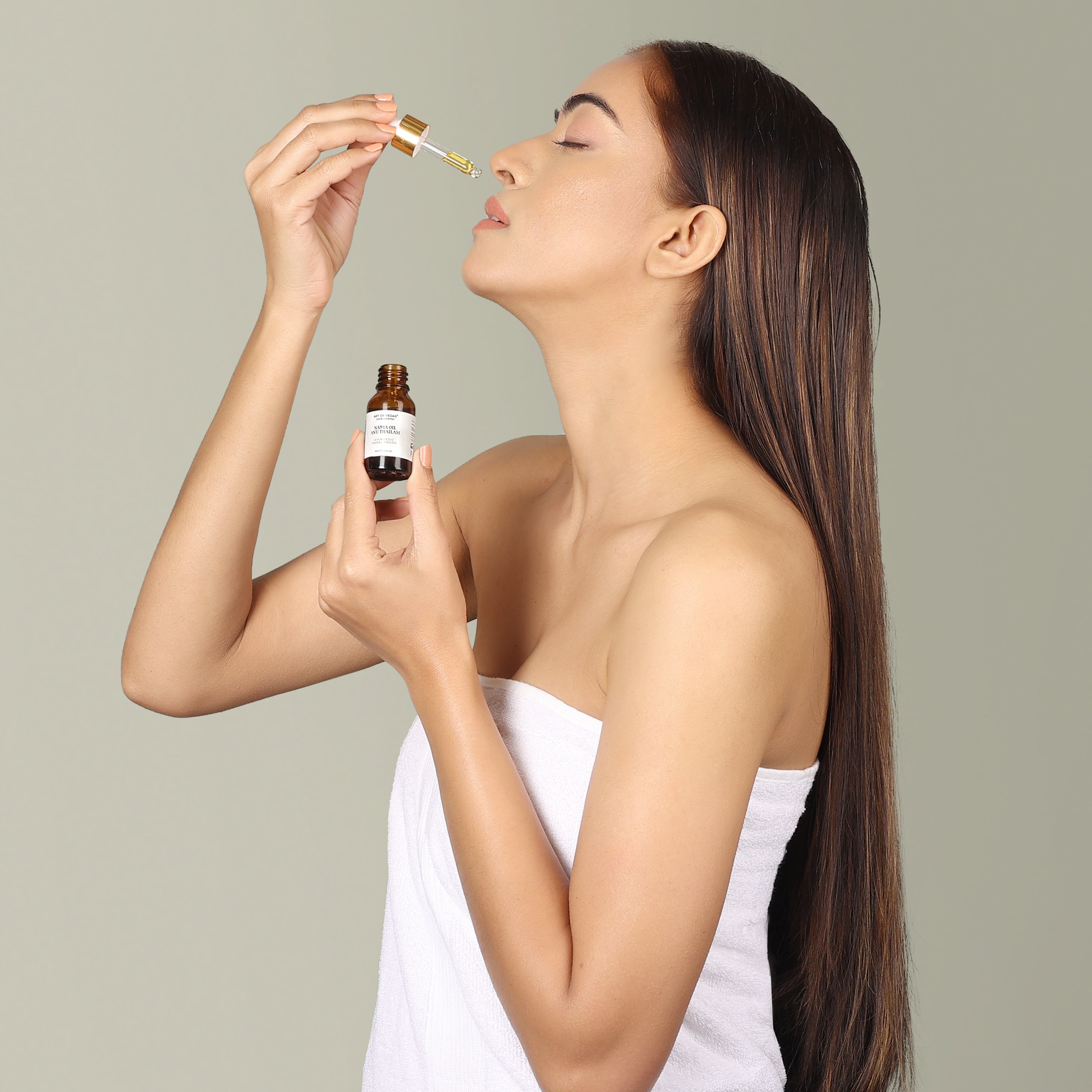
Shadbindu Thailam is a classical nasal oil designed for Nasya (nasal drops), delivering 10 carefully selected herbs directly through the nasal passages. This is not a supplement you swallow or a balm you rub on your chest. It is a specialised Nasya oil formulated according to the classical Ayurvedic tradition.
The formulation brings soothing Bhringraj for scalp nourishment, calming Valerian for a sense of mental ease, cooling Licorice for delicate nasal tissues, warming Ginger and Cinnamon for gentle nasal warmth, and nourishing Goat Milk to protect the nasal membranes. This classical formulation is traditionally valued for supporting Nasya ritual practice, a calm and settled mind, and overall head-region wellbeing.
Shadbindu Thailam is one of the most referenced Nasya preparations in classical Ayurvedic literature. Nasya is described in the Ashtanga Hridayam as one of the five primary Panchakarma therapies, and a practice within Dinacharya, the daily Ayurvedic self-care routine.
For external use only. Not intended to diagnose, treat, cure or prevent any disease. Consult a qualified practitioner before use if pregnant, breastfeeding or taking medication.

Dhanwantharam 101 Avarthy is the most concentrated form of the classical Dhanwantharam formulation. Named after Lord Dhanwantari, the patron deity of Ayurveda, this preparation undergoes Avartana — a process in which the oil is cooked with its herbal ingredients and then re-processed through the same cycle 101 times. Each cycle deepens the potency. The result is a small-volume, highly concentrated oil taken orally in drops.
This method of repeated processing is described in the classical texts as a way to intensify the Vata-pacifying properties of the formulation far beyond what a single processing can achieve. Where Dhanwantharam Thailam is designed for external massage and Dhanwantharam Kuzhambu for concentrated external application, the 101 Avarthy is specifically prepared for internal use.
Traditional Use
In classical Ayurveda, Dhanwantharam 101 Avarthy is valued for its deep Vata-balancing action. It is traditionally used to support the musculoskeletal and nervous systems, to promote strength and tissue nourishment, and as part of pre-natal and post-natal care protocols in Kerala Panchakarma practice. Practitioners use it where internal oil therapy (Snehapana) with concentrated formulations is indicated.
How to Use
Take 5 to 20 drops before food, with warm water or warm milk. This product should be used under the guidance of a qualified Ayurvedic practitioner who can determine the appropriate dosage and duration for your individual needs. Do not self-prescribe.

Sahacharadi Kuzhambu is a classical formulation from the Ashtanga Hridayam, built around Sahachara (Strobilanthes ciliatus), the herb traditionally valued in Ayurveda for its specific action on the lower body. This is the preparation you reach for when the focus is the lower back, hips, thighs, and legs.
The semi-solid Kuzhambu form keeps the formulation in contact with the skin longer than Sahacharadi Thailam, making it the preferred choice for sustained application on the lower extremities. It softens with body heat and absorbs gradually. In classical practice, Sahachara is associated with Apana Vayu, the downward-moving energy that governs the lower body. The Kuzhambu form delivers that targeted action precisely where it is needed.
Practitioners use Sahacharadi Kuzhambu in Panchakarma protocols including Kati Basti and localised lower body therapies. At home, it is well suited to daily application on the lower back and legs.
For external use only. Not a substitute for professional medical advice.

Prabhanjanam Kuzhambu is a classical formulation from the Sahasrayogam, named after Prabhanjana, the Vedic term for the force of wind. In Ayurveda, this directly references Vata, the dosha of movement. This is a preparation designed specifically for conditions where Vata has accumulated and restricted normal movement.
The semi-solid Kuzhambu form holds the formulation in place over the affected area, allowing sustained contact with joints, the lower back, the neck, or limbs where stiffness and restricted mobility are felt. It softens with body heat and absorbs gradually. Practitioners value this preparation in Panchakarma protocols where targeted, prolonged application is required.
Prabhanjanam is one of the more specific Vata-targeting formulations in the classical tradition. The Kuzhambu form makes it practical for precise, localised use at home or in clinical practice.
For external use only. Not a substitute for professional medical advice.

Kottamchukkadi Kuzhambu is a classical warming formulation documented in the Sahasrayogam, traditionally used for localised application on stiff joints and cold, heavy areas of the body. The name comes from its two lead herbs: Kottam (Saussurea lappa) and Chukku (dried Ginger), both valued in Ayurveda for their penetrating, warming action.
The semi-solid consistency holds the formulation in place over joints, the lower back, or any area where deep, warming contact is needed. It softens with body heat and absorbs steadily, making it particularly suited to morning application during cold seasons or before physical activity. Practitioners use this preparation in Panchakarma protocols for Vata-Kapha conditions where both stiffness and heaviness are present.
Kottamchukkadi is classified in Ayurveda as both Vata Shamana and Kapha Shamana. The Kuzhambu form delivers that warming action with precision.
For external use only. Not a substitute for professional medical advice.

Karparastyadi Kuzhambu is a classical formulation documented in the Sahasrayogam, led by Karpasa (cotton seed) and traditionally valued in Ayurveda for its action on Vata dosha in the musculoskeletal system. The semi-solid Kuzhambu form delivers this classical preparation with a consistency that holds in place over the area of application.
Where Karparastyadi Thailam flows and spreads, the Kuzhambu stays. This makes it the natural choice for localised application on specific joints, the neck, or the lower back, areas where sustained contact with the formulation supports the traditional Vata-pacifying action. It softens with body heat and works into the skin gradually.
Traditionally used in Ayurvedic practice for conditions involving stiffness, restricted movement, and discomfort associated with Vata aggravation. The Kuzhambu form is favoured by practitioners for localised external therapies.
For external use only. Not a substitute for professional medical advice.

Dhanwantharam Kuzhambu is the thicker form of the classical Dhanwantharam formulation documented in the Ashtanga Hridayam. The same 28+ herbs, the same traditional preparation method, but with a semi-solid consistency that stays where you apply it.
This is the preparation you choose when you need sustained contact on a specific area. Lower back, knees, shoulders, or any joint where a flowing oil would simply run off. It softens with body heat and absorbs slowly, giving the herbs more time to work with the skin. Practitioners use it in localised Panchakarma therapies like Kati Basti and Janu Basti. At home, it is ideal for targeted daily application on areas that need consistent attention.
For external use only. Not a substitute for professional medical advice.

Balaswagandhadi Kuzhambu is the thicker form of the classical Balaswagandhadi formulation documented in the Sahasrayogam. Built around Bala (strength) and Ashwagandha (vitality), this is the preparation traditionally chosen when the goal is deep, sustained nourishment of muscles and tissue.
The semi-solid consistency keeps the formulation in contact with the skin longer than a flowing Thailam. This makes it the preferred choice for targeted application on fatigued or depleted areas, particularly after physical exertion, during recovery, or as part of a strengthening daily routine. It softens with body heat and absorbs at a measured pace.
In Ayurvedic practice, Balaswagandhadi is classified as Balya (strengthening) and Brimhana (nourishing). The Kuzhambu form concentrates that action exactly where it is needed.
For external use only. Not a substitute for professional medical advice.

Sahacharadi Thailam is a classical Ayurvedic oil documented in Ashtanga Hridayam for supporting the lower body. The formulation combines over 30 herbs including the complete Dashamoola (ten roots) and 18 aromatic paste herbs in a pure sesame oil base processed with fresh cow's milk according to traditional Taila Paka Vidhi.
The name derives from its signature ingredient Sahachara (Strobilanthes ciliatus), a herb traditionally valued in Ayurveda for its specific action on Apana Vayu, the vital energy governing the lower body, including the lower back, hips, thighs and legs. This focus on downward-moving energy makes Sahacharadi the specialist oil in Ayurveda for supporting the lower extremities and healthy circulation in the legs.
Prepared in the Kerala Ayurvedic tradition, this warming oil features an aromatic blend of Vetiver, Sandalwood, Cardamom, Indian Madder, Spikenard and Himalayan Cedar. It is used in daily Abhyanga (self-massage) focusing on the lower body, as well as professional Panchakarma practices including Kati Basti (lower back oil pooling), Janu Basti (knee oil pooling) and Pizhichil. Ideal for those seeking traditional support for lower back comfort, leg wellness and healthy circulation.

Jathyadi Thailam is a classical Ayurvedic formulation documented in the Sushruta Samhita, one of the foundational texts of Ayurveda. This traditional oil combines 9 medicinal plants led by Jati (Jasmine), an important herb in Ayurvedic skin care traditions in a pure sesame oil base. The formulation is traditionally valued in Ayurveda for its Vrana Shodhana (skin cleansing) and Vrana Ropana (skin recovery support) properties. It is used as an external application in classical Ayurvedic practice and continues to be one of the most widely referenced formulations for supporting the skin's natural renewal process.

Chandanadi Thailam is a classical Ayurvedic cooling oil that works where heat actually builds up in your blood. Unlike surface treatments that only cool temporarily, this traditional formula combines 19 powerful cooling herbs (including Vetiver, Licorice, Indian Sarsaparilla, and Manjishtha) in sesame oil to pacify excess Pitta, purify your blood, and restore your skin's natural calm and clarity.

Thikthakam Ghritham is a classical bitter ghee from the Ashtanga Hridayam, belonging to the same Tikta Ghrita (bitter ghee) family as Mahathiktakam Ghritham. Where Mahathiktakam uses a large, broad group of herbs, Thikthakam uses a smaller, more focused group of 9 herb extracts with a specific classical emphasis on the Asthi Dhatu (bone tissue) and Majja Dhatu (marrow) channels.
The Tikta (bitter) taste has a particular affinity for Asthi Dhatu in the classical texts, making bitter ghee preparations the preferred vehicle for supporting the bone tissue level. The herb group centres on Nimba (Neem), Guduchi, Patola and Triphala, processed into purified cow's ghee. Classical texts describe it as Pittahara, Asthiposhaka (bone tissue-nourishing) and Majja Dhatu Poshaka. More targeted than Mahathiktakam for deeper tissue presentations.
Take 1-2g daily on an empty stomach, warmed to liquid consistency, with warm water, or as directed by your Ayurvedic practitioner.
This product is a food supplement. Not intended to diagnose, treat, cure or prevent any disease. Do not exceed the recommended daily dose. Consult a qualified practitioner before use if pregnant, breastfeeding or taking medication.

Mahathiktakam Ghritham is the great bitter ghee of the classical Ayurvedic pharmacopoeia, documented in the Ashtanga Hridayam (Chikitsa Sthana). The name is literal: Maha (great) + Tikta (bitter) + Ghritham (ghee). This formulation combines 26 bitter and astringent herbs including Nimba (Neem), Guduchi, Triphala and Patola, processed into purified cow's ghee through the traditional Sneha Kalpana method.
In the classical framework, the Tikta (bitter) taste is the primary tool for Pitta reduction and Rakta Dhatu (blood tissue) support. Mahathiktakam provides a broad, deep Tikta action across multiple tissue levels simultaneously. Classical texts describe it as Pittahara, Kushthaghna (skin-clarifying) and Raktashodhaka (blood-supporting). The "Maha" prefix distinguishes it from Thikthakam Ghritham by the greater breadth of herbs in the formula.
Take 2g daily on an empty stomach, warmed to liquid consistency, with warm water, or as directed by your Ayurvedic practitioner.
This product is a food supplement. Not intended to diagnose, treat, cure or prevent any disease. Do not exceed the recommended daily dose. Consult a qualified practitioner before use if pregnant, breastfeeding or taking medication.

Dhanwantharam Ghritham is the classical ghee form of the Dhanwantharam formulation, documented in the Ashtanga Hridayam and Sahasrayogam. Named after Lord Dhanwantari, the patron deity of Ayurveda, this preparation carries over 33 herbs led by Bala (Sida cordifolia) and the Dashamula (ten-root) group, processed into purified cow's ghee through the traditional Sneha Kalpana method. As a Ghritham, it nourishes Vata-affected tissues directly through the digestive channels.
The Dashamula group forms the foundational Vata-pacifying base, while Bala adds the primary Brimhana (tissue-building) dimension that distinguishes this formulation. Classical texts describe it as Vatahara, Balya and Brimhana, with particular emphasis in the prenatal and postnatal context (Garbhini and Sutika Paricharya). It complements external application of Dhanwantharam Thailam: the Ghritham works internally, the Thailam externally.
Take 2-3g daily on an empty stomach, warmed to liquid consistency, with warm water, or as directed by your Ayurvedic practitioner.
This product is a food supplement. Not intended to diagnose, treat, cure or prevent any disease. Do not exceed the recommended daily dose. Consult a qualified practitioner before use if pregnant, breastfeeding or taking medication.

Brahmi Ghritham is the classical ghee preparation of Brahmi (Bacopa monnieri), the primary Medhya Rasayana of the Ayurvedic tradition. Documented in the Ashtanga Hridayam (Uttarasthana) and Charaka Samhita, this formulation combines 10 carefully selected herbs processed into purified cow's ghee through the traditional Sneha Kalpana method. The ghee carrier reaches the finest channels of the nervous system, delivering Brahmi's cooling, mind-nourishing properties to Majja Dhatu (nervous tissue) with exceptional depth.
Brahmi Ghritham is Tridoshic with a cooling Virya, particularly valued for Pitta-predominant conditions of the mind. Classical texts describe it as Medhya (intellect-nourishing), Rasayana (rejuvenative) and Majja Dhatu Poshaka (nervous tissue-nourishing). It complements the external application of Brahmi Thailam: the Ghritham works through the internal digestive channels, while the Thailam works through the scalp and transdermal route.
Take 1-3g daily on an empty stomach, warmed to liquid consistency, with warm water, or as directed by your Ayurvedic practitioner.
This product is a food supplement. Not intended to diagnose, treat, cure or prevent any disease. Do not exceed the recommended daily dose. Consult a qualified practitioner before use if pregnant, breastfeeding or taking medication.
Showing 36/105
Let customers speak for us

I was struggling to find authentic Ayurvedic items, i am glad to make my order


I ordered several supplements and oils from there and they are great quality

In advice of a good friend, I ordered and received my goods in really good condition. Wands are beautiful and nice to handle. I'm ready to learn more of Ayurveda and looking forward to see what is does with my body & soul. Service (responding to mail) is friendly and correct. Thx so much for that !


The order was quickly, all items in best conditions, massage oils smooth and healthy. I fully recommend.

Love the Art of Vedas high quality products and there follow up with emails. Highly reliable. Highly recommended.
