


New Arrivals from Art of Vedas
The Art of Vedas range is growing. Every new product follows the same principle as the first: classical Ayurvedic formulation, authentic preparation, no compromise on quality.
Here you will find our latest additions, from newly introduced Thailams and Nasya oils to classical herbal powders, Churnams, traditional Kansa and copper tools, and Ayurvedic supplements. Each one is rooted in primary texts, prepared according to traditional methods, and selected because it belongs in a serious Ayurvedic practice, whether at home or in a professional treatment room.
If you have been with Art of Vedas for a while, this is where you discover what is new. If you are visiting for the first time, this is a good place to see the direction we are heading: deeper into the tradition, wider across the range, and always held to the standard that Ayurveda demands.

Haritaki Churnam (Terminalia chebula) is revered in Ayurveda as Abhaya, "the fearless one," and is considered the most versatile single herb in the classical pharmacopoeia. The Charaka Samhita places it at the very top of Rasayana herbs. It is the first of the three fruits in Triphala.
Haritaki possesses five of the six tastes (all except salty) and balances all three Doshas with a particular affinity for Vata. Its warming Virya combined with a sweet Vipaka gives it the rare quality of being warming yet not aggravating to Pitta. Classical texts describe it as Anulomana (downward-moving), the primary herb for healthy elimination.
Take 1/2 to 1 teaspoon (2-3g) with warm water, preferably before bed. Traditionally taken with different carriers in different seasons: rock salt in the rains, sugar in autumn, ginger in early winter, Pippali in late winter, honey in spring and jaggery in summer.
This product is a food supplement. Not intended to diagnose, treat, cure or prevent any disease. Consult a qualified practitioner before use if pregnant, breastfeeding or taking medication.

Triphala Vati is the classical tablet form of Triphala, the most widely used formulation in Ayurveda. Each tablet contains the synergistic blend of three fruits: Haritaki, Bibhitaki and Amalaki, combined with supportive digestive herbs and bound into a convenient Vati format as described in the Sharangadhara Samhita.
The Vati format offers precise dosing and easy portability without any preparation. The classical properties remain the same: a Tridoshic Rasayana that supports healthy digestion, gentle elimination and overall tissue nourishment. Suitable for year-round use as part of a daily wellness routine.
Take 1-2 tablets with warm water, preferably before bed or on an empty stomach in the morning. For enhanced effect, take alongside warm water with honey (morning) or warm milk (evening).
This product is a food supplement. Not intended to diagnose, treat, cure or prevent any disease. Consult a qualified practitioner before use if pregnant, breastfeeding or taking medication.

Avipattikar Choornam is a classical compound formulation described in the Bhaishajya Ratnavali and Sharangadhara Samhita. It is among the most widely prescribed Pitta-balancing digestive powders, combining cooling, carminative and gently laxative herbs into a single harmonious blend. The name suggests a formulation that prevents "Vipatti" (disorder) in the digestive tract.
The compound includes Trikatu (ginger, black pepper, long pepper), Triphala, Musta, Vidanga and Ela (cardamom) with Mishri (rock sugar). The warming Trikatu stimulates Agni while the cooling majority of the formula pacifies excess Pitta. Both Deepana (appetite-kindling) and Anulomana (gently downward-moving).
Take 1/2 to 1 teaspoon (2-3g) with warm water or buttermilk, after meals. Traditionally taken after lunch and dinner for optimal digestive support.
This product is a food supplement. Not intended to diagnose, treat, cure or prevent any disease. Consult a qualified practitioner before use if pregnant, breastfeeding or taking medication.

The Hrid Basti Yantra is a professional-grade instrument designed for Hrid Basti (also known as Uro Basti or Hridaya Basti), a localised oil-retention practice applied over the sternum and heart region. Rooted in the classical Bahya Snehana (external oleation) principles described in the Charaka Samhita, Sushruta Samhita, and Ashtanga Hridayam, Hrid Basti is one of the most valued localised practices in Panchakarma, addressing the Hridaya, which Ayurveda regards as one of the three Trimarma (vital points of the body).
In this traditional Ayurvedic procedure, the practitioner positions the Yantra over the sternum of the supine-lying client, seals the perimeter with a ring of Masha (urad dal) flour paste, and retains warm medicated oil or ghee within the reservoir. The sustained warmth and herbal properties of the medium nourish the Hridaya Marma region, offering a deeply calming and restorative experience traditionally associated with the care of Prana Vayu, Sadhaka Pitta, and Avalambaka Kapha.
This set includes one Hrid Basti Yantra with an oval profile, ergonomically shaped to conform to the sternal and upper thoracic contour.
Care and Cleaning
After each session, remove all flour paste residue and rinse the Yantra with warm water and a mild, fragrance-free detergent. Sanitise with isopropyl alcohol or a clinical-grade surface disinfectant. Allow to air dry completely before storing. Inspect regularly for any damage or rough edges that could cause discomfort during the session.
What is in the Set
- 1 x Hrid Basti Yantra
- Oval profile designed for the sternal and upper thoracic region
- Material: Durable, reusable clinical-grade construction
- Oil capacity: Approximately 200-300 ml
Classical Reference
Hridaya Marma, Sushruta Samhita (Sharira Sthana Ch. 6, Marma classification). Bahya Snehana principles, Charaka Samhita (Sutrasthana Ch. 13, Snehadhyaya), Sushruta Samhita (Chikitsasthana Ch. 24, Snehopayogika), Ashtanga Hridayam (Sutrasthana Ch. 16, Snehavidhi). Localised Basti practice refined within the Kerala Ashtavaidya Panchakarma tradition.
How it Works
The Hrid Basti Yantra acts as a structural frame for the dough-dam reservoir. The practitioner places the Yantra over the client's sternum, centred on the mid-chest, slightly to the left to align with the Hridaya Marma point, while the client lies in a supine (face-up) position. A ring of Masha (urad dal) flour paste is applied around the outer perimeter to create a watertight seal against the skin. Warm medicated oil or ghee is then poured through the open top until it fills the reservoir and covers the area.
The medium is maintained at a consistent warm temperature throughout the session by periodically removing cooled oil with a cotton swab or syringe and replacing it with freshly warmed oil or ghee. Sessions typically last 30 to 45 minutes, depending on the protocol and the practitioner's clinical assessment.
Why a Professional Basti Yantra?
Traditionally, the reservoir for localised Basti procedures is constructed entirely from Masha flour dough, shaped and moulded around the area by the practitioner. While effective, this method requires skill to maintain structural integrity over the full duration of a session, particularly on the relatively flat but subtly curved surface of the chest.
The Hrid Basti Yantra offers a practical, professional alternative. Its oval profile is ergonomically shaped to conform to the sternal contour, providing consistent structure throughout the session. The practitioner still uses flour paste to seal the instrument to the client's skin, combining the reliability of a reusable clinical tool with the traditional sealing method that ensures a proper fit for every body type.
Advantages for practitioners:
- Structural consistency, no risk of the reservoir collapsing or deforming during longer sessions
- Standardised volume, ensures even coverage of the Hridaya region
- Significantly reduced preparation time compared to full dough-dam construction
- Easy to clean and reuse between clients
- Oval profile designed specifically for the sternal and upper thoracic area
The Classical Medium: Medicated Oils and Ghee
Hrid Basti can use both medicated Thailams (oils) and medicated Ghritham (ghee) as the medium, selected by the practitioner based on the client's presentation, Dosha involvement, and session goals.
Commonly used medicated oils:
- Dhanwantharam Thailam, the primary classical choice for Vata-dominant presentations; deeply nourishing and warming
- Ksheerabala Thailam, traditionally valued for its Brimhana (nourishing) and nervine properties; balances both Vata and Pitta
- Balaswagandhadhi Thailam, traditionally valued for its Balya (strengthening) and Brimhana properties; supports tissue nourishment
- Chandanadi Thailam, a cooling Thailam, classically indicated where Pitta involvement predominates
Commonly used medicated ghee:
- Brahmi Ghritham, traditionally associated with calming the mind and supporting Sadhaka Pitta
- Dhanwantharam Ghritham, the ghee-based counterpart of Dhanwantharam Thailam; deeply nourishing
Plain cow's ghee (Goghrita) may be used for general nourishment and preventive care. The practitioner selects the medium based on the classical principles of Snehana and the client's individual constitution.
Suggested Procedure Overview
Preparation (Purva Karma):
Ensure a calm, warm, draft-free space with subdued lighting. Apply a brief local Abhyanga (oil massage) to the chest and upper thoracic region to prepare the tissue. Warm the selected medicated oil or ghee to a comfortable temperature (approximately 38-42 C) using a double-boiler or oil warmer, never heat directly over flame. Prepare a sufficient quantity of Masha (urad dal) flour paste for sealing. Position the client in a comfortable supine position.
During the session (Pradhana Karma):
Place the Hrid Basti Yantra over the sternum, centred on the Hridaya Marma region. Seal the outer perimeter with flour paste, ensuring a watertight boundary. Pour warm medicated oil or ghee through the open top until it covers the area. Maintain the temperature throughout the session by periodically exchanging cooled medium for freshly warmed oil or ghee. Typical session duration is 30 to 45 minutes. A standard course consists of 7 to 14 consecutive daily sessions, as determined by the practitioner.
After the session (Paschat Karma):
Drain the oil or ghee carefully. Remove the Yantra and flour paste. Gently wipe any excess and perform a light local massage. A mild Swedana (warm fomentation) may be applied to the area. Advise the client to rest in a calm environment and avoid cold drafts, physical exertion, and emotional exertion for several hours following the session. Classical texts recommend post-care precautions for twice the duration of the session itself (Dwiguna Parihara Kala).
This is a professional Ayurvedic practice instrument intended for use by trained practitioners. Hrid Basti should be performed by or under the supervision of a qualified Ayurvedic practitioner. This product is not a medical device and is not intended as a medical device. Always consult a qualified healthcare professional for chest or cardiac concerns.

The Netra Basti Yantra is a professional-grade acrylic instrument designed for Netra Tarpana (also known as Netra Basti), one of the five classical Kriyakalpa procedures described in the Sushruta Samhita and Ashtanga Hridayam. In this traditional Ayurvedic eye care practice, lukewarm medicated ghee is gently retained over the eyes while the client lies supine. The ghee nourishes and soothes the delicate eye area, offering a deeply calming and restorative experience rooted in thousands of years of Ayurvedic tradition.

The large Gokarna is the same classical brass vessel, built for higher-volume Nasya Karma. Same traditional design — wide mouth, tapered spout, pedestal base cast in solid brass with the capacity to warm a larger quantity of oil in a single session.
Where the small Gokarna is sized for daily personal Nasya two to three drops per nostril, one session at a time the large vessel accommodates Marsha Nasya and extended Snehana protocols where more oil is required. It is also the practical choice for practitioners administering Nasya to multiple clients in sequence, where warming a larger reserve of oil saves preparation time between sessions.
The brass holds warmth evenly and for longer. The additional weight keeps the vessel stable on a Dhara table or treatment surface. The spout pours with the same control as the small precise enough for a dropper, steady enough for a direct pour.

The Gokarna is the classical brass vessel used in Ayurveda for Nasya Karma, warming and administering medicated oil through the nasal passages. Hand-cast in solid brass, shaped to the traditional design: a wide mouth for gentle warming in a water bath, a tapered spout for controlled pouring into a dropper or to the fingertip, and a pedestal base that holds the vessel stable and upright.
Brass holds warmth evenly, and the size is proportioned for a single Nasya session. Place the Gokarna in hot water, allow the oil to reach body temperature, and apply. Whether you use Anu Thailam daily as part of your Dinacharya or Shadbindu Thailam for more focused care, this is how the practice is traditionally performed not improvised, not approximated.
For Ayurveda practitioners and Panchakarma centres, this is a clinical-grade Nasya vessel suited to Pratimarsha and Snehana Nasya protocols. Stable on a Dhara table, easy to sanitise between clients, built for daily professional use.

One solid ball of pure copper. Drop it into any glass of water before you go to sleep. By morning, you have Tamra Jal, copper-infused water, prepared the Ayurvedic way.
No copper glass needed. No copper bottle needed. The Copper Energy Ball brings the tradition of Tamra Jal to whatever vessel you already own, a ceramic mug, a glass carafe, an ordinary kitchen glass, a water jug. The copper meets the water. The water rests. That is all it takes.
This is an Art of Vedas original, designed to make the ancient practice of drinking copper water as simple and as portable as possible. One ball, any glass, anywhere.

Sudhabala Thailam is one of Ayurveda's gentlest yet most effective therapeutic oils, referenced in the classical text Sahasrayogam. This beautifully pure formulation features Bala (Sida cordifolia), the renowned "strength-giving" herb, prepared in a nourishing sesame oil base.
The name reveals its essence: Sudha means "pure" or "gentle," while Bala means "strength." This elegant two-ingredient formula delivers the profound benefits of Bala in its purest form, mild enough for daily use by nearly everyone, including during pregnancy and the postpartum period. Traditionally valued for supporting the nervous system, promoting muscle strength and addressing general weakness, Sudhabala Thailam embodies the Ayurvedic principle that the simplest formulations are often the most powerful.

Narayana Thailam is a classical Ayurvedic formulation referenced in the Bhaishajya Ratnavali for neuromuscular and joint support. This potent oil combines the complete Dashamoola (ten roots), dual-strength Ashwagandha and Punarnava, along with traditional nervine herbs like Bala and Shatavari in a nourishing sesame oil base.
Named after Lord Narayana (Vishnu), this oil has been traditionally used for centuries to support muscle strength, joint comfort and nervous system balance. The warming, deeply penetrating formula is ideal for Abhyanga massage and is particularly valued in Ayurveda for supporting those experiencing weakness, stiffness or general Vata imbalance.

Triphaladi Thailam is a classical Ayurvedic Moordhataila (head oil) documented in Sahasrayogam, formulated with the legendary Triphala trio of Amalaki, Haritaki and Bibhitaki at its foundation. This exceptionally comprehensive formulation combines 27 carefully selected herbs including Bhringraj (the "King of Hair"), Neeli (Indigo), Ashwagandha and cooling botanicals like Lotus and Blue Water Lily, all prepared in pure sesame oil using the traditional Sneha Paka Vidhi method.
What sets this Triphaladi Thailam apart is its enhanced formulation. Beyond the classical Triphala base, it includes Neeli (Indigofera tinctoria) traditionally valued for supporting natural hair colour, Ashwagandha for its adaptogenic and stress-relieving properties, and a collection of cooling, Pitta-pacifying herbs that make it ideal for those experiencing scalp sensitivity, excess heat or premature greying.
This tridoshic oil helps restore balance to the scalp environment, supports healthy hair roots and addresses common concerns like dandruff, itching and scalp buildup. Its cooling yet clarifying nature makes it especially beneficial for those with excess Pitta in the head region. Beyond hair wellness, traditional texts note its supportive effects on the sense organs and mental clarity when used regularly for Shiro Abhyanga (head massage).

Experience the power of Ayurveda with Dhanwantharam Mezhukupakam, a traditional Ayurvedic herbal oil crafted with time-honoured wisdom. Made from a unique blend of potent herbs and natural ingredients, this oil is carefully prepared to retain its full benefits.
Rooted in ancient Ayurvedic texts, Dhanwantharam Mezhukupakam is valued for its nourishing, revitalising, and balancing qualities. It is formulated following authentic Ayurveda principles to support overall well-being and relaxation, making it a perfect addition to any holistic self-care routine.
Ideal for Ayurvedic massages, daily self-care rituals, and traditional wellness practices, this herbal oil is widely used in Panchakarma practices. Gently massaging it into the skin allows the herbs to penetrate deeply, nourishing and balancing the body while honouring the age-old Ayurvedic tradition.

Ubtan cleanses, exfoliates and brightens the skin in a single application. Unlike conventional cleansers, it is a dry herbal powder with no preservatives, no water and no synthetic binders, mixed fresh before each use and applied directly to the skin.
This formulation follows the classical Mukhalepa tradition described in the Ashtanga Hridayam and Charaka Samhita. Green Gram provides the base exfoliation. Neem and Turmeric address excess sebum and uneven tone. Manjishtha and Khadira support complexion clarity as classical Varnya herbs. Sandalwood and Rose Petals calm and nourish the skin after cleansing.
Each 35g pack provides approximately 15 to 20 applications. Suitable for all skin types. Use as a daily morning cleanser or a short 5-minute mask two to three times per week. Follow with a face oil for a complete Mukha ritual.
For external use only. Not a substitute for professional medical advice.

Mukhalepa Ubtan is a deep-cleansing face mask for oily, blemish-prone skin. It is a dry herbal powder mixed fresh with water or rose water before each use, with no preservatives, no synthetic binding agents and no conventional mask fillers.
The formulation is based on the Mukhalepa Adhyaya of the Ashtanga Hridayam, the classical Ayurvedic text on skin purification. Multani Mitti absorbs sebum and surface impurities from within the pores. Neem and Tulsi address Kapha imbalances including excess oil and skin buildup. Sandalwood pacifies Pitta and reduces redness. Rose Petals restore softness and luminosity. Turmeric brightens and evens the complexion. Manjistha works on deeper discoloration.
Unlike commercial masks loaded with water and preservatives, this traditional Ubtan activates the moment you mix it. Each application is as potent as the first.

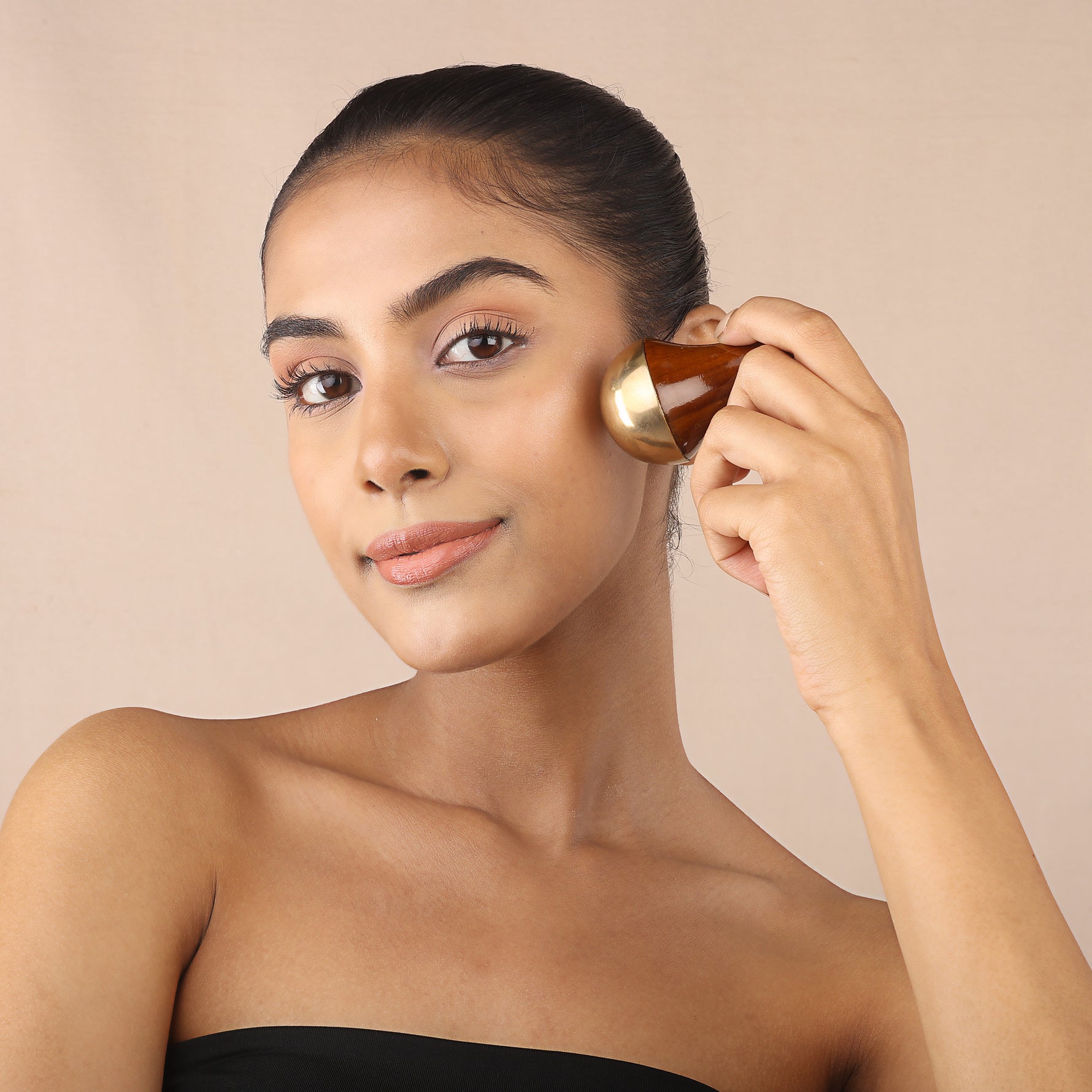
A Kansa scalp and body massage tool with rounded nodes and a carved hardwood handle. The nodes are designed for two distinct Ayurvedic practices: Shiro Abhyanga (classical scalp massage) and Marma point work on the body. On the scalp, the seven nodes cover a broad area with each stroke. On the body, a single node locates and holds an individual Marma point with sustained pressure. Hand-cast in traditional Kansa bronze, traditionally valued in Ayurveda for its cooling quality on both scalp and body tissue.

Shirodhara, an integral part of Ayurvedic practice, involves the gentle, rhythmic flow of warm oil or herbal liquids over the forehead, specifically targeting the Ajna Chakra (third eye). This practice promotes deep relaxation, mental clarity, and balance of the doshas, making it valued for rejuvenation and overall well-being.
Premium Brass Construction: Ensures longevity and maintains the purity of the oils and herbal liquids used.
Traditional Design: Supports a steady and consistent flow of oil, crucial for an effective Shirodhara session.
Adjustable Flow: Equipped with a chain mechanism for adjustable height, allowing practitioners to control the flow of oil with precision.
A must-have for Ayurvedic practitioners, Panchakarma centres, and wellness enthusiasts seeking to offer or experience the full depth of Shirodhara. This brass pot is crafted with care to honour the ancient roots of this profound Ayurvedic practice.

Neelibhringadi Thailam is a traditional Ayurvedic oil formulated to support strong, healthy hair, reduce hair fall, and prevent premature greying. This powerful blend includes herbs like Indigo (Neeli), Bhringraj, and Amla, known in Ayurveda for their ability to nourish the scalp, stimulate hair roots, and cool excess Pitta in the head region.
Prepared in a base of pure coconut oil using the classical method of Sneha Paka Vidhi, Neelibhringadi Thailam penetrates deep into the scalp to calm irritation, remove buildup, and strengthen each strand from the root. Regular use helps maintain natural hair colour, adds volume and shine, and leaves the scalp feeling cool and balanced.
Ideal for daily or weekly head oiling (Murdha Taila), especially suited for Pitta-predominant hair types experiencing thinning, early greying, or a warm, sensitive scalp.

Balaswagandhadhi Thailam is a classical Ayurvedic formulation documented in Sahasrayogam, combining approximately 20 herbs in a pure sesame oil base. The formulation centres on two of Ayurveda's most celebrated strengthening herbs: Bala (Sida cordifolia), meaning "strength," and Ashwagandha (Withania somnifera), known as Indian Ginseng for its vitality-supporting properties.
Prepared using traditional Sneha Paka Vidhi (oil cooking method), this Thailam is traditionally valued for its Balya (strength-promoting) and Rasayana (rejuvenating) qualities. In Ayurvedic practice, it is particularly associated with recovery, nourishment, and supporting the body during times of fatigue or weakness.
Also known as Ashwagandha Bala Lakshadi Thailam, this formulation balances both Vata and Pitta doshas. It is used in daily Abhyanga (self-massage) as well as professional Panchakarma practices including Pizhichil, Kizhi, and Shirodhara.
Showing 72/105
Let customers speak for us

I was struggling to find authentic Ayurvedic items, i am glad to make my order


I ordered several supplements and oils from there and they are great quality

In advice of a good friend, I ordered and received my goods in really good condition. Wands are beautiful and nice to handle. I'm ready to learn more of Ayurveda and looking forward to see what is does with my body & soul. Service (responding to mail) is friendly and correct. Thx so much for that !


The order was quickly, all items in best conditions, massage oils smooth and healthy. I fully recommend.

Love the Art of Vedas high quality products and there follow up with emails. Highly reliable. Highly recommended.
