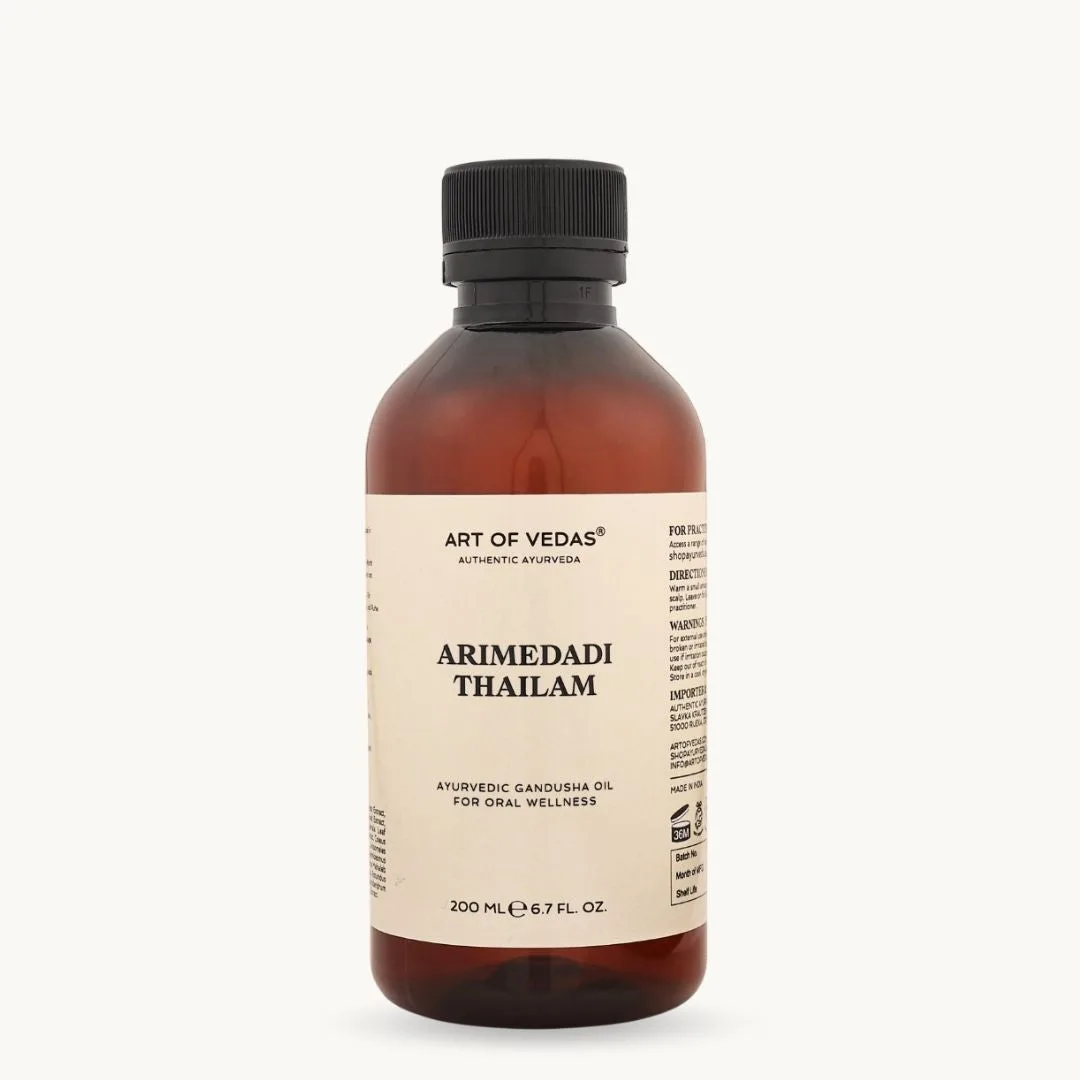
Most people who use oil pulling in their daily routine reach for coconut oil. It is widely available, familiar and well-positioned by the wellness industry. But the classical Ayurvedic tradition never prescribed plain coconut oil for this practice. What the texts describe - specifically in the chapters dealing with Mukha Roga, the diseases of the oral cavity - is a precisely formulated medicated oil containing more than a dozen herbs, each selected for its specific action on the teeth, gums and oral mucosa. That oil is Arimedadi Thailam.
The distinction matters. Classical Ayurvedic pharmacy does not treat all oils as interchangeable. The logic of an Ayurvedic medicated oil is that the base oil - most commonly sesame - acts as a vehicle, carrying the therapeutic properties of the processed herbs into the tissues it contacts. Plain coconut oil carries no herbs at all. Arimedadi Thailam carries a full classical oral care formula that has been documented and refined across multiple centuries of practice.
Art of Vedas includes Arimedadi Thailam in its oral care range precisely because it represents what classical Ayurveda actually prescribed - not a simplified approximation for the wellness market, but the genuine formulation from the original texts.
The Classical Text Reference: Where Arimedadi Appears
Arimedadi Thailam is described in the Ashtanga Hridayam, Uttarasthana, Chapter 22, which is dedicated specifically to the treatment of oral diseases (Mukha Roga Chikitsa). The Ashtanga Hridayam was compiled by Vagbhata in the seventh century CE and represents a synthesis of earlier Ayurvedic knowledge from the Charaka and Sushruta traditions. Its Uttarasthana (later section) covers specialised treatments not covered in the core Sutrasthana, including detailed formulations for the eyes, ears, nose and oral cavity.
The placement of Arimedadi Thailam in the oral disease treatment chapter is significant. This is not a general massage oil that happens to be used in the mouth. It was specifically formulated for the oral environment - a distinction the text makes deliberately by describing its application in the context of Gandusha (holding oil in the mouth) and Kavala (gargling with oil), the two classical oil pulling methods.
The Sahasrayogam, a comprehensive classical text that continues to guide Ayurvedic clinical practice today, also includes Arimedadi Thailam and provides additional guidance on its preparation and application. The tradition, which has preserved the most continuous lineage of classical Ayurvedic practice in India, considers this formulation foundational for oral health protocols.
The Composition of Arimedadi Thailam: Each Ingredient and Its Role
The name Arimedadi gives away the primary ingredient. "Arimed" refers to Acacia catechu, known in Ayurveda as Khadira - a tree whose bark and heartwood have been used in classical Ayurvedic pharmacy for thousands of years. The suffix "-adi" in Sanskrit means "beginning with" or "and others," indicating a compound formulation led by Arimed. Understanding the role of each key ingredient clarifies why this formulation works as a unified whole.
Khadira / Arimed (Acacia catechu): The principal ingredient. Khadira has a pronounced Kashaya (astringent) rasa, making it one of the most direct classical substances for gum and mucous membrane health. Charaka Samhita, Sutrasthana 4, lists Khadira among the premier Kashaya group herbs. The astringent action in classical terms is binding, firming and toning - properties that translate directly to gingival tissue. Khadira also carries Tikta (bitter) secondary rasa, which classical pharmacology associates with anti-inflammatory and purifying actions.
Twak (Cinnamomum zeylanicum, cinnamon bark): Aromatic, warming and with a classical reputation for oral freshness. In the Ayurvedic oral context, Twak's Katu (pungent) and Tikta rasa combined with its aromatic qualities make it a natural inclusion for addressing both bacterial environment and fresh breath. The warming Virya of Twak counterbalances the predominantly Vata environment of the oral cavity.
Ela (Elettaria cardamomum, cardamom): A classical oral herb with aromatic, cooling and Pitta-pacifying properties. Cardamom appears in numerous classical oral formulations - its inclusion in Arimedadi Thailam addresses the Pitta component of oral inflammation and contributes to the formulation's balanced temperature profile.
Lavanga (Syzygium aromaticum, cloves): Cloves have been used in oral care across multiple medical traditions for their Krimighna and analgesic properties. In Ayurvedic pharmacology, Lavanga is described as Tikshna (sharp) and Ushna (hot) - qualities that classical texts associate with penetrating and clearing action on the oral mucosa.
Jatiphala (Myristica fragrans, nutmeg): Aromatic and with classical Katu, Tikta rasa. Nutmeg's inclusion in the formulation contributes to its warming, drying and astringent character, particularly relevant for conditions where excess Kapha (manifesting as excess mucus, heaviness in the gums) is a component.
Haritaki (Terminalia chebula): One of the three fruits in Triphala and one of the most widely referenced herbs across all classical texts. Haritaki is described in the Ashtanga Hridayam as having affinity for all Doshas and for being beneficial across all five taste groups. Its inclusion in Arimedadi Thailam adds both Rasayana and Krimighna properties to the formulation.
Tagara (Valeriana wallichii): A classical herb with calming properties and relevance to Vata conditions, including those manifesting as sensitivity in the teeth and gums. Its grounding and Vata-pacifying properties complement the more Pitta-addressing herbs in the formula.
Priyangu (Callicarpa macrophylla): A classical herb described in multiple texts for its Kashaya rasa and relevance to Pitta-Rakta conditions. In the oral context, its astringent and cooling properties specifically address gingival inflammation.
The base is sesame oil (Tila Taila), the classical carrier of choice for Vata-pacifying formulations. The classical logic is that sesame oil has the deepest penetrative properties of any base oil - it reaches the Majja Dhatu (nervous tissue) in classical anatomy - making it the most effective carrier for the herbs in Arimedadi Thailam to reach the periodontal tissues.
Gandusha and Kavala: The Two Classical Oil Pulling Methods
Classical Ayurveda distinguishes between two methods of oral oil therapy, and understanding the difference is important for using Arimedadi Thailam correctly.
Gandusha involves filling the mouth completely with oil so that it cannot be easily swished - the mouth is held full. This is a passive holding practice, typically maintained for the time it takes to reach discomfort or until the oil becomes thin and watery, indicating it has absorbed oral toxins. The Ashtanga Hridayam, Sutrasthana 22, describes Gandusha as deeply strengthening to the jaw muscles, the sense organs in the face, and the overall oral tissues.
Kavala involves taking a comfortable amount of oil and swishing it actively through the teeth and over the gums. This is the method most people in the West associate with "oil pulling." It is less intensive than Gandusha but more accessible as a daily practice.
For most daily home practice, Kavala with Arimedadi Thailam is the classical recommendation. The standard classical guidance from the Ashtanga Hridayam describes performing Kavala in the morning as part of Dinacharya - the daily routine - after tongue scraping and before eating. You can read the full classical Ayurvedic guide to Gandusha and Kavala for more detail on the two methods and when each is appropriate.
How to Use Arimedadi Thailam: The Classical Protocol
The classical method for Arimedadi Thailam as a daily Kavala practice is straightforward but worth doing correctly. Art of Vedas recommends the following approach, which follows the classical Dinacharya sequence:
Begin with tongue scraping using a copper tongue scraper to remove the accumulated Ama (waste products) from overnight digestion. This is described in the Charaka Samhita as the first step in daily oral hygiene. A copper tongue scraper is the classical material of choice - copper has Kashaya and antimicrobial properties described in the classical texts. You can read about the complete Ayurvedic morning oral care ritual for the full sequence.
Take approximately one tablespoon of Arimedadi Thailam. The oil can be gently warmed by placing the bottle in warm water for a few minutes - this is consistent with the classical preference for warm oil in Vata-dominant environments like the oral cavity.
Swish the oil actively through all areas of the mouth - between the teeth, over the gums, across the palate - for between five and fifteen minutes. The classical texts describe the ideal endpoint as when the oil becomes thinner and white, indicating it has emulsified and absorbed oral waste products.
Spit the oil into a waste bin - not the sink, where it can cause plumbing build-up over time. Do not swallow.
Follow with a thorough rinse with warm water. Some classical protocols describe a brief gargle with warm salt water as an additional step.
The complete Art of Vedas oral care range, including Arimedadi Thailam and a copper tongue scraper, is designed to support the full classical oral Dinacharya as described in the foundational texts.
The Classical Indications for Arimedadi Thailam
The Ashtanga Hridayam describes the specific conditions of the mouth for which medicated oil pulling is indicated. In classical terms, these are Vata-dominant and Kapha-dominant oral conditions - conditions characterised by symptoms such as dryness, sensitivity, looseness, and excess coating. The relevant conditions described in the Mukha Roga chapter include:
Danta Bheda (sensitivity in the teeth) and Danta Shoola (tooth pain) - classical Vata conditions of the dental tissues. The grounding, warming and nourishing quality of medicated sesame oil addresses the Vata component directly through contact with the periodontal tissues.
Shithila Danta (looseness of teeth) - described in classical texts as a Vata condition in which the supporting structures of the teeth become lax. The Kashaya (astringent) action of the herbs in Arimedadi Thailam, particularly Khadira and Haritaki, directly addresses the toning and firming of these tissues in classical terms.
Mukha Daurgandhya (oral malodour) - a Kapha condition in classical terms, arising from excess Ama in the oral cavity. The Tikshna (sharp) and Krimighna herbs in the formulation - cloves, cinnamon, cardamom - address this through their penetrating and purifying classical actions.
Gingivitis patterns - described in classical terms as Pitta-Rakta involvement in the gingival tissues. The cooling and astringent herbs in the formulation, including Priyangu and Khadira, address this dimension.
Arimedadi Thailam as Part of the Classical Daily Routine
One of the most important points about Arimedadi Thailam is that it was never intended as a standalone remedy applied in response to a specific problem. In the classical understanding, the oral cavity is the first point of contact between the external world and the internal digestive system. Maintaining oral health is therefore not a cosmetic concern - it is a foundational part of overall Dosha balance and digestive health.
The Ashtanga Hridayam, Sutrasthana 2, the chapter on Dinacharya, lists oral care practices - including oil pulling - among the daily requirements for maintaining health, not merely as interventions for when problems arise. This preventive orientation is one of the distinguishing features of classical Ayurvedic health maintenance.
Art of Vedas offers the Arimedadi Thailam as part of a complete classical oral care approach that includes a copper tongue scraper and the daily Kavala practice. Incorporating these practices consistently, as the classical tradition recommends, provides the cumulative benefit that any single application cannot achieve.
For a complete understanding of the Dinacharya framework within which oral care sits, the guide to Dinacharya: The Complete Ayurvedic Daily Routine provides the full classical sequence and its rationale.
Frequently Asked Questions
Is Arimedadi Thailam safe to swallow?
Arimedadi Thailam is formulated for oral use - specifically for Kavala (oil pulling/swishing) and Gandusha (holding in the mouth). The classical practice involves spitting the oil out after swishing, and Art of Vedas recommends following this protocol. The oil should not be swallowed intentionally. After swishing, the oil contains oral waste products that have been drawn into it through the process, and swallowing it defeats the purpose of the practice. Children should use Arimedadi Thailam only under adult guidance.
How is Arimedadi Thailam different from plain coconut oil for oil pulling?
Plain coconut oil has no classical Ayurvedic formulation and contains no herbs. Arimedadi Thailam is a multi-herb medicated oil prepared according to a specific classical formula described in the Ashtanga Hridayam. The therapeutic properties - gingival toning, Krimighna action, Vata and Kapha pacification in the oral environment - come from the processed herbs that have been infused into the sesame oil base. The comparison is between plain water and a classical decoction: the base liquid may be similar but the therapeutic content is entirely different.
How often should Arimedadi Thailam be used?
The classical Ayurvedic recommendation, as described in the Ashtanga Hridayam Dinacharya chapter, is daily practice as part of the morning routine - ideally after tongue scraping with a copper tongue scraper and before the first meal. Most people perform the Kavala practice for 5 to 15 minutes. Consistency over time is more important than duration in any single session. For those new to the practice, starting with 5 minutes daily and building up is practical and consistent with classical guidance for establishing new health routines.
Can Arimedadi Thailam be used for Gandusha as well as Kavala?
Yes. The formulation is appropriate for both classical methods. Gandusha - holding the mouth completely full of oil - is described in the classical texts as producing more intensive benefits for the jaw muscles, the vocal organs and the deeper periodontal tissues. It is typically held for several minutes until the urge to swallow or discomfort sets in. Kavala is more accessible as a daily practice and is what Art of Vedas recommends for routine home use of Arimedadi Thailam. Gandusha is described more frequently in Panchakarma and clinical Ayurvedic contexts.
Does Arimedadi Thailam contain sesame? Can those with sesame allergies use it?
Arimedadi Thailam is traditionally prepared in a sesame oil base. Those with confirmed sesame allergies should not use this preparation. If you have a known sesame sensitivity, please check the product ingredient list carefully and consult your healthcare provider before use. Art of Vedas recommends a small patch contact test on the skin before beginning any new topical or oral preparation.
Where does Arimedadi Thailam appear in the classical texts?
The primary classical reference is the Ashtanga Hridayam, Uttarasthana, Chapter 22, which covers the treatment of oral diseases (Mukha Roga Chikitsa). The Sahasrayogam, a classical text that continues to guide Ayurvedic clinical practice, also describes the formulation with preparation and application guidance. These two texts together represent the principal classical basis for the formulation as it is prepared and used today. Art of Vedas' Arimedadi Thailam is carefully selected.
Is Arimedadi Thailam suitable for children?
The classical texts describe Kavala and Gandusha primarily in the context of adult Dinacharya. For children, any oral oil practice should be introduced with care and under adult guidance, ensuring there is no risk of swallowing. Very young children should not use medicated oils in the oral cavity without specific guidance from a qualified Ayurvedic practitioner. For older children who are able to swish and spit reliably, a brief daily practice with a small amount of Arimedadi Thailam under parental supervision may be introduced gradually.
For external and oral use only. Arimedadi Thailam is a traditional Ayurvedic preparation. It is not intended to diagnose, treat, cure or prevent any disease and is not a substitute for professional dental or medical advice.