In brief: Balaswagandhadi Thailam (also written Balaswagandhadi Taila or Balaswagandhadi oil) is a classical Ayurvedic massage oil named after its two leading plants, Bala and Ashwagandha: together with lac, Manjistha, liquorice, Sariva, vetiver, lotus and further plants they are cooked into a sesame oil base. Recorded in the Sahasrayogam, it is classically placed with Vata and traditionally used both for Abhyanga of the body and as a head oil. Art of Vedas offers the liquid Thailam and the thicker Balaswagandhadi Kuzhambu. This guide covers what it is, how it is made, how to warm and apply it, and how it compares with Ksheerabala and Dhanwantharam Thailam.
Balaswagandhadi Thailam: what it is, how it is made and how to use it
Reviewed by Dr. Anu Joy, MD (Ayurveda), Ayurvedic doctor of Art of Vedas
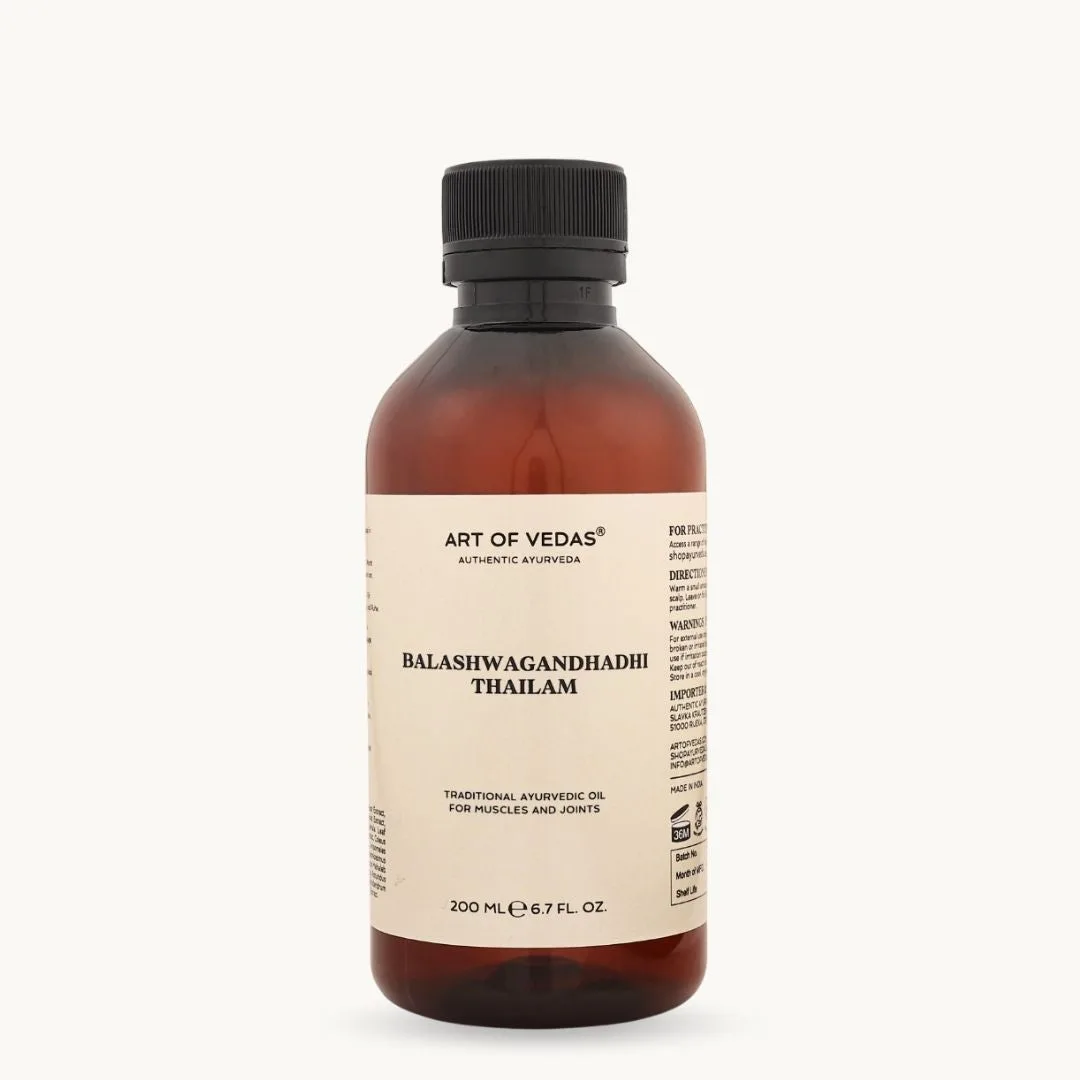
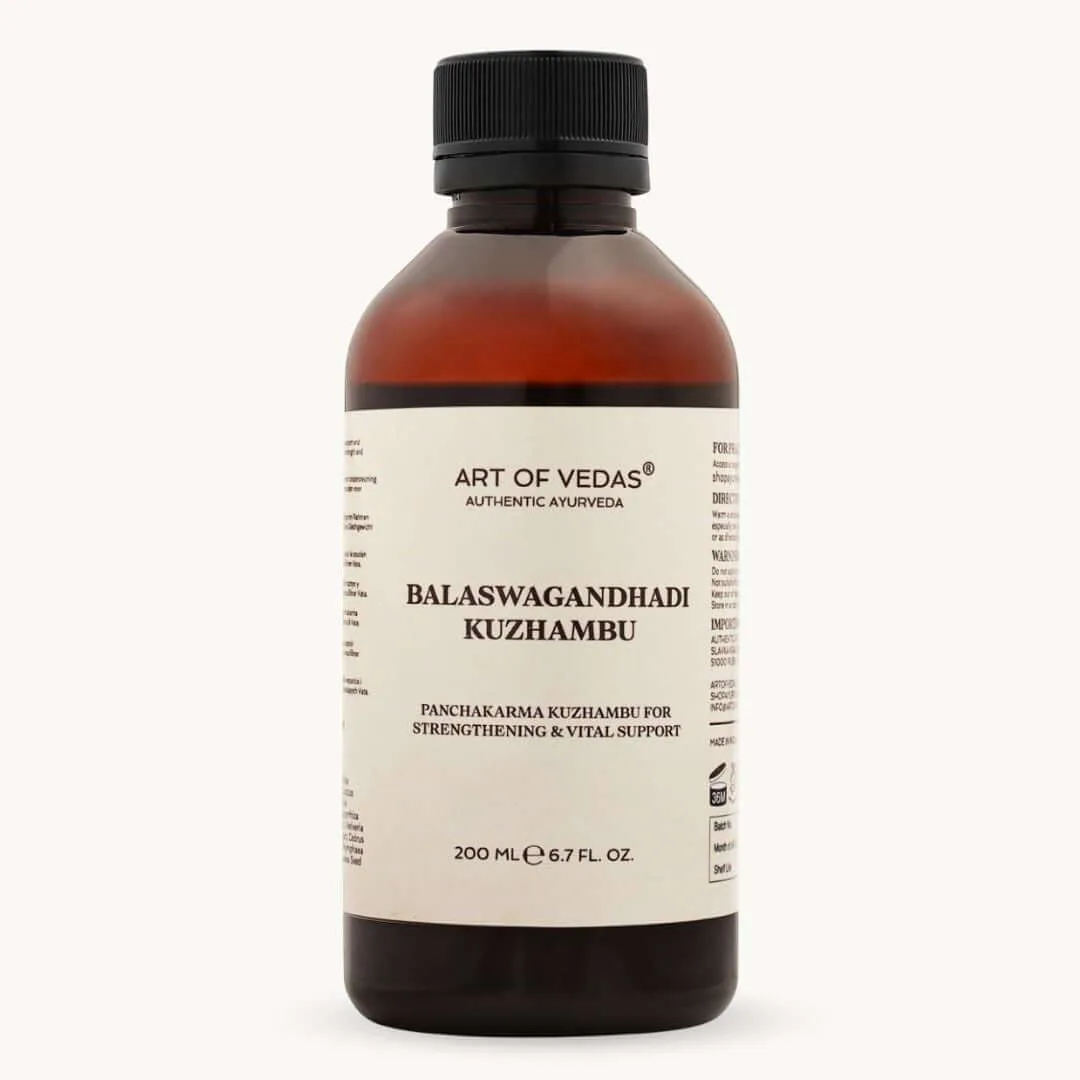
What Balaswagandhadi Thailam is, and what the name means
The name reads as three parts. Bala is the root of Sida cordifolia, the country mallow, one of the most used plants of the classical oil tradition. Ashwagandha is the root of Withania somnifera. The ending adi means "and the others": the classical way of saying that these two lead a longer list. Balaswagandhadi Thailam is therefore the oil in which Bala and Ashwagandha stand first.
A Thailam is a medicated oil in the Ayurvedic sense: not a blend of oils and essences, but a base oil into which plant decoctions and pastes have been cooked until the oil carries their character. Balaswagandhadi Thailam is built on sesame oil and is made for external use. It is one of the quieter classical oils, less spice-led than Mahamasha or Prabhanjanam Thailam, and it is used across the whole body as well as on the head. People search for it as Balaswagandhadi Thailam, Balaswagandhadi Taila or simply Balaswagandhadi oil; all four name the same preparation.
The classical description: texts, plants, base and method
The classical texts place Balaswagandhadi Thailam among the Bala-based oils, and the recipe is recorded in the Sahasrayogam, the compendium that gathers many of the oils still made today. The classical recipe names, among others, Bala, Ashwagandha and Laksha, the lac resin, cooked into sesame oil, and surrounds them with a group of roots, flowers and aromatic plants.
The Art of Vedas Balaswagandhadi Thailam declares sesame seed oil as its base, and then Bala root, Ashwagandha root, lac, galangal root (Rasna), Manjistha root, Durva grass, liquorice root (Yashtimadhu), Sariva root (Indian sarsaparilla), vetiver root (Ushira), nutgrass rhizome (Musta), deodar wood (Devadaru), turmeric rhizome (Haridra), blue lotus flower (Utpala), Mahaleb cherry seed, dill seed (Shatapushpa) and sacred lotus flower. The full declaration is on the product page and on the label. Lac is a resin of insect origin, so the oil is not vegan.
The method is the classical Sneha Paka. The tougher roots are simmered into a decoction (Kashayam), the softer plants are ground into a paste (Kalka), and both are cooked slowly into the sesame oil over a low fire until the water has gone and the paste meets the traditional finishing tests. The oil is then filtered and left to settle. Nothing is added afterwards: the colour, the scent and the character of the finished oil come from the plants cooked into it. Our complete guide to Thailams describes the method in more detail.
Character in Ayurvedic terms
Sesame oil is the classical Vata base, and the tradition counts Bala and Ashwagandha among its nourishing plants, so Balaswagandhadi Thailam is classically placed with Vata: with dryness, cold, restlessness and the thinner, drier skin of the colder months. At the same time, several of the plants in its recipe, among them the two lotus flowers, vetiver, Sariva, Durva, Manjistha and liquorice, are counted as cooling in the Ayurvedic classification. The finished oil is therefore described by the tradition as nourishing and gentle rather than hot. It does not have the spreading heat of the spice-led oils, which is why it is also used on the head, where the strongly warming oils are not.
In practice this gives Balaswagandhadi Thailam a wide season. It is used through autumn and winter like the other Vata oils, and it remains comfortable in spring and in milder weather, when Mahamasha Thailam or Prabhanjanam Thailam would feel like too much.
How Balaswagandhadi Thailam is used in practice
Abhyanga, the body massage. Stand the closed bottle in a bowl of warm water for a few minutes until a drop feels pleasantly warm on the inner wrist. Do not use a microwave. Pour a small amount into the palm and apply it with long strokes along the limbs, circular strokes around the joints and the abdomen, and broad strokes over the back. Two to three tablespoons are enough for the whole body. Leave the oil on the skin for 15 to 20 minutes, then take a warm shower or bath; a mild soap or a gram-flour paste takes off the excess. The classical daily routine, Dinacharya, describes Abhyanga every morning; two or three times a week is a common European rhythm. Our Abhyanga guide sets out the full sequence.
Shiroabhyanga, the head massage. Balaswagandhadi Thailam is one of the classical oils used on the head, which is where many of the searches for "Balaswagandhadi Thailam for head" come from. Warm a small amount, a tablespoon or less, and work it into the scalp with the fingertips in slow circles, from the crown outwards, then along the hairline and the back of the head. Leave it for at least thirty minutes, or for an hour on a quiet evening, protect the pillow if you leave it longer, and wash the hair with a mild shampoo. Once or twice a week is the usual rhythm.
Padabhyanga, the foot massage. A teaspoon of warm oil worked into the soles and around the ankles before bed is the simplest use of all, and a good way to get to know the oil. Put on old socks and wash in the morning.
Whichever way it is used, Balaswagandhadi Thailam is applied warm, in modest amounts, and given time on the skin before it is washed off. Use older towels; a sesame-based oil marks fabric.
Thailam or Kuzhambu: the thicker form
Art of Vedas also offers Balaswagandhadi Kuzhambu, the thicker form of the same formula. The Kuzhambu declares castor oil beside the sesame oil and is cooked down until it sets semi-solid at room temperature. It does not pour. Warmed in a water bath it softens and spreads, then stays in a thin layer where it is placed and absorbs slowly, which suits twenty to thirty minutes of focused work on one region: the shoulders, the thighs, the calves after a long day on the feet.
The rule of thumb is simple. Reach for the Thailam when the routine covers, the whole body or the head, and for the Kuzhambu when the routine concentrates on one area. Many households keep both. The Kuzhambu has its own page, Balaswagandhadi Kuzhambu: the semi-solid form, and our Kuzhambu guide explains the format as a whole.
Who should ask first
Balaswagandhadi Thailam is for external use only. Do a small skin test on the inner forearm before the first full application and wait a day; if the skin reddens or itches, do not use the oil. Keep it away from the eyes and broken skin. It contains sesame oil, so anyone who reacts to sesame should not use it, and because lac is declared it is not vegan. If you are pregnant, breastfeeding, or wish to use the oil for a child, ask your doctor or a qualified Ayurvedic practitioner first. A qualified Ayurvedic practitioner can also tell you whether this oil, a lighter one such as Ksheerabala Thailam or a warmer one suits your constitution and the season. Store the bottle closed, in a cool place away from sunlight, and use it within the period printed on the label.
Balaswagandhadi compared with Ksheerabala and Dhanwantharam Thailam
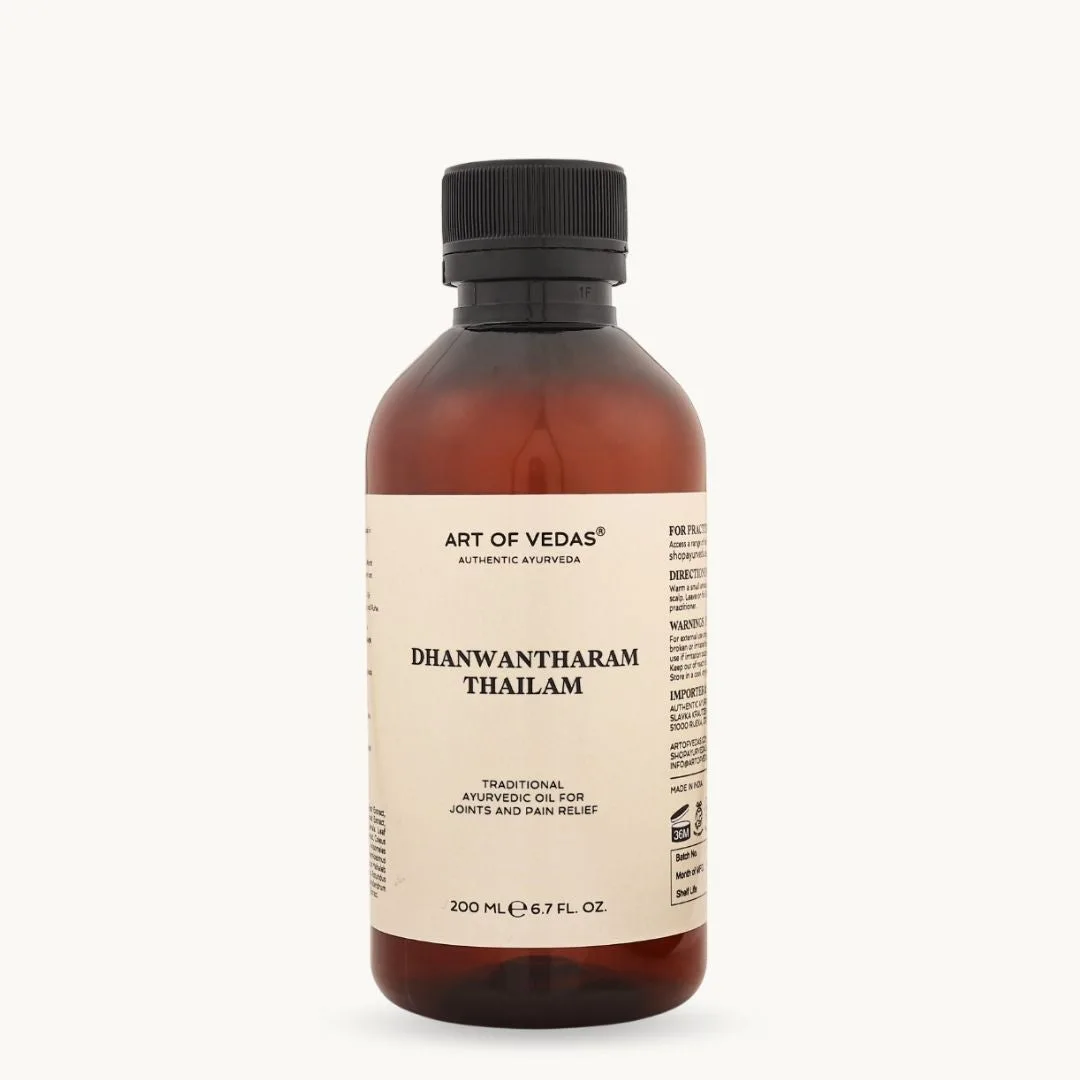
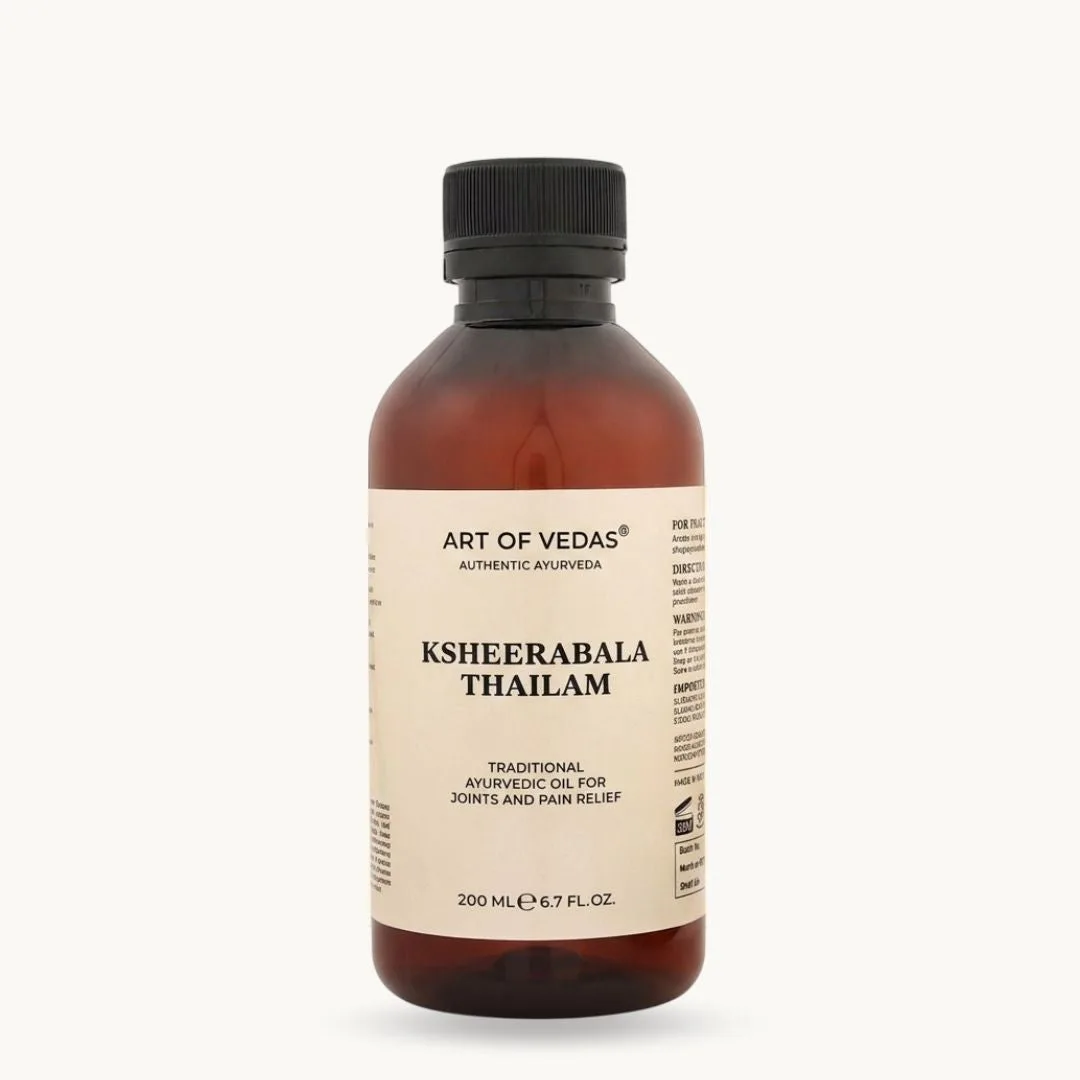
All three are sesame-based oils built on Bala and classically placed with Vata, and all three are used on the body and on the head. Ksheerabala Thailam is built on Bala alone and is the mildest of the three: the first choice for the head, for Shirodhara and for skin that likes very little. Balaswagandhadi Thailam adds Ashwagandha, lac and the group of cooling plants described above; it is fuller than Ksheerabala and still gentle, and it serves both body and head. Dhanwantharam Thailam adds the Dashamoola roots and a long list of further plants; it is mildly warming and is the oil most often chosen for a daily full-body Abhyanga of the muscles and joints. Someone who wants one oil for body and head will usually settle on Balaswagandhadi; someone who wants a head oil alone will settle on Ksheerabala; someone who wants a daily body oil for the cold months will settle on Dhanwantharam. Our comparison of Ayurvedic massage oils sets the three side by side with the other oils in the range.
Frequently asked questions about Balaswagandhadi Thailam
What is Balaswagandhadi Thailam? A classical Ayurvedic massage oil named after its two leading plants, Bala and Ashwagandha, which are cooked into a sesame oil base together with lac, Manjistha, liquorice, Sariva, vetiver, lotus and further plants. It is recorded in the Sahasrayogam, classically placed with Vata, and sold by Art of Vedas for external use. The name is also written Balaswagandhadi Taila, Balaswagandhadi Thailam or Balaswagandhadi oil.
What is Balaswagandhadi Thailam used for? For Abhyanga, the Ayurvedic oil massage of the whole body, and for Shiroabhyanga, the head massage. The tradition describes it as a nourishing Vata oil that is gentle rather than hot, which is why it serves both the body and the head. Art of Vedas sells Balaswagandhadi Thailam as an oil for external use and makes no claims beyond this traditional practice; ask a qualified Ayurvedic practitioner first.
How do you use Balaswagandhadi Thailam? Warm the closed bottle in a bowl of warm water until a drop feels pleasantly warm on the inner wrist. Apply two to three tablespoons over the whole body with long strokes along the limbs and circular strokes around the joints, leave it for 15 to 20 minutes, then take a warm shower. Daily, as Dinacharya describes, or two to three times a week. Do not use a microwave.
Can Balaswagandhadi Thailam be used on the head and the hair? Yes. Balaswagandhadi Thailam is one of the classical oils used for Shiroabhyanga, the head massage. Warm a tablespoon or less, work it into the scalp with the fingertips in slow circles, leave it for thirty minutes to an hour and wash the hair with a mild shampoo. Once or twice a week is the usual rhythm. It is a scalp oil in the classical sense, not a styling product.
What are the ingredients of Balaswagandhadi Thailam? The Art of Vedas oil declares sesame seed oil as its base, with Bala root, Ashwagandha root, lac, galangal, Manjistha, Durva grass, liquorice, Sariva, vetiver, nutgrass, deodar, turmeric, blue lotus, Mahaleb cherry seed, dill seed and sacred lotus flower cooked into it. Because lac, a resin of insect origin, is declared, the oil is not vegan. The full declaration is on the product page and on the label.
What is Balaswagandhadi Kuzhambu? The thicker form of the same formula. Balaswagandhadi Kuzhambu declares castor oil beside the sesame oil and is cooked down until it sets semi-solid at room temperature, so it stays where it is placed and absorbs slowly. It is used in small amounts on one region, while the Thailam is the pouring oil for body and head. Art of Vedas offers both in 200 ml.
Is Balaswagandhadi Kashayam the same as Balaswagandhadi Thailam? No. A Kashayam is a water decoction, a different classical preparation that is not an oil and is not applied to the skin; it is given by a practitioner. Balaswagandhadi Thailam is the oil, cooked on a sesame base and used for external massage. Art of Vedas offers the Thailam and the Kuzhambu, not the Kashayam; ask a qualified Ayurvedic practitioner about any preparation taken by mouth.
Can Balaswagandhadi Thailam be used in pregnancy or for children? Ask your doctor or a qualified Ayurvedic practitioner first. Balaswagandhadi Thailam is for external use only. Do a small skin test on the inner forearm before the first full application, keep it away from the eyes and broken skin, and do not use it if you react to sesame. Store the bottle closed, in a cool place away from sunlight, out of the reach of children.