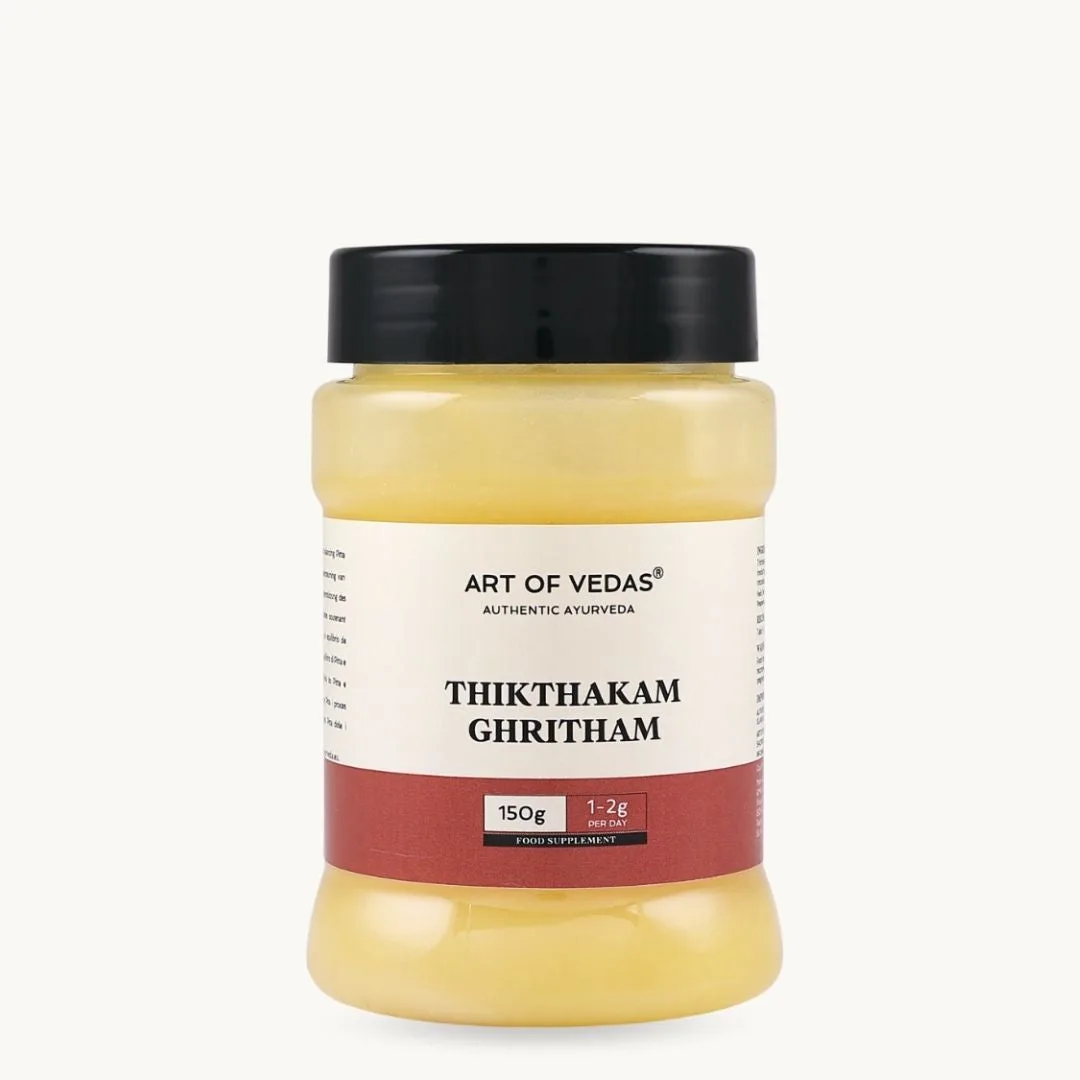
Bitter is the least popular taste and the best documented one. Classical Ayurveda gives Tikta a prominent place in its materia medica, and an entire branch of the ghee family is built on it. Gulgulu Thikthakam Ghritham belongs to that branch.
Tikta among the six tastes
The texts describe Tikta as light and drying in character, the opposite pole from Madhura, the sweet taste that dominates preparations such as Sukumaram Ghritham. Because ghee itself is heavy and unctuous, a bitter ghee is a deliberate combination of opposites, and the classical literature treats that combination as the point of the preparation rather than a compromise.
The bitter ghees of the family
- Thikthakam Ghritham, the plain bitter preparation.
- Mahathiktakam Ghritham, the greater bitter one, with a longer herb list.
- Gulgulu Thikthakam Ghritham, the bitter group with Guggulu added.
The three are related entries in the formulation literature rather than variations invented later, and the range comparison shows how they sit against the sweet and pungent preparations.
Taste as a practical matter
A bitter ghee tastes pronounced, and the classical response is not to mask it. The customs are warmth, a suitable Anupana and a modest quantity, which are set out in how Ghritham is traditionally taken. The tradition values steadiness of practice over the size of a single portion.
Frequently Asked Questions
Why combine a bitter taste with ghee?
Because the classical texts treat the pairing as the purpose of the preparation: ghee carries what is cooked into it, and the bitter group is what this family carries.
Are the three bitter ghees interchangeable?
They are separate entries in the formulation literature with different herb lists. The range comparison sets them side by side.
How is a strong taste handled traditionally?
With warmth, a suitable Anupana such as warm water, and a modest quantity, rather than by masking it.
This article is for educational purposes and describes the classical Ayurvedic record. The products mentioned are food supplements, not a substitute for a varied, balanced diet, and are not intended to diagnose, treat, cure or prevent any disease. Take classical ghee preparations under the guidance of a qualified Ayurvedic practitioner.