In brief: Brahmi (Bacopa monnieri) is a bitter, cooling creeping herb that classical Ayurveda places in the Medhya group, the small set of plants the tradition gathers under Medha.
Two different plants answer to the name Brahmi
Which of the two you receive is worth settling first. In some regional traditions the name Brahmi belongs to Bacopa monnieri, a low creeping plant with small fleshy leaves that grows in wet ground. Elsewhere the same name is given to Centella asiatica, known in Europe as Gotu Kola and in Ayurveda as Mandukaparni. The two plants are unrelated botanically, they taste different, and the tradition uses them differently.
Neither is a substitute for the other. When a label reads only "Brahmi" with no Latin binomial, you cannot tell which plant is in the jar. Where Art of Vedas writes Brahmi, we mean Bacopa monnieri. If you are comparing products, read the Latin name first and the marketing second.
What Ayurveda means by a Medhya herb
Medha, in classical usage, refers to the faculty of retention and comprehension. Herbs described as Medhya are those the tradition directs towards that faculty rather than towards the tissues of the body. The classical materia medica is large, and the Medhya group within it is small.
The Charaka Samhita sets out four herbs under the heading Medhya Rasayana: Mandukaparni, Yashtimadhu, Guduchi and Shankhapushpi. The first of those is Centella asiatica, the other plant described above, so Bacopa monnieri is not one of Charaka's four. It was placed in the Medhya group by the later compendia, and that is where it became the herb most people now mean by Brahmi. A Rasayana is not something taken for an afternoon: classical practice assumes a steady course over weeks or months, alongside regular sleep and regular meals. The herb was never understood to work in isolation from the life around it.
Bitter and cooling: the classical qualities
Brahmi is described as Tikta (bitter) in taste and Shita (cooling) in potency. In the language of the three Doshas (the functional principles of Vata, Pitta and Kapha), a bitter and cooling herb is classically suited to those in whom Pitta and Kapha are prominent.
The practical consequence is a caution rather than a warning. Bitter, cooling substances are also light and slightly drying, which is the opposite of what Vata is traditionally given. If your Prakriti (constitutional type) tends towards Vata, or you simply run cold and dry, the plain powder on its own may not suit you as well as the same herb carried in ghee or in oil. This is not a defect in the herb; it is why the tradition developed several preparations of it.
The four classical forms, and what each is for
Churnam, the plain powder
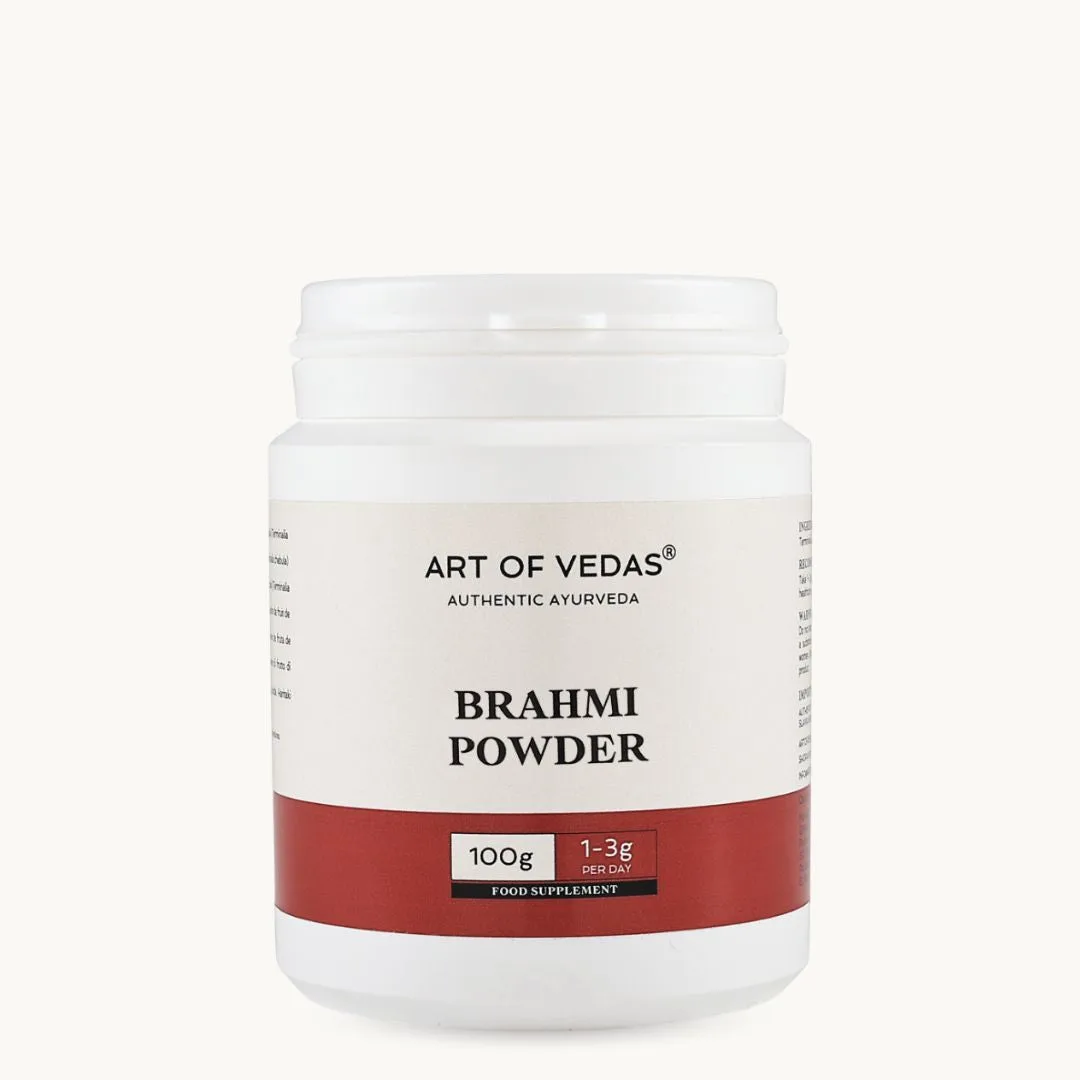
Brahmi Powder is the dried aerial parts of the plant reduced to a Churnam (fine powder). It is genuinely bitter, which is part of its character. It is usually taken in a small quantity stirred into warm water, or mixed with a little ghee to carry the taste. The powder suits people who want to control the quantity themselves and who do not mind the flavour.
Capsules, the same herb without the taste
Brahmi Capsules contain the same herb in a measured quantity. There is no traditional superiority to either form. The capsule exists because a bitter powder twice a day is an easy habit to abandon, and a Rasayana is defined by continuity. If consistency is your obstacle, the capsule is the sensible choice.
Ghritham, the herb carried in ghee
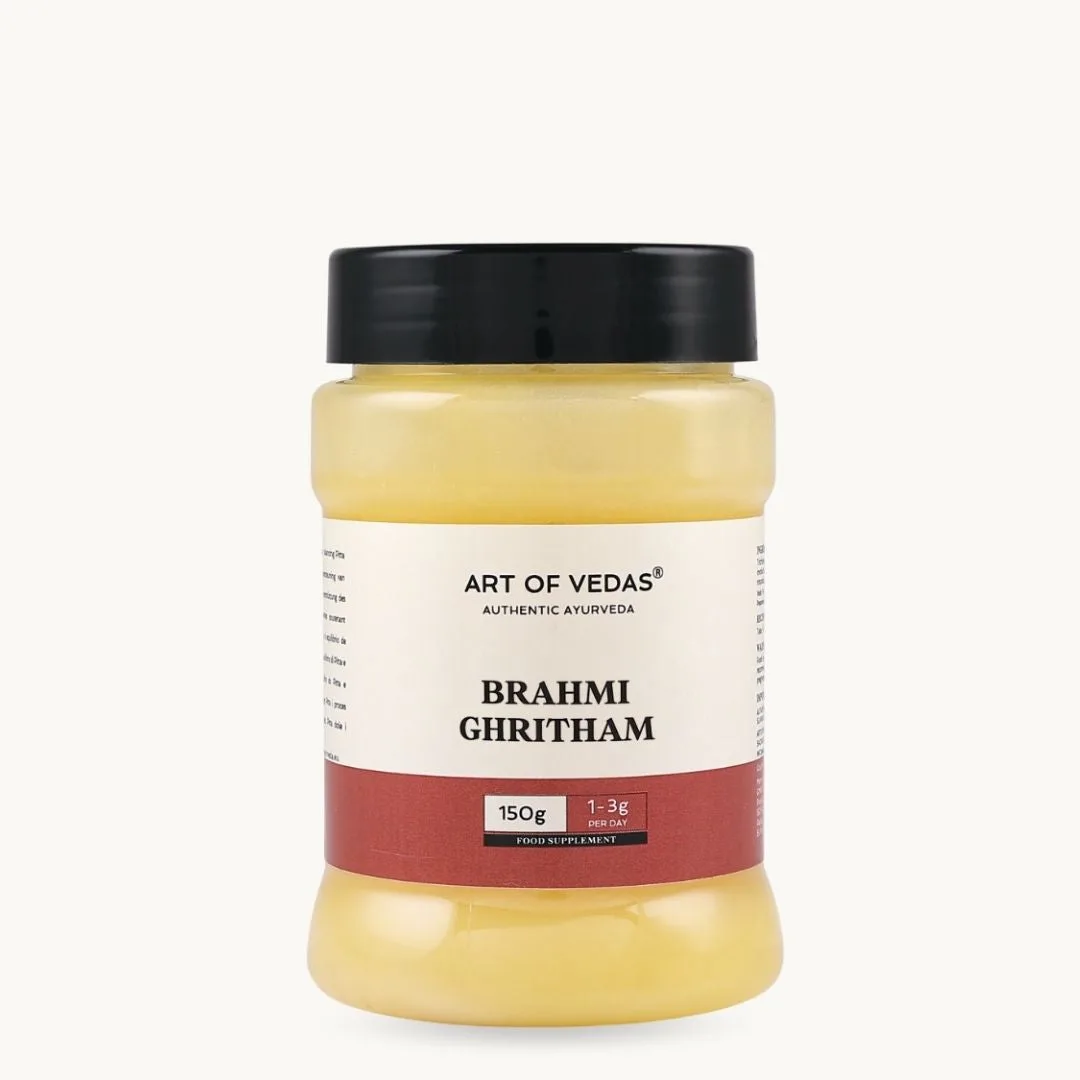
Brahmi Ghritham is Brahmi processed into ghee by long, slow cooking, so that the fat-soluble constituents of the plant pass into the medium. Ayurveda holds ghee in particular regard as a vehicle for Medhya preparations, and a Ghritham is also the form best suited to those of Vata Prakriti, since the unctuousness of the ghee balances the dryness of a bitter herb. It is taken in small quantities, traditionally on an empty stomach in the morning. We cover this class of preparation in more detail in our guide on where to buy Ghritham in Europe.
Thailam, the oil for the head
Brahmi Thailam is a medicated oil (Thailam) for external use, applied above all to the scalp. Shiro Abhyanga, the oiling of the head within the wider practice of Abhyanga (Ayurvedic oil massage), belongs to the ordinary daily round: a small quantity of oil worked into the scalp with the fingertips, left for twenty minutes or longer, then washed out. Warming the oil slightly makes it easier to apply and considerably more pleasant. For those who oil the head in the evening, the cooling quality of Brahmi is the classical reason this Thailam is chosen over a warming one.
Placing Brahmi in a daily rhythm
Dinacharya (the classical daily routine) is where Ayurveda expects a herb like this to live. In practice that usually means one internal form taken at a consistent hour, and the oil used on the head once or twice a week rather than daily.
Two habits work against that: taking a large quantity for a short time, when the tradition asks for a modest quantity over a long one, and using the herb in place of practice rather than alongside it. The classical texts assume the person taking a Medhya herb is also sitting quietly and keeping regular hours. If that is new to you, our guide to yoga and Ayurveda covers how the two disciplines were meant to fit together.
When Brahmi may not be the right herb
Ayurveda does not assume one herb suits everyone, and a herb chosen against your own qualities will disappoint you however good it is. If you feel cold and depleted rather than heated and busy, a bitter cooling herb may not be what your constitution is asking for. In that case a warming, strengthening herb is the traditional direction, and our guide to Bala describes that group.
The internal forms of Brahmi are food supplements and the Thailam is an external oil. Neither is a substitute for medical advice. If you are pregnant or breastfeeding, if you take prescribed medication, or if you are caring for a child, speak to your doctor or a qualified Ayurvedic practitioner before beginning any herb. This is ordinary prudence rather than a specific concern about this plant.
How to judge what you are buying
- The Latin name. Bacopa monnieri should appear on the label. Its absence is the clearest signal to look elsewhere.
- Whole herb or extract. Classical preparations use the whole dried plant. A standardised extract is a modern format the classical texts do not describe.
- Taste and colour. Brahmi powder is decidedly bitter and a dull grey-green. A powder that tastes of very little is worth questioning, and so is a bright green one.
Common questions about Brahmi
Is Brahmi the same as Gotu Kola?
No. Gotu Kola is Centella asiatica, called Mandukaparni in Ayurveda, and in the whole plant they are easy to tell apart: Centella carries round, fan-shaped leaves on long stalks, while Bacopa has small, thick, blunt leaves set close to a creeping stem. In powder form, only the Latin name tells you which you have.
Can the Thailam be used on its own?
Yes. Head oiling is a practice in its own right within Dinacharya, and nothing in the tradition requires the external oil and an internal form to be used together. Beginning with the oil is reasonable if the bitterness is what puts you off, and an internal form can follow later.
How long is Brahmi normally taken for?
As a Rasayana it is taken in courses rather than occasionally. A traditional course runs for weeks or months and is then paused, and the pause is part of the pattern rather than an interruption of it. Taking it for three days and stopping is outside the way the tradition uses it.
Can Brahmi be used together with Ashwagandha?
The two herbs are frequently used in the same period, and they are chosen for opposite qualities: Ashwagandha is warming and grounding where Brahmi is cooling and light. That complementarity is deliberate in classical formulation. If you are combining herbs, it is worth asking a practitioner to look at the whole picture, including your Prakriti and the season.