In brief: Chandanadi Thailam (also written Chandanadi Thailam, Chandanadi Taila, Chandanadi Tel or Chandanadi oil) is a classical Ayurvedic oil named after Chandana, sandalwood, which opens its recipe: a group of cooling plants cooked into sesame oil by the Sneha Paka method. The reference usually cited is the Sahasrayogam. The classical texts describe it as cooling and place it with Pitta, and it is traditionally used for Abhyanga in the warm season and for Shiroabhyanga, the head massage. This guide covers what it is, the declared ingredient list of the Art of Vedas oil, how it is used, the Valiya and Cheriya forms, and the closest oils in our range.
Chandanadi Thailam: what it is, what is in it, and how to use the cooling oil
Reviewed by Dr. Anu Joy, MD (Ayurveda), Ayurvedic doctor of Art of Vedas
What Chandanadi Thailam is, and what the name means
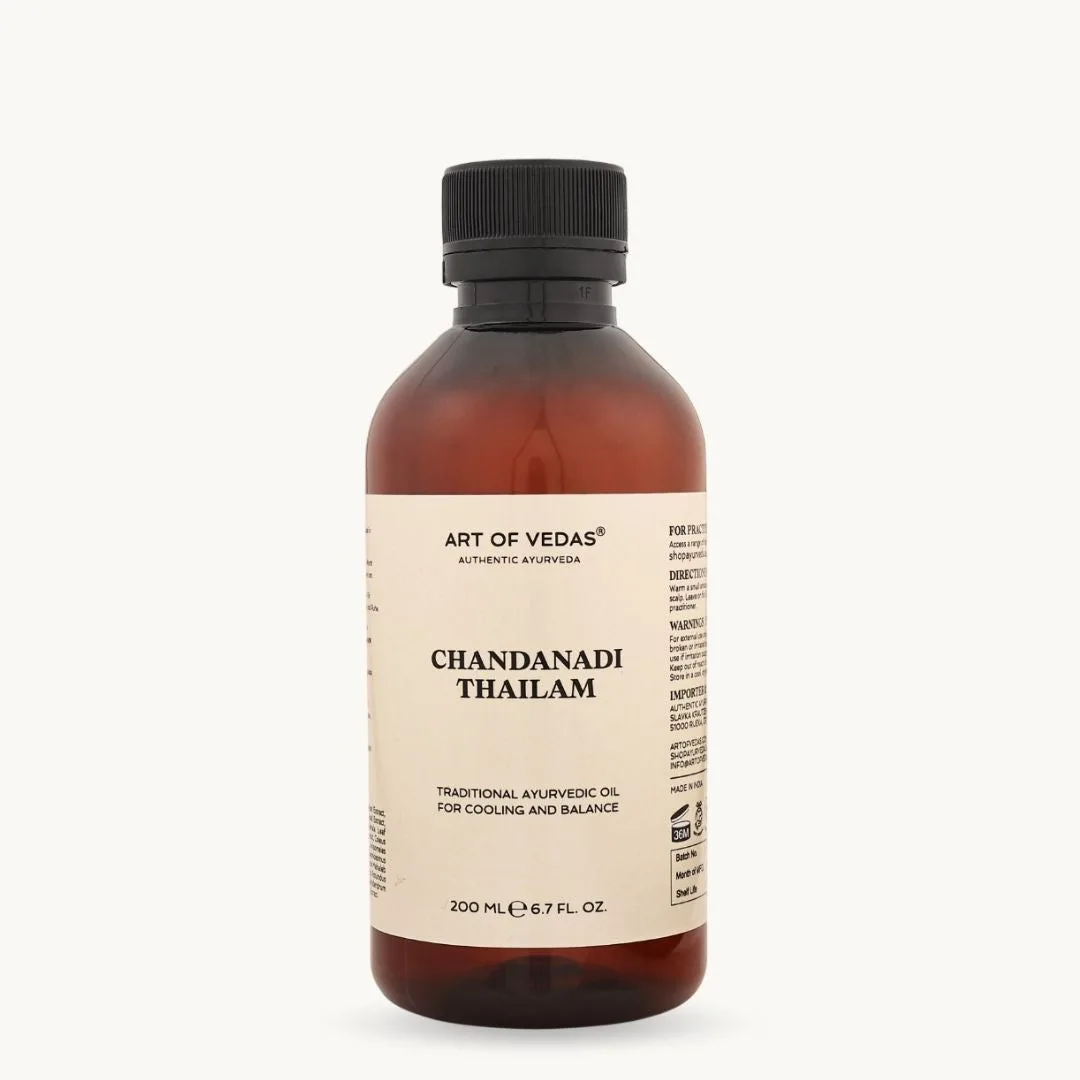
Chandanadi Thailam is a classical Ayurvedic oil of the cooling kind. Chandana is the Sanskrit name for sandalwood, and the ending adi means and the others, so Chandanadi is the recipe that begins with sandalwood: a group of cooling and aromatic plants, cooked into a base oil. Thailam, also written thailam, taila or tel, is the word for an oil in which plants have been cooked, and Chandanadi Thailam, Chandanadi Thailam, Chandanadi Taila and Chandanadi oil all name the same preparation. Art of Vedas sells it as Chandanadi Thailam in 200 ml, 1 litre and 5 litre sizes, for external use.
The classical description
The reference usually cited is the Sahasrayogam. The classical recipe names, among others, sandalwood, vetiver (Usheera), liquorice (Yashtimadhu), Manjishtha and Indian sarsaparilla (Sariva), the plants the tradition reaches for when it wants a cooling oil, prepared in sesame oil by the Sneha Paka method: a decoction of the tougher roots and woods, a paste of the softer plants, and the oil, cooked slowly together until the water has gone and the paste meets the traditional finishing tests. The tradition also knows a longer and a shorter version, Valiya (greater) and Cheriya (lesser) Chandanadi Thailam, which differ in the length of the plant list. Art of Vedas sells one Chandanadi Thailam, and the list that counts is the one declared on its label.
The declared ingredient list of the Art of Vedas oil
The Art of Vedas Chandanadi Thailam declares sesame seed oil (Sesamum indicum) as the base, and in it: liquorice root (Glycyrrhiza glabra), Ashwagandha root (Withania somnifera), deodar cedar wood (Cedrus deodara), vetiver root (Vetiveria zizanioides), Indian bay leaf (Cinnamomum tamala), turmeric root (Curcuma longa), Bala (Sida cordifolia), Manjishtha root (Rubia cordifolia), Indian sarsaparilla root (Hemidesmus indicus), Indian dill seed (Anethum graveolens), cardamom seed (Elettaria cardamomum), nutgrass root (Cyperus rotundus) and cinnamon bark (Cinnamomum verum). Limonene, linalool, cinnamal, eugenol, coumarin, benzyl benzoate and carvone are declared at the end of the list. They are not added perfume: they occur naturally in cinnamon, cardamom, bay leaf and dill, and EU cosmetics rules require them to be named above a set concentration so that sensitive people can check for them. Sandalwood itself does not appear on the declared list; the name follows the classical recipe, and the declaration states what is in the bottle. No animal-origin ingredient is declared, and the oil contains sesame.
Character in Ayurvedic terms
The classical texts describe Chandanadi Thailam as cooling (Sheeta Virya) and place it with Pitta, the Dosha of heat. Vetiver, Sariva, Manjishtha and liquorice are among the plants the tradition lists as cooling; Bala and Ashwagandha bring the nourishing quality of the Vata oils; and the small share of cinnamon, cardamom and bay leaf is the aromatic group that appears in most cooked oils. In the Ayurvedic calendar it is the oil for the warm months, when the warming sesame oils such as Mahanarayana Thailam are set aside, and for people whose constitution a practitioner describes as Pitta.
How Chandanadi Thailam is used in practice
Three traditional applications, all external:
- Abhyanga, the whole-body oil massage described in our Abhyanga guide: warm two to three tablespoons by standing the closed bottle in warm water, never in a microwave, and apply with long strokes along the limbs and circular strokes around the joints. Leave it on for 15 to 20 minutes, then take a warm, not hot, shower. In summer, or on warm skin, the oil can be used at room temperature. Daily in the warm season as part of the daily routine (Dinacharya), or two to three times a week.
- Shiroabhyanga, the head massage: a teaspoon or two worked into the scalp with the fingertips in small circles, left on for 30 to 60 minutes, or overnight on an old pillowcase, then washed out with a mild shampoo. Traditionally done in the evening, once or twice a week.
- Padabhyanga, the foot massage: a small amount massaged into the soles before bed, with cotton socks over it. This is the classical evening use of a cooling oil.
On the face, Chandanadi Thailam is heavier than the face oils of the range; a few drops on damp skin, washed off after 15 minutes, is enough. For the face itself, the lighter coconut-based Nalpamaradi Kera Thailam is the usual choice.
Who should ask first
Chandanadi Thailam is for external use only. Do a small skin test on the inner forearm and wait 24 hours before the first full application; keep it away from the eyes and broken skin, and stop if the skin reacts. It contains sesame and the declared fragrance components named above; anyone with a known sensitivity should read the declaration first. In pregnancy, while breastfeeding, or for children, ask your doctor or a qualified Ayurvedic practitioner first. The choice of oil for a given constitution and season is the work of a qualified Ayurvedic practitioner, and that is who to ask when in doubt.
Chandanadi compared with the closest oils in our range
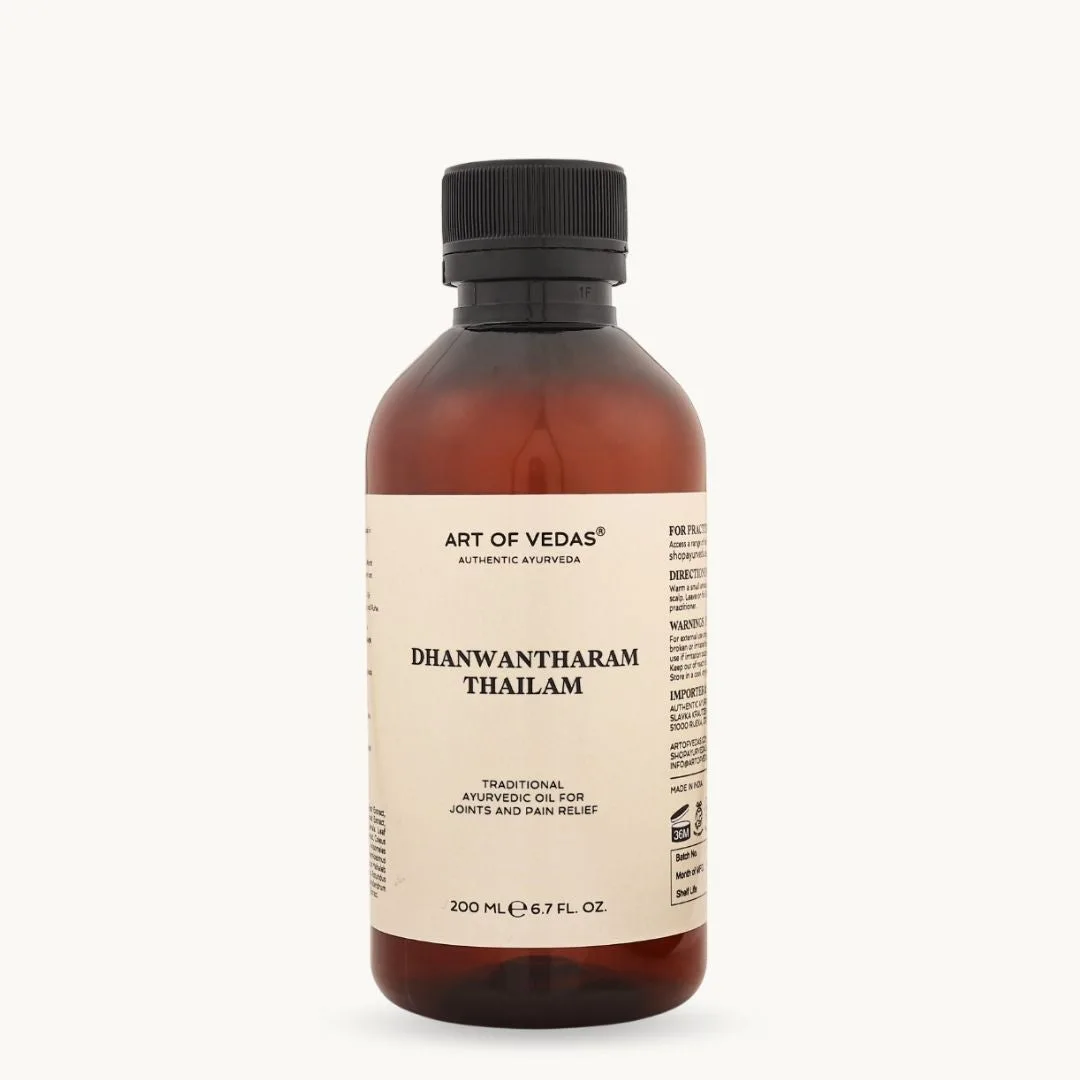
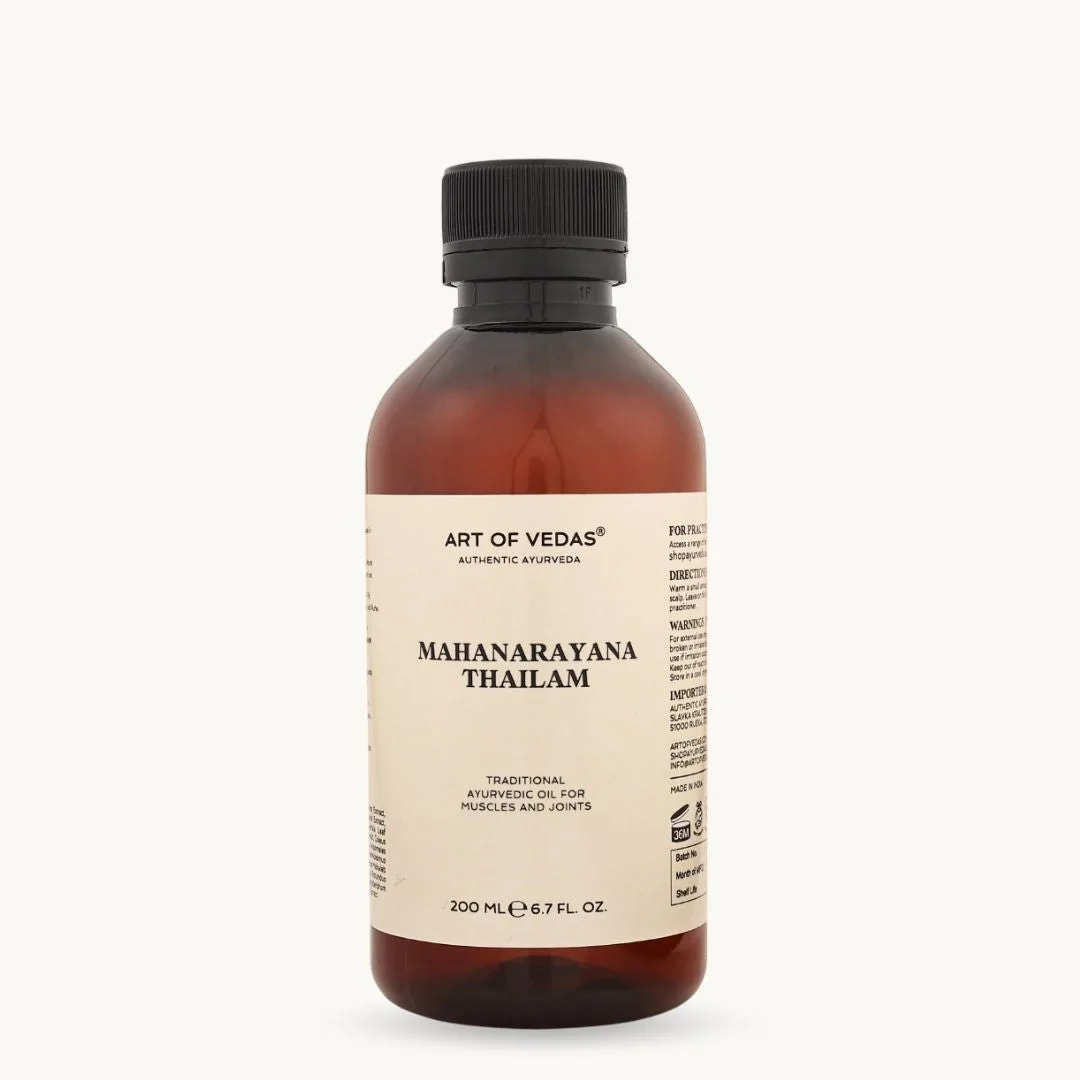
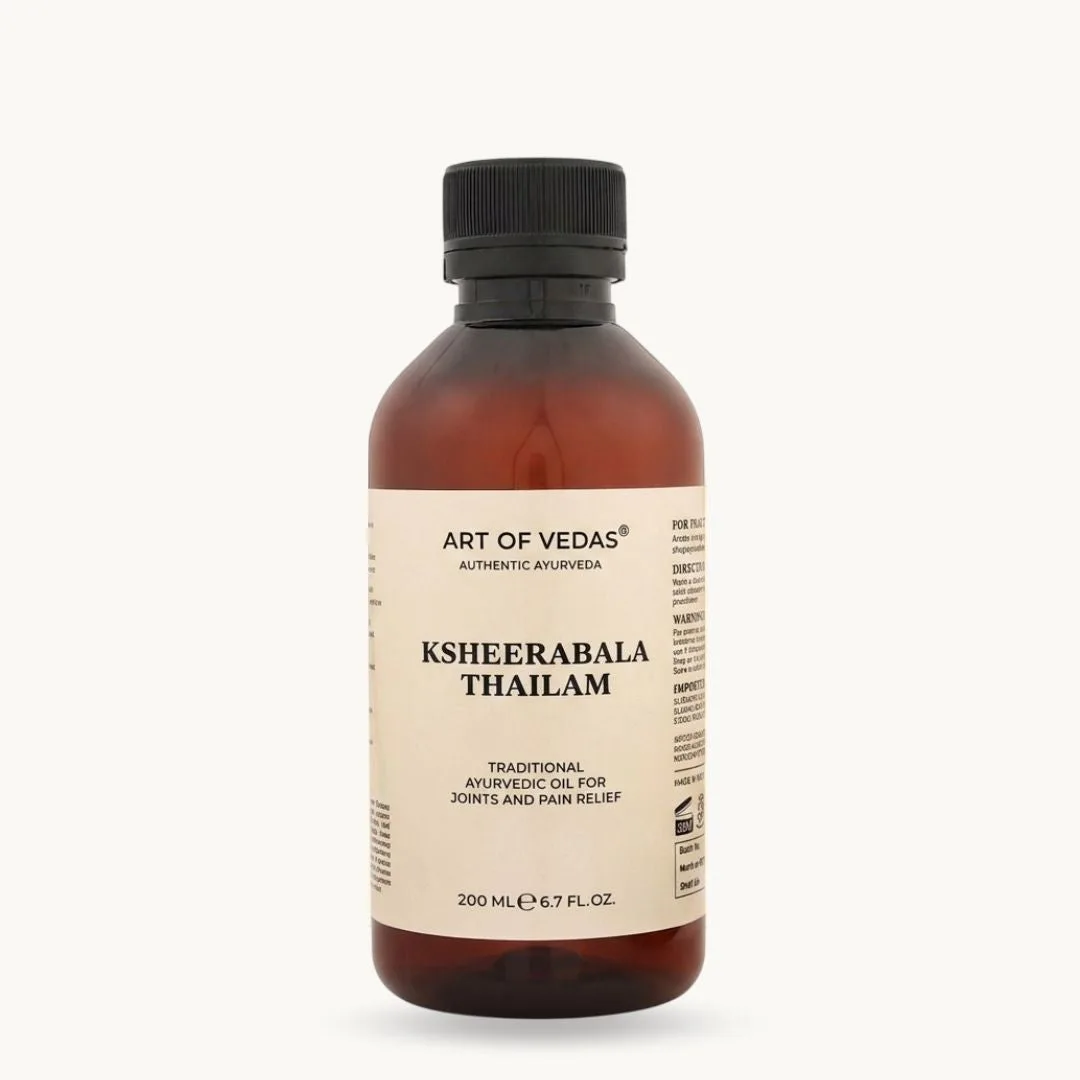
Ksheerabala Thailam is the other gentle oil of the range: Bala cooked in sesame oil with milk, mild and placed with Vata, the usual choice for a daily routine in any season. Chandanadi Thailam is the cooling counterpart, placed with Pitta, for the warm months and for warm skin. Nalpamaradi Kera Thailam is also cooling and placed with Pitta, but it is a skin oil in a coconut base, used on the face and washed off, not a body massage oil. The warming Vata oils, Mahanarayana Thailam and Dhanwantharam Thailam, sit at the other end of the scale. Our comparison of Ayurvedic massage oils and the complete guide to Thailams set them all side by side.
Frequently asked questions about Chandanadi Thailam
What is Chandanadi Thailam? A classical Ayurvedic oil named after Chandana, sandalwood, the first plant of its recipe: a group of cooling plants cooked into sesame oil by the Sneha Paka method. The reference usually cited is the Sahasrayogam. It is also written Chandanadi Thailam, Chandanadi Taila or Chandanadi Tel, and Art of Vedas sells it as an oil for external use.
What is Chandanadi Thailam used for? Traditionally for Abhyanga, the oil massage, in the warm season, for Shiroabhyanga, the head massage, and for Padabhyanga, the evening foot massage. The classical texts describe it as cooling and place it with Pitta. Art of Vedas sells Chandanadi Thailam for external use and makes no claim beyond that traditional description.
What are the ingredients of Chandanadi Thailam? The Art of Vedas oil declares sesame seed oil with liquorice, Ashwagandha, deodar cedar, vetiver, Indian bay leaf, turmeric, Bala, Manjishtha, Indian sarsaparilla, dill, cardamom, nutgrass and cinnamon, plus naturally present fragrance components. Sandalwood is not on the declared list. The full declaration with botanical names is on the product page and on the label.
How do you use Chandanadi Thailam, and Valiya Chandanadi Thailam? Warm the bottle in warm water, apply two to three tablespoons to the body or a teaspoon to the scalp, massage, leave it for 15 to 20 minutes on the body or 30 to 60 minutes on the head, and wash off with a warm shower or a mild shampoo. The Valiya form is used the same way. Two to three times a week, or daily in summer.
Can Chandanadi Thailam be used on the face and skin? Yes, as a cooling oil for the skin of the body and, in a few drops, for the face, washed off after 15 minutes. It is heavier than the coconut-based face oils, so for the face most people choose Nalpamaradi Kera Thailam. Do a skin test first, and ask a qualified Ayurvedic practitioner about your skin type.
Is Chandanadi Thailam used for sleep or for hair growth? The tradition uses it in the evening: a cooling head massage or foot massage before bed is a classical part of the daily routine. Art of Vedas makes no claim about sleep or hair growth. For hair care the range has Neelibhringadhi Thailam, a hair oil; Chandanadi Thailam is a cooling body and head oil.
What is the difference between Valiya and Cheriya Chandanadi Thailam? Valiya means greater and Cheriya lesser: the greater version has the longer plant list, the lesser the shorter one. Both are cooling oils placed with Pitta and used in the same way. Art of Vedas sells one Chandanadi Thailam; its declared list, on the product page and the label, tells you what is in it.
Can Chandanadi Thailam be used in pregnancy or for children? Ask your doctor or a qualified Ayurvedic practitioner first. Chandanadi Thailam is for external use only; do a small skin test on the inner forearm and wait 24 hours before the first full application, keep it away from the eyes and broken skin, and stop if the skin reacts. It contains sesame and declared fragrance components.