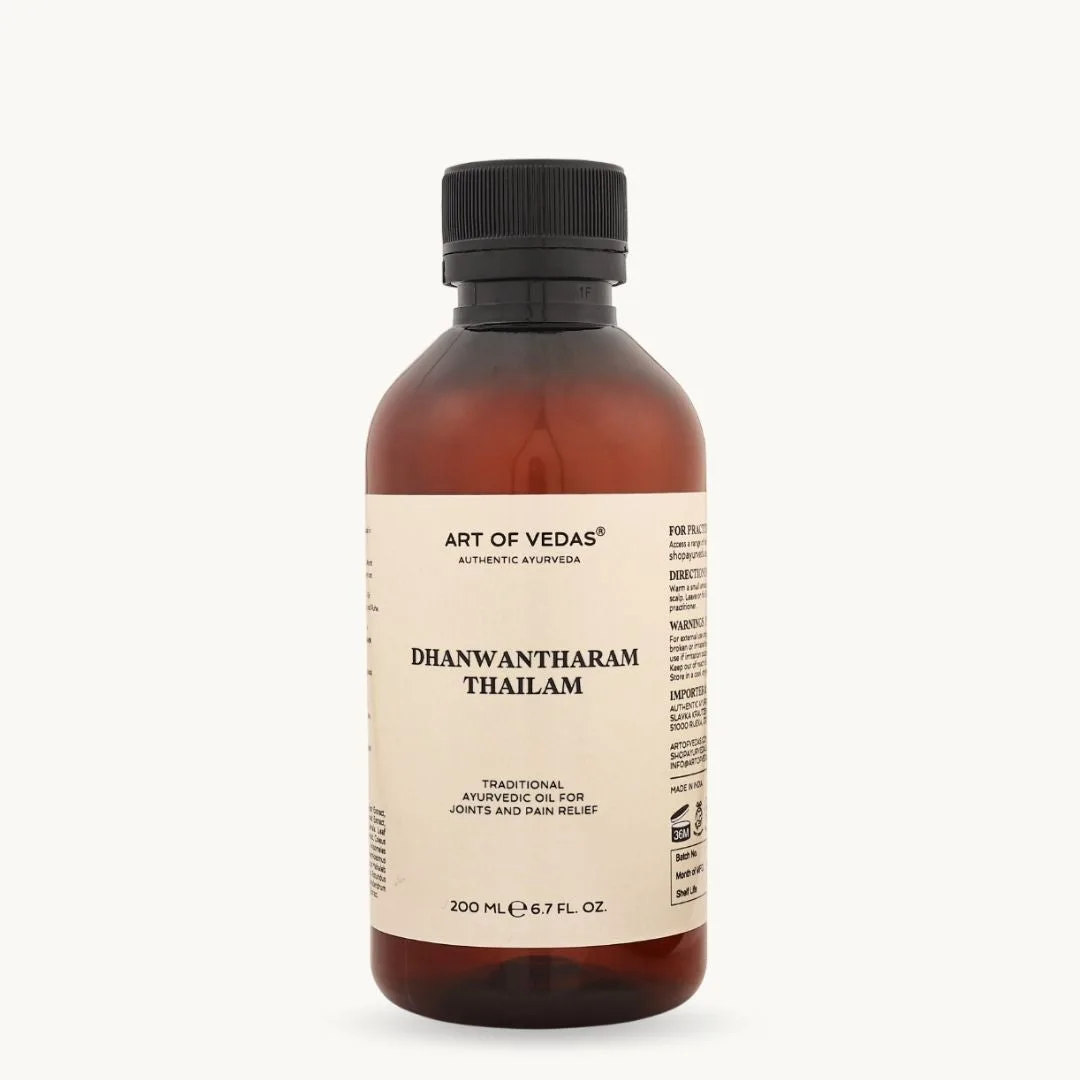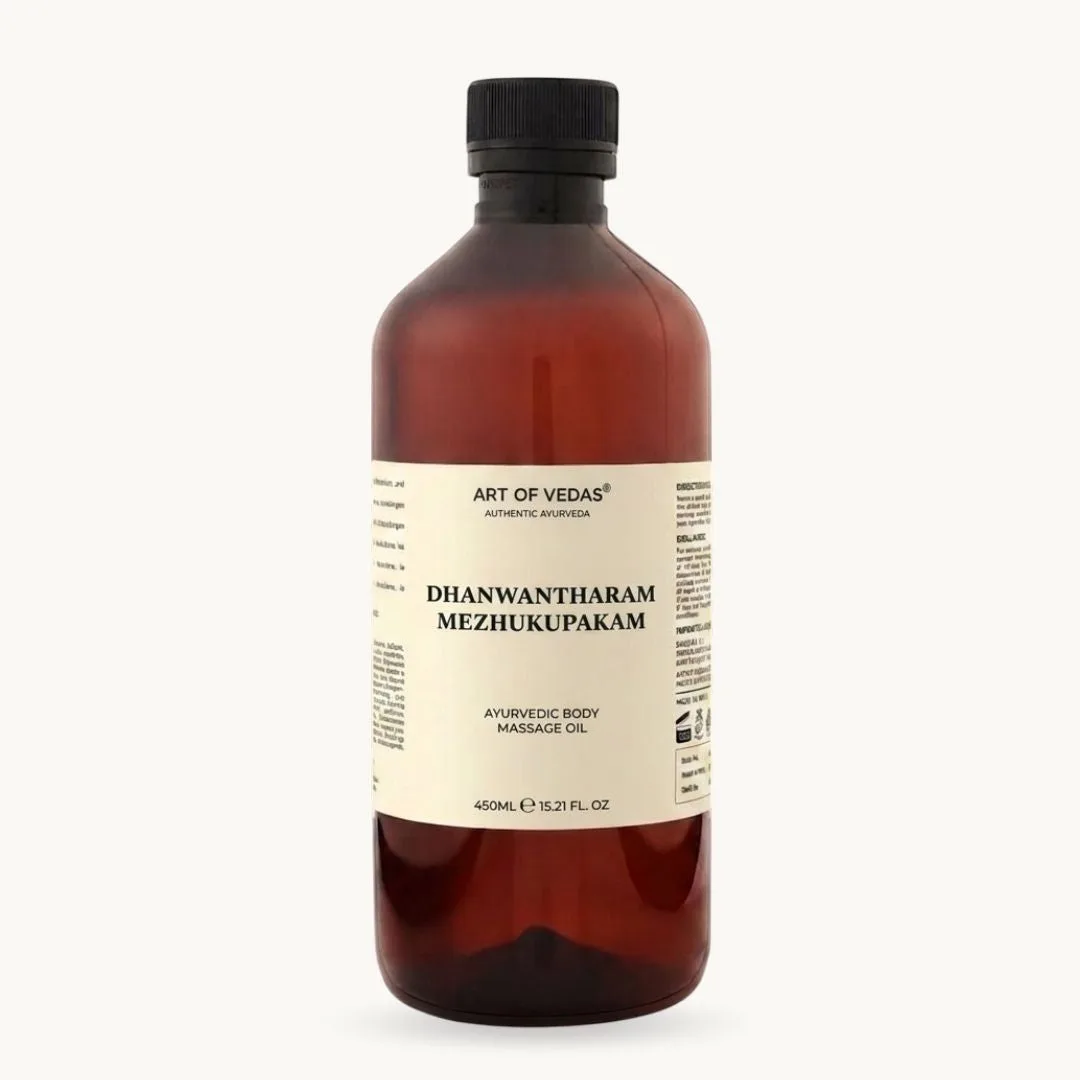
In brief: Dhanwantharam 101 Avartana (also written 101 Avarthy or Avarti) is the classical Dhanwantharam Thailam, the Bala and Dashamoola oil of the Ashtanga Hridayam, cooked 101 times over, each round with a fresh decoction of the herbs; Avartana means one such round. The tradition values the repeated oil as finer and more concentrated, so it comes in a 15 ml bottle and is used in small amounts. Art of Vedas sells it in the EU as an oil for external use. This guide covers how the 101 oil differs from the Thailam and the Mezhukupakam, how to use it, and when to ask a qualified Ayurvedic practitioner.
Therapies & Oils
Dhanwantharam 101 Avartana Explained
Reviewed by Dr. Anu Joy, MD (Ayurveda), Ayurvedic doctor of Art of Vedas

What Avartana Means
Avartana means a repetition or a cycle. In oil-making, one Avartana is a complete round of preparing the oil with a fresh batch of herbal decoction and, in the classical method. To make a higher Avartana oil, the same oil is processed again and again, each time with a new decoction of the herbs, so that more of their qualities are drawn into it. A 101 Avartana oil has been through this cycle one hundred and one times.
Why 101 Times?
Each repetition is understood in the tradition to make the oil finer and more concentrated, carrying the herbal character more deeply. The number 101 is the classical benchmark for a fully matured Dhanwantharam oil, reached over a long and labour-intensive production. Because so much herbal material and time go into a single batch, the finished oil is potent, which is why only a small quantity is used at a time. It is traditionally used in Ayurveda as a refined form of the same Vata-settling oil.
Why It Is Sold in Drops, Not Millilitres
The 101 version is concentrated enough that it is used sparingly, often just a few drops, so it is packaged in small bottles and measured in drops rather than by the larger volumes used for everyday massage oil. It is often applied to specific areas rather than the whole body, and any traditional use beyond external massage should be guided by a qualified practitioner. You can find it in our range as Dhanwantharam 101 Avartana. A parallel example is Ksheerabala 101, explained in our Ksheerabala 101 guide.
101 vs Standard Thailam vs Mezhukupakam
The three forms are the same family at different concentrations and consistencies. The standard Dhanwantharam Thailam is a free-flowing oil for everyday Abhyanga. The 101 Avartana is the concentrated, drops-based form. The Dhanwantharam Mezhukupakam is a semi-solid, wax-like preparation used for thicker local application. For a full map of every Dhanwantharam format side by side, see our Dhanwantharam formats guide.
What Makes the 101 Version Distinct
- Prepared through one hundred and one rounds of the traditional process.
- More concentrated, so used in drops rather than by the spoonful.
- Packaged in small bottles that reflect the sparing dose.
- Often reserved for focused, local application rather than whole-body massage.
- Shares the Bala and Dashamoola core of the standard oil.
Using the 101 Oil Sensibly
Because it is concentrated, the 101 oil is best introduced carefully and in small amounts, a few drops warmed and massaged into a specific area. Any traditional use beyond external massage should be discussed with a qualified Ayurvedic practitioner. For the oil's overall context and its place in a routine, our complete Dhanwantharam guide is the best place to start.
Frequently asked questions about Dhanwantharam 101 Avartana
What is Dhanwantharam 101 Avarthi? Dhanwantharam 101 Avarthi, also written Dhanwantharam 101 Avartana or Avarti, is the classical Dhanwantharam Thailam, the Bala and Dashamoola oil described in the Ashtanga Hridayam, taken through the traditional cooking process 101 times, each round with a fresh decoction of the herbs. The repetition gives a finer, more concentrated oil. Art of Vedas sells it in a 15 ml bottle as an oil for external use.
What does Avartana mean? Avartana is a Sanskrit word for a turn, a round or a repetition. In oil-making, one Avartana is one complete cooking of the oil with a fresh batch of the herbal decoction and paste until the water has gone. A 7 Avartana oil has been cooked seven times, a 101 Avartana oil one hundred and one times. Avarthy and Avarti are spellings of the same word.
What is Dhanwantharam 101 used for? Classically, the higher Avartana oils are the refined form of the same Vata oil, used sparingly and on one area rather than over the whole body. Art of Vedas sells Dhanwantharam 101 as an oil for external use: a very small amount, warmed and massaged into the chosen area of the muscles and joints. The further classical uses of a 101 oil belong with a qualified Ayurvedic practitioner.
How do you use Dhanwantharam 101? Stand the closed bottle briefly in warm water. Put a little oil in the palm, warm it between the hands and massage it into one area with slow strokes until absorbed. Leave it for 20 to 30 minutes before a warm shower. The oil is concentrated, so start with less than you think you need. Any use beyond external massage is for a qualified Ayurvedic practitioner to decide.
What is the difference between Dhanwantharam 101, Dhanwantharam Thailam and Mezhukupakam? The same formula in three forms. Dhanwantharam Thailam is the oil cooked once, free-flowing, for a daily Abhyanga of the whole body. Dhanwantharam 101 is that oil cooked 101 times, more concentrated and used in small quantities on one area. Dhanwantharam Mezhukupakam is the recipe cooked longer, until it is semi-solid and wax-like, for the thickest local application.
Dhanwantharam 101 or Ksheerabala 101: what is the difference? Both are classical oils taken through 101 Avartana, and both are classically placed with Vata. Dhanwantharam 101 carries the long Dhanwantharam list, with Bala, the Dashamoola roots, Ashwagandha and Shatavari among its herbs, in sesame oil. Ksheerabala 101 is the simpler Bala recipe cooked with milk, which the tradition favours for the head. Art of Vedas sells Dhanwantharam 101 in 15 ml; the Ksheerabala 101 guide explains its counterpart.
Why is Dhanwantharam 101 sold in a 15 ml bottle? Because so much herbal material and time go into one batch, cooked 101 times over with a fresh decoction each round, the finished oil is used in small quantities on one area rather than poured for a whole-body massage. A 15 ml bottle is therefore the practical size: enough for many applications, and small enough to stay fresh between uses. The size reflects the sparing use, not poor value.
Does Dhanwantharam 101 have side effects, and can it be used in pregnancy or for children? Dhanwantharam 101 is an oil for external use. Do a skin test on the inner forearm before the first application, keep it away from the eyes and broken skin, and do not use it if you react to sesame or to any ingredient named on the label. In pregnancy, for children, or with any health question, ask your doctor or a qualified Ayurvedic practitioner first.