This article is part of our The Complete Guide to Dhanwantharam Thailam: Ancient Ayurvedic Oil for Modern Wellness guide series.
Dhanwantharam Ghritham is the internal medicated ghee form of the classical Dhanwantharam formulation - one of the most important and widely referenced preparations in the entire Ayurvedic classical tradition. Named after Lord Dhanwantari, the divine physician and patron of Ayurveda, the Dhanwantharam formulation is described in both the Ashtanga Hridayam and the Sahasrayogam as the primary classical Vata-pacifying compound - and its ghee form, Dhanwantharam Ghritham, brings this comprehensive Vata-managing action through the internal oral route to reach the deep tissue levels that external Abhyanga oil alone cannot access.
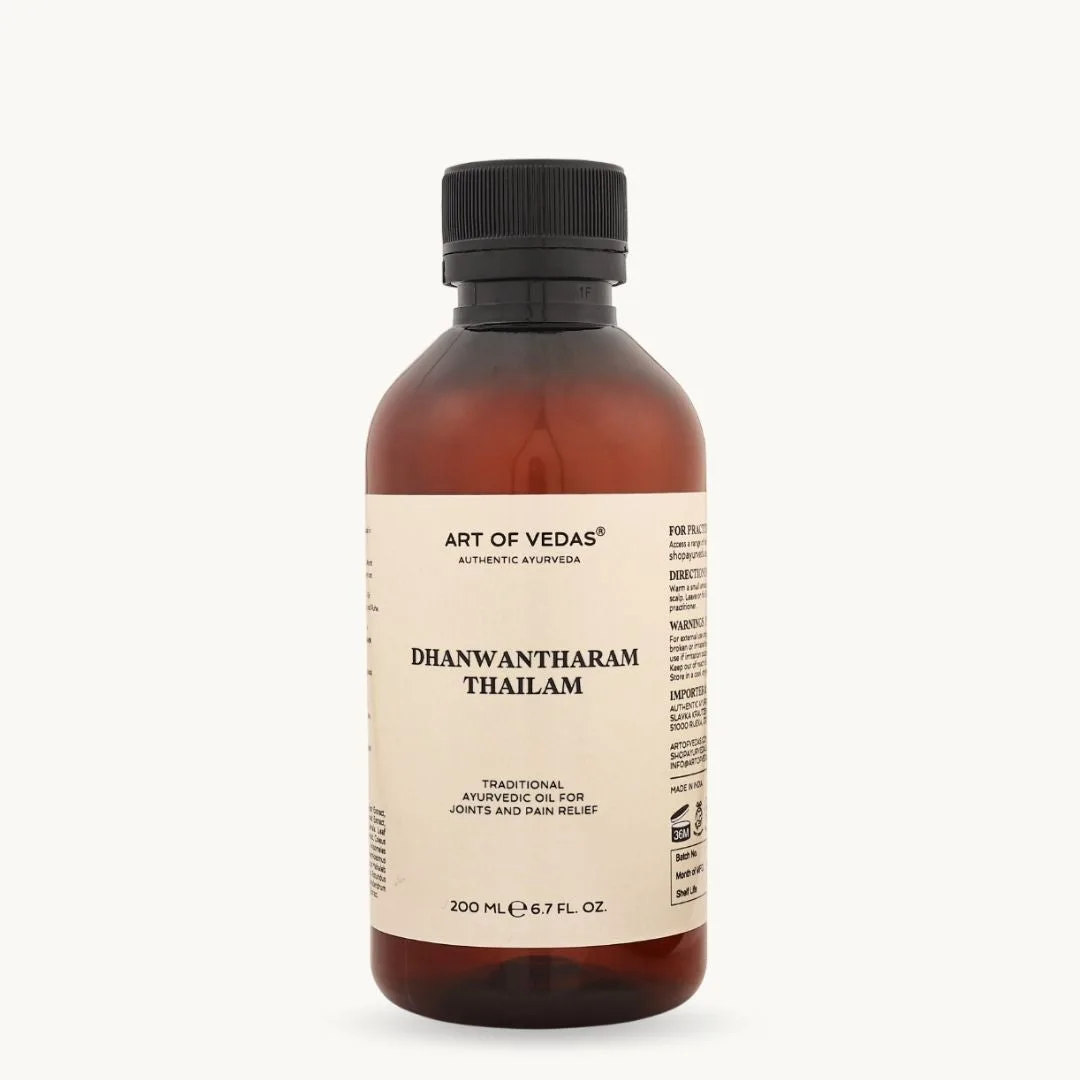
The external oil form - Dhanwantharam Thailam - is one of the most used classical oils at Art of Vedas, described in full in the Dhanwantharam Thailam guide. The Ghritham form carries the same core formulation - the same over-28 herbs, the same Dashamula foundation, the same Bala (Sida cordifolia) lead herb - but delivers it through the internal digestive route, creating an internal-external pair that the classical texts describe as the most complete approach to systemic Vata management.
The full Dhanwantharam Ghritham product is available in the Art of Vedas Ghritham collection. The foundational context for Ghritham preparations is in the Ghritham overview guide.
The Dhanwantharam Formulation: Classical Composition
The Dhanwantharam formulation is a complex multi-herb preparation whose composition is described in detail in the Ashtanga Hridayam, Chikitsa Sthana. Its core structure is built on three interlocking herb groups, each contributing a different dimension of the overall Vata-pacifying action:
Bala (Sida cordifolia) - the lead herb: Bala (meaning "strength" in Sanskrit) is the primary herb of the Dhanwantharam formula. Its classical pharmacology is Madhura (sweet) and Kashaya rasa, Sheeta (cooling) Virya, Madhura Vipaka - making it a cooling, nourishing, tissue-building herb with specific affinity for the musculoskeletal, nervous and reproductive channels. Bala is classified as Balya, Brimhana, and Vatahara (Vata-pacifying) - and as a Rasayana when used in sustained daily preparation. In Dhanwantharam Ghritham, Bala's cooling nourishment of depleted tissues is amplified by ghee's carrier penetration to reach the deepest Vata-affected channels.
Dashamula (the ten roots): The complete ten-root Dashamula complex - Brihat Panchamula (Bilva, Shyonaka, Gambhari, Patala, Agnimantha) and Laghu Panchamula (Shalaparni, Prishnaparni, Brihati, Kantakari, Gokshura) - provides the Sarva Vata Hara (all-Vata-addressing) foundation of the Dhanwantharam formula. As described in full in the Dashamula guide, the ten roots together cover all five Vata sub-types across all body regions. In the Ghritham form, this broad Vata-pacifying action is delivered internally through the digestive channel network, reaching tissue layers from within that complement the external Abhyanga route of the Thailam.
Supporting herbs: A complex group of additional herbs - including Ashwagandha (Withania somnifera), Shatavari (Asparagus racemosus), Vidari (Pueraria tuberosa), Devadaru (Cedrus deodara), Rasna (Pluchea lanceolata) and aromatic herbs - contributes tissue-building, channel-opening, pain-relieving and Ojas-building dimensions to the formula. The combination creates a preparation that addresses Vata not only through pacification but also through rebuilding the depleted Ojas and Dhatu quality that chronic Vata imbalance erodes over time.
Internal and External: Why Both Matter
The classical Ayurvedic management of significant Vata conditions - postpartum Vata, chronic musculoskeletal Vata presentations, neurological Vata patterns, deep constitutional Vata depletion - consistently describes a two-route approach: external Abhyanga with Vata oils to address the channel network through the transdermal route, and internal Snehapana (oleation through ghee) to address the tissue network through the digestive-Dhatu route.
The transdermal route of Dhanwantharam Thailam applied in Abhyanga reaches the skin, subcutaneous tissue, muscles and the superficial channel layers. The internal route of Dhanwantharam Ghritham reaches the Rasa Dhatu (plasma-lymph) and all downstream Dhatus through the normal tissue nourishment sequence - including the Majja Dhatu (nervous tissue) and the Shukra Dhatu (reproductive tissue) that are most affected by deep constitutional Vata depletion.
This is why the classical texts, when describing conditions such as postpartum Vata restoration or significant musculoskeletal Vata presentations, routinely prescribe both the Thailam and the Ghritham form of the same formula - the two routes are complementary, not redundant. Using Dhanwantharam Ghritham in the morning alongside daily Abhyanga with Dhanwantharam Thailam provides the most complete internal-external Vata management approach available in classical home practice.
Classical Indications
The Ashtanga Hridayam describes Dhanwantharam Ghritham across a range of Vata presentations. These are described in classical Ayurvedic terms for educational purposes:
Vata Vyadhi (conditions of Vata disturbance): The classical category that encompasses the full range of conditions arising from disturbed, depleted or aggravated Vata across the body channel network - from musculoskeletal stiffness and pain to neural presentations to digestive Vata disturbance. Dhanwantharam Ghritham's Sarva Vata Hara character makes it broadly applicable across this range in a way that single-herb preparations are not.
Sutika Paricharya (postpartum care): The classical texts describe postpartum care as the most acute and demanding context for systematic Vata management. The intense Vata disturbance of labour and delivery - involving all five Vata sub-types simultaneously - requires restoration through both external oleation (Dhanwantharam Thailam Abhyanga) and internal oleation (Dhanwantharam Ghritham). The combination restores the depleted Ojas, nourishes the Shukra Dhatu depleted through childbirth, and gradually re-establishes the tissue quality and channel function that sustained Vata disruption has eroded. The Postpartum Recovery collection at Art of Vedas reflects this classical priority.
Bala Kshaya (depletion of strength and tissue): When Vata imbalance has progressed to Stage 4 or 5 in the classical Samprapti (disease development) model - when Vata has settled into specific Dhatus and begun to produce tissue depletion rather than merely functional disturbance - the Ghritham form of Dhanwantharam provides the sustained deep tissue nourishment that is needed. The Bala herb's Brimhana action in a ghee carrier directly addresses this depletion at the Dhatu level. The Vata framework is described in full in the Vata imbalance guide.
Garbha Dharana and prenatal support: The classical texts also describe Dhanwantharam formulations in the context of prenatal care - supporting the nourishment of the developing Garbha (foetus) and maintaining the Vata balance of the mother through pregnancy. This is a formal clinical context requiring qualified practitioner guidance; it is mentioned here to reflect the full classical scope of the formulation.
Dhanwantharam Ghritham in Daily Rasayana Practice
Beyond the specific clinical contexts above, Dhanwantharam Ghritham can be used as a daily Rasayana for anyone with a Vata-dominant constitution or a consistent pattern of Vata accumulation - particularly in the autumn and winter seasons when the Ritucharya framework calls for the most intensive Vata management. The Ritucharya seasonal guide describes how to adjust the Ghritham and oil practice with each seasonal transition.
In daily Rasayana use, Dhanwantharam Ghritham pairs most naturally with:
Dhanwantharam Thailam for daily Abhyanga - the external partner of the same formula. Ashwagandha Powder in warm water as the warming Rasayana complement. Triphala in the evening for channel clearing that prepares the body to receive the next morning's Ghritham. The complete framework is in the Vata imbalance guide and the Abhyanga complete guide.
How to Use
Take half a teaspoon of Dhanwantharam Ghritham on an empty stomach in the morning, warmed to liquid consistency, with a small amount of warm water. The practice can be gradually built to one teaspoon daily. For those sensitive to taking ghee on an empty stomach, it can be stirred into warm water after an initial acclimatisation period.
Dhanwantharam Ghritham can also be taken in the evening before sleep with warm water - particularly for the cold, restless, anxious Vata pattern of sleep disturbance that responds well to evening oleation and warming milk nourishment together.
Frequently Asked Questions
How does Dhanwantharam Ghritham differ from Mahanarayana Thailam?
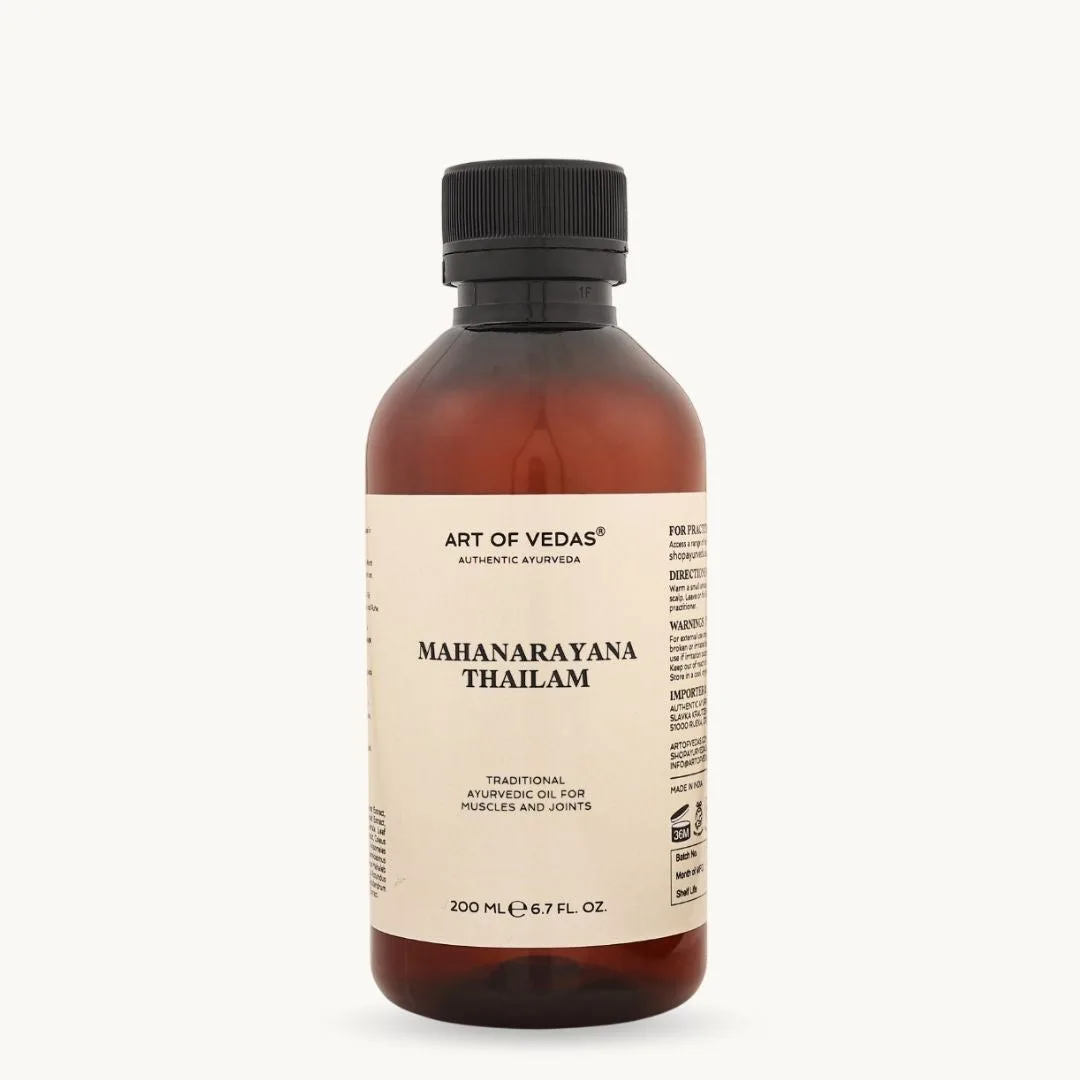
Both preparations address broad Vata presentations across the full body channel network. Mahanarayana Thailam is an external oil applied in Abhyanga - it works through the transdermal route. Dhanwantharam Ghritham is an internal preparation taken orally - it works through the digestive-Dhatu route. They can be used together: Ghritham internally in the morning and Mahanarayana Thailam externally in the Abhyanga practice. The choice between Dhanwantharam and Mahanarayana externally for Abhyanga is covered in the comparing classical oils guide.
Is Dhanwantharam Ghritham appropriate year-round?
For Vata-dominant constitutions, yes - with increased frequency in autumn and winter (the Vata-aggravating seasons) and reduced frequency in summer. The Ritucharya guide covers the seasonal adjustment in detail. For mixed constitutions, working with a qualified Ayurvedic practitioner to determine the appropriate seasonal Ghritham practice is the most precise approach.
Can Dhanwantharam Ghritham be used alongside Brahmi Ghritham?
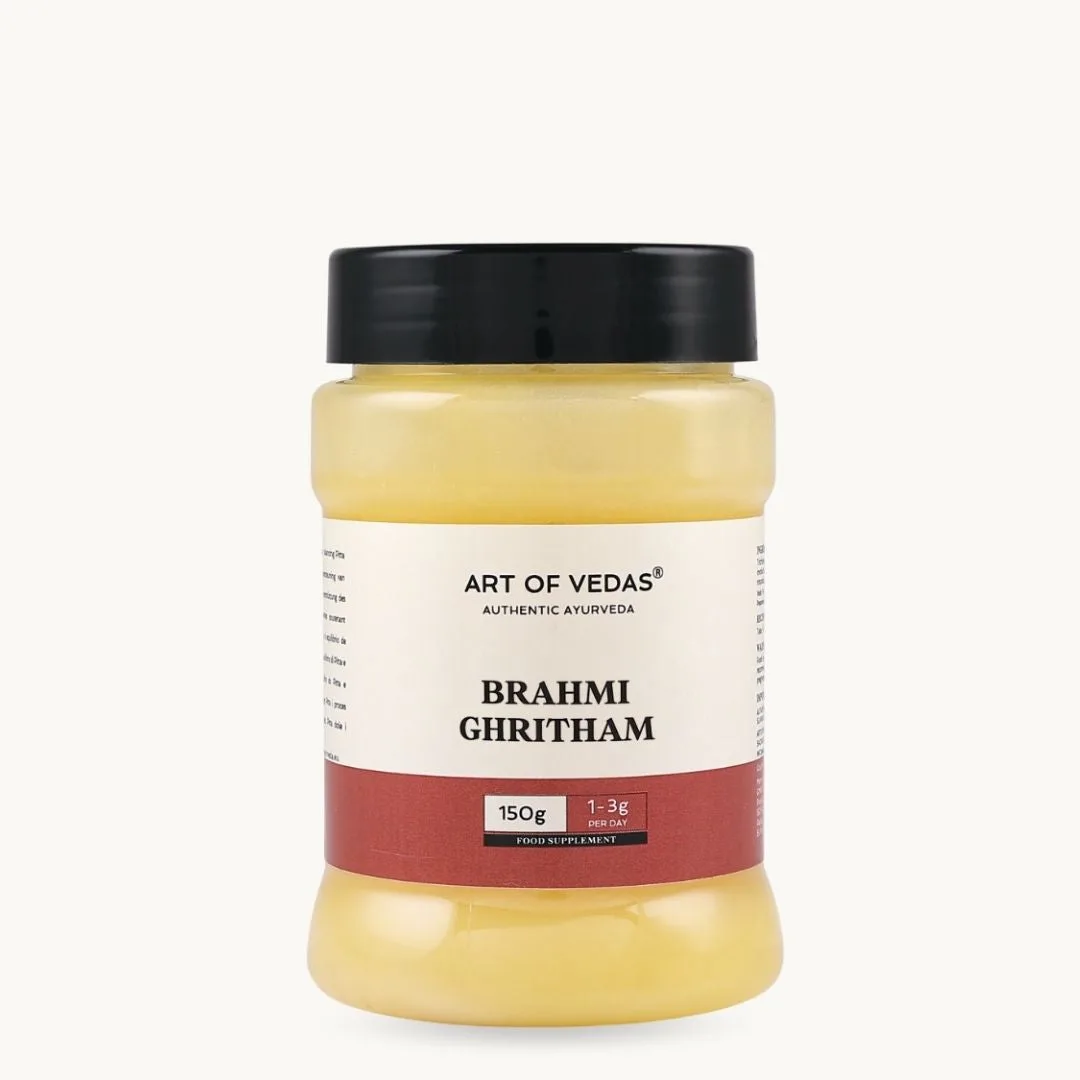
The classical texts describe combining Ghritham preparations in specific Panchakarma protocols, but for daily home Rasayana use, selecting the one preparation most aligned with the primary presentation is the simpler approach. For Vata-dominant depletion without significant Pitta mental heat, Dhanwantharam Ghritham is most appropriate. For Pitta-dominant mental-cognitive presentations, Brahmi Ghritham is most appropriate. Where both dimensions are present, a qualified practitioner can advise on the appropriate combination and sequencing.
This guide presents classical Ayurvedic concepts about Dhanwantharam Ghritham for educational purposes. Dhanwantharam Ghritham is a food supplement for daily Rasayana use and is not intended to diagnose, treat, cure or prevent any disease. Contains dairy (purified ghee). Consult a qualified Ayurvedic practitioner before use during pregnancy or if taking medications.