The causes of Vata imbalance: dietary, lifestyle and psychological
The Charaka Samhita (Sutrasthana, chapter 17) lists the causes of Vata aggravation in detail and groups them into three categories.
Dietary causes
Beyond the dry, cold and raw foods described above, the text names excessive fasting as a cause. It also singles out astringent and bitter tastes, which dominate many so-called health foods and supplements, as the most aggravating tastes for Vata when taken in excess.
Lifestyle causes
Excess movement and travel, particularly air travel, is one of the strongest Vata aggravators named in the texts, and frequent travellers and shift workers are among the first to notice Vata signs. The Ashtanga Hridayam also lists staying awake past midnight, excessive physical exercise, exposure to cold and wind, and the suppression of natural urges such as hunger, thirst, sleep and elimination as direct causes of Vata disturbance.
Psychological causes
Fear, grief, worry and excessive mental work aggravate Vata through the Prana and Vyana sub-doshas, because the mind and the nervous system are Vata's domain. Prolonged stress and overstimulation from screens and noise add to the restless, scattered Vata pattern most often seen in European practice.
Vata imbalance symptoms: the full picture
The Ashtanga Hridayam and the Charaka Samhita describe dozens of signs of excess Vata. Alongside the stage-by-stage signs above, the most common Vata dosha symptoms seen in contemporary practice are:
Physical symptoms of aggravated Vata
- Dry skin, cracked heels, brittle nails and hair that thins or sheds
- Joint stiffness that is most noticeable in cold weather and first thing in the morning
- Low body weight or difficulty maintaining weight despite adequate food
- Muscle twitches and restlessness in the legs at night
- A dry, hoarse voice
- Frequent urination, particularly at night
- Scanty or irregular menstruation with cramping
Mental and emotional symptoms of high Vata
- Fear that appears without a clear external cause
- Jumping from task to task
- Light, unrefreshing sleep with vivid or disturbing dreams
- A sense of overwhelm when facing several tasks at once
- Rapid speech and an inability to slow down, even when tired
Ayurveda sees these experiences as one pattern rather than as separate problems: restlessness and disturbed sleep, dry skin and irregular digestion, stiff joints and a busy mind all express the same excess of Vata.
Apana Vata imbalance
Apana Vata, the downward-moving sub-dosha, is seated in the pelvic region and the lower back. When it is disturbed, the signs gather around its functions: irregular elimination, bloating, frequent urination and irregular or scanty menstruation. This is why classical Abhyanga pays particular attention to the lower back, the seat of Apana Vata, and why Shatavari is traditionally associated with supporting Apana Vata in women.
When to see a practitioner
The self-care routine on this page suits mild to moderate Vata disturbance. If signs are severe or long-standing, or come with significant pain, numbness or neurological changes, consult a qualified Ayurvedic practitioner. The same applies during pregnancy, for children and when taking prescribed products.
The Vata-pacifying approach in daily life
The logic is simple: counter the qualities of Vata with their opposites. Since Vata is dry, light, cold, rough and mobile, the answer is moist, heavy, warm, smooth and stable.
Dietary adjustments
Within the warm, cooked Vata diet, soups, stews, kitchari (rice and lentils cooked together) and cooked root vegetables are ideal, and sesame, almonds and avocado are particularly nourishing for Vata types. Besides cold raw food and dry snacks, carbonated drinks, large quantities of very bitter greens and excessive coffee are worth reducing when Vata is high.
Sleep and daily rhythm
Adequate, regular sleep is the most accessible Vata practice, and the classical texts consistently list sleep deprivation as a direct cause of Vata aggravation. The Ashtanga Hridayam recommends going to bed by 10 p.m. and rising before 6 a.m. An evening self-massage with warm oil is one of the most cherished Vata practices at home: even ten minutes of warm oil on the feet and scalp before bed is traditionally associated with a settled, calm feeling.
Pranayama and lifestyle practices
Nadi Shodhana (alternate nostril breathing) is the principal breathing practice for Vata balance in the Yoga tradition, which shares its foundations with Ayurveda. Practised for ten minutes before sleep or in the morning before meals, it is traditionally said to calm Prana Vata and settle the mental side of Vata disturbance. Reducing screen exposure after sunset, keeping consistent meal and sleep times and spending time in warm, sheltered natural surroundings rather than windy or cold ones all follow the classical advice. The Charaka Samhita regards the regularity of the daily schedule (Dinacharya) itself as a primary supportive practice.
Seasonal routine for Vata
The Charaka Samhita (Sutrasthana, chapter 6) sets out the seasonal routine (Ritucharya) for the Vata months of autumn and early winter. Besides more oil, warm food and more intensive Abhyanga, it adds heavier clothing and less exposure to wind and cold. People with a Vata constitution are particularly advised to follow it.
Choosing an Ayurvedic oil for Vata imbalance
Oil is Vata's primary companion, and the Ashtanga Hridayam devotes entire chapters to the traditional use of oils (Sneha) in Vata care.
Dhanwantharam Thailam
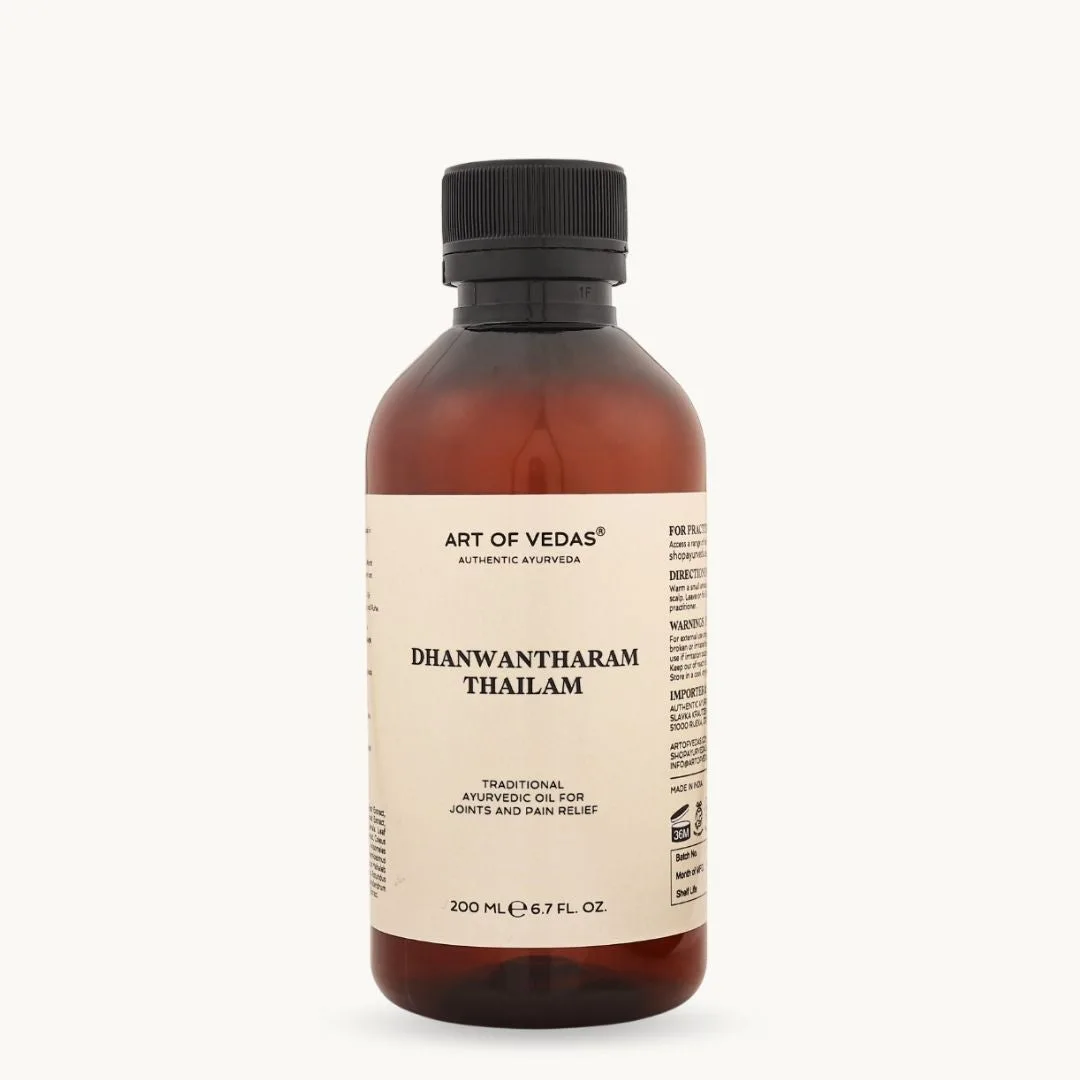
Named after Dhanwanthari, the divine physician of Ayurveda, Dhanwantharam Thailam is described in the Sahasrayogam as a principal Vata-pacifying oil for full-body Abhyanga. Its sesame base is combined with a classical decoction of more than 25 herbs, including Bala, Dashamula (the ten roots) and Ashwagandha, and it is a primary classical choice for Vata care relating to muscles, joints and the nervous system.
Bala Thailam
Bala Thailam is based on Bala root (Sida cordifolia), a herb whose name means strength. It is traditionally associated with Vata depletion: thinness, low energy, periods of recovery and the deep fatigue that follows prolonged stress. It is gentler and more nourishing than Dhanwantharam Thailam.
Excess or depletion: which oil fits
If restlessness, dryness, worry and light sleep dominate (excess Vata), Dhanwantharam Thailam is the standard choice for Abhyanga. If weakness, fatigue, depletion and low weight dominate (deficiency with Vata), Bala Thailam is more appropriate. Plain, untoasted sesame oil is warm, nourishing and genuinely Vata-pacifying and is a valid starting point for daily Abhyanga; the classical Thailams differ in that they carry a decoction of specific herbs for more targeted traditional use.
The home Abhyanga ritual for Vata
The Charaka Samhita (Sutrasthana, chapter 5) describes daily warm oil massage in the direction of the body hair, with particular attention to the scalp, ears and feet. These three areas carry the most Vata Marma points (vital junctions) and respond most readily to oil. The same chapter lists Abhyanga as a daily practice traditionally said to counteract Vata, improve skin quality, strengthen the body, promote sound sleep and support longevity.
- Warm the oil to just above body temperature. Never apply cold oil to a Vata body, as this increases rather than reduces Vata.
- Apply oil to the scalp and massage gently in circular motions.
- Use long strokes along each limb towards the heart and circular strokes at the joints.
- Pay particular attention to the lower back, the seat of Apana Vata.
- Leave the oil on for at least 20 minutes before a warm shower or bath.
When time is short, even five minutes of warm sesame oil or Dhanwantharam Thailam on the feet before sleep is traditionally associated with a settled, calm feeling.
Herbal formulations for Vata support
Alongside oil, classical Ayurveda uses internal preparations for deep Vata nourishment, above all the Rasayana herbs that the Charaka Samhita classes as rejuvenating.
- Ashwagandha: the most widely used Vata Rasayana, described in the Charaka Samhita Chikitsasthana in the context of Vata depletion and the nervous system. Its Sanskrit name means "the strength of a horse", reflecting its traditional use for physical and mental resilience. As a food supplement it is traditionally taken with warm water as the carrier (Anupana).
- Bala root powder: another primary Vata tonic, traditionally valued for muscle strength and nourishment of the nervous system.
- Shatavari: the primary Vata tonic for women, traditionally supporting the female reproductive system and the function of Apana Vata.
All internal use should be guided by a qualified practitioner, particularly where existing health concerns or prescribed products are involved, because some Rasayana herbs are not appropriate for everyone.
The Classical Logic of Vata: Why It Becomes Imbalanced
Before identifying the signs of Vata imbalance, understanding the classical framework for why it occurs provides the context that makes the signs intelligible rather than arbitrary.
Vata is the Dosha of movement. Anatomically and physiologically, it governs every movement in the body and mind - the movement of breath, blood, nerve impulses, the digestive peristalsis, the movement of food through the gut, the movement of thoughts through the mind. Its classical qualities are light (Laghu), dry (Ruksha), cold (Sheeta), subtle (Sukshma), mobile (Chala), rough (Khara) and clear (Vishada).
The classical principle of Samanya Vishesha - the law of increase and decrease - states that like increases like and opposites decrease. Vata increases through exposure to things with similar qualities: dry food, cold environments, excessive movement, irregularity, and the specific behaviours and foods that carry Vata-like properties. It decreases through exposure to opposing qualities: warmth, heaviness, moisture, regularity and the grounding practices that classical Ayurveda groups under Snehana (oleation), warmth, routine and rest.
Most people in modern Europe encounter multiple Vata-increasing factors simultaneously, daily. This is why Vata imbalance is the most common presentation in Ayurvedic practice in contemporary Western clinical contexts - not because Vata constitutions are more common than Pitta or Kapha, but because the modern environment itself is Vata-aggravating for everyone.
The Earliest Signs: Vata in Accumulation Phase
Classical Ayurvedic pathology describes six stages of disease development (Kriya Kala or Shat Kriya Kala). The first stage is accumulation (Sanchaya) - when a Dosha begins to build up in its home seat before it begins spreading. At this stage, the signs are subtle and easily overlooked, but classically important because this is when the imbalance is easiest to correct.
For Vata, the accumulation signs described in the Ashtanga Hridayam, Nidanasthana 1, include:
A subtle sense of fullness, distension or discomfort in the lower abdomen - the classical home seat of Vata is the colon, and early accumulation manifests there. This is often experienced as mild bloating after meals, a tendency towards gas and abdominal gurgling, or a sense that the digestive process is irregular even when no specific problem can be identified.
Preference for warmth - a noticeable increase in the desire for warm food, warm drinks, warm environments and warm physical contact. This is the body's natural compensatory response to the cold quality of accumulating Vata.
Slight increase in mental restlessness or racing thoughts, particularly at night. Vata governs the mind's movement, and accumulating Vata often first manifests in the mental dimension as difficulty settling the mind before sleep, an increase in planning and worrying, and a tendency for the mind to keep generating thoughts when rest is needed.
At the Sanchaya stage, these signs are addressed most effectively through simple lifestyle adjustments - establishing a regular routine, eating warm and grounding foods, reducing cold and dry foods, and introducing a basic Abhyanga practice. Art of Vedas provides a range of Vata-balancing massage oils suitable for this preventive context, including the foundational Dhanwantharam Thailam and the broad-spectrum Vata Dosha Massage Oil.
Stage Two: Vata in Aggravation Phase
If accumulation is not addressed, Vata enters the aggravation phase (Prakopa) - it builds to excess in its home seat before beginning to spread. The signs at this stage become more noticeable and more specifically Vata in character:
Increased digestive irregularity - alternating between constipation and loose stools, unpredictable appetite, increased gas and bloating. The colon, as Vata's home seat, is directly affected by Vata excess, and its classical functions - absorption of nutrients, formation and movement of faeces - become irregular.
Increased dryness - in the skin, in the mouth (particularly on waking), in the stools, and a general sensation of the body being less moist and resilient than usual. Dryness is one of the defining Gunas of Vata, and excess Vata expresses itself through dryness across all tissues it contacts.
Sleep disturbance - difficulty falling asleep, waking between 2 and 4 am (the classical Vata time of night), or light and unrefreshing sleep regardless of duration. The Ashtanga Hridayam specifically associates sleep disturbance with elevated Vata and lists it among the early signs of Vata Prakopa.
Anxiety and hypersensitivity - Vata governs the nervous system, and its excess manifests mentally as anxiety, worry, oversensitivity to sound, light and touch, and a tendency to feel overwhelmed by stimulation. This is one of the most diagnostically reliable signs of elevated Vata in clinical Ayurvedic assessment.
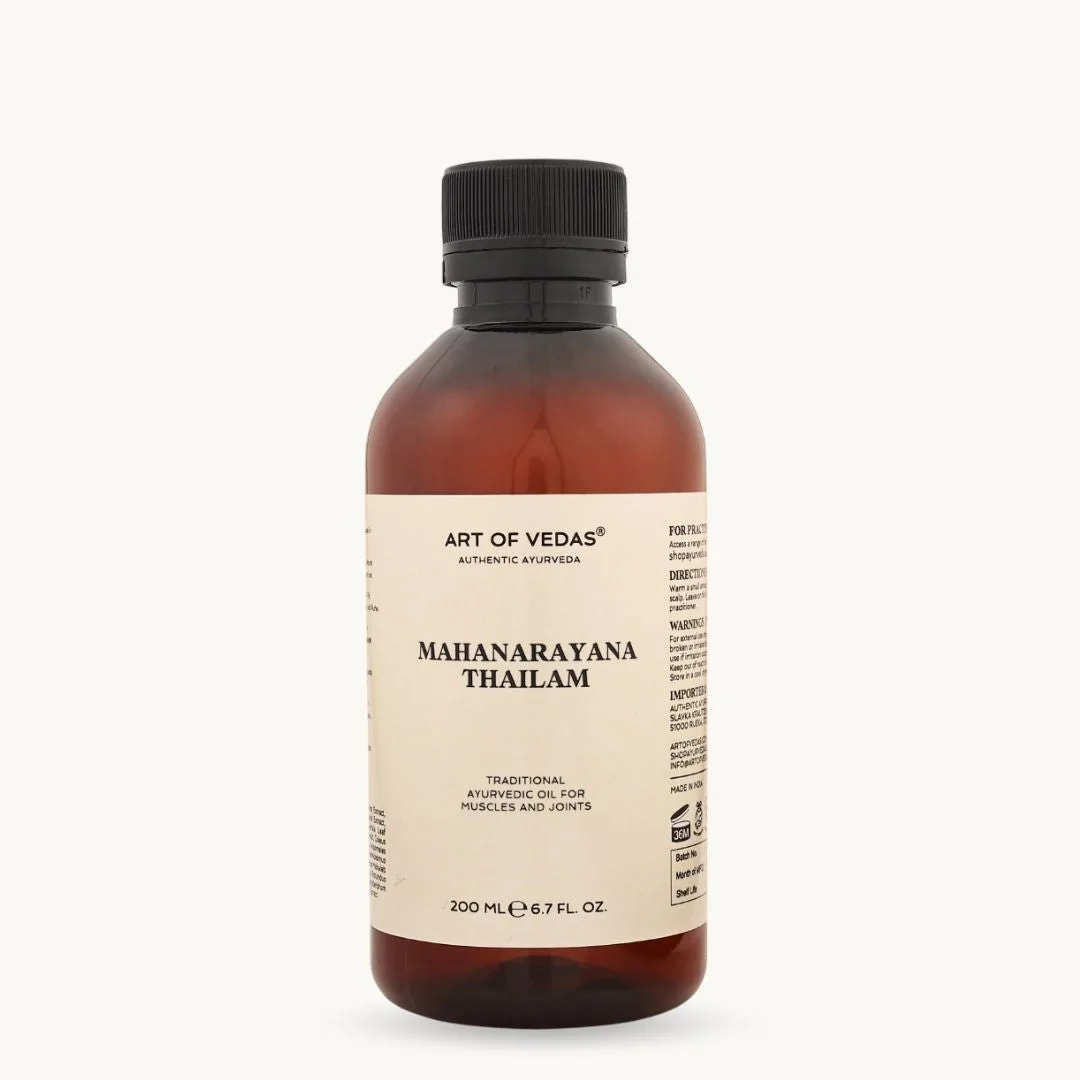
Joint sounds and mild stiffness - the classical sign of Vata excess in the joints is audible cracking or popping sounds (Sandhi Shosha), particularly on waking. This reflects the beginning of Sleshaka Kapha depletion in the joint spaces - the joint lubricant that Vata excess is drying out. Regular Abhyanga with classical Vata oils such as Dhanwantharam Thailam or Mahanarayana Thailam is the primary classical recommendation at this stage for musculoskeletal Vata signs.
Stage Three: Vata Spreading into the Channels
The third stage of classical pathology is Prasara - when the accumulated and aggravated Dosha overflows its home seat and begins moving through the channels (Srotas) into other areas of the body. For Vata, this is when the signs begin to appear in areas beyond the colon and the mind, and the range of possible presentations expands significantly.
Spread to the musculoskeletal system: pain that moves - the classical description of migratory or shifting pain (Charavata) as a sign of Vata spreading through the Srotas. Unlike the fixed pain of conditions involving other Doshas, Vata pain is characteristically mobile, changing location and intensity unpredictably.
Spread to the head and sensory organs: headaches with a Vata character - typically at the back of the head, temples or along the sides, often worsening in cold or windy conditions. Ringing in the ears (Karnashoola), dryness in the eyes and a tendency towards dizziness are classical signs of Vata reaching the head and sensory Srotas.
Spread to the skin: Vata-type skin signs - dry, rough, flaking skin that responds poorly to standard moisturising, crackling at the heels and knuckles, and a tendency for the skin to feel thin and poorly nourished despite topical care. This is when classical Ayurvedic skin care specifically oriented to Vata - including oils suited to dry skin types - becomes relevant. Art of Vedas offers skin care formulations developed for dry and Vata-type skin in its face care collection.
Spread to the respiratory tract: dry cough without significant mucus production, a tendency towards voice hoarseness, and dryness in the nasal passages. Classical Ayurveda addresses this dimension of Vata through Nasya - nasal oleation - which is described in the Ashtanga Hridayam as directly nourishing the Prana Vata channel through the nasal passages. The Anu Thailam (Nasya Oil) from Art of Vedas is the foundational classical Nasya formulation for this purpose, and the complete Nasya guide provides the classical protocol for this practice.
Deeper Vata Imbalance: Tissue-Level Signs
When Vata spreading through the Srotas reaches specific tissues, the classical signs reflect the properties of both Vata and the affected Dhatu. These are the presentations described in detail in the Ashtanga Hridayam's Vata Vyadhi chapter - conditions that have moved beyond the early and middle stages into specific tissue-level pathology.
Vata in Rasa Dhatu (plasma tissue): The classical signs include poor circulation, a pallid or dull complexion, cold extremities, a feeling of hollowness or emptiness in the body, and poor nutrition of the deeper tissues. Rasa Dhatu is the first tissue layer processed from food, and Vata excess here affects all subsequent tissue layers in sequence.
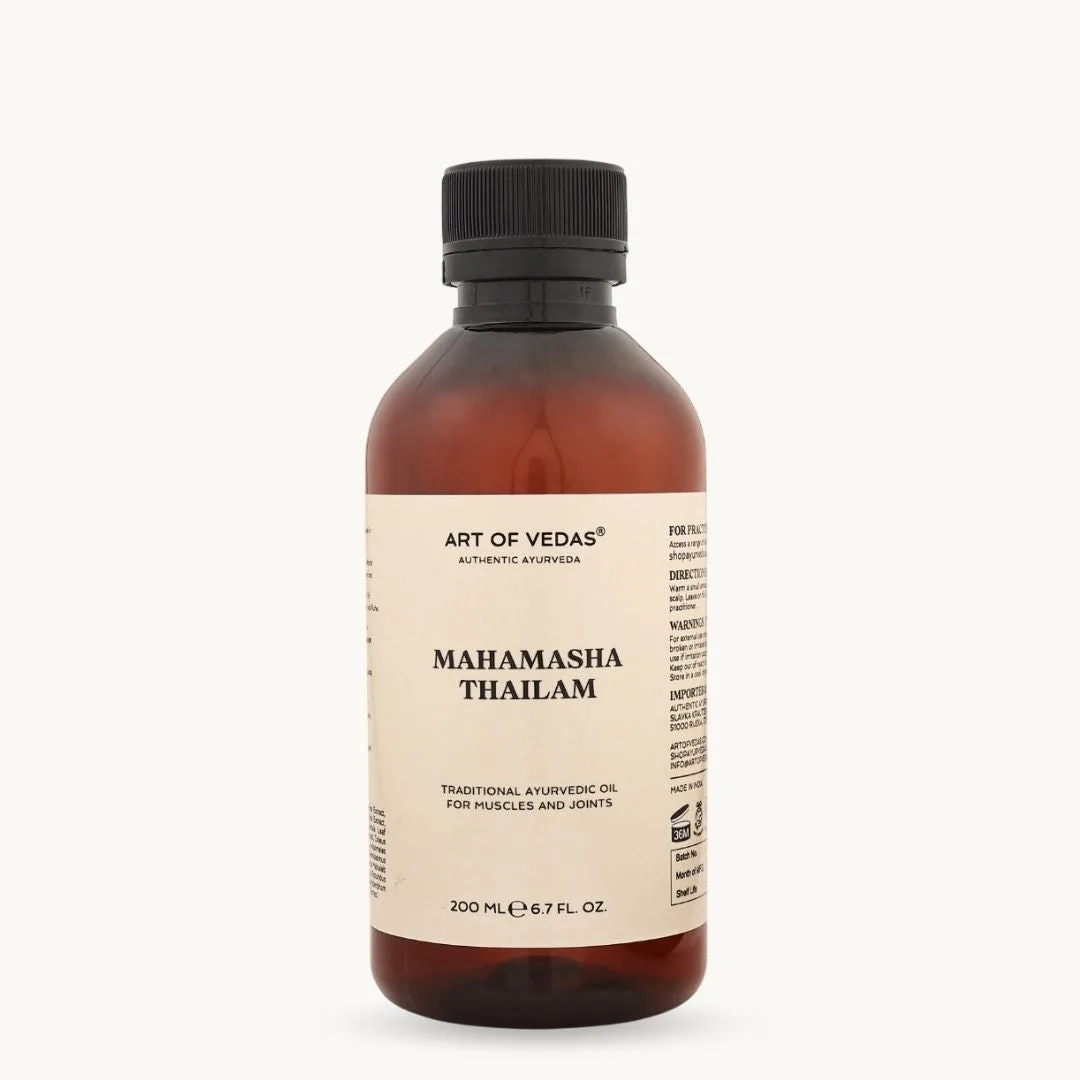
Vata in Mamsa Dhatu (muscular tissue): Tremor, twitching, muscle cramps, progressive muscular weakness and a tendency for muscles to feel thin and inadequately developed despite normal physical activity. The classical formulation specifically indicated for this stage is Mahamasha Thailam - its Brimhana action on Mamsa Dhatu is the most directly targeted classical response to this presentation.
Vata in Asthi Dhatu (bone tissue): Joint deterioration, fragility, a tendency for bones to feel achy particularly at night or in cold conditions, and the progressive deterioration of joint surfaces that the classical texts describe as Sandhivata. Regular Abhyanga with classical Vata oils, particularly Dhanwantharam Thailam, is the classical preventive and supportive measure for bone-level Vata.
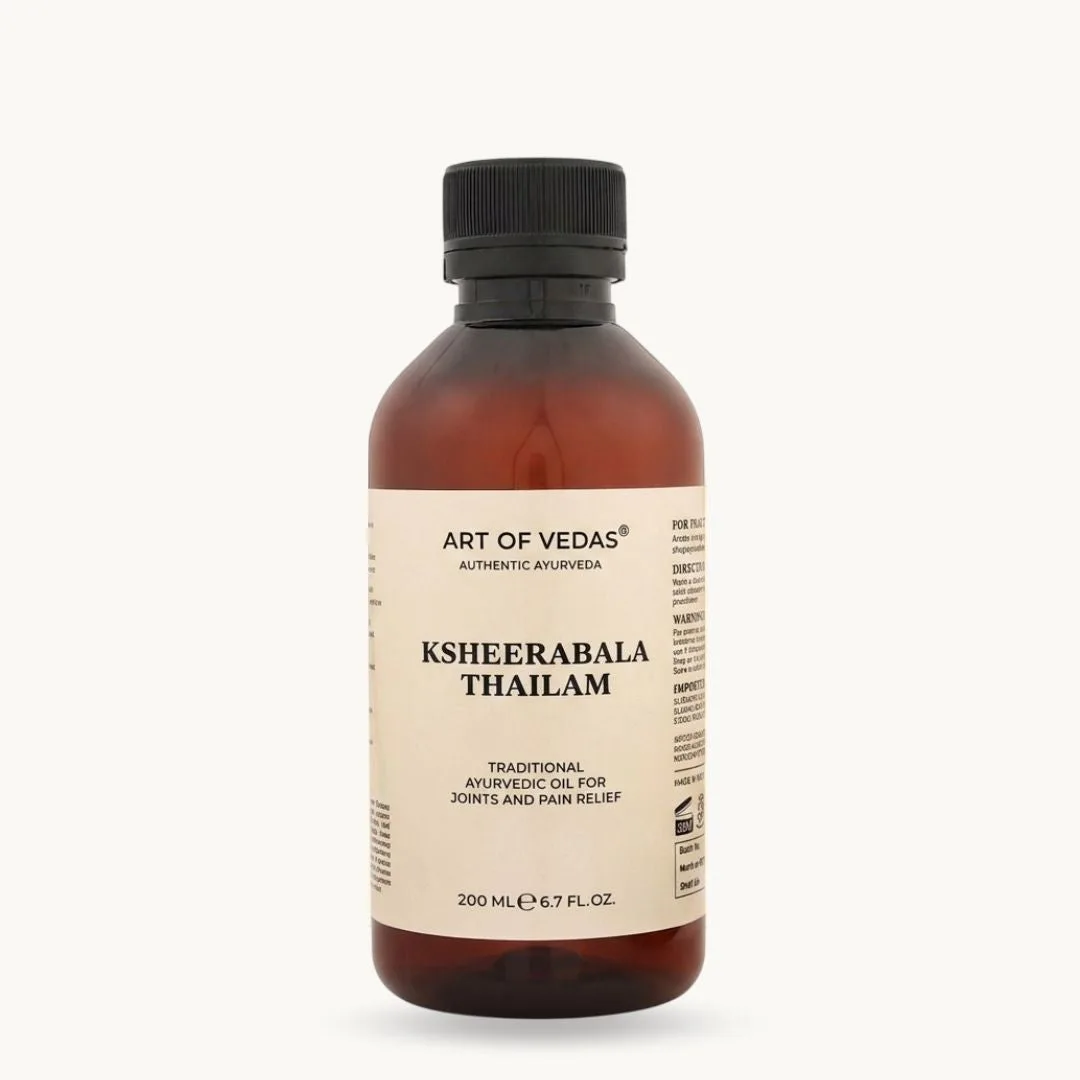
Vata in Majja Dhatu (nervous tissue): This is the deepest tissue-level Vata presentation. Classical signs include severe insomnia, tremors, difficulty with coordination, progressive weakness in specific neural pathways, and the kind of persistent fatigue that classical Ayurveda distinguishes from muscular fatigue - a deep neural exhaustion. This is the specific indication for Ksheerabala Thailam, the Ksheerapaka-processed oil with the deepest classical affinity for Majja Dhatu nourishment.
Mental and Emotional Signs of Vata Imbalance
Classical Ayurveda does not separate the mental and physical dimensions of Dosha imbalance. Vata governs the mind's movement, and Vata excess produces specific mental and emotional patterns that are as diagnostically relevant as physical signs.
The classical signs of Vata imbalance in the mental dimension include: racing thoughts and an inability to slow the mental stream even when rest is desired; anxiety and worry disproportionate to circumstances; difficulty with decision-making - the classical term Vata Pratiloma describes the quality of confused, contradictory or scattered thought that elevated Vata produces; hypersensitivity to sensory stimulation including sound, light and touch; and the emotional correlate of Vata excess described in the Charaka Samhita as fear, insecurity and a sense of groundlessness.
The Manovaha Srotas - the mental channel - is directly governed by Prana Vata, the subdivision of Vata that operates in the head and governing the mind and nervous system. When Prana Vata is elevated, these mental signs are among the earliest manifestations. The classical recommendation for Prana Vata specifically involves Shiro Abhyanga (head and scalp massage) with warming oils, Nasya with the Nasya Oil (Anu Thailam) from Art of Vedas, and the full Dinacharya practices that create the regularity and routine that Vata requires to settle.
Practical Assessment: Is Your Vata Elevated?
Classical Ayurvedic pulse diagnosis (Nadi Pariksha) and the full eight-fold examination (Ashtavidha Pariksha) performed by a qualified practitioner are the definitive tools for assessing Dosha status. For a self-assessment framework, the following classical observation points provide a useful starting checklist:
Digestion: Is your digestion regular and predictable, or does it vary day to day? Bloating, gas and irregular stool consistency are classical Vata digestive signs. Skin and body: Is your skin well-hydrated or dry and flaking? Are your joints making sounds? Do you feel physically light or depleted in a way that food and rest do not fully address? Sleep: Do you fall asleep easily and sleep through the night, or do you wake easily and sleep lightly? Mind: Is your mental state generally calm and focused, or do you experience racing thoughts, anxiety and difficulty settling? Seasonal patterns: Do your signs worsen in autumn and early winter - the classical Vata season described in the Ashtanga Hridayam - or during cold and dry weather?
Art of Vedas offers a structured classical Dosha assessment that provides a more comprehensive framework for evaluating your constitution and current Dosha balance. For those who identify significant Vata excess through self-assessment, the Ayurvedic Thailams collection provides the classical oil toolkit matched to different presentations of Vata imbalance.
The Classical Response to Vata Imbalance: An Overview
The Ashtanga Hridayam describes the fundamental approach to Vata imbalance through the principle of Vata Hara - Vata-pacifying - interventions that apply opposite qualities to those of excess Vata. Warmth opposes Vata's cold quality. Heaviness and nourishment oppose its lightness and depletion. Moisture and oil oppose its dryness. Regularity and routine oppose its mobility and irregularity.
The classical interventions for Vata can be organised by depth: dietary and lifestyle adjustments address the earliest stages; external oil therapy (Abhyanga with classical medicated oils) addresses the musculoskeletal and superficial tissue level; Nasya addresses the head and Prana Vata channel; internal oleation and Panchakarma procedures address the deepest tissue-level presentations under practitioner guidance.
For the vast majority of people dealing with common Vata imbalance in its early and middle stages, the practical toolkit includes: establishing a regular daily routine (Dinacharya) with consistent mealtimes, sleep and wake times; warm, nourishing foods with adequate oil and fat; reducing cold, raw and dry foods; and a regular Abhyanga practice using classical Vata oils from Art of Vedas.
The foundational starting point for Vata-type bodies is daily self-massage with the Vata Dosha Massage Oil or with a classical Thailam matched to the specific presentation - Dhanwantharam Thailam for general Vata and joint support, Ksheerabala Thailam for neural presentations, Mahamasha Thailam for muscular depletion and Mahanarayana Thailam for broader Sarva Vata presentations. The full range is described in the guide to comparing classical Ayurvedic massage oils.
Frequently Asked Questions
What are the most common Vata imbalance symptoms?
The most common Vata imbalance symptoms are dryness of skin, hair and nails, cold hands and feet, bloating and irregular digestion, cracking or stiff joints, light sleep with vivid dreams, worry and racing thoughts, and difficulty concentrating. Ayurveda reads these signs of excess Vata as one connected pattern of dryness, coldness and irregularity rather than as separate problems.
Who is most prone to Vata imbalance?
People with a Vata Prakriti, naturally slim with a light frame, quick mind and variable digestion, are the most prone to Vata imbalance. But anyone can build up excess Vata through travel, shift work, late nights, cold weather or age. Ayurveda places the Vata phase of life after about 60, and autumn and early winter are the Vata seasons.
How long does it take for Vata imbalance to settle?
Classical texts give no fixed timeline for Vata imbalance, because it depends on how long it has been building and how consistently the routine is followed. A mild, recent disturbance after travel or stress often eases within one to two weeks of regular oil massage, warm food and enough sleep. Long-standing imbalance needs months of practice and guidance from a qualified practitioner.
Can I use plain sesame oil instead of a classical Thailam for Vata?
Yes. Plain, untoasted sesame oil is warm and nourishing and genuinely pacifies Vata, so it is a valid starting point for daily Abhyanga. Classical Thailams such as Dhanwantharam or Bala Thailam differ because they carry a decoction of specific herbs, which makes them more targeted in traditional use. Both are applied warm.
Is Vata imbalance the same as feeling worried or restless?
Not quite. Worry and restlessness are common signs of Vata imbalance, but Ayurveda sees them within a wider pattern that also includes dryness, coldness and irregular digestion and sleep. Worry can also come from Pitta, as irritable, competitive pressure, or from Kapha, as heavy, low-spirited brooding. Ayurveda looks at the whole pattern, not the single sign.
Which oil suits Vata imbalance best: Dhanwantharam or Bala Thailam?
For Vata imbalance with restlessness, dryness, worry and light sleep, Dhanwantharam Thailam is the standard classical choice for full-body Abhyanga. When weakness, fatigue, depletion and low weight dominate, Bala Thailam, based on Bala root and gentler and more nourishing, is the more appropriate oil. Both have a sesame base and are applied warm.
What is Apana Vata imbalance?
Apana Vata is the downward-moving sub-dosha of Vata, seated in the pelvic region and lower back, and it governs elimination, urination and menstruation. Apana Vata imbalance therefore shows as irregular elimination, bloating, frequent urination or irregular menstruation. Classical care includes warm food at regular times and Abhyanga with special attention to the lower back.
When should you see a practitioner about Vata imbalance?
Self-care with routine, warm food and Abhyanga suits mild to moderate Vata imbalance. If signs are severe or long-standing, or come with significant pain, numbness or neurological changes, see a qualified Ayurvedic practitioner, and see a doctor for any persistent complaint. Always ask a qualified practitioner during pregnancy, for children or when taking prescribed products.
How do I know if my imbalance is Vata or something else?
The classical signs of Vata imbalance are characterised by movement, irregularity, dryness and coldness - both physically and mentally. Pitta imbalance, by contrast, presents with heat, sharpness, intensity and inflammation. Kapha imbalance presents with heaviness, slowness, congestion and stagnation. In practice, mixed presentations are common, which is why a qualified Ayurvedic practitioner's assessment is valuable for complex or persistent conditions. The Art of Vedas Dosha assessment provides a structured framework for self-evaluation of constitutional and current Dosha balance as a starting point.
Can Vata imbalance cause weight loss?
Yes. The Charaka Samhita lists Karshya (thinness and weight loss) among the direct consequences of excess Vata, because Vata's depleting, drying and light qualities progressively reduce the density of the Dhatus. This is distinct from Pitta-driven weight changes, which have a different character. In the classical framework, addressing weight loss associated with Vata involves Brimhana interventions - including internal Rasayana preparations, nourishing foods and external oil therapy with heavy oils like Mahamasha Thailam and Dhanwantharam Thailam.
Is Vata imbalance more common in older people?
The classical texts describe the three stages of life in terms of Dosha dominance: childhood is Kapha-dominant, adulthood is Pitta-dominant, and old age is Vata-dominant. This means Vata increases naturally with ageing - the progressive dryness, tissue depletion and reduced mobility associated with ageing are all classical Vata phenomena. This is why classical Ayurvedic care for the elderly emphasises oleation, warmth and nourishing practices. However, Vata imbalance can occur at any age, particularly in those with Vata constitutions or those exposed to the Vata-aggravating lifestyle factors described in this article.
What foods aggravate Vata most significantly?
The Ashtanga Hridayam and Charaka Samhita describe the foods that most significantly increase Vata: dry, light and rough foods - raw vegetables, crackers, popcorn, rice cakes; cold foods and drinks; foods that are bitter, astringent or pungent in excess; and irregular eating - skipping meals or eating at inconsistent times. The classical Vata-pacifying diet emphasises warm, well-cooked, well-oiled foods with sweet, salty and sour tastes - the three tastes that the classical texts describe as directly pacifying Vata.
Why does Vata imbalance often worsen in autumn and winter?
The Ashtanga Hridayam describes seasonal Dosha cycles in detail. Autumn (Sharad and Hemanta in the classical calendar) is described as the season of Vata aggravation - the cold, dry, windy qualities of autumn and early winter directly mirror Vata's own qualities and therefore amplify it by the principle of Samanya (like increases like). This is why classical Ayurveda recommends Vata-pacifying practices most intensively in autumn and early winter - increased oil use, warmer foods, earlier sleep and regular Abhyanga with classical Vata oils such as Dhanwantharam Thailam.
Can Vata imbalance affect digestion?
The colon is the home seat of Vata in classical anatomy, which means digestive health and Vata status are directly linked. Vata excess in the colon produces the characteristic digestive signs described in this article - bloating, gas, irregular bowel movements and variable appetite. In classical Ayurveda, addressing Vata through the digestive channel is often the most direct and efficient intervention: classical herbs like Triphala, warm spices, and practices like warm water with ginger support the Vata-pacifying action in the colon before it spreads to other tissues.
This article is for educational purposes. Ayurvedic self-assessment is not a substitute for evaluation by a qualified Ayurvedic practitioner or healthcare provider. If you are experiencing significant health concerns, please consult a qualified professional.