The Three-Layer Architecture: How the Formula Is Organized
Before examining individual herbs, understanding the organizational structure helps make sense of why certain ingredients appear in certain forms.
Mahanarayana Thailam is built in three distinct layers, each processed differently and contributing different types of constituents to the final oil:
Layer One: Kwatha Dravya (Decoction Herbs) - 13 herbs prepared as a concentrated water decoction, then added to the oil. This layer contributes water-soluble constituents like polyphenols, alkaloids, and glycosides.
Layer Two: Kalka Dravya (Paste Herbs) - 38 herbs ground into fine paste and added during oil cooking. This layer provides both constituents for extraction and serves as a physical filter and moisture indicator during the cooking process.
Layer Three: Prakshepa Dravya (Final Additions) - 3 precious ingredients added after cooking to preserve their volatile aromatic compounds.
This layering isn't arbitrary - it reflects different extraction requirements for different plant constituents. Water-soluble compounds extract best in aqueous decoction. Fat-soluble compounds extract during oil cooking. Volatile aromatics would be destroyed by prolonged heat, so they're added at the end.
The base media - sesame oil, goat's milk, and Shatavari juice - provide the extraction vehicles and contribute their own properties.
Understanding this structure, let's now examine each functional group within these layers.
The Foundation: Three Base Media
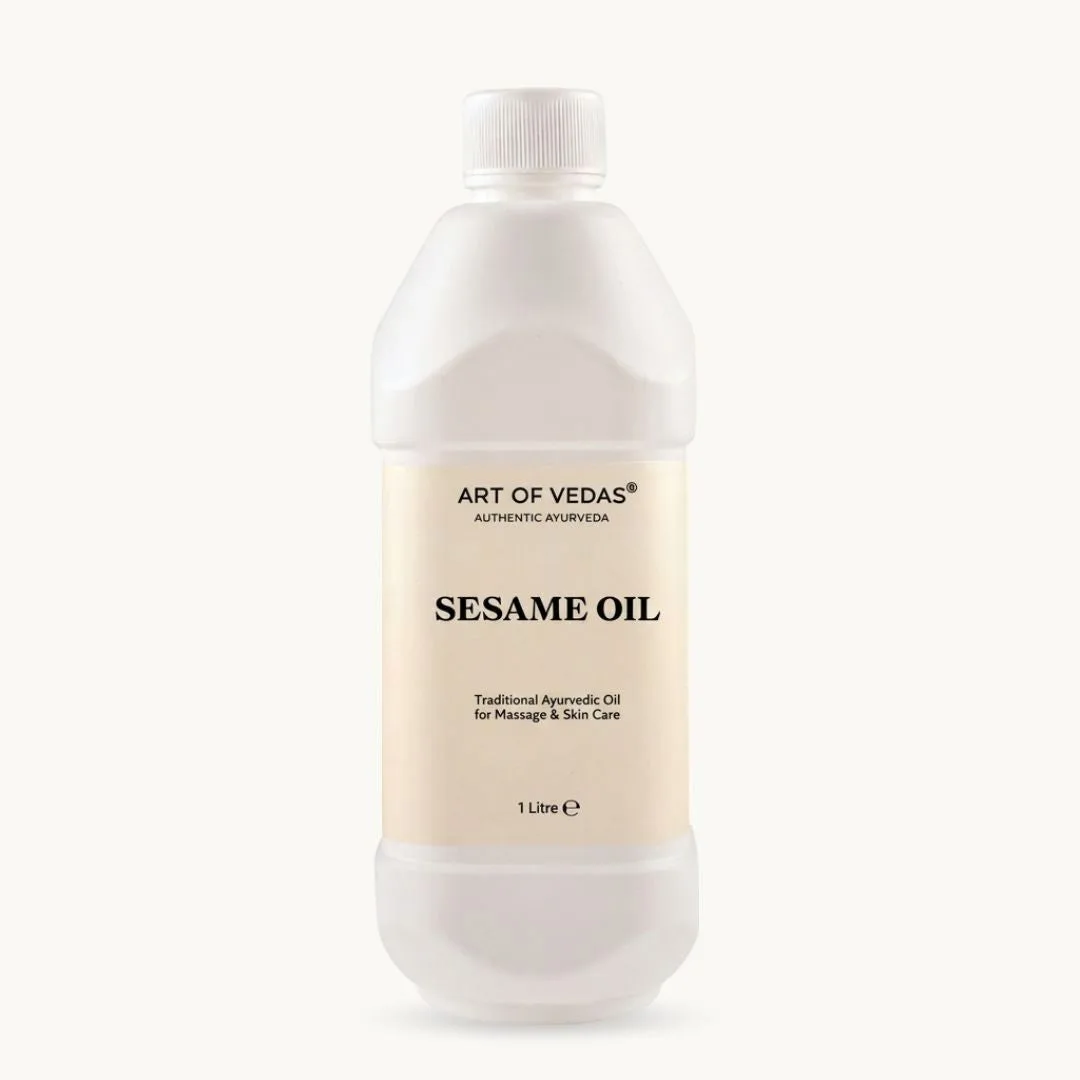
Sesame Oil (Tila Taila) - The Primary Carrier
Quantity: Approximately 6 kg (forms roughly 80% of final volume)
Why sesame oil? Ayurvedic texts specifically recommend sesame oil as the preferred base for most medicated oils. This isn't random preference - sesame oil has unique properties:
Transdermal absorption: Research confirms that sesame oil penetrates skin more effectively than many other carrier oils. Its molecular structure allows it to carry other constituents into the skin.
Vata-balancing properties: In Ayurvedic energetics, sesame oil is heating (Ushna Virya), nourishing, and has a special affinity for Vata dosha. Its qualities directly counter Vata's dry, cold, light nature.
Extraction capability: During the cooking process, sesame oil can extract both fat-soluble phytochemicals (like certain alkaloids and essential oils) and, when combined with aqueous media, capture water-soluble constituents that get emulsified into the oil.
Stability: Sesame oil contains natural antioxidants (sesamin, sesamolin, sesamol) that prevent rancidity, giving medicated oils good shelf life without synthetic preservatives.
Phytochemistry: Sesame oil contains approximately 42% oleic acid (omega-9), 45% linoleic acid (omega-6), plus vitamin E, lignans, and phytosterols. These contribute to its skin-nourishing and soothing qualities.
Goat's Milk (Aja Kshira) - The Secondary Medium
Quantity: Approximately 6 liters
Role in preparation: Milk serves multiple functions in Ayurvedic oil preparation:
Extraction of water-soluble constituents: Many herbal compounds are water-soluble but not oil-soluble. The aqueous milk phase extracts these during cooking, and as water evaporates, these constituents become suspended in the oil.
Moderating heating herbs: Some herbs in the formula have very strong heating properties. Milk's cooling nature (in Ayurvedic terms) balances these, preventing the final oil from being excessively heating.
Nourishing quality: Milk itself contributes Rasayana properties and Snigdha (unctuous) quality.
Why goat's milk specifically? Traditional texts specify goat's milk for Vata constitutions because it's lighter and easier to metabolise. It has smaller fat globules and different protein structure.
Composition: Goat's milk contains proteins (casein, whey), fats, lactose, vitamins (A, B-complex, C, D), minerals (calcium, phosphorus, magnesium), and bioactive peptides.
Shatavari Juice (Shatavari Swarasa) - The Herbal Juice
Quantity: Approximately 6 liters
Botanical: Asparagus racemosus
Role: Shatavari juice provides additional water-soluble extraction power while contributing its own significant traditional properties.
Traditional properties:
-
Rasa (taste): Sweet (Madhura), Bitter (Tikta)
-
Virya (potency): Cooling (Sheeta)
-
Vipaka (post-digestive effect): Sweet (Madhura)
-
Primary actions: Rasayana, Balya, Vrishya
Why Shatavari specifically? It's one of Ayurveda's most important Rasayana herbs, particularly valued for nourishing deeper tissues (Dhatus). Its inclusion gives Mahanarayana a rejuvenative character alongside its traditional comforting qualities.
Phytochemistry: Shatavari contains steroidal saponins (shatavarins I-IV), polysaccharides, mucilage, isoflavones, and alkaloids. These are studied for antioxidant and adaptogenic properties.
The combination of these three media creates a unique extraction environment where both fat-soluble and water-soluble plant constituents can be captured and stabilized in the final oil.
Layer One: The Dashamoola Foundation (Decoction Herbs)
The decoction layer contains 13 herbs, prominently featuring the Dashamoola ("ten roots") group - one of Ayurveda's most important herbal combinations.
Understanding Dashamoola: The Traditional Backbone
Dashamoola appears in hundreds of Ayurvedic formulations. The group is divided into two sub-groups:
Brihad Panchamoola (Five Large Roots):
-
Bilva (Aegle marmelos) - Bael tree
-
Agnimantha (Premna integrifolia) - Headache tree
-
Shyonaka (Oroxylum indicum) - Indian trumpet tree
-
Kashmari (Gmelina arborea) - Beechwood
-
Patala (Stereospermum suaveolens) - Trumpet flower
Laghu Panchamoola (Five Small Roots):
-
Brihati (Solanum indicum) - Indian nightshade
-
Kantakari (Solanum xanthocarpum) - Yellow-berried nightshade
-
Shalaparni (Desmodium gangeticum) - Sal-leaved desmodium
-
Prishniparni (Uraria picta) - Painted-leaved uraria
-
Gokshura (Tribulus terrestris) - Puncture vine
Collective properties of Dashamoola:
-
Rasa: Predominantly bitter (Tikta), astringent (Kashaya), some sweet (Madhura)
-
Virya: Heating (Ushna)
-
Primary actions: Vata-pacifying, traditionally soothing, supporting comfort, supports natural tissue renewal
Why these ten specifically? Traditional understanding holds that they work on all three doshas but particularly pacify Vata. They have affinity for the musculoskeletal system, nervous system, and deeper tissue layers.
Phytochemistry across the group: Dashamoola herbs collectively contain alkaloids, flavonoids, phenolic compounds, steroids, saponins, and tannins. Research on individual Dashamoola members has explored antioxidant and other bioactivities.
In the context of Mahanarayana: The Dashamoola provides the foundational Vata-pacifying character that makes this oil traditionally valued for joint and muscle comfort. These roots are prepared as a concentrated decoction, extracting their water-soluble constituents before being combined with the oil.
The Three Additional Decoction Herbs
Beyond Dashamoola, three more herbs complete the decoction layer:
Ashwagandha (Withania somnifera) - Indian Ginseng
Traditional properties:
-
Rasa: Bitter (Tikta), Astringent (Kashaya), Sweet (Madhura)
-
Virya: Heating (Ushna)
-
Vipaka: Sweet (Madhura)
-
Primary actions: Rasayana, Balya, Vajikara (vitality), Medhya
Why it's included: Ashwagandha is Ayurveda's premier adaptogenic and rejuvenative herb. It is traditionally valued to support the body during times of stress and to nourish muscle and nerve tissue (Mamsa and Majja Dhatus).
Phytochemistry: Rich in withanolides (particularly withaferin A), alkaloids (somniferine, anaferine), and steroidal lactones. It is widely studied for adaptogenic and related properties.
Role in Mahanarayana: Contributes traditional nervous system support and overall strengthening character, giving the formula a rejuvenative dimension.
Bala (Sida cordifolia) - Country Mallow
Traditional properties:
-
Rasa: Sweet (Madhura)
-
Virya: Cooling (Sheeta)
-
Vipaka: Sweet (Madhura)
-
Primary actions: Balya, Rasayana, Vrishya, Vata-pacifying
Why it's included: Bala literally means "strength." It's valued for nourishing muscle tissue and supporting structural integrity. Its cooling nature balances some of the heating herbs in the formula.
Phytochemistry: Contains alkaloids (ephedrine, vasicine), flavonoids, sterols, and essential oils.
Role in Mahanarayana: Provides strengthening and nourishing character, particularly for muscle tissue. Works synergistically with Ashwagandha for overall structural support.
Punarnava (Boerhavia diffusa) - Hogweed
Traditional properties:
-
Rasa: Sweet (Madhura), Bitter (Tikta), Astringent (Kashaya)
-
Virya: Heating (Ushna)
-
Vipaka: Sweet (Madhura)
-
Primary actions: Supports natural cleansing, reduces excess Kapha, traditionally light and refreshing
Why it's included: Punarnava is valued for supporting natural fluid balance and helping the body clear accumulated metabolic residue (Ama). It ensures the formula doesn't create heaviness or stagnation.
Phytochemistry: Contains alkaloids (punarnavine), rotenoids, flavonoids, and steroids.
Role in Mahanarayana: Provides a light, cleansing quality that prevents stagnation, ensuring the nourishing herbs work optimally.
Layer Two: The 38 Paste Herbs - Complexity and Synergy
The paste layer contains 38 herbs, including the rare and precious Ashtavarga group. Let's examine them by functional category.
The Ashtavarga: Eight Rare Himalayan Treasures
This group of eight high-altitude Himalayan plants is what elevates Mahanarayana Thailam from a good formulation to an exceptional one.
-
Jivaka (Malaxis acuminata)
-
Rishabhaka (Malaxis muscifera)
-
Meda (Polygonatum verticillatum)
-
Mahameda (Polygonatum cirrhifolium)
-
Kakoli (Fritillaria roylei)
-
Ksheera Kakoli (Lilium polyphyllum)
-
Riddhi (Habenaria intermedia)
-
Vriddhi (Habenaria edgeworthii)
Why they're special: These plants grow at high altitudes (3,000-5,000 meters) in the Himalayas. Classical texts describe them as the most prized Rasayana herbs, traditionally said to nourish all seven tissue layers (Dhatus) and support longevity.
Traditional properties (as a group):
-
Rasa: Sweet (Madhura)
-
Virya: Cooling (Sheeta)
-
Primary actions: Supreme Rasayana, Balya, Vrishya, Ojas-promoting
Rarity and substitution: Due to their high-altitude habitat and increasing rarity, many commercial Ayurvedic formulations substitute Ashtavarga with more available herbs like Vidari, Ashwagandha, or Shatavari. Authentic Mahanarayana Thailam sources genuine Ashtavarga herbs, though this significantly increases cost.
Why they're in Mahanarayana: They give the oil a rejuvenative character alongside its traditional soothing qualities. While the Dashamoola contributes traditional comfort, the Ashtavarga nourishes deep tissues and supports overall vitality.
Limited research: Due to their rarity, modern scientific research on individual Ashtavarga members is limited. Traditional knowledge and classical texts remain the primary information sources.
Nervine Herbs: Supporting the Nervous System
Three herbs are traditionally associated with the nervous system and calming, grounding qualities:
-
Rasa: Bitter (Tikta), Sweet (Madhura), Astringent (Kashaya)
-
Virya: Cooling (Sheeta)
-
Primary actions: Medhya, calming, Vata-pacifying, skin-enhancing
Phytochemistry: Contains sesquiterpenes, coumarins, and alkaloids, studied for calming and neuro-supportive properties.
Role in Mahanarayana: Provides a traditionally calming, grounding character. Particularly valued where Vata is aggravated and rest feels elusive.
Tagara (Valeriana wallichii) - Indian Valerian
Traditional properties:
-
Rasa: Bitter (Tikta), Pungent (Katu), Astringent (Kashaya)
-
Virya: Heating (Ushna)
-
Primary actions: Traditionally settling, nervine, muscle-soothing, Vata-calming
Phytochemistry: Rich in valepotriates, essential oils, and alkaloids, well studied for settling and soothing properties.
-
Rasa: Pungent (Katu), Bitter (Tikta)
-
Virya: Heating (Ushna)
-
Primary actions: Medhya, nervine, clears channels (Srotas), speech-enhancing
Role in Mahanarayana: Traditionally associated with clear channels (Srotas), supporting smooth circulation of nutrients to tissues.
Cleansing and Brightening Herbs
Several herbs contribute traditional cleansing and skin-brightening qualities:
Haridra (Curcuma longa) - Turmeric
Traditional properties:
-
Rasa: Bitter (Tikta), Pungent (Katu)
-
Virya: Heating (Ushna)
-
Primary actions: Traditionally soothing, skin-brightening, blood-purifying, supports skin renewal
Phytochemistry: Rich in curcuminoids (curcumin, demethoxycurcumin, bisdemethoxycurcumin), among the most widely studied plant constituents.
Role in Mahanarayana: Provides a traditionally soothing quality and contributes to the oil's golden color. Synergizes with Dashamoola for joint comfort.
Manjishta (Rubia cordifolia) - Indian Madder
Traditional properties:
-
Rasa: Bitter (Tikta), Astringent (Kashaya), Sweet (Madhura)
-
Virya: Heating (Ushna)
-
Primary actions: Blood-purifying, skin-enhancing, supports natural cleansing
Phytochemistry: Contains anthraquinones, glycosides, and purpurin.
Role in Mahanarayana: Traditionally supports tissue cleansing and a clear, healthy-looking complexion, so the nourishing herbs work in a clean tissue environment.
Daruharidra (Berberis aristata) - Indian Barberry
Traditional properties:
-
Rasa: Bitter (Tikta)
-
Virya: Heating (Ushna)
-
Primary actions: Traditionally cleansing, skin-clarifying, skin-enhancing
Phytochemistry: Rich in berberine, berbamine, and other alkaloids.
Role in Mahanarayana: Contributes a naturally clarifying quality (helping keep the oil fresh) and supports overall cleansing action.
Nutritive and Rejuvenative Herbs
Several herbs specifically nourish tissues and provide Rasayana properties:
Yashtimadhu (Glycyrrhiza glabra) - Licorice
Traditional properties:
-
Rasa: Sweet (Madhura)
-
Virya: Cooling (Sheeta)
-
Primary actions: Rasayana, Balya, Vrishya, voice-enhancing, traditionally soothing
Phytochemistry: Contains glycyrrhizin, flavonoids, and isoflavonoids, studied for adaptogenic and demulcent properties.
Role in Mahanarayana: Provides nourishing sweetness that balances bitter herbs. Synergizes other herbs (called "Yoga Vahi" - a carrier that enhances other herbs' effects). Adds a traditionally soothing quality.
Shatavari (Asparagus racemosus) - Wild Asparagus
Already discussed as juice in base, but also appears as herb in paste.
Role in paste form: Provides additional rejuvenative properties beyond what the juice contributes. The root paste contributes different constituents than the fresh juice.
Mudgaparni and Mashaparni (Phaseolus trilobus & Teramnus labialis)
Traditional properties:
-
Rasa: Sweet (Madhura), Bitter (Tikta)
-
Primary actions: Balya, nutritive, muscle-nourishing
Role in Mahanarayana: These two herbs from the legume family provide specific nourishment to muscle tissue (Mamsa Dhatu). They're valued for supporting muscle strength and renewal.
Aromatic and Warming Herbs
Several aromatic herbs contribute warming properties and pleasant fragrance:
Devadaru (Cedrus deodara) - Himalayan Cedar
Traditional properties:
-
Rasa: Bitter (Tikta), Pungent (Katu)
-
Virya: Heating (Ushna)
-
Primary actions: Traditionally soothing, warming, naturally clarifying
Phytochemistry: Rich in essential oils (α-himachalene, β-himachalene), diterpenes.
Role in Mahanarayana: Provides warming penetration, helps carry other herbs deeper, contributes pleasant cedar aroma.
-
Rasa: Bitter (Tikta), Pungent (Katu), Sweet (Madhura)
-
Virya: Heating (Ushna)
-
Primary actions: Vata-pacifying, warming, skin-enhancing
Phytochemistry: Contains sesquiterpene lactones, essential oils.
Role in Mahanarayana: Provides warming quality and helps with deep tissue penetration.
Ela (Elettaria cardamomum) - Cardamom
Traditional properties:
-
Rasa: Pungent (Katu), Sweet (Madhura)
-
Virya: Cooling (Sheeta)
-
Primary actions: Aromatic, traditionally refreshing
Phytochemistry: Rich in essential oils (cineole, terpinyl acetate, linalool).
Role in Mahanarayana: Contributes pleasant aroma, balances heating herbs with its cooling nature, helps keep the oil fresh.
Twak (Cinnamomum zeylanicum) - Cinnamon
Traditional properties:
-
Rasa: Pungent (Katu), Sweet (Madhura), Bitter (Tikta)
-
Virya: Heating (Ushna)
-
Primary actions: Warming, traditionally invigorating, naturally clarifying
Phytochemistry: Contains cinnamaldehyde, eugenol, and essential oils.
Role in Mahanarayana: Provides warming quality, gives an invigorating character (helping carry other herbs to tissues), pleasant aroma, and helps keep the oil fresh.
Additional Paste Herbs (Brief Overview)
The remaining paste herbs each contribute specific properties:
-
Atibala (Abutilon indicum): Similar to Bala, strengthening
-
Nagabala (Grewia hirsuta): Strengthening, Vata-pacifying
-
Eranda (Ricinus communis): Traditionally soothing, particularly valued for joints
-
Prasarini (Paederia foetida): Vata-pacifying, traditionally comforting
-
Rasna (Pluchea lanceolata): Traditionally valued for joint comfort
-
Saindhava (Rock salt): Enhances penetration, balances other herbs
-
Sarjarasa (Vateria indica resin): Traditionally soothing, supports skin renewal
-
Musta (Cyperus rotundus): Digestive, reduces Kapha accumulation
-
Shati (Hedychium spicatum): Warming, aromatic
And several others, each chosen for specific synergistic contributions.
Layer Three: The Final Aromatic Triad
After all cooking is complete and the oil has cooled slightly, three precious ingredients are added:
Karpura (Camphor)
Quantity: Approximately 48 grams
Traditional properties:
-
Rasa: Pungent (Katu), Bitter (Tikta)
-
Virya: Cooling (Sheeta) - paradoxically feels cool initially but has warming action
-
Primary actions: Penetrating, cooling sensation, aromatic
Phytochemistry: Pure camphor (C₁₀H₁₆O), a bicyclic monoterpene ketone, well known for its cooling, aromatic sensory character in topical use.
Role in Mahanarayana: Provides penetrating quality that helps carry other herbs deeper. Creates pleasant cooling-then-warming sensation. Contributes distinctive aroma.
Why added last: Camphor is highly volatile and would evaporate during cooking. Adding it after cooling preserves its properties.
Kumkuma (Saffron)
Quantity: Approximately 48 grams
Traditional properties:
-
Rasa: Bitter (Tikta), Pungent (Katu)
-
Virya: Heating (Ushna)
-
Primary actions: Rasayana, blood-purifying, skin-enhancing, traditionally uplifting, Ojas-promoting
Phytochemistry: Contains crocin, crocetin, safranal, and picrocrocin, studied for antioxidant and other properties.
Role in Mahanarayana: Provides supreme rejuvenative character and contributes to the oil's golden hue. Adds to the formula's Ojas-promoting quality.
Why added last: Preserves delicate bioactive compounds that would degrade with prolonged heat.
Kasturi (Musk)
Quantity: Approximately 48 grams (traditional formulation)
Note: Most modern commercial preparations omit or substitute musk due to wildlife conservation concerns (natural musk comes from musk deer). When included, plant-based or synthetic musk alternatives are used.
Traditional properties:
-
Rasa: Bitter (Tikta), Pungent (Katu)
-
Virya: Heating (Ushna)
-
Primary actions: Highly penetrating, nervine, traditionally vitalising, aromatic
Role in traditional formula: Provides extreme penetrating quality and aromatic stabilization. Traditionally said to help other herbs reach the deepest tissues (Majja Dhatu).
Modern formulations: Art of Vedas and most ethical manufacturers either omit musk or use plant-based alternatives that provide similar aromatic and penetrating properties without wildlife harm.
The Preparation Process: Taila Paka Vidhi Explained
Having all 57 ingredients doesn't create Mahanarayana Thailam - the preparation method is equally critical. Taila Paka Vidhi (the method of oil cooking) is what transforms raw materials into medicated oil.
Stage One: Decoction Preparation (Kwatha)
Process:
- The 13 decoction herbs (Dashamoola + Ashwagandha + Bala + Punarnava) are coarsely powdered
- Added to approximately 98 liters of water
- Boiled and simmered until reduced to one-quarter volume (approximately 24.5 liters)
- Strained to remove solids, yielding concentrated decoction
Why this step: Water-soluble constituents (alkaloids, glycosides, tannins, polyphenols) extract into the decoction. These would not extract directly into oil.
Time required: 4-6 hours of simmering
Stage Two: Paste Preparation (Kalka)
Process:
- The 38 paste herbs are cleaned, dried
- Finely powdered (traditionally using stone grinders)
- Mixed with small amount of water to form thick paste
Fineness matters: The finer the powder, the better the surface area for extraction. Traditional stone grinding creates finer powder than modern mechanical grinding.
The paste serves three functions:
- Source of constituents for extraction
- Physical filter during cooking
- Moisture indicator (cooking is complete when paste becomes completely dry and crisp)
Stage Three: The Three-Phase Oil Cooking
The actual oil cooking happens in a large vessel (traditionally copper, which has naturally clarifying properties and excellent heat conduction).
Initial setup:
- Sesame oil (6 kg) is added to the vessel
- Goat's milk (6 liters) is added
- Shatavari juice (6 liters) is added
- Herbal paste (from 38 herbs) is added
- Concentrated decoction (from 13 herbs) is added
- Heating begins over controlled fire
Phase One: Mrudu Paka (Soft Stage)
Temperature: Moderate (80-90°C)
Duration: 12-24 hours typically
What happens:
- Mixture is heated gently
- Water begins to evaporate from milk and juice
- Herbal constituents begin extracting into the oil
- Temperature is kept moderate to prevent burning
Why this phase matters: Gentle initial heating allows gradual extraction without destroying heat-sensitive compounds.
Phase Two: Madhyama Paka (Medium Stage)
Temperature: Increasing (95-105°C)
Duration: 12-24 hours
What happens:
- More water evaporates
- Temperature rises as water content decreases
- Herbal paste begins to dry
- Oil starts separating from aqueous phase
Why this phase matters: The critical extraction happens here. As water evaporates, it carries extracted constituents that then concentrate in the oil. Temperature increase helps extract more stubborn compounds.
Attention required: This is the most delicate phase. Too much heat causes burning; too little prevents complete extraction. Constant monitoring and stirring are essential.
Phase Three: Khara Paka (Hard Stage)
Temperature: Higher (110-120°C)
Duration: 6-12 hours
What happens:
- Final water evaporation
- Herbal paste becomes completely dry and crisp
- Oil becomes clear and stable
Completion tests (traditional quality checks):
Varti Pariksha (Wick Test): Dip a cotton wick in the oil and light it. If properly prepared: burns with clear, steady flame. If moisture remains: sputters and crackles.
Shabda Pariksha (Sound Test): Drop a small amount of oil into fire. If properly prepared: burns silently. If moisture remains: crackling sound.
Phenodgama (Froth Test): Stir the oil vigorously. If properly prepared: minimal froth. If moisture remains: excessive foaming.
Kalka Pariksha (Paste Test): Take a piece of the herbal paste. If properly prepared: completely dry, crisp, crumbles easily. If undercooked: retains moisture, flexible.
Stage Four: Cooling and Final Additions
Once completion tests confirm proper preparation:
- Fire is removed
- Oil begins cooling
- When temperature drops to approximately 60-70°C (still quite warm but not scalding)
- Camphor is added and stirred in
- Saffron is added and stirred in
- (Traditionally) Musk is added and stirred in
- Mixture is allowed to cool completely
- Oil is filtered through cloth to remove any remaining solid particles
- Bottled and stored
Why specific temperature for final additions: Too hot and volatile compounds evaporate; too cool and they don't disperse properly. 60-70°C is optimal for preservation and dispersion.
Total Time Investment
Traditional Taila Paka Vidhi for Mahanarayana Thailam requires:
- Decoction preparation: 4-6 hours
- Paste preparation: 2-4 hours
- Oil cooking (three phases): 30-60 hours of actual cooking time
- Total process: 3-5 days typically, with constant monitoring
This is why authentic Ayurvedic medicated oils are expensive and cannot be mass-produced quickly. The process cannot be rushed without compromising quality.
What This Process Achieves
Molecular transformation: The prolonged cooking creates new molecular structures. Fat-soluble and water-soluble constituents combine in ways impossible through simple mixing.
Concentration: Herbal constituents are concentrated to rich levels far beyond what fresh herb application would provide.
Stability: Complete water removal prevents microbial growth, giving the oil 1-2 year shelf life without synthetic preservatives.
Bioavailability: The extraction process makes plant constituents more readily absorbed through the skin than they would be in raw form.
Synergy: The heat and mixing facilitate chemical reactions between different herb constituents, creating synergistic combinations.
Why 57? The Logic of Complexity
A reasonable question: why 57 herbs instead of 5 or 10? Isn't this unnecessarily complex?
The answer lies in Ayurvedic formulation philosophy:
Synergistic action: Multiple herbs with similar qualities (say, traditionally soothing) work better together than any single herb at higher dose. They provide multiple complementary qualities simultaneously.
Balancing: Some herbs have strong heating properties; others cooling. Some are light; others heavy. The combination creates a balanced formula suitable for more people than any single herb.
Comprehensive tissue targeting: Different herbs have affinity for different tissues (Dhatus) and channels (Srotas). The 57-herb combination ensures all relevant tissues receive support.
Primary and supporting roles: Some herbs (like Dashamoola) provide the primary traditional character. Others support, enhance, or balance the primary herbs. Still others ensure good absorption or keep the formula gentle.
Rasayana effect: The combination of multiple rejuvenative herbs (Ashtavarga, Ashwagandha, Bala, Shatavari, etc.) creates a synergistic Rasayana character impossible with any single herb.
Think of it like an orchestra: while a solo violin is beautiful, a full orchestra creates dimensions of sound impossible for any single instrument. Similarly, the 57-herb combination creates dimensions of character impossible for any single herb or simple combination.
Synergistic Combinations: How Specific Herbs Work Together
Let's examine a few specific synergistic relationships:
Dashamoola + Haridra + Rasna: This traditionally soothing triad combines complementary qualities. Dashamoola works through traditional channels, Haridra brings its curcuminoid-rich character, Rasna has specific joint affinity. Together they offer broader traditional support than any single herb.
Ashwagandha + Bala + Ashtavarga: This strengthening and rejuvenative combination nourishes muscle, nerve, and bone tissue together. Ashwagandha supports the nervous system, Bala supports muscle, Ashtavarga provides deep tissue rejuvenation.
Yashtimadhu as Yoga Vahi: Licorice is considered a "Yoga Vahi" - a herb that enhances the effects of other herbs. Its sweet, nourishing nature helps other herbs work more effectively and balances their potential harshness.
Saindhava (salt) as catalyst: The small amount of rock salt enhances penetration of all other herbs, acting as a traditional catalyst.
Quality Markers: How to Identify Authentic Preparation
Not all "Mahanarayana Thailam" products are equally prepared. Quality markers include:
Complete ingredient list: Authentic formulation lists all 57 herbs. Simplified versions omit expensive ingredients like Ashtavarga.
Preparation method stated: Labels or documentation mentioning "Taila Paka Vidhi" or traditional multi-day preparation indicate authenticity.
Color and consistency: Should be golden (from turmeric and saffron), slightly viscous, homogeneous. Too light suggests insufficient herb content; too dark suggests burning during preparation.
Aroma: Should have complex, pleasant herbal aroma with notes of camphor, saffron, and various spices. Simple sesame smell suggests poor preparation.
Sediment: Slight sediment is normal and acceptable. Excessive sediment suggests poor filtering. Complete absence suggests over-filtering that removes beneficial constituents.
Transparency about quality: Reputable manufacturers state where herbs are sourced and how preparation is verified.
Conclusion: The Intelligence of Traditional Formulation
Mahanarayana Thailam's 57-herb complexity isn't arbitrary or excessive - it reflects centuries of empirical observation and refinement. Each ingredient serves specific purposes, and the preparation method is designed to extract, combine, and preserve their traditional properties in optimal form.
Understanding what's in this classical oil and how it's made helps you appreciate both its traditional significance and its practical value. The Dashamoola provides the traditionally soothing foundation, the Ashtavarga contributes rejuvenation, the nervine herbs bring grounding and calm, the aromatic herbs provide penetration and warmth, and the preparation method binds it all together into a stable, well-absorbed traditional oil.
When you apply Mahanarayana Thailam, you're applying not just 57 herbs but the accumulated wisdom of generations of Ayurvedic physicians who refined this formula, the formulation intelligence embedded in Taila Paka Vidhi, and the synergistic combinations that make the whole greater than the sum of parts.
This is what distinguishes classical Ayurvedic medicated oils from simple herb-infused oils or commercial massage blends - depth of formulation, sophistication of preparation, and time-tested tradition.
Continue Your Mahanarayana Thailam Journey
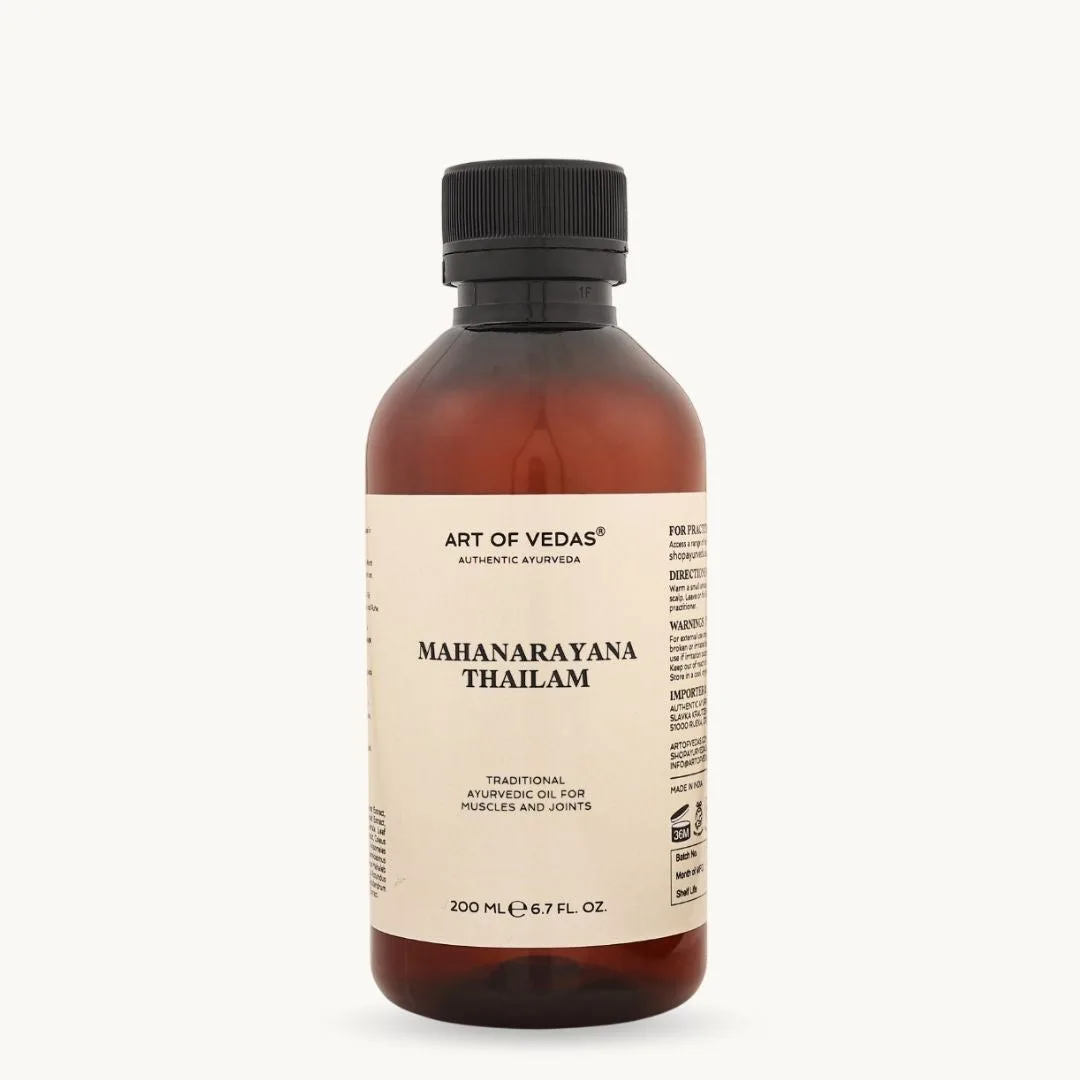
Experience this classical formulation: Get Authentic Mahanarayana Thailam from Art of Vedas
Understand the complete context: The Complete Guide to Mahanarayana Thailam
Learn how to use it effectively: How to Use Mahanarayana Thailam: Abhyanga Guide
Explore the classical textual origins: Coming soon: What the Classical Texts Say About Mahanarayana Thailam
See the modern research: Coming soon: Mahanarayana Thailam and Modern Science
Compare with other oils: Comparing Ayurvedic Oils: Which Thailam Is Right for You?
This article is for educational purposes about traditional Ayurvedic formulations. Not intended to diagnose, treat, cure, or prevent any disease. Consult healthcare providers for medical conditions.