This article is part of our Guide to Nasya: Ayurvedic Nasal Therapy guide series.
Nasya Therapy in Clinical Practice
Nasya (nasal administration of substances) is one of the five primary Panchakarma procedures described in classical Ayurvedic texts. The Charaka Samhita dedicates an entire chapter (Siddhisthana, Chapter 9) to Nasya, establishing its position as a fundamental clinical therapy rather than a supportive or adjunct treatment.
The classical principle underlying Nasya is direct: the nose is described as the gateway to the head (Shiras). Substances administered through the nasal passages are traditionally understood to act on the structures of the head, neck, and sensory organs. This makes Nasya the primary Panchakarma procedure for conditions above the clavicle (Urdhva Jatrugata Vikaras).
For practitioners, Nasya requires a precise understanding of its multiple forms, contraindications, and pre- and post-treatment protocols. This guide covers the clinical framework for offering Nasya as a professional Ayurvedic therapy.
Classical Classification of Nasya
Charaka classifies Nasya into five types based on the action of the administered substance. Understanding this classification is essential for selecting the correct form for each client.
Virechana Nasya (Cleansing Nasya)
Strong, pungent substances are administered to promote elimination of accumulated Kapha from the head and sinuses. Classical substances include Vidanga, Apamarga Kshara, and strong herbal powders. This is the most intensive form of Nasya and requires careful client selection.
Traditionally indicated when Kapha accumulation in the head region is the primary concern. Signs may include a persistent sensation of heaviness, congestion, or dullness in the head area.
Brimhana Nasya (Nourishing Nasya)
Nutritive, sweet, and unctuous substances are used to provide nourishment. Ghee-based preparations, and medicated oils fall into this category. Brimhana Nasya is traditionally indicated for Vata-predominant presentations where dryness and depletion are the primary patterns.
Shamana Nasya (Pacifying Nasya)
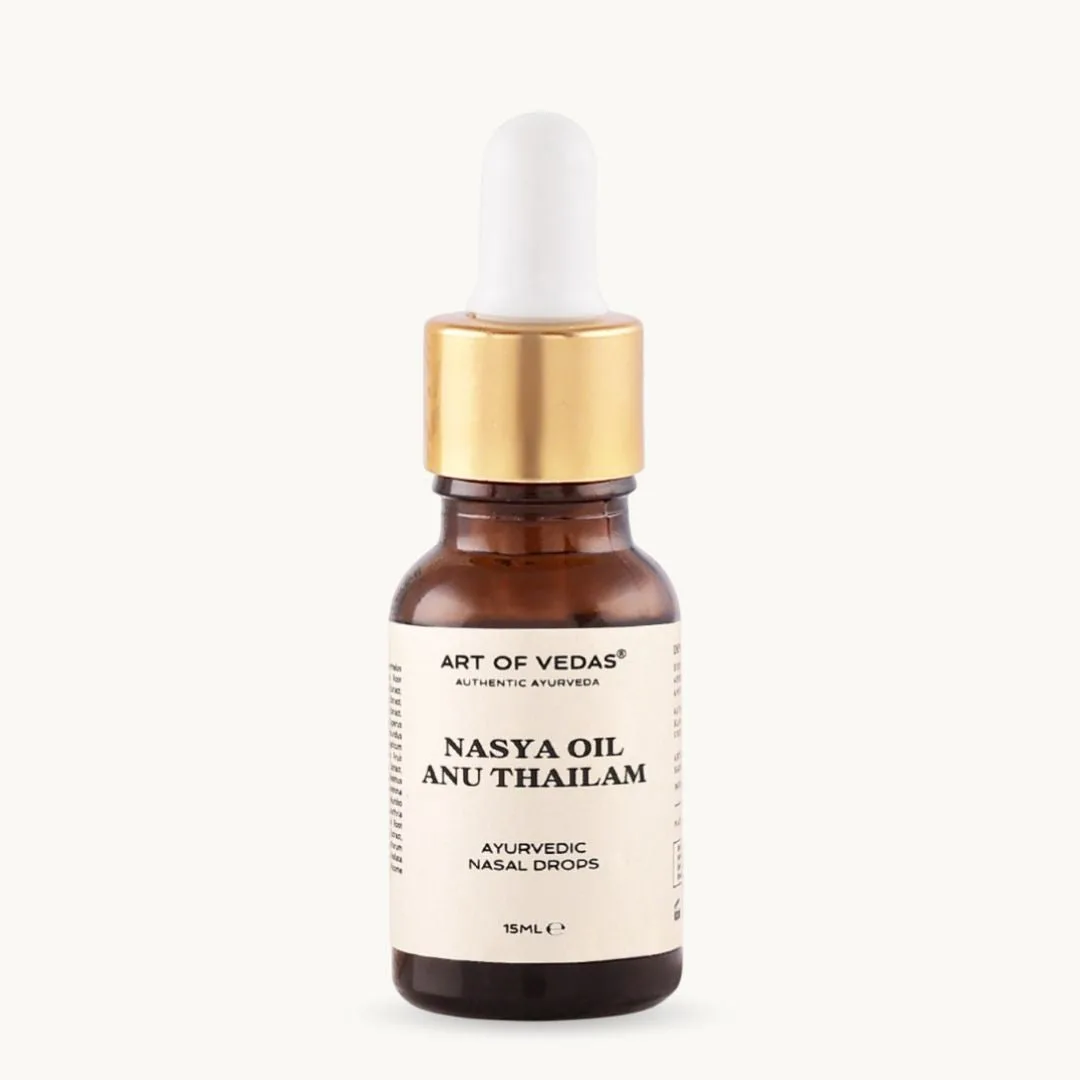
Medicated oils or herbal juices with a balancing action are used. Anu Thailam is the classical example of a Shamana Nasya oil. It is traditionally described as Tridoshahara (balancing to all three Doshas) and suitable for daily use in appropriate quantities.
Navana Nasya (Medicated Oil Nasya)
Fresh herbal juices mixed with medicated oils are administered. This form combines the penetrating quality of fresh juice with the oleating property of oil. It is a refined clinical technique requiring fresh preparation for each session.
Marshya and Pratimarshya Nasya (Daily Oil Nasya)
These are the mildest forms, suitable for daily self-care or gentle clinical application. Pratimarshya Nasya uses just one or two drops of oil per nostril. It is the form most commonly recommended for client home practice between clinical sessions. Anu Thailam and plain sesame oil are the standard choices.
Contraindications and Precautions
Classical texts are specific about when Nasya should not be performed. Practitioners must screen for these contraindications before every session.
Absolute Contraindications
- Immediately after meals (wait at least one hour; classical texts specify performing Nasya on an empty stomach or well after digestion)
- Immediately after bathing or head washing (nasal passages should be at a neutral temperature)
- During acute fever or acute respiratory distress
- During pregnancy
- During menstruation (classical texts advise avoiding Nasya during this period)
- In children under seven years of age (Charaka's guideline)
- In adults over eighty (Charaka's guideline; clinical judgement applies for those between 70 and 80)
- Immediately after bloodletting or purgation therapy (the body needs recovery time)
Relative Contraindications
- Grief, anger, or strong emotional states (the client should be calm and receptive)
- Alcohol intoxication
- Immediately after exercise or exertion
- Extreme weather conditions (very cold or very hot environments may alter the treatment's effect)
The classical approach to contraindications is conservative. When in doubt, postpone the treatment. Nasya involves sensitive mucosal tissue, and adverse reactions from inappropriate timing or substance selection, while typically mild, are uncomfortable for the client and undermine confidence in the therapy.
Clinical Protocol: Step by Step
Consultation and Assessment
Before the first Nasya session, conduct a thorough Ayurvedic consultation. Determine the client's Prakriti (constitutional type), Vikriti (current imbalance), and specific presentation in the head and neck region. This assessment drives the selection of Nasya type and substance.
Key assessment points:
- History of nasal sensitivity, prior nasal procedures, or structural irregularities
- Current state of the sinuses and nasal passages (dry, congested, or mixed)
- Dosha predominance in the head region (may differ from overall constitution)
- Client's experience with nasal treatments (first-time clients require more preparation and gentler substances)
Pre-Treatment: Purvakarma for Nasya
The preparatory phase is not optional. Classical texts emphasise that Nasya without proper Purvakarma is less effective and may cause discomfort.
-
Facial oil application (Mukha Abhyanga): apply warm sesame oil or an appropriate medicated oil to the face, forehead, and neck. Massage gently for 5-10 minutes, focusing on the sinus areas, temples, and jawline.
-
Localised steam (Nadi Swedana): direct gentle steam to the face using a facial steamer or steam tent. Duration: 3-5 minutes. The steam should be warm, not scalding. This opens the nasal passages and prepares the mucosa to receive the substance.
-
Client positioning: the client lies supine with the head tilted back. A rolled towel or bolster under the neck achieves the correct angle. The nostrils should face upward. Classical texts specify that the head should be slightly lower than the shoulders (Pravilambita Shiras position).
Administration
-
Warm the Nasya substance to body temperature (approximately 37 degrees Celsius). For oil-based Nasya, place the oil bottle in warm water for a few minutes. Test on your inner wrist before administering. Cold oil causes immediate discomfort and vasoconstriction.
-
Occlude one nostril gently by pressing the ala (side of the nose) with your finger. Instil the prescribed number of drops into the open nostril. For clinical Nasya using Anu Thailam, the standard dose is 6-8 drops per nostril. For Pratimarshya (daily care), 1-2 drops.
-
Release the nostril and instruct the client to inhale gently, drawing the oil inward. The inhalation should be soft, not forceful. A sharp sniff drives the substance too deep and can cause irritation.
-
Repeat on the second nostril following the same procedure.
-
Post-instillation massage: gently massage the soles of the feet, palms, and ears while the client rests. This classical post-Nasya step is described in Vagbhata's text and serves to settle the Vata that may be disturbed during nasal administration.
-
Rest period: the client remains supine for 2-3 minutes, then slowly sits up. Provide tissues for any discharge. The client may experience temporary watering of the eyes, which is normal.
Post-Treatment: Paschat Karma
- Instruct the client to spit out any substance that drains to the throat. Swallowing small amounts is not harmful but should not be encouraged.
- Offer warm water for gargling (Kavala Graha) to clear residual substance from the throat.
- Light Dhumapana (herbal smoke inhalation) using traditional herbs is classical post-Nasya protocol, though not all European practitioners include this step.
- Advise the client to avoid cold water, cold air exposure, dust, and wind for at least one hour following treatment.
- No head bath or hair washing on the day of Nasya treatment.
Dosage Guidelines by Nasya Type
Classical texts provide specific dose ranges. These serve as starting points; clinical experience and individual client response guide adjustments.
-
Pratimarshya Nasya (daily care): 1-2 drops per nostril of Anu Thailam or sesame oil
-
Shamana Nasya (therapeutic balancing): 6-8 drops per nostril of medicated oil
-
Shodhana/Virechana Nasya (cleansing): 8-10 drops per nostril (or powder insufflation as per specific formulation instructions)
-
Brimhana Nasya (nourishing): 8-10 drops per nostril of ghee or nourishing oil preparations
Always begin with the lower end of the dose range for new clients and increase in subsequent sessions based on tolerance and response.
Treatment Course Planning
Nasya is most effective when administered as a course rather than a single session. Classical recommendations:
-
Standard course: 7 consecutive days
-
Extended course: 14 or 21 days for established conditions
-
Within Panchakarma: Nasya is performed after Vamana (emesis) and Virechana (purgation) as the third of the five procedures; the duration depends on the overall Panchakarma protocol
-
Maintenance: Pratimarshya Nasya can be recommended as daily home practice, performed in the morning after oral hygiene as part of Dinacharya (daily routine)
Seasonal Considerations
Classical texts link Nasya timing to the Ritu (seasons). In European climate zones:
- Late winter to early spring (Kapha season): Virechana Nasya may be particularly indicated as Kapha naturally accumulates
- Summer (Pitta season): cooling Nasya substances (Brimhana type with ghee or cooling oils) are preferred; avoid strong cleansing Nasya
- Autumn to early winter (Vata season): oil-based Shamana Nasya with warming oils counters seasonal Vata aggravation
Anu Thailam: The Classical Nasya Oil
Anu Thailam holds a singular position in Nasya therapy. Described in the Ashtanga Hridayam (Sutrasthana, Chapter 20), it is the most referenced Nasya oil in classical literature. Its formulation includes over 20 herbs processed in sesame oil with goat's milk, resulting in a balanced preparation suitable for all constitutional types.
The name "Anu" means "subtle" or "fine," reflecting the oil's quality of deep penetration through the nasal mucosa. Classical texts describe Anu Thailam as traditionally supporting clarity of the senses, comfort in the head and neck region, and overall balance of the Doshas above the clavicle.
Anu Thailam from Art of Vedas is prepared according to the classical formulation described in the Ashtanga Hridayam. It is suitable for both professional Nasya therapy and client home practice (Pratimarshya Nasya).
Common Clinical Errors in Nasya Practice
Based on classical cautions and practical experience, the following errors are most frequently observed:
-
Skipping Purvakarma: administering Nasya without facial massage and steam significantly reduces comfort and effectiveness
-
Cold oil: oil that is not warmed to body temperature causes immediate nasal irritation and client reluctance to continue treatment
-
Excessive force during inhalation: instructing the client to inhale too sharply drives substance into areas where it causes discomfort
-
Wrong Nasya type for the constitution: performing Virechana Nasya on a Vata-predominant client, or Brimhana Nasya where Kapha is accumulated, produces suboptimal results
-
Ignoring contraindications: performing Nasya immediately after meals, during acute fever, or during menstruation disregards classical guidelines and may cause adverse effects
-
No post-treatment guidance: failing to advise the client about post-Nasya care (avoiding cold, wind, head washing) reduces the treatment's lasting effect
Integrating Nasya into Your Practice
Nasya is one of the most accessible Panchakarma procedures for European practitioners to implement. It requires minimal equipment (a treatment table, facial steamer, warm oil, and dropper), a single therapist, and a relatively short session time (30-45 minutes including Purvakarma).
For practitioners who already offer Abhyanga and Shirodhara, Nasya is a natural addition. It completes the trilogy of primary head and upper body therapies. Clients receiving a Nasya course can be scheduled for morning appointments, as classical texts recommend performing Nasya before midday.
The investment in learning proper Nasya technique is modest compared to treatments like Pizhichil or Vasti (Basti), and the client demand is consistent because Nasya addresses concerns that clients frequently present with in clinical practice. Combined with client education about daily Pratimarshya Nasya at home, practitioners can extend the therapeutic relationship beyond the clinic through guided self-care protocols.
Nasya also serves as an excellent demonstration of Ayurvedic medicine's systematic approach. The logical structure of assessment, Purvakarma, treatment, and Paschat Karma shows clients that Ayurveda is a rigorous clinical discipline. This understanding encourages deeper engagement with the full range of Ayurvedic therapies you offer.
Documentation and Client Records
Maintain detailed records for each Nasya course. Document the Nasya type and substance used, dose per nostril, number of sessions completed, and any client-reported responses. This documentation serves both clinical continuity and professional accountability.
Record the following at each session:
- Nasya type and specific formulation administered
- Dose (drops per nostril) and oil temperature at administration
- Client's subjective response: comfort level, any immediate effects such as watering eyes or mild discharge
- Any modifications made to the protocol and the clinical reasoning behind them
- Post-treatment observations and recommendations given to the client
Thorough documentation becomes especially important when Nasya is part of a longer Panchakarma programme. The client's response to Nasya often informs decisions about subsequent procedures. Having a clear record of how the nasal therapy progressed allows the supervising practitioner to adjust the overall treatment plan with confidence.
Explore the full context of Nasya within Ayurvedic nasal therapy in our comprehensive Nasya guide, and browse Anu Thailam for your clinical and retail needs.