In brief: Sahacharadi Kuzhambu (also written Sahacharadi Kuzhampu or Sahacharadi Kuzhambu oil) is the thick form of the classical Sahacharadi recipe: Sahachara, the ten Dashamoola roots, Shatavari, Devadaru and other plants cooked into a base of sesame and castor oil until it is denser and slower-flowing than Sahacharadi Thailam. Described in the Ashtanga Hridayam, the Sahasrayogam and the Ashtanga Samgraha, it is warming, classically placed with Vata, and traditionally used for a focused Abhyanga of the legs, the feet and the lower back. This guide covers what it is, how it differs from the Thailam, what Art of Vedas declares, how to apply it and who should ask first.
Sahacharadi Kuzhambu: what it is, how it differs from the Thailam and how to use it
Reviewed by Dr. Anu Joy, MD (Ayurveda), Ayurvedic doctor of Art of Vedas
What Sahacharadi Kuzhambu is, and what the name means
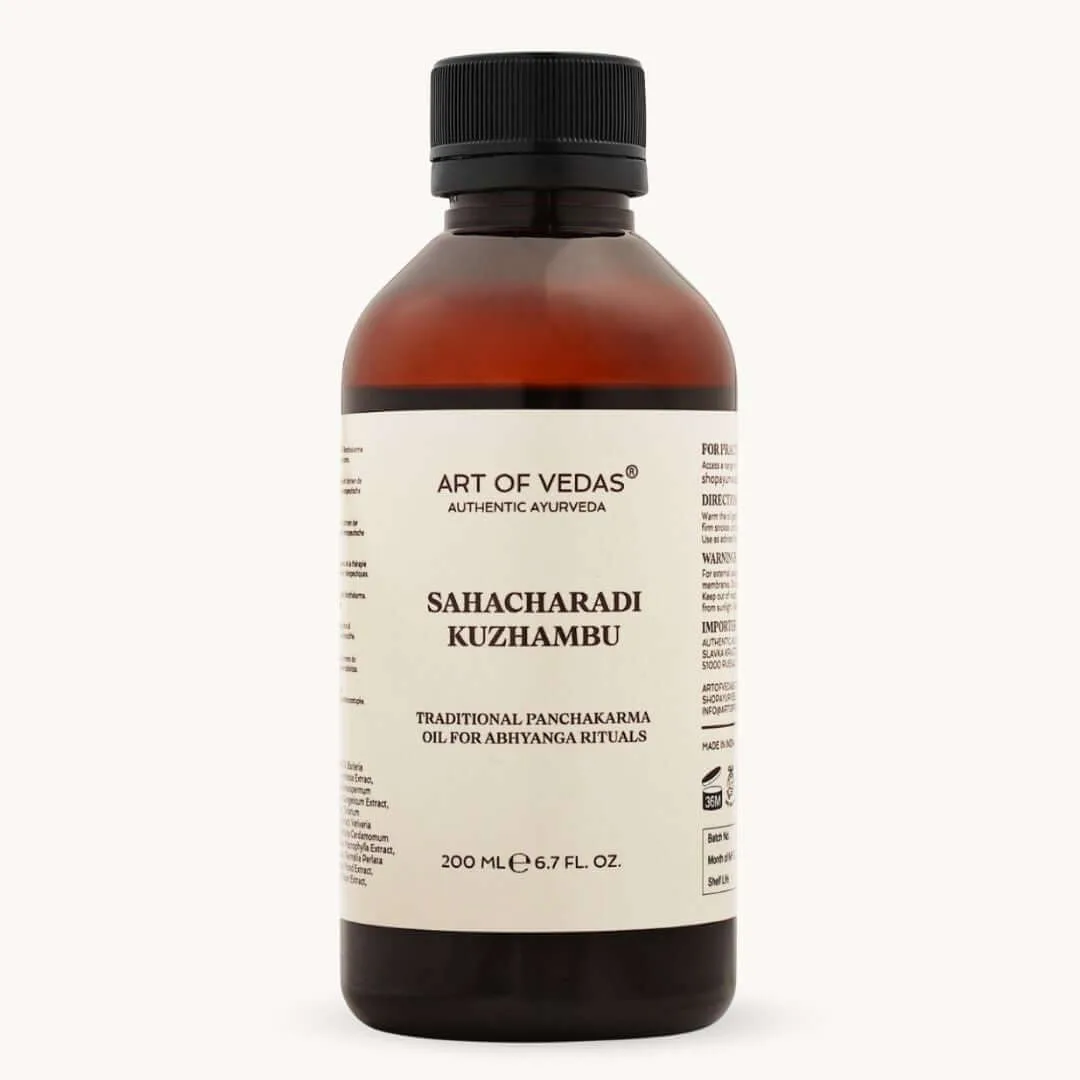
Sahachara is the lead plant of the recipe, and the ending adi means "and the others": Sahacharadi is the preparation in which Sahachara stands first in a longer list. Kuzhambu names the consistency, a thick, slow-flowing liquid, and in Ayurvedic pharmacy a medicated oil prepared in a heavier base and cooked further than a Thailam. Sahacharadi Kuzhambu and Sahacharadi Kuzhampu are two spellings of the same preparation. The Art of Vedas Sahacharadi Kuzhambu declares sesame seed oil and castor seed oil as its base; at room temperature it pours slowly, and between warm hands it softens within a minute. The form itself is covered in our complete guide to Kuzhambu.
Thailam, Kuzhambu and Mezhukupakam: three consistencies of one recipe
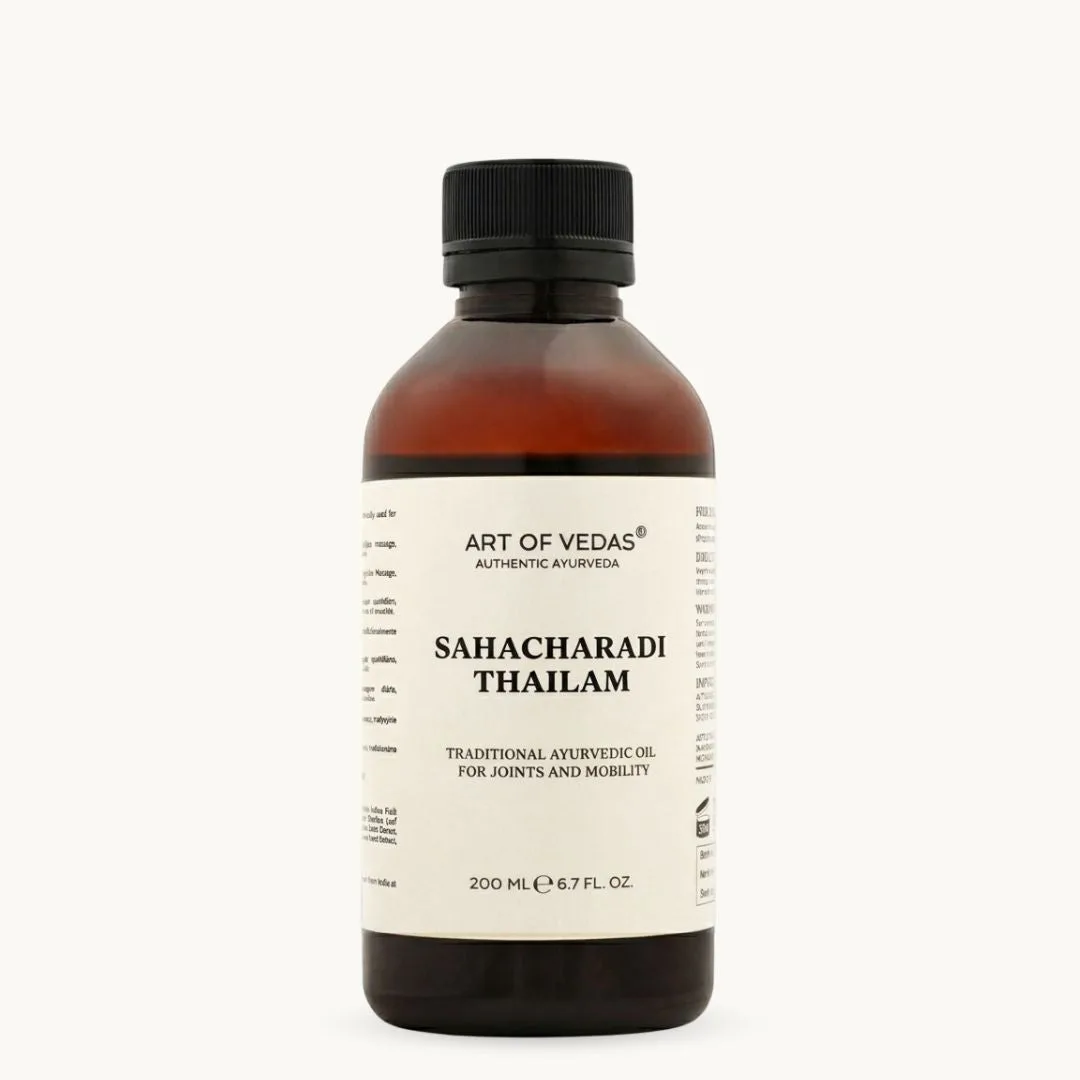
Sahacharadi Thailam is cooked into sesame oil and remains a flowing oil: the form for Abhyanga of the legs and the lower back with long strokes, and for Padabhyanga, the evening foot massage. Sahacharadi Kuzhambu is cooked in sesame and castor oil and taken further, so that it is thick, stays where it is placed and is worked into one area in a smaller amount. Cooked further still, a recipe becomes a Mezhukupakam, semi-solid and wax-like. Art of Vedas offers Sahacharadi as the Thailam, in 200 ml and 1 litre, and as the Kuzhambu, in 200 ml, not as a Mezhukupakam.
What the Art of Vedas Sahacharadi Kuzhambu declares
The declared list opens with sesame seed oil and castor seed oil, then Sahachara, declared as Barleria prionitis. The ten roots of the Dashamoola group follow: bael, Agnimantha, Shyonaka, Gambhari, Patala, Gokshura, Shalaparni, Prishniparni, Brihati and Kantakari. Shatavari, Manjistha, Devadaru and stone flower are declared, with aromatic plants, vetiver, Coleus and Plectranthus vettiveroides, cardamom and fennel, and with Capparis horrida, Anisomeles, Callicarpa, Pergularia and storax resin. Limonene and linalool, declared at the end, are not added fragrances: they occur naturally in the aromatic plants and EU cosmetics rules require them to be named. Every declared ingredient is a plant material or resin, so the Kuzhambu is suitable for vegans. The full declaration, with botanical names, is on the product page and the label; the method, the classical Sneha Paka, is described in our complete guide to Thailams.
Character in Ayurvedic terms
The classical texts place Sahachara among the warming plants, and the recipe is described as warming and classically placed with Vata. The Dashamoola roots and Shatavari give it the nourishing character the tradition associates with the Vata oils, and its heat is gentler than that of a ginger and mustard recipe such as Kottamchukkadi. The texts describe Sahacharadi for the lower body and keep the description general.
How Sahacharadi Kuzhambu is used in practice
Soften the Kuzhambu in warm water or between the palms until it feels pleasantly warm on the inner wrist; no microwave. The evening foot routine is the classical place for Sahacharadi: sitting down, work a teaspoon into each sole with the thumbs in slow circles, then around the ankle and up the calf with long strokes towards the knee, put on an old pair of socks and leave it for 20 to 30 minutes, or overnight. For the lower back, a teaspoon worked in with slow circles and then long strokes along the muscles, followed by warmth and rest, then a warm wash. Daily or on alternate days through autumn and winter, and a lighter rhythm in warm weather, is the common pattern. For a full Abhyanga use the Thailam, in the sequence our Abhyanga guide describes. Store it closed and cool; if it firms up in winter, warm water softens it again.
Who should ask first
Sahacharadi Kuzhambu is for external use only. Do a small skin test on the inner forearm before the first full application, keep it away from the eyes and broken skin, and do not use it if you react to sesame, castor oil or any declared ingredient. In pregnancy, while breastfeeding and for children, ask your doctor or a qualified Ayurvedic practitioner first; a qualified Ayurvedic practitioner is also the right person to say whether a warming Vata preparation suits you.
Frequently asked questions about Sahacharadi Kuzhambu
What is Sahacharadi Kuzhambu? The thick form of the classical Sahacharadi recipe: Sahachara, the ten Dashamoola roots, Shatavari, Devadaru and aromatic plants cooked into a base of sesame and castor oil until it is denser than the Thailam. It is described in the Ashtanga Hridayam, the Sahasrayogam and the Ashtanga Samgraha. Art of Vedas sells it for external use in a 200 ml bottle.
What is Sahacharadi Kuzhambu used for? For a focused Abhyanga of the lower body, where the classical texts place the Sahacharadi recipe: the soles and ankles in the evening foot routine, the calves, the knees and the lower back. It is warming and classically placed with Vata. Art of Vedas sells it for external use; ask a qualified Ayurvedic practitioner whether it suits you.
How do you use Sahacharadi Kuzhambu? Soften a teaspoon between warm hands or stand the closed bottle in warm water, then work it into one area with slow, sustained strokes: circles on the soles and around the joints, long strokes along the calf or the lower back. Keep the area warm for 20 to 30 minutes, or under socks overnight, then wash.
What is the difference between Sahacharadi Kuzhambu and Sahacharadi Thailam? Base and consistency, not the plants. The Thailam is cooked into sesame oil and flows freely, for a massage of the whole lower body and the full foot routine. The Kuzhambu is cooked in sesame and castor oil to a thick consistency that stays where it is placed, for one area. Art of Vedas offers both.
What does Sahachara mean? Sahachara is the name of the lead plant of the recipe, declared in the Art of Vedas preparation as Barleria prionitis. The ending adi means "and the others", so Sahacharadi Kuzhambu is the thick preparation in which Sahachara leads a longer list that includes the ten Dashamoola roots and Shatavari.
Is Sahacharadi Kuzhambu warming, and which Dosha does it suit? It is warming and classically placed with Vata. Its heat is gentler than that of Kottamchukkadi Kuzhambu, which is built on ginger and mustard, and its character is nourishing rather than sharp. It suits autumn and winter and the evening. Ask a qualified Ayurvedic practitioner what suits your constitution.
Is there a Sahacharadi Mezhukupakam? Mezhukupakam is the third, semi-solid consistency, cooked further than a Kuzhambu until it is wax-like. Art of Vedas offers the Sahacharadi recipe as a Thailam and as a Kuzhambu; the Mezhukupakam in our range is Dhanwantharam Mezhukupakam, a different recipe.
Can Sahacharadi Kuzhambu be used in pregnancy or for children? Ask your doctor or a qualified Ayurvedic practitioner first. Sahacharadi Kuzhambu is for external use only: do a small skin test on the inner forearm before the first full application, keep it away from the eyes and broken skin, and do not use it if you react to sesame, castor oil or any declared ingredient.