Characteristics of the Vata type
People with a dominant Vata constitution (Vata Prakriti) tend to display a distinctive set of physical and psychological characteristics. The Charaka Samhita and Ashtanga Hridayam describe the Vata type in considerable detail:
Physical traits
- Slender frame - often with a lean, light build and difficulty gaining weight
- Dry skin that is prone to roughness, especially in cooler and drier seasons
- Fine, dry, or curly hair
- Cool skin - Vata types tend to feel cold more easily than other constitutions
- Light, irregular appetite - hunger comes and goes unpredictably
- Variable digestion - sometimes strong, sometimes weak, often accompanied by gas or bloating
- Light and potentially irregular sleep patterns
- Quick, light movements - Vata types often walk and speak rapidly
Psychological traits
- Creative, quick-thinking, and imaginative - Vata types often have an abundance of ideas
- Enthusiastic and adaptable, though sometimes scattered or hard to focus
- A tendency towards anxiety or worry when out of balance
- Variable memory - learns quickly but may not retain long
- Sensitive nervous system - responds strongly to stimulation, change, and noise
Signs of Vata imbalance
When Vata accumulates beyond its balanced state, Ayurveda describes a range of characteristic signs. These are not medical diagnoses but traditional observations about how excess Vata expresses itself:
- Increased dryness - dry skin, dry eyes, dry lips, dry or rough hair
- Physical restlessness or difficulty staying still
- Mental anxiety, worry, or racing thoughts
- Irregular or disturbed sleep
- Variable appetite and digestive irregularity
- Feeling of cold - in the hands, feet, or body generally
- A sense of being scattered, overwhelmed, or ungrounded
- Joint stiffness or cracking (Vata governs joint mobility)
In Ayurveda, Vata aggravates easily through cold, dry, and irregular habits: travelling frequently, irregular eating times, insufficient sleep, excessive stimulation, and late nights. Autumn and early winter are classically considered Vata seasons in many European climates.
What balances Vata: the classical approach
The foundational principle for balancing Vata is the use of its opposites: warmth, moisture, regularity, heaviness, and stability. Classical Ayurvedic Vata management (Vata Shamana) incorporates several key elements:
Oil massage (Abhyanga)
Regular warm oil massage is the single most important Vata-balancing practice in classical Ayurveda. The Charaka Samhita states that Abhyanga - daily self-massage with warm medicated oil - is directly Vata-pacifying. Oil is unctuous (Snigdha), warm, and heavy - precisely the qualities that counteract the dry, cold, and light nature of Vata. For the Vata type, Abhyanga is ideally practised every morning as part of the Dinacharya (daily routine).
The classical Ayurvedic oils recommended for Vata are:
-
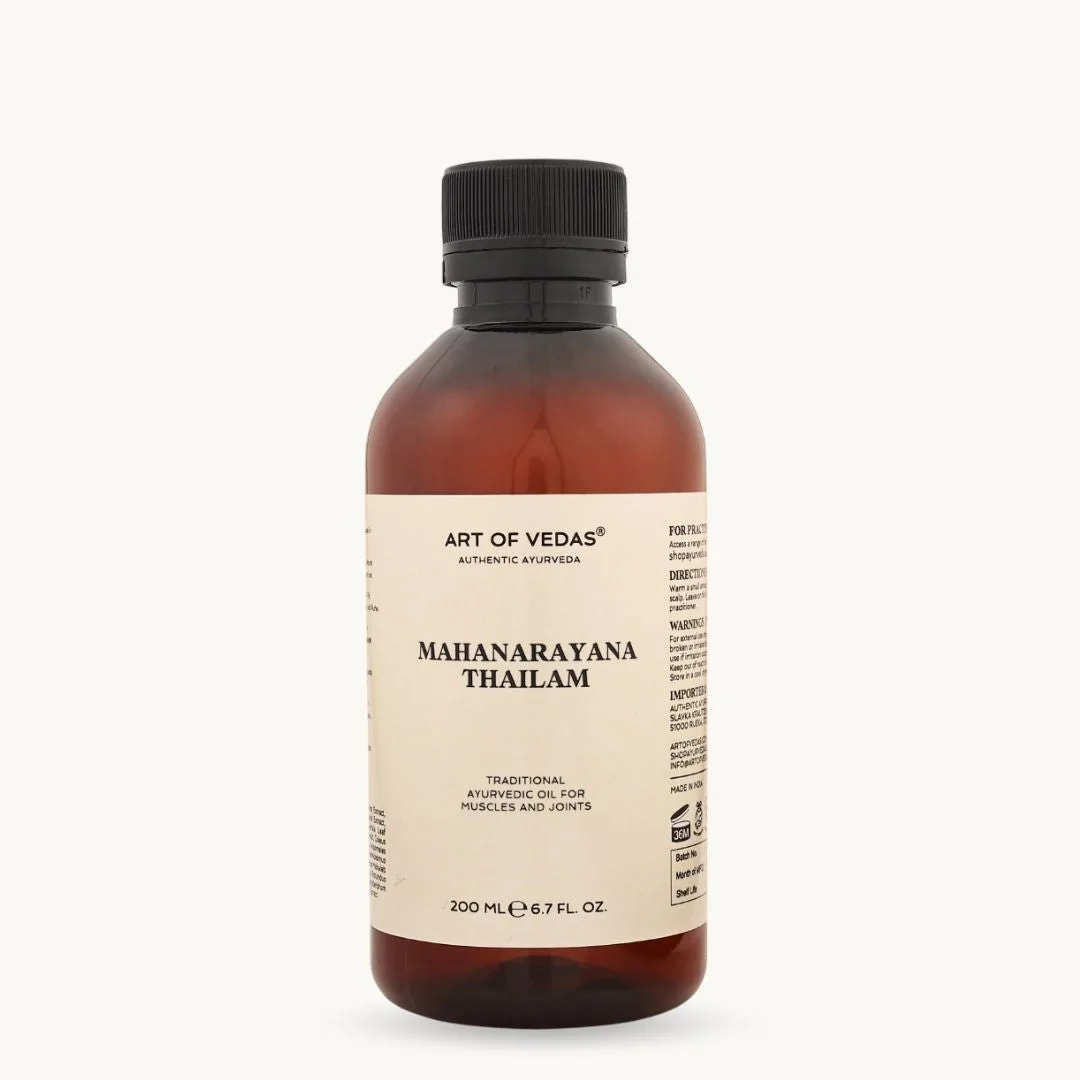
Mahanarayana Thailam - the foremost classical Vata-pacifying oil, prepared from 57 ingredients according to the Sahasrayogam. Considered the most comprehensive classical formulation for full-body Abhyanga in Vata conditions.
-
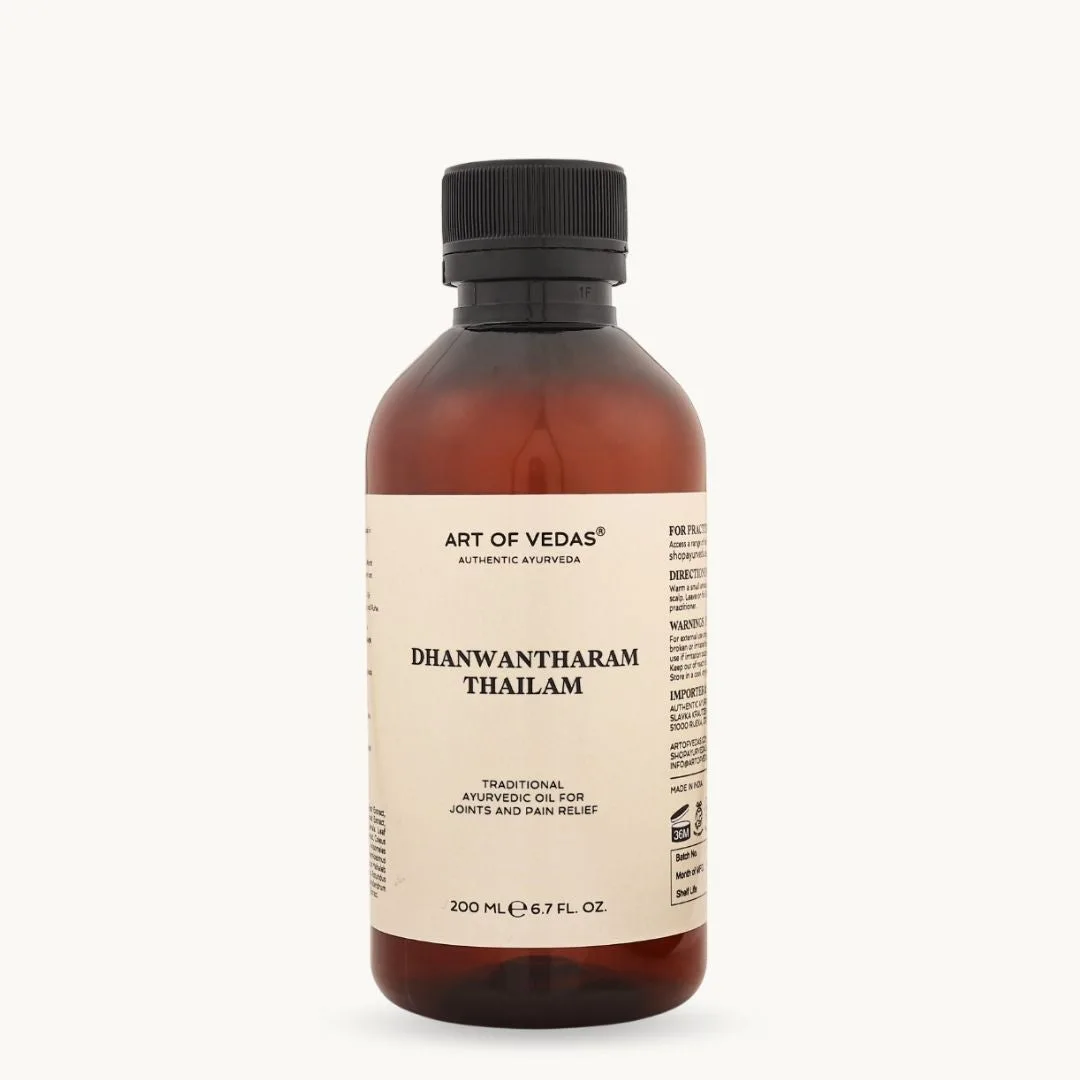
Dhanwantharam Thailam - described in the Ashtanga Hridayam as a classical Vata-pacifying preparation, one of the most widely used oils in South Indian Panchakarma practice.
-
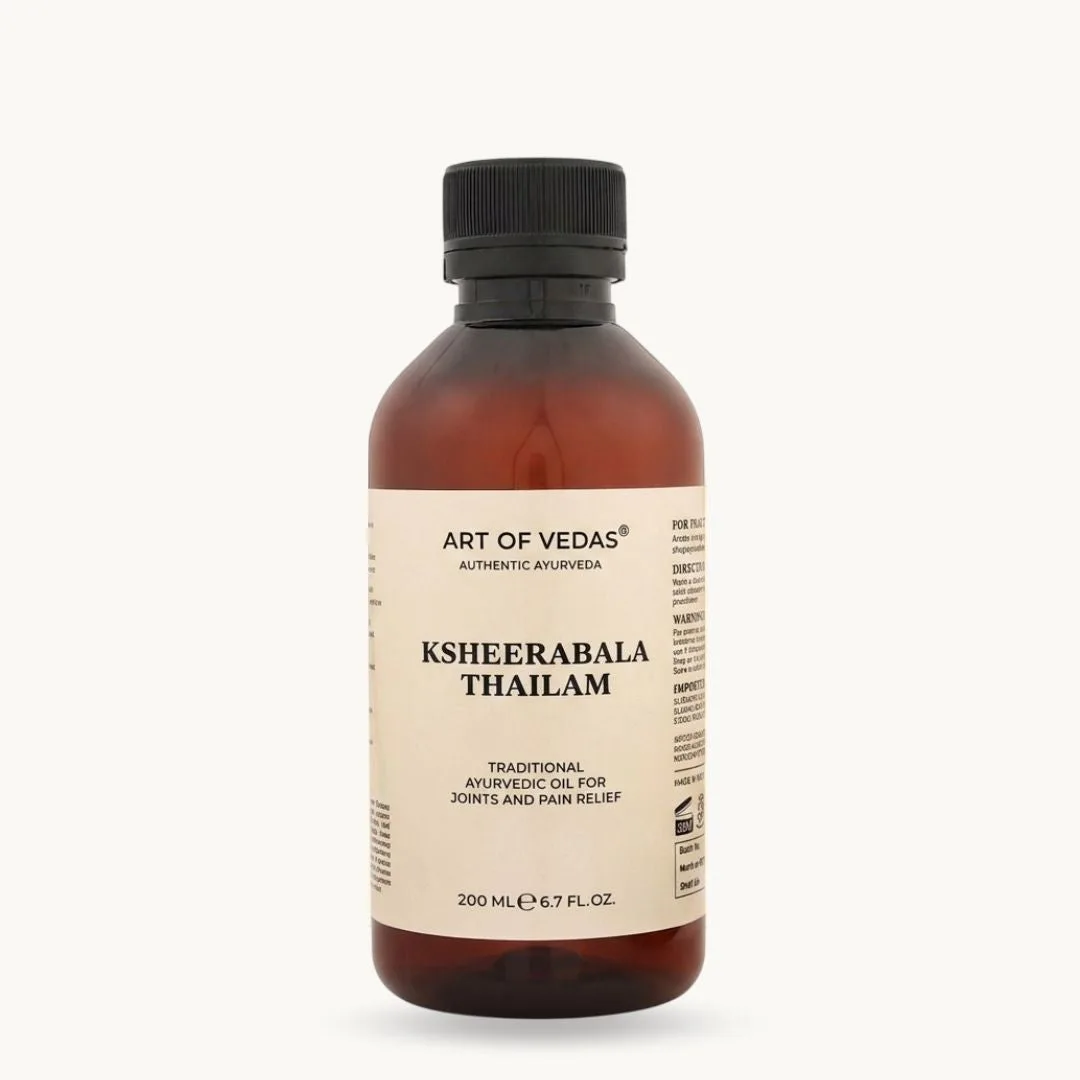
Ksheerabala Thailam - a classical preparation of Bala herb with sesame oil and, described in the Ashtanga Hridayam as specifically beneficial for Vata conditions.
You can find the full range of classical Vata-supporting oils in our Ayurvedic Oils collection.
Diet and lifestyle for Vata
Classical Ayurveda recommends the following general principles for Vata balance through diet and routine:
-
Warmth: Prefer warm, cooked foods over raw or cold. Soups, stews, and well-cooked grains are traditionally considered Vata-calming.
-
Oils and fats: Vata benefits from good-quality fats - ghee (clarified butter) is the classic choice in Ayurvedic dietary practice.
-
Regularity: Eating at consistent times each day is particularly important for Vata, whose digestion is easily disturbed by irregularity.
-
Tastes: Sweet (Madhura), sour (Amla), and salty (Lavana) tastes are traditionally calming for Vata. Bitter, pungent, and astringent tastes aggravate Vata.
-
Sleep: Regular sleep before midnight supports the nervous system and is especially important for Vata types.
Classical Vata-balancing herbs and preparations
Several classical Ayurvedic herbs are described as particularly supportive for Vata constitution:
-
Ashwagandha (Withania somnifera) - described in classical texts as Balya and Rasayana, Ashwagandha is one of the foremost herbs for supporting vitality and resilience in Vata constitution.
-
Shatavari (Asparagus racemosus) - a classical moistening and nourishing herb, particularly described in Ayurvedic texts for supporting nourishment and vitality.
-
Bala (Sida cordifolia) - one of the classic Vata-supporting herbs, forming the primary ingredient in Ksheerabala Thailam.
Nasya - nasal care for Vata
Nasya - the daily application of a small amount of medicated oil into the nasal passages - is particularly important for Vata types in classical Ayurveda. The Ashtanga Hridayam describes Nasya as a key practice for supporting the head and nervous system, both of which are Vata-governed regions. Anu Thailam is the classical nasal oil used for this purpose.
Understanding your Dosha: the next step
Pure Vata types - those in whom Vata is clearly dominant over both other Doshas - are relatively uncommon. More frequent are dual-dosha types such as Vata-Pitta or Vata-Kapha. Understanding your individual combination gives a more precise foundation for daily care practices. You can explore this with our Ayurvedic Dosha test.
For an overview of how the three Dosha types compare, see our guide to mixed Dosha types in Ayurveda. For the Pitta constitution, see our Pitta type guide.
Vata dosha meaning: the qualities behind the Dosha of movement
The Charaka Samhita, the Sushruta Samhita and the Ashtanga Hridayam describe Vata through its qualities (Gunas). Understanding these qualities explains the whole Vata constitution, because Ayurvedic care rests on one principle: like increases like, and opposites create balance.
- Ruksha (dry): shows as dry skin, dry hair, dry mucous membranes, cracking joints and a tendency towards dry, irregular elimination. Internally it is the dryness of depleted tissue and insufficient lubrication.
- Laghu (light): gives a naturally lean frame, light sleep, quick movements and a mind that moves rapidly from thought to thought. In excess, lightness becomes instability: weight loss, broken sleep and a feeling of groundlessness.
- Sheeta (cold): shows as cold hands and feet, sensitivity to cold weather and cold foods, and a clear preference for warmth.
- Khara (rough): appears as rough or cracked skin, rough hair and a quality of irregularity and friction in bodily functions.
- Sukshma (subtle): the subtlety or minuteness of Vata lets it reach the finest channels of the body, which is why Vata imbalance can appear in almost any tissue. It also explains Vata's sensitivity to environment, emotion and sensory input.
- Chala (mobile): the defining quality. In balance, mobility is responsiveness, creativity and adaptability. In excess, it becomes restlessness, worry, scattered attention and the inability to sit still, physically or mentally.
Some texts add a seventh quality, clear. Vata's cold, dry, light and mobile nature is therefore balanced by warmth, moisture, heaviness and stability, and every Vata-pacifying practice, from oil massage to warm food to a regular routine, follows this single principle.
Classical texts call Pitta and Kapha "lame" (Pangu) without Vata's motive force, and the Charaka Samhita states that Vata imbalance is the most common, the most varied in its presentation and the most important to address. Its main seat in the body is the colon, followed by the lower back, thighs, bones and nervous system. These are the places where Vata imbalance tends to show and where Vata care is directed.
The five sub-doshas of Vata
Classical Ayurveda divides Vata into five sub-doshas, each with its own seat and direction of movement.
Prana Vayu: the vital breath
Seated in the head, chest and throat. Prana Vayu governs inhalation, swallowing, sneezing and the movement of sensory impressions into the mind, and it is regarded as the most fundamental, because it governs the life force itself. When Prana Vayu is disturbed, the texts describe worry, shallow breathing, difficulty focusing and a scattered quality of attention. Nasya is described classically as the primary practice for supporting Prana Vayu.
Udana Vayu: the upward-moving breath
Seated in the throat and chest. Udana Vayu governs speech, self-expression, exhalation, effort and the upward movement of energy that produces enthusiasm and motivation. When it is disturbed, the texts describe difficulty with speech, loss of voice, low energy, difficulty starting an effort and the inability to rise to challenges.
Samana Vayu: the equalising breath
Seated in the stomach and small intestine, alongside Agni. Samana Vayu moves food through the digestive tract, fans the digestive fire and supports the assimilation of nutrients. It decides whether Agni burns evenly (Sama Agni) or erratically (Vishama Agni). The erratic digestion of Vata imbalance, with variable appetite, bloating that comes and goes, and alternating hard and loose stools, is described as a direct expression of disturbed Samana Vayu.
Apana Vayu: the downward-moving breath
Seated in the colon and pelvic region, Vata's primary home in the body. Apana Vayu governs all downward and outward movements: elimination, urination, menstruation, ejaculation and the bearing-down effort of childbirth. It is the sub-dosha most commonly disturbed in modern life, and its disturbance lies behind Vata's most characteristic sign: dry, irregular, incomplete or uncomfortable elimination.
Vyana Vayu: the pervasive breath
Seated in the heart but pervading the entire body. Vyana Vayu governs circulation, the rhythmic contraction and relaxation of the heart and all voluntary and involuntary muscular movement. It carries the nourishment that Samana Vayu has helped digest to the tissues. When it is disturbed, the texts describe poor circulation, cold extremities, muscle cramps and a sense of disconnection or numbness.
Vata dosha symptoms in detail
Vata imbalance is the most changeable of all Dosha disturbances: the Charaka Samhita lists 80 classical Vata patterns, more than Pitta and Kapha combined. When Vata is high, recognisable patterns still emerge. These are traditional observations, not diagnoses.
Physical signs
Dry skin, cracking joints, dry or irregular elimination, gas and bloating that come and go without a clear dietary cause, cold hands and feet, weight loss or difficulty maintaining weight, fatigue despite feeling "wired", light and unrefreshing sleep with difficulty falling asleep or waking in the early hours, and muscular tension, particularly in the neck, shoulders and lower back.
Digestive signs
The classic Vata digestive pattern is Vishama Agni, irregular and erratic digestion. The same food that digests well one day causes discomfort the next. Appetite swings between excessive and absent, and stools may alternate between hard and loose, or be dry and difficult to pass.
Mental and emotional signs
Worry, racing thoughts, difficulty concentrating, a tendency to feel overwhelmed, sensitivity to noise and stimulation, restlessness, starting many tasks and finishing few, a feeling of being scattered or ungrounded, and fear or insecurity that feels out of proportion to the circumstances.
Seasonal pattern
Vata naturally increases in autumn and early winter, the dry, cold, windy season. Most Vata-prone people notice their characteristic signs increasing from October to December, particularly if they do not adjust their diet and routine.
Causes of Vata dosha imbalance: what aggravates Vata
Because like increases like, anything that shares Vata's qualities will increase it. Beyond the irregular habits, travel and overstimulation named above, the classical picture includes:
- Cold weather: autumn and winter are Vata seasons, and cold, dry, windy conditions increase Vata rapidly.
- Cold, dry, raw foods: salads, crackers, cold drinks and raw vegetables.
- Fasting or skipping meals: Vata types lose stability quickly without regular nourishment.
- Excessive exercise: intense cardio, running or high-impact activity without adequate rest.
- Stress and overwork: sustained mental effort without breaks depletes Vata.
Classical Ayurveda would describe the modern European lifestyle, with its irregular schedules, high screen time, heavy mental workload, short sleep and cold or processed food, as almost systematically Vata-aggravating. Many people experience Vata aggravation without recognising it as such.
The Vata personality: in balance and out of balance
In balance, the Vata personality is spontaneous and a lively conversationalist with a wide range of interests. When Vata becomes excessive, the same mental mobility becomes destabilising: racing thoughts, difficulty making decisions or following through on plans, and a feeling of being scattered. Vata in balance feels like inspiration and flow; Vata out of balance feels like chaos and depletion.
Vata's qualities are not a problem in themselves. They are the source of creativity, spontaneity, sensitivity and the quickness of mind that makes Vata-dominant people often the most intuitive and adaptive people in a room. The goal is not to suppress Vata but to support it, with the warmth, nourishment, regularity and grounding that let these qualities express themselves without tipping into excess.
Vata type diet: foods to favour and foods to reduce
The Charaka Samhita builds its dietary guidance for Vata on the principle of opposites. Since Vata is dry, light, cold, mobile and rough, the foods that balance it are warm, moist, nutritionally dense, stable and smooth. Soups, stews, khichadi (rice and lentils cooked together) and warm grain dishes with a moderate amount of good-quality fat are the classical staples.
Foods that support Vata balance
- Grains: cooked rice, cooked oats, wheat and quinoa, always warm and well cooked.
- Vegetables: cooked root vegetables such as carrots, beetroot and sweet potatoes, squash, asparagus and green beans. Always cooked, not raw.
- Fruits: sweet, ripe fruits such as bananas, mangoes, avocados, berries and cooked apples.
- Proteins: mung dal, red lentils, warm tofu and eggs, lightly spiced and well cooked.
- Oils and fats: sesame oil and olive oil. Vata types need more fat in their diet than the other types.
- Spices: ginger, cumin, cinnamon, cardamom, fennel, turmeric, asafoetida (hing) and black pepper in moderation. Warming spices support Vata's irregular digestion.
Foods to reduce
- Raw salads and cold foods
- Dried fruit (unless soaked), popcorn and crackers
- Caffeine in excess
- Large quantities of bitter and astringent foods, such as raw leafy greens and beans
- Cold drinks, especially with ice
Eating habits for Vata
Vata types tend to skip meals, eat at irregular times and be easily distracted from eating. Eat in a calm setting without distractions, and, as the classical texts advise, make the midday meal the largest, when Agni (the digestive fire) is strongest.
Daily routine for the Vata type
For Vata, structure is the foundation of balance. The same practices at the same times each day have a cumulative calming effect that no single measure can match.
- Waking: rise at a consistent hour, ideally before 7 a.m.
- Gentle exercise: yoga, walking, tai chi or swimming rather than intense cardio or competitive sport.
- Meditation: even 10 to 15 minutes of seated stillness helps settle Vata's restless quality.
- Bedtime: by 10 p.m.
Warmth in every form
Vata's cold quality means that warmth in every form is supportive: warm food, warm water, warm oil, warm baths, warm clothing and warm rooms. Avoiding unnecessary exposure to cold, particularly in Vata season, is a simple but effective measure.
Sensory moderation
Vata's subtle, mobile nature makes it especially sensitive to sensory stimulation. Long screen time, loud environments, constant notifications and intense sensory input all aggravate Vata directly. Periods of quiet and sensory rest are pacifying.
Seasonal care
In autumn and early winter, increase the warming practices: more oil massage, warmer food, earlier bedtimes and less travel. Spring and summer counterbalance Vata with warmth, so these seasons are usually easier for Vata types.
More classical oils for Vata
The classical texts name sesame oil (Tila Taila) as the primary base for Vata, because its warming potency, heaviness and nourishing quality directly oppose Vata's cold, light and dry character. Classical Thailams are prepared by processing herbs such as Ashwagandha, Bala and Dashamula into this sesame base, which adds herbal warmth and nourishment. Beyond the oils described above:
- Sahacharadi Thailam: traditionally chosen for the lower legs and feet, where Vata tends to accumulate.
- Bala Thailam: prepared with Bala root in sesame oil and referenced for nourishing and strengthening Vata-related tissues.
- Ksheerabala Thailam: also used for head and scalp massage, to support calm and restful sleep.
- Mahanarayana Thailam: traditionally used where joints feel stiff and muscles tense, both common Vata concerns.
- Plain sesame oil: cold-pressed sesame oil is an excellent everyday choice for self-massage.
The Charaka Samhita's Sutrasthana describes daily Abhyanga as reducing the qualities of Vata in the skin, the musculoskeletal system and the nervous tissues, supporting sleep quality and giving the tissues resilience over time.
Herbs for Vata: Balya, Rasayana and Vatahara
The classical texts describe three groups of herbs for Vata: Balya herbs, which support strength and vitality; Rasayana herbs, which renew tissue quality over time; and Vatahara herbs, which directly reduce excess Vata. Several herbs belong to more than one group.
- Ashwagandha: the most widely used Balya and Rasayana herb for Vata, with a warming potency, a sweet post-digestive effect and a specific affinity for the nervous and musculoskeletal tissues. Traditionally used to support strength, calm and restful sleep.
- Shatavari: cooling and nourishing, so it balances Vata without aggravating Pitta. It is relevant where Vata imbalance involves depletion of the deeper tissues, particularly Rasa and Rakta Dhatu.
- Bala: one of the primary Vatahara herbs, described in the Ashtanga Hridayam as reducing Vata in the musculoskeletal and nervous tissues.
- Triphala: the classical combination of three fruits, supporting regular digestion and Vata in the colon, its primary classical seat.
Herbs for internal use should be taken under the guidance of a qualified practitioner, who chooses them according to which tissues and systems are most affected.
Vata and the tissue system
Vata influences the whole classical Dhatu (tissue) system, with a particular affinity for three tissues:
- Asthi Dhatu (bone tissue): Vata's primary tissue seat. The Charaka Samhita describes an inverse relationship: when Vata increases, the quality of bone tissue decreases, and vice versa. This is the classical reasoning behind Vata's association with cracking joints and brittle nails.
- Majja Dhatu (nerve and marrow tissue): the tissue behind nervous system function, directly animated by Vata's motive force.
- Shukra Dhatu (reproductive tissue): the deepest tissue in the chain, which needs complete transformation at every preceding level to be well nourished. Vata's tendency to disturb digestion and tissue transformation makes it particularly vulnerable.
The link between Vata, the tissues and Ojas, the refined essence produced at the end of the Dhatu chain, explains why long-standing Vata imbalance has such wide-ranging effects on vitality and resilience.
Prakriti and Vikriti: telling your Vata nature from a Vata imbalance
Ayurveda distinguishes your birth constitution (Prakriti) from your current state of imbalance (Vikriti). A Vata Prakriti does not change; what you work with day to day is the Vikriti, the excess that daily life adds. The Dosha test gives an educational first reading of your tendencies. A qualified Ayurvedic practitioner can tell the two apart and give dietary, lifestyle and herbal guidance specific to your Vata pattern. During pregnancy, for children, when taking any prescribed products or with persistent complaints, always ask a qualified practitioner.
Note: The Ayurvedic concepts described on this page are for general information and education. Ayurvedic products from Art of Vedas are personal care products and food supplements, not medicines. They do not replace consultation with a physician or qualified practitioner.
Frequently asked questions
What is Vata in Ayurveda? Vata is one of the three Doshas in Ayurveda, the principle of movement. It combines the elements air and ether and carries their qualities: dry, light, cold, rough, subtle and mobile. Every movement in the body, from the breath to the transmission of nerve impulses, is attributed to Vata in classical Ayurveda, and without it Pitta and Kapha cannot move.
What are the signs of a Vata imbalance? Classical Ayurveda describes increased Vata through its own qualities: dry skin and hair, cold hands and feet, irregular appetite, restless sleep, a busy, scattered mind and fatigue that comes in waves. A Vata imbalance tends to rise in autumn, while travelling and under irregular routines. Persistent complaints always belong with a doctor or a qualified practitioner.
How do you balance Vata? Vata is balanced with the opposite qualities: warmth, moisture, heaviness and routine. Ayurveda recommends warm, cooked, slightly oily meals at regular times, enough sleep, gentle movement and a daily warm oil massage with a sesame-based oil. The Vata diet favours sweet, sour and salty tastes and keeps cold, raw and dry foods to a minimum.
What is the meaning and definition of Vata dosha in Ayurveda? Vata dosha, also written Vatha, Vaatha or Vatta, is the Ayurvedic principle of movement, formed from air (Vayu) and ether (Akasha). By definition it governs everything that moves in body and mind: breath, heartbeat, circulation, nerve impulses, elimination and the flow of thought. Classical texts call Vata the leader of the Doshas because neither Pitta nor Kapha can act without it.
What are the Vata subdoshas? Classical Ayurveda describes five Vata subdoshas. Prana Vayu sits in the head and chest and governs breath and perception. Udana Vayu governs speech and effort. Samana Vayu works with Agni in digestion. Apana Vayu, in the colon and pelvis, governs downward movements such as elimination. Vyana Vayu pervades the body and governs circulation and muscular movement.
What is the best Abhyanga oil for Vata dosha? Classical texts name sesame oil as the best base for Vata Abhyanga, because it is warm, heavy and nourishing. Classical Thailams build on that base: Mahanarayana and Dhanwantharam Thailam for full-body massage, Ksheerabala Thailam also for the head and scalp, and Sahacharadi Thailam for the legs. Warm the oil slightly and apply it before bathing.
Can a person have both Vata and Pitta together? Yes. Pure Vata types, in whom Vata clearly dominates both other Doshas, are relatively uncommon, and dual types such as Vata-Pitta or Vata-Kapha are more frequent. A person with a dual-doshic Vata-Pitta constitution does well with warmth and routine for Vata while not overheating Pitta. Shatavari, for example, is described as balancing Vata without aggravating Pitta.
I am a mix of both Vata and Kapha: am I supposed to increase or decrease that dosha? Neither Dosha needs to be raised or suppressed for its own sake. Your Prakriti, the mix you are born with, stays as it is; what Ayurveda works with is the Vikriti, whichever Dosha is currently in excess. If Vata signs dominate, warmth, oil and routine help; if Kapha signs dominate, the approach shifts. The Dosha test and a qualified practitioner can show which applies.
What foods should Vata types eat? Classical Ayurveda recommends warm, freshly cooked, moist and nourishing foods for Vata types: soups, stews, khichadi, cooked grains, root vegetables, sweet ripe fruit, mung dal and good oils such as sesame and olive oil. Sweet, sour and salty tastes balance Vata. Cold, raw and dry foods, dried fruit that has not been soaked and iced drinks increase it.