
ANU TAILAM
Nasya Oil
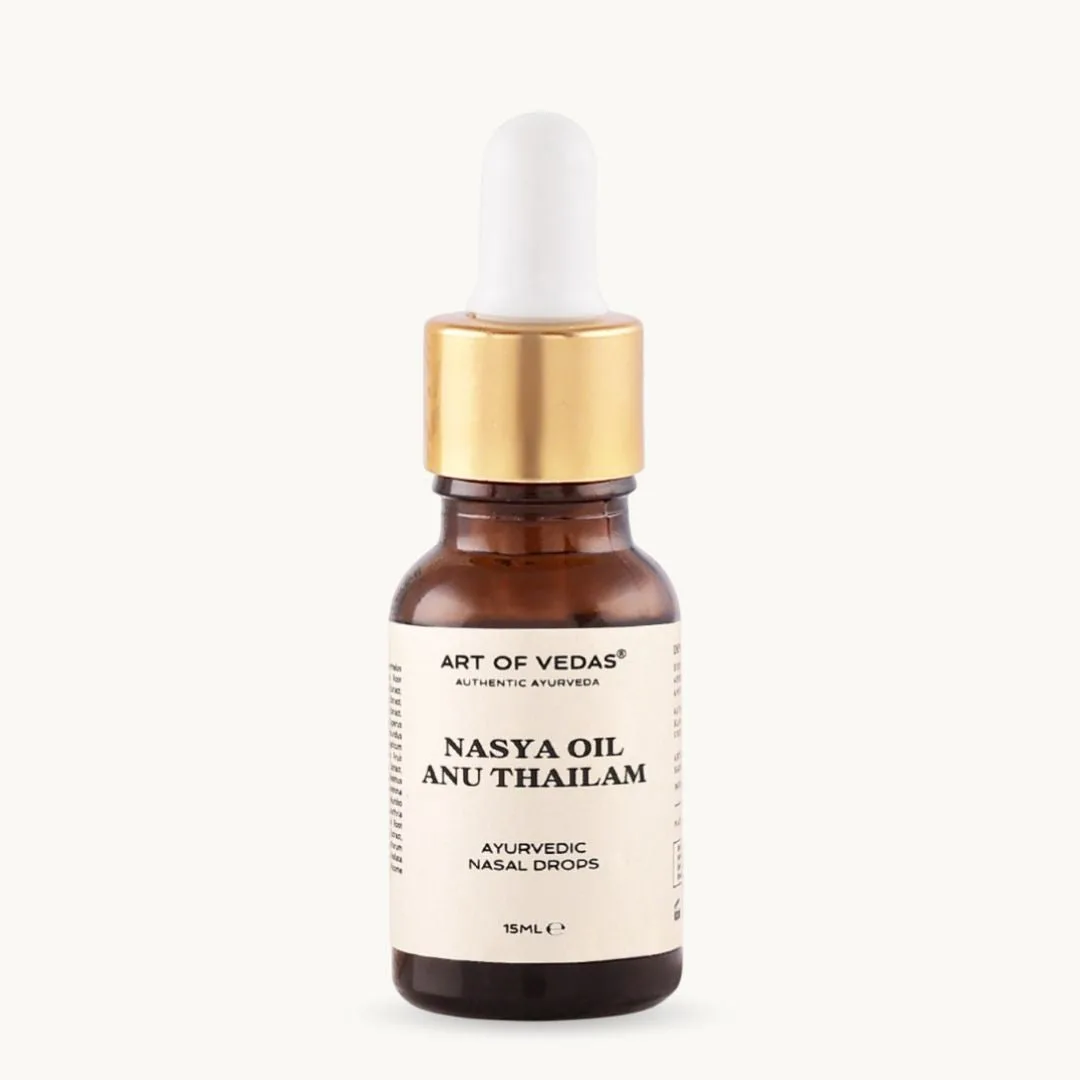
Anu Tailam, the classical Marma and Nasya oil of Ayurveda, a base of 24 botanicals in sesame oil.
Anu Tailam is a classical Ayurvedic preparation recorded in the Ashtanga Hridaya and known in the tradition of Nasya and Marma. Art of Vedas keeps its composition in the original form: an anhydrous base of 24 botanicals in sesame oil, in a 15 ml bottle. This page sets out what the oil is, the classical tradition it belongs to, and the heavy-metal and microbiological test results recorded for every batch.
What Anu Tailam is
Anu Tailam is a classical Ayurvedic herbal oil, prepared by Art of Vedas as a Marma and Nasya oil. It is anhydrous, meaning it contains no added water: a base of 24 botanicals in sesame oil, with nothing else added and no preservative needed. The bottle holds a net 15 ml and carries a period after opening of 12 months. It is made in India under cosmetic Good Manufacturing Practice, following ISO 22716 principles, and is not tested on animals, in line with Article 18 of the EU Cosmetics Regulation.
The full INCI list begins with Sesamum Indicum (sesame) seed oil and continues through the further classical botanicals, including Cyperus rotundus, Cedrus deodara, Glycyrrhiza glabra, Asparagus racemosus, Aegle marmelos, Ocimum sanctum and Nelumbo nucifera, for 24 botanicals in all. Four fragrance components present naturally in these aromatic botanicals are declared as EU rules require: Cinnamal, Eugenol, Linalool and Limonene. The complete ordered ingredient list is given further down this page.
Nasya and Marma in classical Ayurveda
Anu Tailam takes its name from the classical Ayurvedic literature, where it appears in the Ashtanga Hridaya. In the tradition it is associated with the practice of Nasya, the administration of oil through the nasal passages, which the classical texts count among the principal practices of Dinacharya, the daily routine. The Sanskrit name Anu Tailam is the name the texts themselves use, and Art of Vedas keeps it intact as part of the formulation’s heritage.
Marma refers to the vital points described in Ayurveda: places on the body where the classical texts hold that consciousness and the elements meet. In Ayurvedic massage these points on the face, neck and shoulders are worked with warmed oil and slow, attentive movement, and Anu Tailam belongs to this lineage of oils.
Art of Vedas presents the oil within that classical frame, describing the practice rather than any outcome. Nasya and Marma are described here as Ayurvedic tradition and heritage. The oil itself is offered as the classical Anu Tailam, kept in its original composition and tested with every batch.
Quality and testing
Tested with every batch
Every production batch of Anu Tailam is tested before it is released for sale. Two things are checked: heavy metals, by a laboratory method called ICP-MS, and microbiological safety, against the EU standard for cosmetics, ISO 17516:2014. The figures below are representative results; every batch is retested before release.
Heavy metals
Five heavy metals were tested. Each one came back below the detection limit, which means the test could not find any. The right-hand column shows the maximum level allowed under German BfR guidance for leave-on cosmetics, so you can see how far below the limit the results sit.
| Metal | Result | Permitted maximum |
|---|---|---|
| Lead (Pb) | Below detection limit | max 2 mg/kg |
| Cadmium (Cd) | Below detection limit | max 0.1 mg/kg |
| Mercury (Hg) | Below detection limit | max 0.1 mg/kg |
| Arsenic (As) | Below detection limit | max 0.5 mg/kg |
| Nickel (Ni) | Below detection limit | max 5 mg/kg |
ICP-MS stands for inductively coupled plasma mass spectrometry, a standard laboratory method for detecting metals. The limits shown are the German BfR guidance values for leave-on cosmetics, in milligrams per kilogram (mg/kg).
Microbiological safety
Microbiological safety is tested against ISO 17516:2014, the EU standard for cosmetics. The overall counts of microbes stay within the limits set for leave-on products, and four specific organisms that cosmetics must be free of were each absent.
| Test | Result |
|---|---|
| Total Aerobic Microbial Count | Within the EU limit |
| Total Yeast and Mould Count | Within the EU limit |
| Escherichia coli (E. coli) | Absent (not found) |
| Pseudomonas aeruginosa | Absent (not found) |
| Staphylococcus aureus (Staph) | Absent (not found) |
| Candida albicans | Absent (not found) |
ISO 17516:2014 sets the microbiological limits for cosmetic products; the leave-on thresholds apply to this oil.
Further assurances
- An anhydrous, water-free oil, so it needs no added preservatives.
- Made in India under cosmetic Good Manufacturing Practice, following ISO 22716 principles.
- Not tested on animals, in line with Article 18 of the EU Cosmetics Regulation.
Full ingredients
The complete INCI list, given in order. The base is sesame oil, carrying the extracts of the classical botanicals:
Sesamum Indicum (Sesame) Seed Oil, Vetiveria Zizanioides (Vetiver) Root Extract, Cyperus Rotundus (Nutgrass) Rhizome Extract, Holostemma Ada-Kodien (Holostemma) Root Extract, Coleus Zeylanicus (Coleus) Root Extract, Cedrus Deodara (Cedarwood) Wood Extract, Cinnamomum Zeylanicum (Cinnamon) Bark Extract, Hemidesmus Indicus (Indian Sarsaparilla) Root Extract, Berberis Aristata (Indian Barberry) Stem Extract, Glycyrrhiza Glabra (Licorice) Root Extract, Asparagus Racemosus (Shatavari) Root Extract, Saccharum Officinarum (Sugarcane) Extract, Aegle Marmelos (Bael) Root Extract, Kaempferia Rotunda (Round Zedoary) Rhizome Extract, Pseudarthria Viscida (Pseudarthria) Extract, Desmodium Gangeticum (Desmodium) Extract, Ocimum Sanctum (Holy Basil) Leaf Extract, Solanum Melongena (Eggplant) Root Extract, Aerva Lanata (Mountain Knotgrass) Root Extract, Embelia Ribes (False Black Pepper) Fruit Extract, Mesua Ferrea (Ironwood) Flower Extract, Elettaria Cardamomum (Cardamom) Seed Extract, Piper Cubeba (Cubeb) Fruit Extract, Nelumbo Nucifera (Lotus) Extract, Sida Cordifolia (Country Mallow) Extract, Cinnamal, Eugenol, Linalool, Coumarin, Benzyl Benzoate, Limonene
Cinnamal, Eugenol and Linalool occur naturally within the aromatic botanicals of the formulation. They are listed because EU rules require these fragrance components to be declared.
Product details
- Net content: 15 ml.
- Period after opening: 12 months.
- Made in India.
Precautions
- For external use only. Do not use internally.
- Avoid contact with the eyes. If contact occurs, rinse with water.
- Keep out of reach of children.
- If irritation occurs, discontinue use.
- Store in a cool, dry place away from direct sunlight.
Anu Tailam Nasya Oil: questions on quality, testing and use
- What is Anu Tailam Nasya oil?
- Anu Tailam is a classical Ayurvedic herbal oil recorded in the Ashtanga Hridaya and associated in the tradition with Nasya and Marma. Art of Vedas prepares it as an anhydrous Marma and Nasya oil, a base of 24 botanicals in sesame oil, in a 15 ml bottle. It contains no added water and no preservative.
- Is Anu Tailam tested for heavy metals?
- Yes. Every batch is tested for five heavy metals by ICP-MS (inductively coupled plasma mass spectrometry). Lead, Cadmium, Mercury, Arsenic and Nickel each came back below the detection limit, meaning the method could not find them. Results are benchmarked against German BfR guidance for leave-on cosmetics: Lead max 2, Cadmium max 0.1, Mercury max 0.1, Arsenic max 0.5 and Nickel max 5 mg/kg.
- Is this Ayurvedic oil microbiologically safe and EU compliant?
- Yes. Microbiological safety is tested to ISO 17516:2014, the EU cosmetics standard. Total Aerobic Microbial Count and Total Yeast and Mould Count stay within the leave-on limits, and Escherichia coli, Pseudomonas aeruginosa, Staphylococcus aureus and Candida albicans are each absent. The product also follows ISO 22716 cosmetic Good Manufacturing Practice principles and EU labelling and ingredient rules.
- Does Anu Tailam contain a preservative?
- No. The oil is anhydrous, meaning it contains no added water, so no preservative is needed or added. The formulation is the 24 botanicals in a sesame-oil base, nothing more.
- What are the ingredients in Anu Tailam?
- The base is Sesamum Indicum (sesame) seed oil, with the extracts of further classical botanicals including Cyperus rotundus, Cedrus deodara, Glycyrrhiza glabra, Asparagus racemosus, Aegle marmelos, Ocimum sanctum and Nelumbo nucifera, for 24 botanicals in all. Four fragrance components occurring naturally in these botanicals are declared as EU rules require: Cinnamal, Eugenol, Linalool and Limonene.
- How is Anu Tailam used in the Marma tradition?
- In Ayurvedic Marma massage, a small amount of oil is warmed between the palms and applied to the Marma points of the face, neck and shoulders, then worked with the fingertips in slow, even movements. The oil is left to rest on the skin for a few minutes before any excess is removed with a soft cloth. It is for external use only; avoid contact with the eyes.
- What does Nasya mean in Ayurveda?
- Nasya is the classical Ayurvedic practice of administering oil through the nasal passages, described in texts such as the Ashtanga Hridaya as part of Dinacharya, the daily routine. Anu Tailam is the oil the classical literature names in this context. Art of Vedas describes Nasya here as Ayurvedic heritage and tradition; the practice is part of the formulation’s history rather than a claim about the product.
- Is Anu Tailam tested on animals?
- No. Anu Tailam is not tested on animals, in line with Article 18 of the EU Cosmetics Regulation, which prohibits animal testing for cosmetic products placed on the EU market.
ART OF VEDAS
Bring Anu Tailam into your ritual
The classical Marma and Nasya oil of Ayurveda, kept in its original composition and tested with every batch. See the sizes, the full details and availability.
Shop Anu Tailam Nasya OilResponsible Person and distribution
Responsible Person (EU): Svedica B.V., Herengracht 449A, 1017BR Amsterdam, The Netherlands.
EU Distributor: Authentic Ayurveda d.o.o., Slavka Krautzeka 51, 51000 Rijeka, Croatia.
Anu Tailam by Art of Vedas: the classical Marma and Nasya oil of Ayurveda, kept in its original composition and tested for heavy metals and microbiological safety with every batch.