
AYURVEDIC BODY MASSAGE OIL
Prasarini Thailam
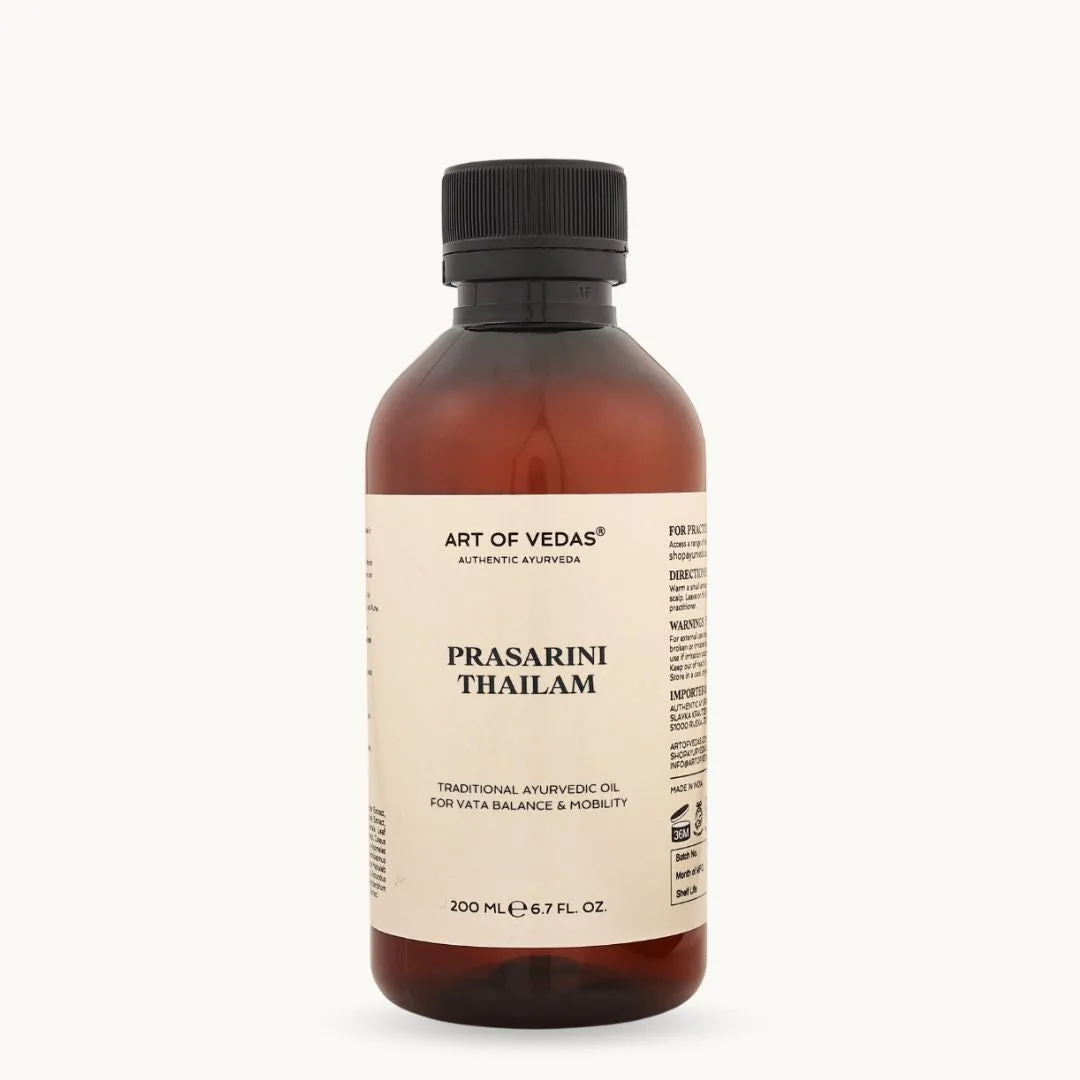
Prasarini Thailam, a classical body oil of Ayurveda, a sesame base carrying Prasarini and a blend of classical herbs, for body massage.
Prasarini Thailam is a classical Ayurvedic body massage oil. Art of Vedas keeps its composition in the classical form: a sesame oil base carrying Prasarini (Paederia foetida) and a blend of supporting herbs, cooked by the classical Sneha Paka method. It is massaged into the body. This page sets out what the oil is, the classical tradition it belongs to, and the heavy-metal and microbiological test results recorded for every batch.
What Prasarini Thailam is
Prasarini Thailam is a classical Ayurvedic herbal oil, prepared by Art of Vedas as a body massage oil. It is anhydrous, meaning it contains no added water: a sesame oil base carrying a classical blend of herbs, with no preservative needed. It is made in India under Good Manufacturing Practice following ISO 22716 principles, and not tested on animals. It carries a period after opening of 12 months and is offered in 200 ml and 5 litre sizes.
It is built on Prasarini (Paederia foetida), the herb that gives the oil its name, together with Devadaru, licorice and a range of supporting herbs in a sesame base. It also contains Laksha (Lac), a natural resin, so it is not vegan. It is a rich, warming oil for massage, worked into the body. The complete ordered ingredient list is given further down this page.
Prasarini Thailam in classical Ayurveda
Prasarini Thailam belongs to the classical body oils of Ayurveda, named for Prasarini (Paederia foetida), the spreading creeper at the heart of the formula.
It is prepared by the classical Sneha Paka method, in which the herbs are cooked slowly into a sesame oil base. In the tradition the oil is used for Abhyanga, the practice of slow, even massage: the warmed oil is worked into the body, left for a time, and followed by a warm bath.
Art of Vedas presents the oil within that classical frame, describing the practice rather than any outcome. The oil itself is offered as the classical Prasarini Thailam, kept in its original composition and tested with every batch.
Quality and testing
Tested with every batch
Every production batch of Prasarini Thailam is tested before it is released for sale. Two things are checked: heavy metals, by a laboratory method called ICP-MS, and microbiological safety, against the international standard ISO 17516:2014. The figures below are representative results; every batch is retested before release.
Heavy metals
Five heavy metals were tested by ICP-MS. Each one was within the permitted limit for products used on the skin. The right-hand column shows the maximum level allowed under German BfR guidance, so you can see the limit each result sits within.
| Metal | Result | Permitted maximum |
|---|---|---|
| Lead (Pb) | Within the permitted limit | max 2 mg/kg |
| Cadmium (Cd) | Within the permitted limit | max 0.1 mg/kg |
| Mercury (Hg) | Within the permitted limit | max 0.1 mg/kg |
| Arsenic (As) | Within the permitted limit | max 0.5 mg/kg |
| Nickel (Ni) | Within the permitted limit | max 5 mg/kg |
ICP-MS stands for inductively coupled plasma mass spectrometry, a standard laboratory method for detecting metals. The limits shown are the German BfR guidance values, in milligrams per kilogram (mg/kg).
Microbiological safety
Microbiological safety is tested against ISO 17516:2014. The overall counts of microbes stay within the limits, and the specific organisms that must not be present were each absent.
| Test | Result |
|---|---|
| Total Aerobic Microbial Count | Within the EU limit |
| Total Yeast and Mould Count | Within the EU limit |
| Escherichia coli (E. coli) | Absent (not found) |
| Pseudomonas aeruginosa | Absent (not found) |
| Staphylococcus aureus (Staph) | Absent (not found) |
| Candida albicans | Absent (not found) |
ISO 17516:2014 sets the microbiological limits for cosmetic products.
Further assurances
- Contains Laksha (Lac), a resin of natural (insect) origin, so it is not vegan.
- An anhydrous, water-free oil, so it needs no added preservatives.
- Made in India under Good Manufacturing Practice, following ISO 22716 principles; not tested on animals.
Full ingredients
The complete INCI list, given in order. The base is sesame oil, carrying Laksha, Prasarini, Devadaru, licorice and supporting herbs:
Sesamum Indicum (Sesame) Seed Oil, Laccifer Lacca (Laksha) Extract, Paederia Foetida (Prasarini) Extract, Cedrus Deodara (Cedar) Wood Extract, Glycyrrhiza Glabra (Licorice) Root Extract, Plumbago Zeylanica (Chitraka) Root Extract, Anethum Sowa (Dill) Seed Extract, Piper Longum (Long Pepper) Fruit Extract, Scindapsus Officinalis (Gajapippali) Fruit Extract, Sodium Chloride
The oil is sesame-based with classical herbs and Laksha (Lac), a resin of natural (insect) origin, so it is not vegan. Any naturally occurring fragrance allergens above the labelling threshold are declared at the end of the ingredient list on the pack. It is not tested on animals.
Product details
- Net content: 200 ml (also 5 litres).
- Period after opening: 12 months.
- Made in India.
Precautions
- For external use only. Do not use internally.
- Do a patch test before first use; if irritation occurs, discontinue use.
- Avoid contact with the eyes. Do not apply to broken or irritated skin.
- Keep out of reach of children.
- Store in a cool, dry place away from direct sunlight.
Prasarini Thailam: questions on quality, testing and use
- What is Prasarini Thailam?
- Prasarini Thailam is a classical Ayurvedic herbal oil named for Prasarini (Paederia foetida). Art of Vedas prepares it as an anhydrous body massage oil: a sesame oil base carrying Prasarini, Devadaru, licorice and supporting herbs, cooked by the classical Sneha Paka method, in 200 ml and 5 litre sizes. It is massaged into the body.
- Is Prasarini Thailam vegan?
- No. Prasarini Thailam contains Laksha (Lac), a natural resin of insect origin, so it is not vegan. It is not tested on animals.
- Is Prasarini Thailam tested for heavy metals?
- Yes. Every batch is tested for five heavy metals by ICP-MS. Lead, Cadmium, Mercury, Arsenic and Nickel were each within the permitted limit, benchmarked against German BfR guidance: Lead max 2, Cadmium max 0.1, Mercury max 0.1, Arsenic max 0.5 and Nickel max 5 mg/kg.
- Is Prasarini Thailam tested for microbiological safety?
- Yes. Microbiological safety is tested to ISO 17516:2014. Total Aerobic Microbial Count and Total Yeast and Mould Count stay within the limits, and Escherichia coli, Pseudomonas aeruginosa, Staphylococcus aureus and Candida albicans are each absent. The product is also made under ISO 22716 Good Manufacturing Practice principles.
- What are the ingredients in Prasarini Thailam?
- A sesame oil base carrying Laksha (Lac), Prasarini (Paederia foetida), Devadaru (Cedrus deodara), licorice and supporting herbs, with rock salt. The full ordered INCI list is given above.
- Does Prasarini Thailam contain a preservative?
- No. The oil is anhydrous, meaning it contains no added water, so no preservative is needed or added.
- Is Prasarini Thailam tested on animals?
- No. Prasarini Thailam is not tested on animals.
ART OF VEDAS
Bring Prasarini Thailam into your ritual
The classical Prasarini body oil of Ayurveda, kept in its original composition and tested with every batch. See the full details and availability.
Shop Prasarini ThailamResponsible Person and distribution
Responsible Person (EU): Svedica B.V., Herengracht 449A, 1017BR Amsterdam, The Netherlands.
EU Distributor: Authentic Ayurveda d.o.o., Slavka Krautzeka 51, 51000 Rijeka, Croatia.
Prasarini Thailam by Art of Vedas: the classical Prasarini body oil of Ayurveda, tested for heavy metals and microbiological safety with every batch.