For external use oils only. All topical products are for general wellbeing as part of a self-care routine. Not a substitute for professional medical advice for any joint or musculoskeletal condition.
Ayurvedic Joint and Muscle Care: Classical Oils, Treatments and Daily Practices for Mobility
Joint stiffness and muscular discomfort are among the most common presentations in Ayurvedic clinical practice, and they have been since the classical texts were written. Charaka Samhita devotes specific chapters to the Vata disorders that underlie most joint and muscle conditions, and Ashtanga Hridayam's treatment chapters describe the oils, preparations, and procedures that have been used for this purpose for at least fifteen hundred years of documented practice.
The Ayurvedic approach to joints and muscles is not primarily anti-inflammatory in the modern pharmacological sense. It is a system of nourishing and lubricating the tissues that have become depleted or disturbed, restoring the natural oil content of the joint spaces, and regulating the Vata that governs movement through the channels. This guide covers the classical understanding, the Thailams most specifically indicated, the home-applicable treatments, and the daily practices that maintain joint and muscle health over time. Art of Vedas provides several of the preparations described here, prepared according to classical method.
The Ayurvedic Understanding of Joints and Muscles
In Ayurvedic anatomy, the joints (Sandhi) are classified as sites where Kapha naturally accumulates to provide lubrication and cushioning. This Kapha within the joint space - called Shleshaka Kapha - maintains the smooth movement of bone against bone and the integrity of the surrounding connective tissue. When Vata becomes disturbed, it dries out this Kapha fluid. The result is the cracking, stiffness, pain on movement, and degeneration that characterises the major Vata joint disorders described in Charaka Samhita Chikitsasthana.
Muscles (Mamsa Dhatu) are governed by Kapha in their nourished state and by Vata in their functional state. Depletion of Mamsa tissue through overuse, undernutrition, prolonged stress, or age weakens the muscular framework that protects and supports the joints. The classical treatments for joint conditions therefore address both the Vata disturbance (through warming, lubricating oils and treatments) and the Mamsa depletion (through nourishing Rasayana herbs and preparations).
Vata and the Joint Disorders of Classical Ayurveda
Charaka Samhita Chikitsasthana Chapter 28 describes the Vata-type joint disorders in detail. The relevant classical categories include Amavata (a condition involving Ama - undigested metabolic residue - combined with Vata disturbance, producing joint symptoms with systemic involvement), Sandhigata Vata (Vata specifically lodged in the joints, producing degeneration and cracking without significant swelling), and Vatarakta (Vata combined with blood disorder, producing acute joint presentations with redness and heat).
These classical categories do not map precisely onto modern diagnostic categories, nor do they need to. What they describe are the tissue conditions and dosha patterns that determine which treatment approach is most appropriate. For home self-care, the most relevant distinction is between the dry, stiff, cold joint presentations (pure Vata pattern, most common in autumn and winter, in older individuals, and in those with Vata constitutions) and the hot, red, swollen joint presentations (Pitta or Vatarakta pattern, requiring a different approach with cooling rather than warming treatments).
For most people in European climates, the dry, cold, stiff presentation dominates. This is the pattern most amenable to the warming Thailam approach described below.
The Most Important Classical Thailams for Joints and Muscles
The selection of the appropriate Thailam is the most consequential decision in home Ayurvedic joint care. Different classical oils are formulated for different joint presentations, and using the wrong oil - cooling when warming is needed, or warming when cooling is needed - will not produce the desired outcome.
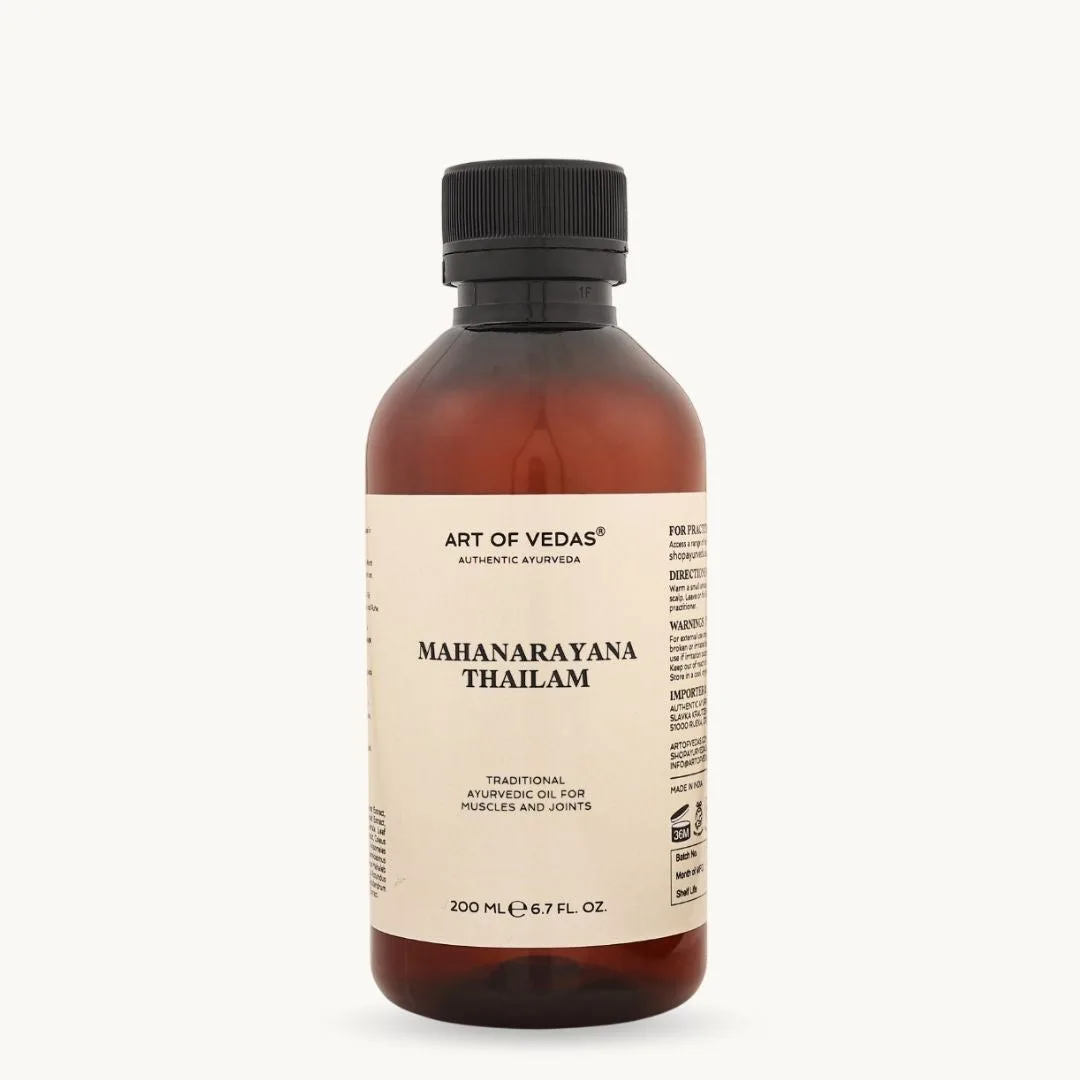
Mahanarayana Thailam
Mahanarayana Thailam is described in Sahasrayogam and Ashtanga Hridayam as one of the principal formulations for Vata disorders affecting the joints, muscles, and spine. It is one of the most complex classical Thailams, prepared with a decoction of over 50 herbs in sesame oil base, and is specifically cited for conditions of joint stiffness, muscular tension, spinal care, and the Vata disorders associated with the back and lower limbs. Its warming quality and deeply penetrating action on the muscle and joint tissue make it the most widely used classical oil for musculoskeletal presentations 's Ayurvedic tradition. It is appropriate for the dry, stiff, cold joint presentation and for muscular tension and lower back stiffness.
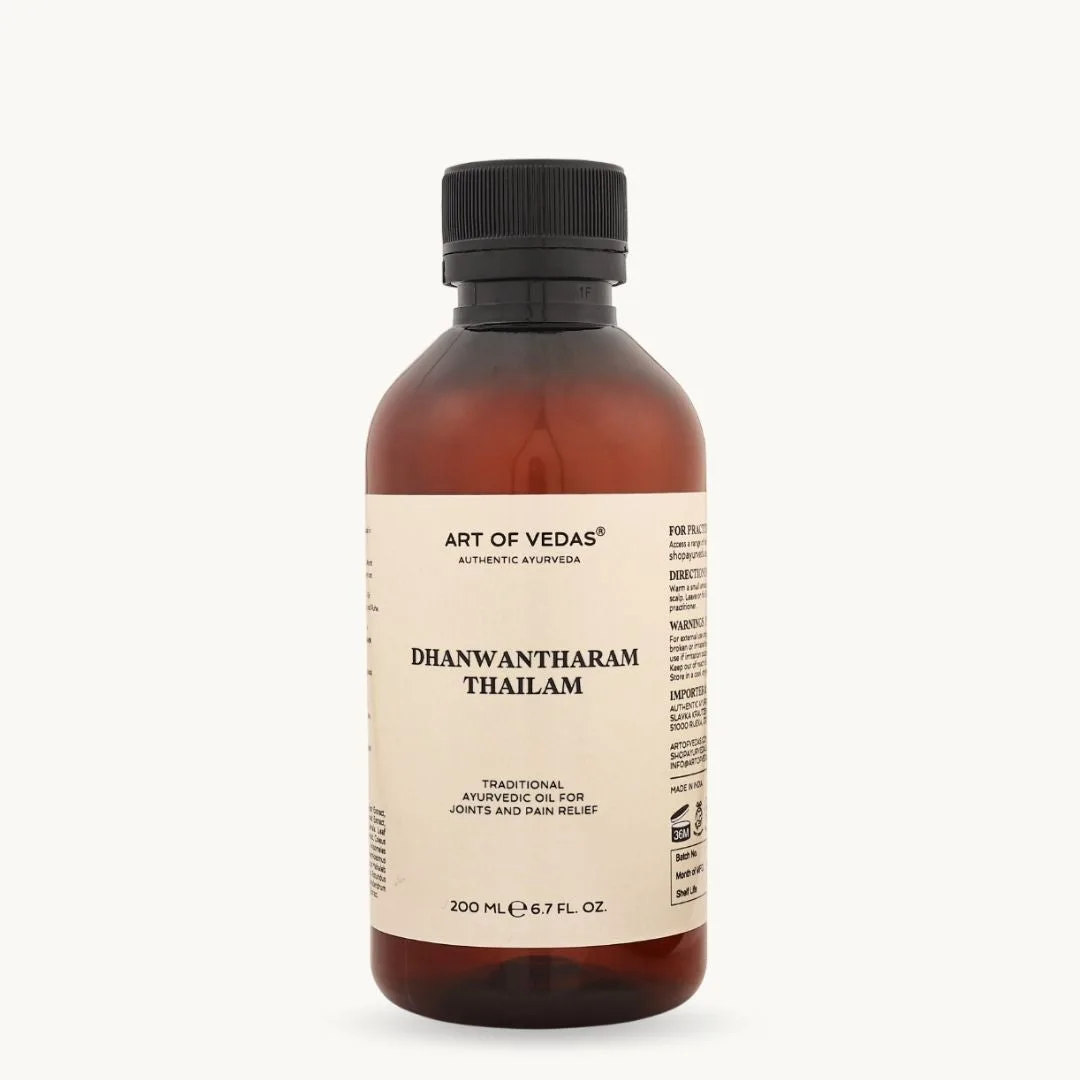
Dhanwantharam Thailam
Dhanwantharam Thailam, described above in the Vata imbalance guide, is a primary Vata-pacifying oil with broad applications. For joint care, it is particularly appropriate when the joint condition accompanies general Vata imbalance - dryness, nervousness, poor sleep, and overall depletion combined with joint stiffness. Its classical indication includes post-illness recovery, postnatal Vata restoration, and conditions affecting the neuromuscular system broadly.
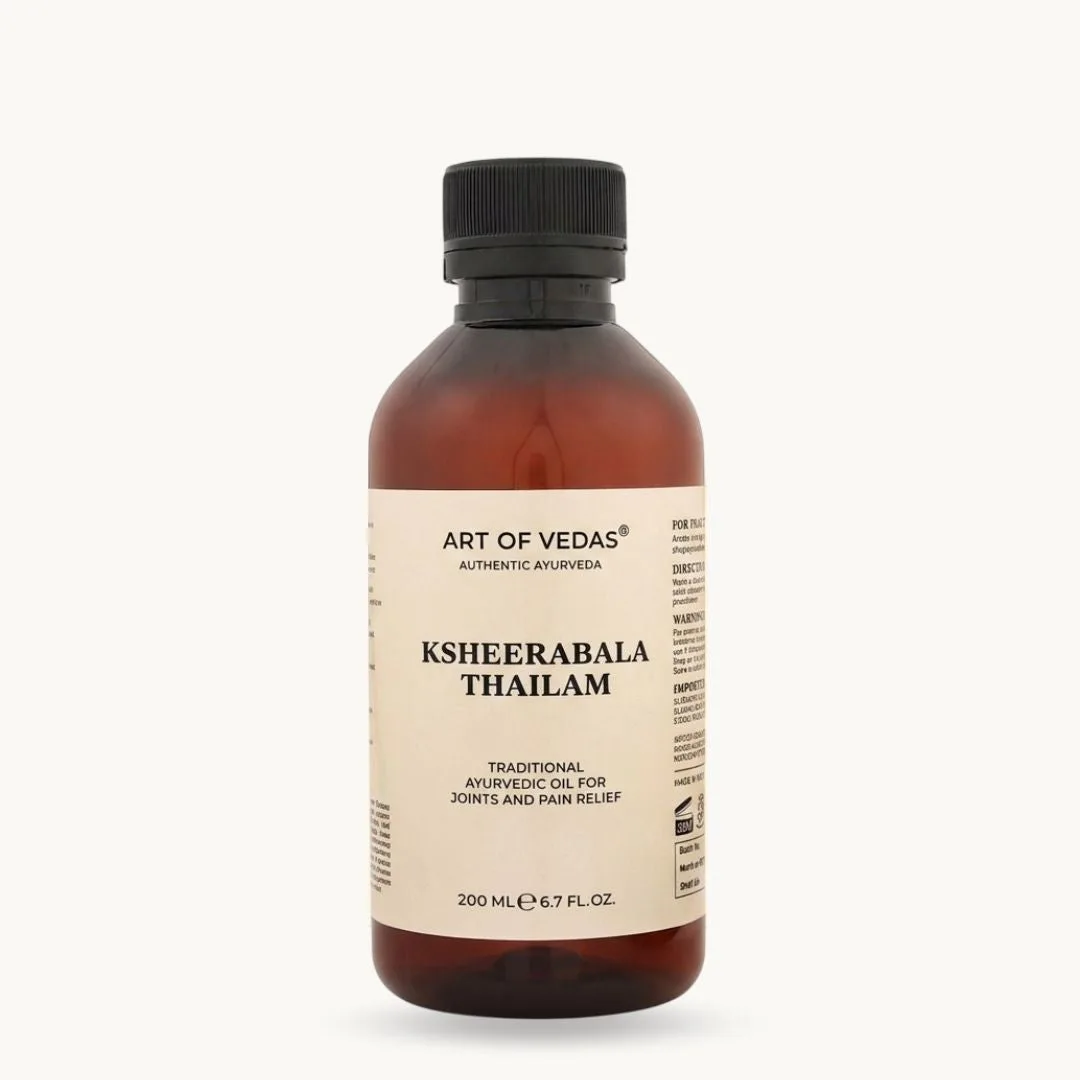
Ksheerabala Thailam
Ksheerabala Thailam is prepared with Bala root (Sida cordifolia) processed in both sesame oil and milk (Ksheera). The addition of milk as a processing medium adds a nourishing, cooling quality that makes Ksheerabala more appropriate for joint conditions where there is some heat or where the tissue depletion aspect is significant. Charaka Samhita cites Ksheerabala specifically for Vata disorders affecting the nerves and joints, particularly in cases of depletion and weakness accompanying the joint presentation.
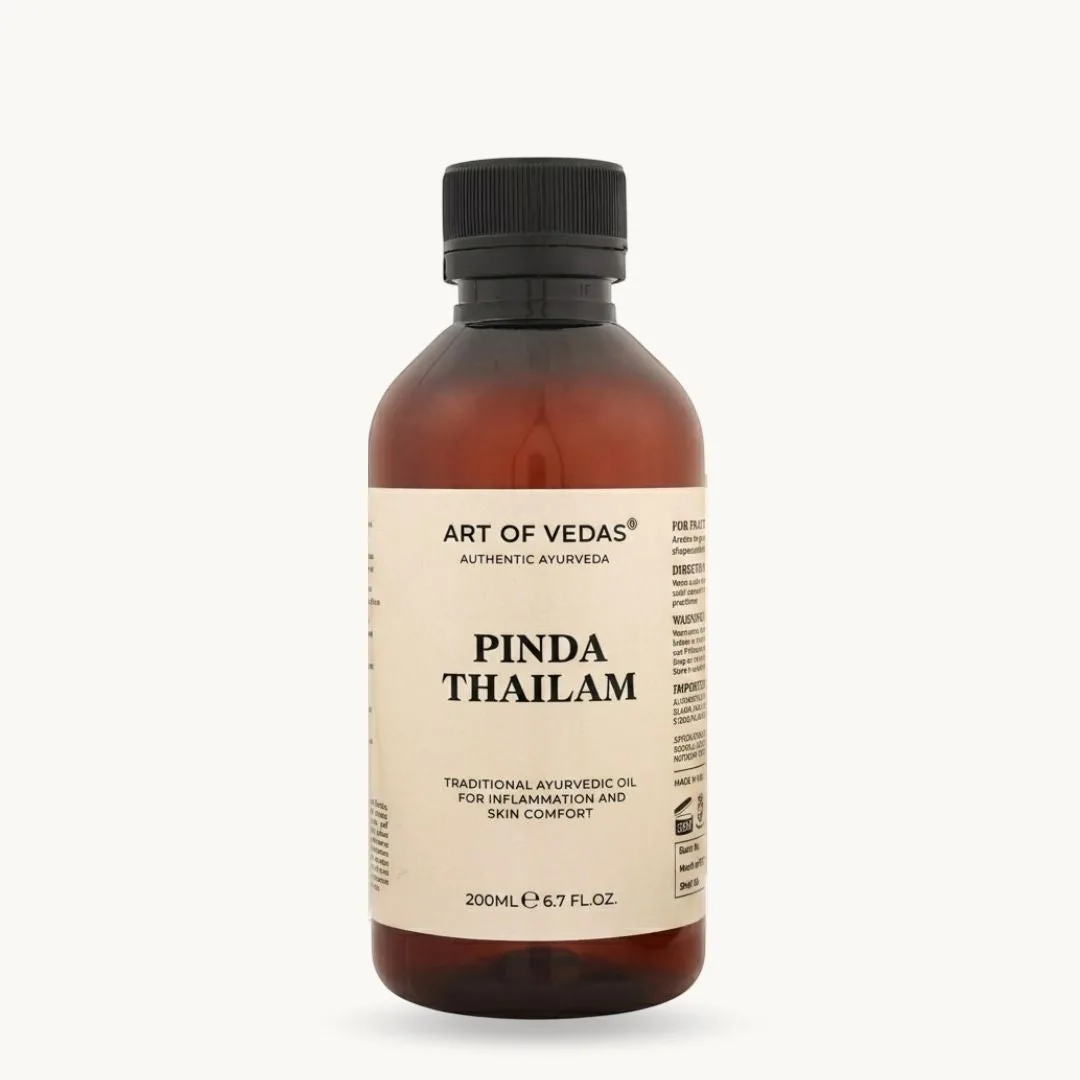
When heat is present
If the joint is hot, swollen, red, or acutely inflamed, the warming Mahanarayana and Dhanwantharam Thailams are contraindicated. A hot, inflamed joint requires a cooling approach. Pinda Thailam, with its cooling properties, is the classical first choice for such presentations. See the Pinda Thailam guide for details. For acute inflammatory joint presentations, professional guidance is always recommended before applying any oil.
How to Apply Thailam for Joints
The classical application method for joint oils in Ayurveda differs from full-body Abhyanga. Joint-specific oil application is called Samvahana or localised Snehana, and it focuses the application and massage on the specific joint or muscle region rather than the full body.
Warm the oil to above body temperature. Apply generously to the joint and surrounding tissue. Massage with moderate pressure using circular movements at the joint itself and long strokes along the muscle belly above and below. The Ashtanga Hridayam advises oil massage in the direction of the muscle fibres for tense muscles and in circular strokes at the joints themselves. Leave the oil on for at least 20-30 minutes. Follow with warmth - either a warm cloth applied to the oiled area, or a warm bath or shower.
Consistency matters far more than duration. A 15-minute daily application with warm oil over four to six weeks produces cumulative benefits that a single long session cannot match. The classical texts describe Snehana (oiling) as a practice that requires sustained repetition for the oil to penetrate progressively deeper tissue layers.
Basti: The Classical Joint Treatment
For specific joint areas - the lower back (Kati Basti), the knee (Janu Basti), and the neck (Greeva Basti) - classical Ayurveda uses a procedure in which warm medicated oil is pooled directly over the joint within a dough ring for an extended period. This Basti procedure allows the oil to penetrate and nourish the specific joint at sustained temperature for 30-45 minutes. It is among the most effective classical interventions for deep joint conditions and is described in detail in the Ashtanga Hridayam Chikitsasthana.
The Kati Basti, Janu Basti, and Greeva Basti procedures require a second person to maintain the dough ring and warm oil throughout the treatment. The Basti treatment guide provides the full procedure for home application of these classical localised treatments.
Internal Formulations for Joint and Muscle Support
External oil application is the primary classical treatment for joint and muscle conditions, but the classical texts consistently describe it in combination with internal preparations. The most important internal preparations for joint care include:
Yogarajaguggulu is among the most cited classical formulations for joint support in Charaka Samhita and Ashtanga Hridayam. It combines Guggulu resin with Trikatu (three pungents), Triphala, and specific herbs for joint and metabolic support. Guggulu is described as specifically scraping and clearing Ama from the joint spaces - the undigested metabolic residue that contributes to the Amavata presentation.
Triphala churna is used as a supporting preparation for its gentle Ama-clearing and metabolic regulation properties. The Triphala guide covers this formulation in detail. Ashwagandha preparations provide the Mamsa Dhatu (muscle tissue) nourishment that supports the muscular framework protecting the joints. For more on Ashwagandha as a supporting formulation, see the Ashwagandha capsules guide.
All internal preparations should be used under the guidance of a qualified Ayurvedic practitioner, particularly where joint conditions are significant or where other medications are involved. The Art of Vedas consultation service can provide personalised guidance for specific joint presentations.
Daily Practices That Protect Joint Health
The classical approach to joints is preventive as much as it is therapeutic. Charaka Samhita Sutrasthana's chapters on Dinacharya (daily routine) and Ritucharya (seasonal routine) both include specific guidance on maintaining joint and muscle health through daily practices.
Daily warm oil Abhyanga is the single most important preventive practice for joint health in classical Ayurveda. The Charaka Samhita Sutrasthana Chapter 5 lists it as specifically beneficial for the joints and specifically preventive of Vata disorders. Gentle daily movement - walking, yoga, swimming - maintains the natural lubrication of the joint spaces by stimulating the production of Shleshaka Kapha. The Ashtanga Hridayam is specific that Vyayama (exercise) should not be taken to exhaustion, as this depletes Mamsa and Ojas and weakens the joint supporting structures.
See the Thailam collection for the full range of classical oils available from Art of Vedas for joint and muscle care. The Abhyanga at home guide provides the full self-massage technique that is the daily foundation of joint health in classical practice.
Frequently Asked Questions
Can I use Mahanarayana Thailam if I have an acute joint injury?
For acute injuries in the first 24 to 48 hours - sprains, strains, significant impacts - cold application is generally preferred before introducing oil massage. The warming quality of Mahanarayana Thailam is not appropriate in the acute inflammatory phase. Once the acute phase has settled (typically after 48-72 hours), gentle warm oil application can begin. For any significant acute injury, medical assessment is always the first step.
How often should I apply joint oil?
The classical protocol for active joint stiffness is daily application. For maintenance and prevention, three times weekly is sufficient in most cases. The Ashtanga Hridayam describes the progressive benefit of oil treatment (Snehana) as cumulative - the oil penetrates progressively deeper tissue layers with each successive application, which is why consistency over weeks is more important than a single prolonged application.
Does age affect which oil to use?
Yes. The classical texts explicitly describe the Vata phase of life as beginning from around 60 years onward, and the increasing joint stiffness and dryness of later life as a natural Vata accumulation. For older individuals, more nourishing, heavier oils are appropriate: Ksheerabala and Dhanwantharam are particularly well-suited. Younger individuals with acute joint stiffness from overuse or sport may respond well to Mahanarayana Thailam's more specifically musculoskeletal action.
Is there anything I should avoid eating if I have joint conditions?
The Ayurvedic dietary guidance for joint conditions focuses primarily on reducing Ama (undigested residue) and Vata-aggravating foods. This means avoiding cold, raw, and dry foods; reducing nightshade vegetables (potato, tomato, aubergine, pepper) which are considered Vata-aggravating in the classical texts; reducing cold dairy; and avoiding large meals eaten at irregular times. Warm, freshly cooked food with ginger and other digestive spices, eaten at consistent times, is the dietary foundation of classical joint care.