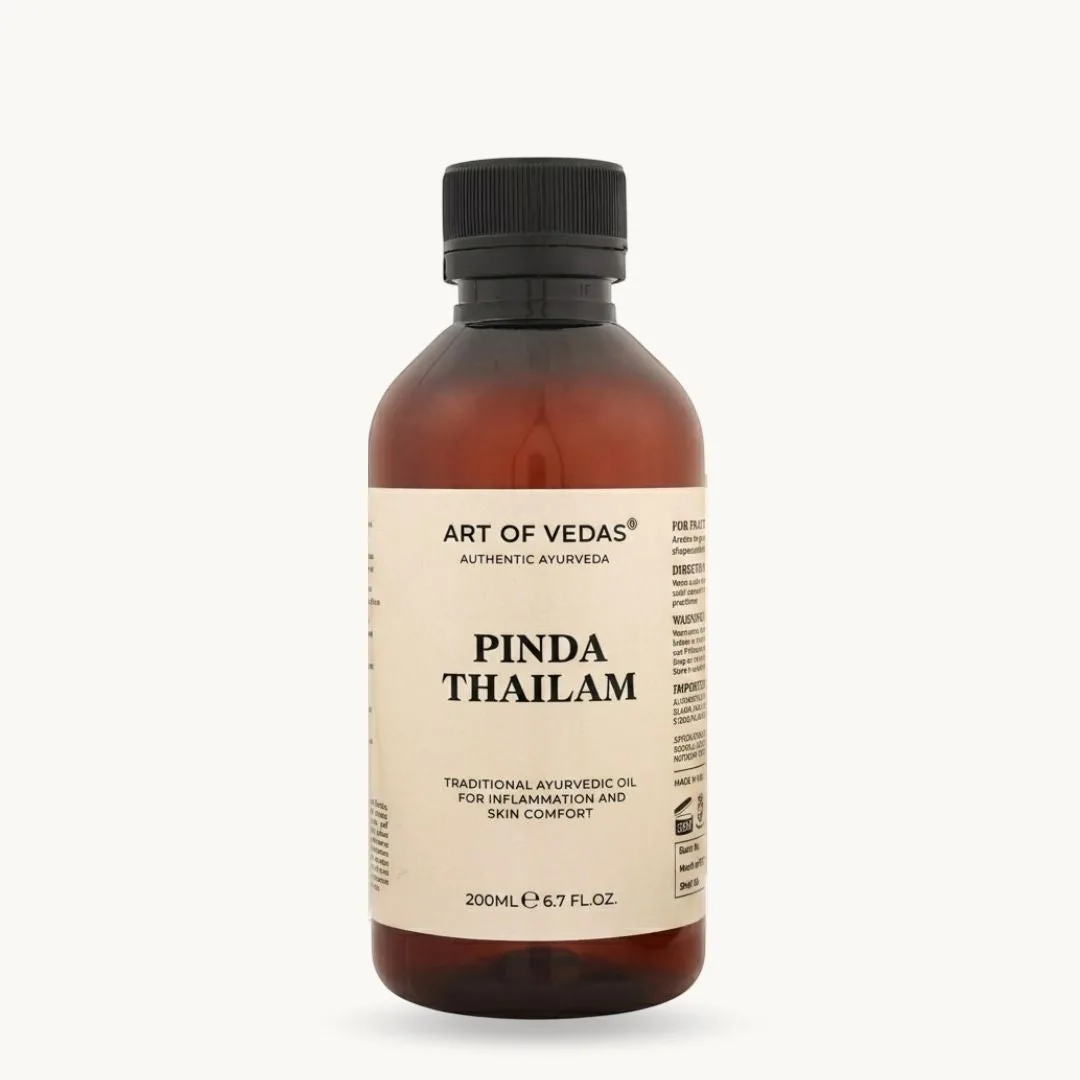
In brief: Pinda Thailam (also written Pinda Taila, Pinda Thailam, Pinda Tel or Pinda oil) is a classical Ayurvedic massage oil in which Manjistha and Sariva roots are cooked into sesame oil. Described in the Ashtanga Hridayam and the Sahasrayogam, it is a cooling oil, classically placed with Pitta and Vata, and traditionally used for Abhyanga of the joints and limbs. The name comes from Pinda, a bolus, after the Pinda Sweda application in which warm boluses are used. This guide covers what it is, how it is made, how to apply it, and how it compares with the warming Vata oils such as Dhanwantharam Thailam.
Pinda Thailam: The Classical Cooling Oil for Pitta-Type Joint and Skin Conditions
Reviewed by Dr. Anu Joy, MD (Ayurveda), Ayurvedic doctor of Art of Vedas
The Name and Its Classical Significance
Pinda in Sanskrit means a bolus, ball or lump. The name directly references the traditional Pinda Sweda application technique - a classical Ayurvedic therapy in which warm medicated boluses wrapped in cloth are applied rhythmically to the body. In clinical Panchakarma practice, Pinda Sweda is performed with boluses soaked in medicated oil, and Pinda Thailam is among the classical oils used in this context. The name reflects the oil's classical therapeutic positioning - not a general-purpose daily oil but a formulation placed within a specific clinical application method.
Classical Foundation: The Ksheerapaka Processing Method
Pinda Thailam is prepared through the Ksheerapaka Taila method - the same milk-based processing technique used for Ksheerabala Thailam, though the herb composition and resulting therapeutic character differ significantly. The Ksheerapaka process involves cooking the primary herbs in fresh milk until the milk solids are fully incorporated, then combining this milk decoction with sesame oil and cooking until only the oil remains. The milk processing transfers the cooling and Pitta-pacifying properties of milk into the oil base, giving the resulting Taila its Sheeta (cooling) character that cannot be achieved through standard water-decoction processing.
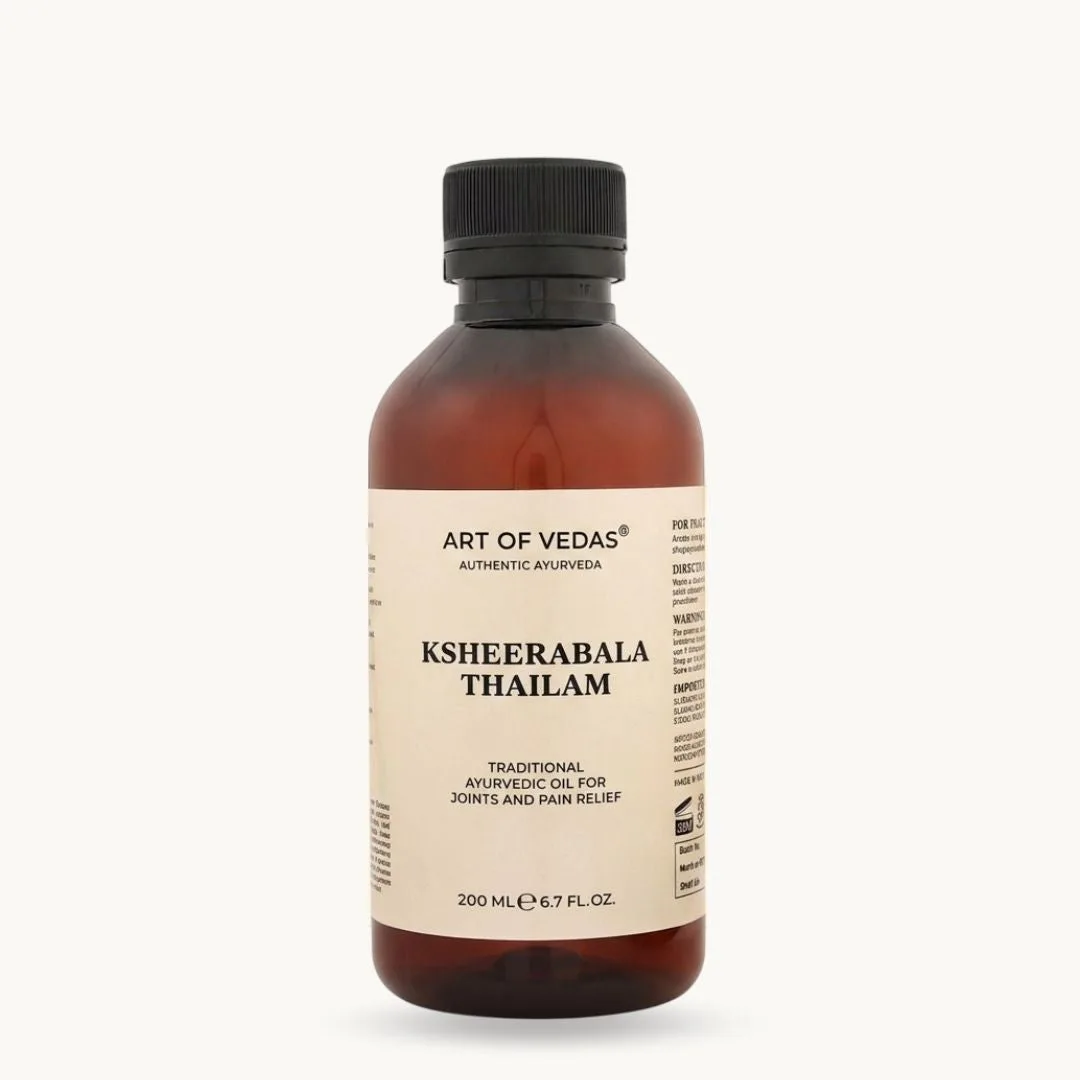
The distinction between the two milk-processed oils lies in the primary herbs and focus: Ksheerabala centres on Bala (Sida cordifolia) with primary affinity for Majja Dhatu (nervous tissue) and neural depletion. Pinda Thailam's composition is oriented towards the musculoskeletal system and skin, specifically for presentations with prominent heat and Pitta-Vata involvement at the tissue and joint level.
Classical Indications: The Conditions Pinda Thailam Addresses
The Ashtanga Hridayam, Charaka Samhita and Sahasrayogam describe the following as the primary classical indications for Pinda Thailam:
Vatarakta (Pitta-Vata joint condition with heat and burning): The classical Vatarakta is described as a condition where Vata and Rakta (blood tissue, reflecting Pitta excess) combine in the joints, producing a characteristic combination of pain, burning heat, redness and sensitivity. This is the defining indication for Pinda Thailam - the presentation where the joint is not merely stiff and cold (which calls for a warming Vata oil) but visibly inflamed, hot to the touch and associated with a burning quality. Pinda Thailam's cooling, milk-processed character directly addresses the Pitta-Rakta dimension that warming oils would aggravate. For those with conditions affecting the joints described in this way, the Joint and Muscle Support collection contains the full range of classical formulations for this presentation.
Visarpa (Spreading Pitta-type skin conditions): The classical Visarpa describes conditions characterised by spreading, burning and heat in the skin - attributed to Pitta-Rakta involvement in the Twak (skin) channel. Applied externally, Pinda Thailam's Sheeta Virya directly counters the spreading heat quality. The Skin Health and Balance collection at Art of Vedas includes formulations specifically suited to this type of presentation.
Pitta-type joint conditions with heat and redness: Beyond the specific Vatarakta classification, any joint condition presenting with inflammatory heat - worse in summer and during the Pitta hours, aggravated by Pitta-provoking foods and associated with burning or sharp pain quality - is the classical context for Pinda Thailam. The contrast with warming Vata joint conditions (stiff, cold, worse in cold weather) is the key diagnostic distinction the classical texts provide.
Burning sensations in the feet and hands (Paada Daaha): Described in the Ashtanga Hridayam as a Pitta excess presentation in the peripheral channels, burning sensations in the feet and palms respond classically to Sheeta Virya oil application. Pinda Thailam applied to the feet before sleep is a classical Ashtavaidya recommendation for this presentation.
Postpartum support: Pinda Thailam is described classical practice as among the oils appropriate for postpartum external application where Pitta is elevated in the recovery period. Postpartum classical formulations are available in the Postpartum Recovery collection.
Pinda Thailam vs. Other Classical Oils: The Thermal Framework
The most useful framework for Pinda Thailam's position in the classical range is thermal - warming vs. Cooling.
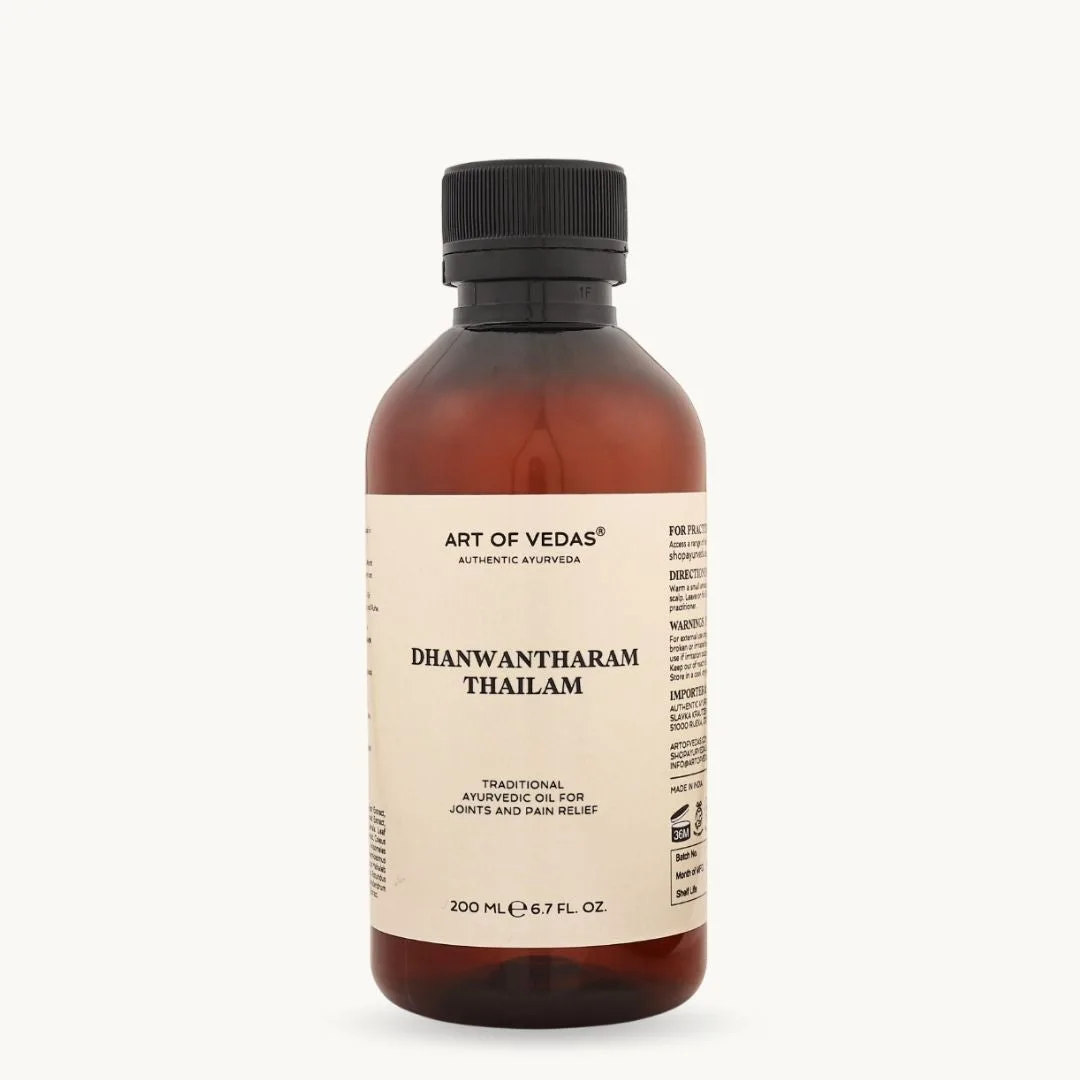
Dhanwantharam Thailam is warming and nourishing - for general Vata, cold stiff joints, and daily Abhyanga for Vata constitutions. When joints are stiff, cold and creak on movement but are not inflamed, Dhanwantharam is the classical answer.
Mahamasha Thailam is warming and heavily nourishing - for deep muscular and neural Vata depletion. Clearly contraindicated in presentations with active heat.
Ksheerabala Thailam is cooling but primarily neural - for Vata-neural depletion with Majja Dhatu involvement and Pitta elevation alongside depletion.
Pinda Thailam is cooling and musculoskeletal - for joint and skin conditions where Pitta-Vata involvement produces heat, burning and inflammation as the primary features. This is its specific and non-substitutable role.
Mahanarayana Thailam is broad-spectrum Vata (Sarva Vata Hara) - appropriate for diffuse Vata aggravation without a prominent thermal character.
The complete framework is covered in the guide to comparing classical Ayurvedic massage oils.
Seasonal Relevance and Dosha Context
The Ashtanga Hridayam describes Pitta as aggravating in summer. The period from late spring through summer is when Pitta-type joint and skin conditions are most commonly aggravated - and when Pinda Thailam becomes most relevant as an external therapy. For Pitta-dominant and Vata-Pitta constitutions, the classical seasonal recommendation is to shift from warming Vata oils toward cooling Pitta-appropriate formulations during summer months. The Dosha-specific massage oils in the Abhyanga Oils collection and Dosha Massage Oil collection reflect this seasonal approach, and the Pitta Dosha Massage Oil provides a blended formulation for Pitta constitutions alongside the classical Pinda Thailam. For a general starting point across all constitutions, the Tri Dosha Massage Oil is also available for those who want a balanced, all-season formulation.
How to Apply Pinda Thailam
For Abhyanga application, Pinda Thailam is warmed gently in the palms - not overheated, as excessive heat reduces its cooling character - and applied with sustained strokes to the affected areas. For joint conditions, focus on the specific joints with steady circular strokes around the joint capsule. Allow the oil to remain for 30 to 45 minutes before bathing in cool or lukewarm water. For the burning-feet presentation, applying the oil before sleep with cotton socks to maintain contact through the night is a classical home-practice approach.
For Vata-Pitta dual constitutions, a practical combination is Pinda Thailam on the inflamed joints alongside Dhanwantharam Thailam on the broader muscular areas - addressing both the Pitta inflammatory and Vata structural dimensions simultaneously. The full classical Abhyanga technique is described in the Art of Vedas Abhyanga guide. The complete Abhyanga collection is in Body Rituals (Abhyanga).
Frequently Asked Questions
How do I know whether I need a warming or cooling Ayurvedic oil?
The classical test is the thermal character of the presentation. Stiff, cold joints worse in cold weather with a contracted, dry quality - these are Vata cold signs, and a warming oil like Dhanwantharam Thailam is classically appropriate. Hot, tender, reddened joints worse in summer heat with a burning quality - these are Pitta heat signs, and Pinda Thailam's cooling character is the classical response. For mixed presentations, alternating or combining the oils under practitioner guidance is the classical approach. The Art of Vedas Dosha assessment provides a structured constitutional starting point.
Can Pinda Thailam be used for daily Abhyanga by a Pitta constitution?
Yes. For a clearly Pitta-dominant constitution, Pinda Thailam is an appropriate daily Abhyanga oil during summer months. In cooler months, even Pitta constitutions benefit from the nourishing warmth of an oil like Dhanwantharam Thailam. The Dosha-specific formulations in the Abhyanga Oils collection and the Pitta Dosha Massage Oil provide accessible entry points for Pitta constitutions beginning an Abhyanga practice.
Is Pinda Thailam appropriate during pregnancy?
Pinda Thailam is described classical practice as appropriate for certain postpartum external applications where Pitta is elevated. For use during pregnancy, any medicated oil should be used only under the guidance of a qualified Ayurvedic practitioner. The Postpartum Recovery collection at Art of Vedas covers the classical oils used in this context.
Can Pinda Thailam be used alongside warming Vata oils?
Yes - for mixed Vata-Pitta presentations, using both simultaneously on different areas is a classical clinical approach. Pinda Thailam on the inflamed joints or hot skin areas, and Dhanwantharam Thailam or Mahanarayana Thailam on the broader muscular and structural areas. A qualified Ayurvedic practitioner can guide the appropriate combination for a specific presentation.
What classical texts describe Pinda Thailam?
The primary classical references are the Ashtanga Hridayam, Chikitsa Sthana, Chapters 19 (Vatarakta Chikitsa) and 21 (Vata Vyadhi Chikitsa). The Sahasrayogam includes Pinda Thailam in its classical formulations for Pitta-Vata musculoskeletal conditions, and the Ashtavaidya tradition has maintained it as a standard clinical offering, providing unbroken practical validation of its classical indications across centuries of practice.
For external use only. Pinda Thailam is a traditional Ayurvedic medicated oil. It is not intended to diagnose, treat, cure or prevent any disease and is not a substitute for professional medical advice. Consult a qualified Ayurvedic practitioner for conditions involving joint inflammation or persistent skin conditions.
Frequently asked questions about Pinda Thailam
What is Pinda Thailam? A classical Ayurvedic massage oil in which Manjistha and Sariva roots are cooked into sesame oil, described in the Ashtanga Hridayam and the Sahasrayogam. The name comes from Pinda, the Sanskrit word for a bolus or ball, after the Pinda Sweda application in which warm boluses are used. It is also written Pinda Taila, Pinda Thailam, Pinda Tel or Pinda oil.
What is Pinda Thailam used for? For Abhyanga, the Ayurvedic oil massage, on the joints and limbs, and as one of the oils used in Pinda Sweda. It is a cooling oil, classically placed with Pitta and Vata, and the classical texts describe it where warmth is not wanted, in contrast to the warming Vata oils. Art of Vedas sells Pinda Thailam as an oil for external use.
How do you use Pinda Thailam? Warm a little Pinda Thailam in the palms, not in hot water, so that its cooling character is kept, and apply it to the joints and limbs with steady circular strokes around the joints and long strokes along the limbs. Leave it on the skin for 30 to 45 minutes, then wash with lukewarm water. For one area, massage a small amount in until it is absorbed.
Is Pinda Thailam a warming or a cooling oil? Cooling. Most classical Ayurvedic massage oils, such as Dhanwantharam and Mahanarayana Thailam, are warming and placed with Vata. Pinda Thailam is the classical cooling oil of the range, placed with Pitta and Vata, and is the oil to reach for in the warm months or for a Pitta constitution, when a warming oil is not wanted. Ask a qualified Ayurvedic practitioner which suits you.
What is Pinda Sweda, and is Pinda Thailam used in it? Pinda Sweda is a classical Ayurvedic application in which warm boluses (Pinda) wrapped in cloth are moved rhythmically over the body by a trained practitioner. It is carried out in a clinic or Panchakarma setting, not at home. Pinda Thailam takes its name from this practice and is among the oils classically used in it; at home it is applied as an ordinary Abhyanga oil.
Can Pinda Thailam be used on the face or for skin whitening? Pinda Thailam is not a skin-lightening product and Art of Vedas makes no claim about skin tone. It is a body oil for Abhyanga of the joints and limbs; with its wax it is thicker than a face oil and is not sold for the face. The classical texts describe it only as a cooling massage oil placed with Pitta and Vata, not as a cosmetic for the complexion.
What is Pinda Thailam made of? The Art of Vedas Pinda Thailam declares sesame seed oil, in which Manjistha (Rubia cordifolia) root and Sariva (Hemidesmus indicus) root are cooked, set with a wax that gives the oil its thicker body. It is a short list compared with the long Vata oils. The full declaration is printed on the product page and on the label of the bottle.
Can Pinda Thailam be used in pregnancy, after delivery or for children? Ask your doctor or a qualified Ayurvedic practitioner first; Art of Vedas gives no use recommendation for pregnancy, the weeks after delivery or children. Pinda Thailam is for external use only. Do a small skin test on the inner forearm before the first full application and keep it away from the eyes and broken skin.