In brief: Bala Ashwagandha Thailam (also written Balashwagandha Taila, Bala Ashwagandha oil, Balashwagandha Thailam or simply Ashwagandha Thailam) is a classical Ayurvedic massage oil in which Bala root and Ashwagandha root lead a list of plants cooked into sesame oil with Laksha. Its full classical name is Balaswagandhadi Thailam, the oil of Bala, Ashwagandha and the others, described in the Sahasrayogam, and that is the name under which Art of Vedas sells it. This guide covers what the oil is, how it is used for Abhyanga and on the head, and how it compares with Ksheerabala and Dhanwantharam Thailam.
Bala Ashwagandha Thailam: the Balaswagandhadi oil and how to use it
Reviewed by Dr. Anu Joy, MD (Ayurveda), Ayurvedic doctor of Art of Vedas
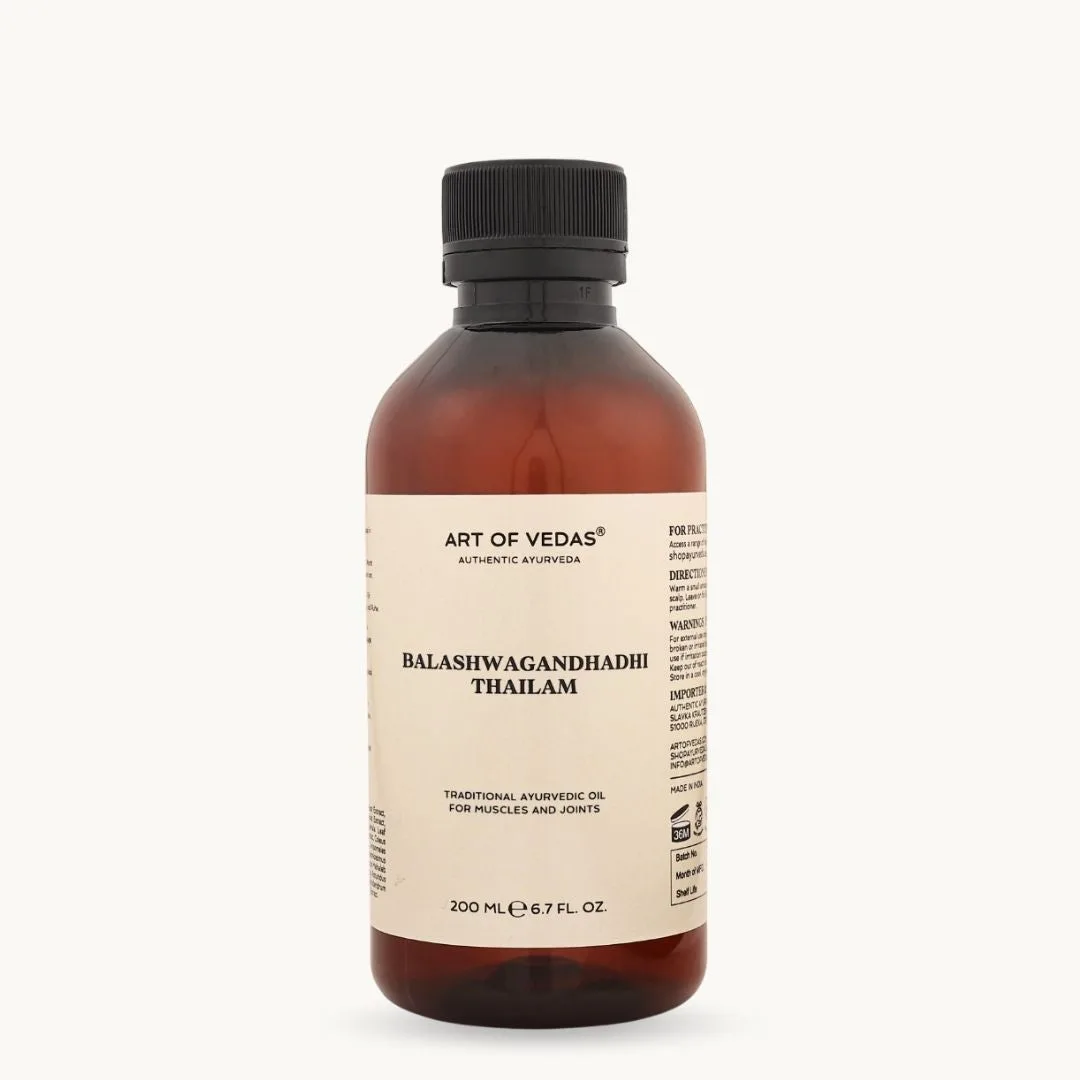
What Bala Ashwagandha Thailam is and what the name means
Bala is the root of Sida cordifolia, the country mallow; Ashwagandha is the root of Withania somnifera. The ending adi in the full name Balaswagandhadi means "and the others": Bala, Ashwagandha and the plants that follow them in the recipe. Balashwagandha and Bala Ashwagandha are the same two words written together or apart; Taila, Thailam, Thailam and oil are one word in different spellings.
So Bala Ashwagandha Thailam, Balashwagandha Taila, Balaswagandhadi Thailam and Ashwagandha Thailam all name one classical oil. The Art of Vedas Balaswagandhadi Thailam is that oil. Sugandha Thailam and Gandha Thailam look similar but are different classical recipes and are not covered here.
The classical description
Balaswagandhadi Thailam is described in the Sahasrayogam. The classical recipe names, among others, Bala root, Ashwagandha root and Laksha, the lac resin, followed by a group of plants that includes Rasna (galangal root), Manjishtha, Durva grass, liquorice root, Sariva (Indian sarsaparilla), Ushira (vetiver root), Musta (nutgrass), deodar wood, turmeric, blue lotus and lotus flowers, dill seed and Priyangu. The Art of Vedas oil declares Bala, Ashwagandha, Laksha and this group in a sesame seed oil base, with mahaleb cherry seed in the place of Priyangu.
The preparation follows the Sneha Paka method: decoction, paste and sesame oil are cooked slowly together until the water has gone. Our complete guide to traditional Thailams describes the method step by step.
Character in Ayurvedic terms
Bala and Ashwagandha are the two nourishing roots of the Vata oils, and the classical texts place Balaswagandhadi Thailam with Vata. Unlike the hot, spice-heavy Vata oils, this recipe surrounds its two lead roots with cooling and sweet plants: Durva, vetiver, Sariva, liquorice and the two lotus flowers. The tradition therefore describes it as a balancing oil, nourishing to Vata without heating Pitta, neither strongly warming nor cooling on the skin.
How Bala Ashwagandha Thailam is used in practice
Abhyanga of the body. Warm the closed bottle in a bowl of warm water for a few minutes until a drop feels pleasantly warm on the inner wrist; never use a microwave. Apply a generous amount with long strokes along the limbs and circular strokes around the joints, leave it on the skin for 15 to 20 minutes, then take a warm shower or bath. Daily, or two to three times a week, is the usual rhythm.
Shiroabhyanga, the head massage. Balaswagandhadi Thailam is one of the oils the tradition names for the head. Warm a small amount, part the hair and work the oil into the scalp with the fingertips in slow circles for five to ten minutes. Leave it on for at least half an hour, or overnight with a towel on the pillow, then wash the hair as usual, once or twice a week. The full sequence is in our Abhyanga guide.
Thailam or Kuzhambu. The same recipe is also made as Balaswagandhadi Kuzhambu, in which castor oil is cooked alongside sesame oil. The Kuzhambu is thicker and slower to absorb, the form for a longer, heavier massage; the Thailam is lighter and suits daily Abhyanga and the head. Our Kuzhambu guide explains the forms.
Who should ask first
Balaswagandhadi Thailam is for external use only. Do a small skin test on the inner forearm before the first full application, and keep the oil away from the eyes and broken skin. It declares sesame and Laksha: not for anyone who reacts to sesame, and not vegan. If you are pregnant or wish to use any oil on a child, ask your doctor or a qualified Ayurvedic practitioner first.
Balaswagandhadi, Ksheerabala and Dhanwantharam Thailam
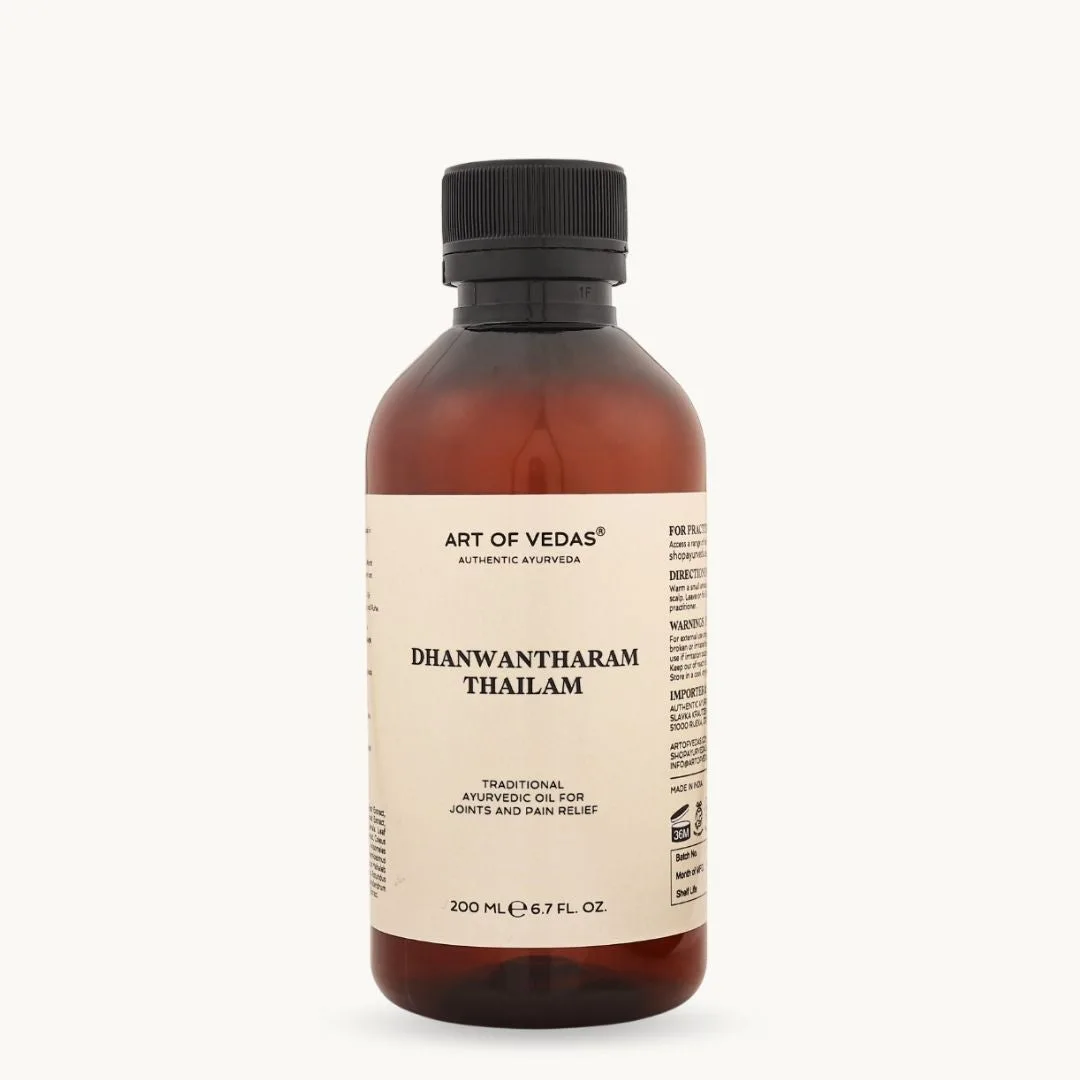
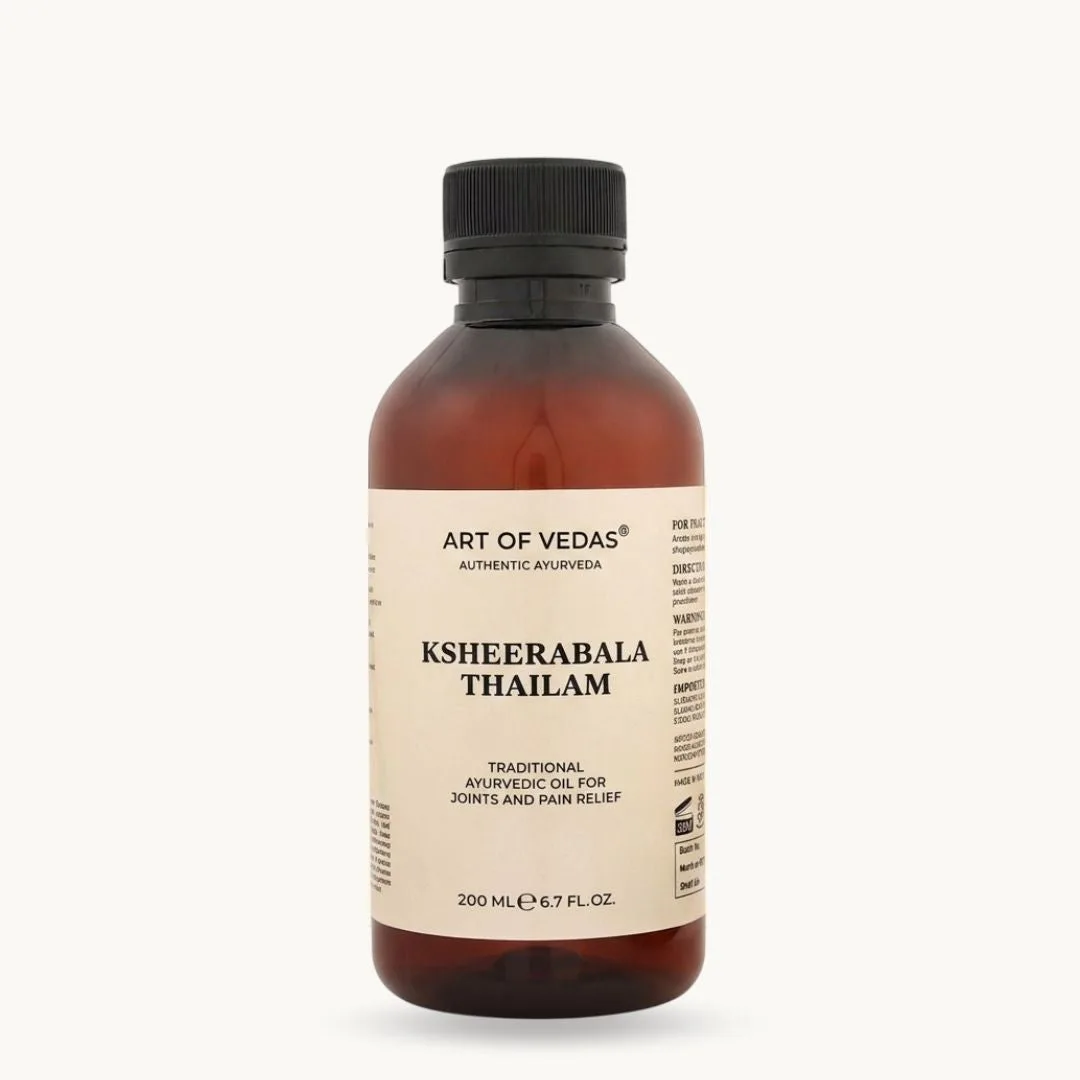
All three are Bala-led sesame oils placed with Vata. Ksheerabala Thailam is the simplest: Bala alone, cooked into sesame oil by the Ksheerapaka method, the mildest of the family and the one most often used on the head and face. Dhanwantharam Thailam adds the Dashamoola roots, barley, jujube and horse gram and is the mildly warming oil for a regular daily routine. Balaswagandhadi Thailam adds Ashwagandha and Laksha to Bala and sits between the two: fuller than Ksheerabala, less warming than Dhanwantharam, for body and head alike. Our comparison of Ayurvedic massage oils sets the whole range side by side.
Frequently asked questions about Bala Ashwagandha Thailam
What is Bala Ashwagandha Thailam? A classical Ayurvedic massage oil in which Bala root and Ashwagandha root lead a list of plants cooked into sesame oil with Laksha. Its full name is Balaswagandhadi Thailam, described in the Sahasrayogam, and it is also written Balashwagandha Taila, Bala Ashwagandha oil or Ashwagandha Thailam. Art of Vedas sells it in 200 ml.
What is Balashwagandha Taila used for? For Abhyanga, the Ayurvedic oil massage of the body, and for Shiroabhyanga, the oil massage of the head. The classical texts place Balaswagandhadi Thailam with Vata and describe it as a nourishing, balancing oil that does not heat Pitta, which is why it is also named for the head.
Is Ashwagandha Thailam the same as Balaswagandhadi Thailam? In practice, yes. Ashwagandha Thailam, Bala Ashwagandha Thailam, Balashwagandha Taila and Balaswagandhadi Thailam are spellings and shortenings of one classical oil whose recipe opens with Bala and Ashwagandha. A product sold simply as Ashwagandha oil may be a plain infusion, so check that Bala and Laksha are declared on the list.
How do you use Bala Ashwagandha oil? Warm the closed bottle in warm water, apply the oil with long strokes along the limbs and circular strokes around the joints, leave it on for 15 to 20 minutes and wash off with a warm shower. For the head, work a small amount into the scalp, leave it for half an hour or overnight, then wash the hair.
Can Balaswagandhadi Thailam be used on the head? Yes. It is one of the body oils the tradition also names for Shiroabhyanga, because its recipe balances the nourishing roots with cooling plants. Warm a little, massage it into the scalp, leave it on for at least half an hour and wash the hair as usual, once or twice a week.
Is Bala Ashwagandha Thailam warming? Only mildly. The classical texts place Balaswagandhadi Thailam with Vata, but the recipe surrounds Bala and Ashwagandha with sweet and cooling plants, so the finished oil is described as balancing rather than hot. Dhanwantharam Thailam is warmer, Mahanarayana Thailam warmer still.
What is the difference between Balaswagandhadi Thailam and Kuzhambu? The recipe is the same; the base differs. The Thailam is cooked in sesame oil and is lighter, suited to daily Abhyanga and the head. Balaswagandhadi Kuzhambu adds castor oil, is thicker and slower to absorb, and is the form used for a longer, heavier massage of the limbs.
Can Bala Ashwagandha Thailam be used in pregnancy or for children? Ask your doctor or a qualified Ayurvedic practitioner first. Balaswagandhadi Thailam is for external use only; do a small skin test on the inner forearm before the first full application, and keep it away from the eyes and broken skin.