This article is part of our The Complete Guide to Dhanwantharam Thailam: Ancient Ayurvedic Oil for Modern Wellness guide series.
The information in this article is provided for educational purposes and reflects traditional Ayurvedic knowledge. It is not intended as medical advice and should not replace consultation with a qualified healthcare professional.
In brief: Dhanwantharam Thailam is named after Dhanwanthari, the divine physician of Ayurvedic tradition, and is referenced in the Ashtanga Hridayam and Sahasrayogam as the primary classical oil for Vata conditions, postnatal recovery, and full-body Abhyanga. This guide covers the classical texts, the key herbs, correct application methods, and why this Thailam holds a unique position in the classical pharmacopoeia.
Dhanwantharam Thailam: The Oil That Ayurveda Considers the Foundation of Vata Care
Among the hundreds of classical medicated oils described in Ayurvedic texts, Dhanwantharam Thailam holds a singular position. Its name - taken from Dhanwanthari, the divine physician and patron deity of Ayurvedic medicine - signals its centrality in the classical tradition. This is not a peripheral or specialised preparation; it is described in the Ashtanga Hridayam and Sahasrayogam as the foundational Vata-balancing oil, the primary preparation for postnatal care, and one of the most broadly applicable classical Thailams in the entire pharmacopoeia.
Understanding why requires looking at both the formula itself and the classical framework within which it was developed. The Ashtanga Hridayam's Chikitsa Sthana contains detailed guidance on the use of Dhanwantharam Thailam across a remarkable range of Vata-related conditions - from full-body Abhyanga as a general wellness practice to specific applications in postnatal recovery, musculoskeletal support, and neurological care. The breadth of its classical applications reflects the formula's foundational design: it is built to address the Vata dosha across all its sites and manifestations.
Classical Origins: Dhanwanthari and the Texts
The Ashtanga Hridayam, composed by Vagbhata approximately in the seventh century CE and considered one of the three foundational classical texts of Ayurveda alongside the Charaka Samhita and Sushruta Samhita, contains the primary classical description of Dhanwantharam Thailam's composition and indications. The Sahasrayogam - the classical text that represents the culmination of the southern Ayurvedic tradition - provides detailed practical guidance on its preparation and application that reflects centuries of clinical refinement.
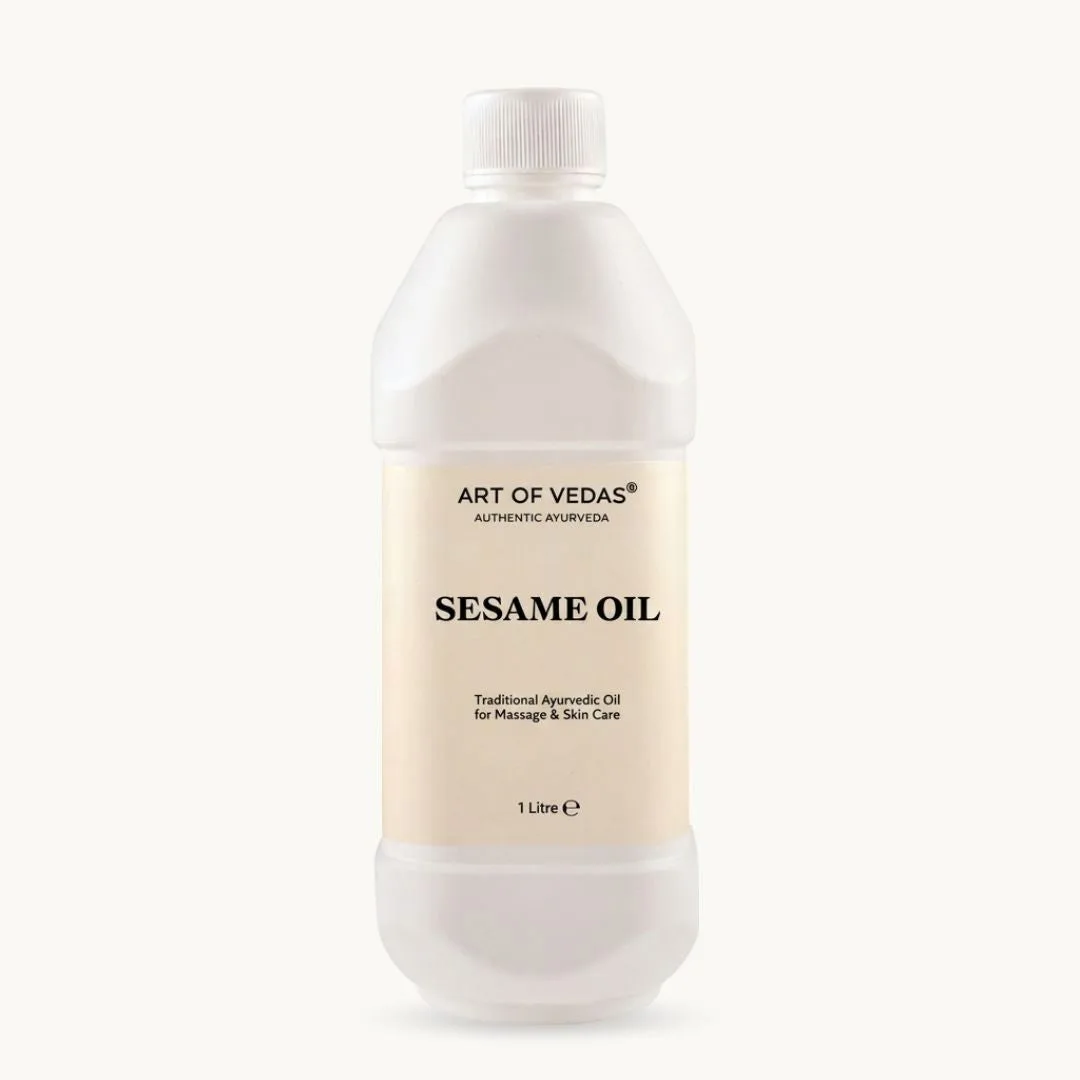
The formula is built around a sesame oil base processed with Bala (Sida cordifolia) as the primary herb. Bala is one of the most highly regarded classical herbs for Vata conditions: its name means "strength" in Sanskrit, and the classical texts describe it as nourishing, strengthening, Vata-balancing, and specifically supportive of the musculoskeletal and nervous tissues. The Ashtanga Hridayam classifies Bala among the Balya and Rasayana herbs, and its processing in sesame oil through the classical Thailam preparation method is understood in classical terms to concentrate and potentiate its actions.
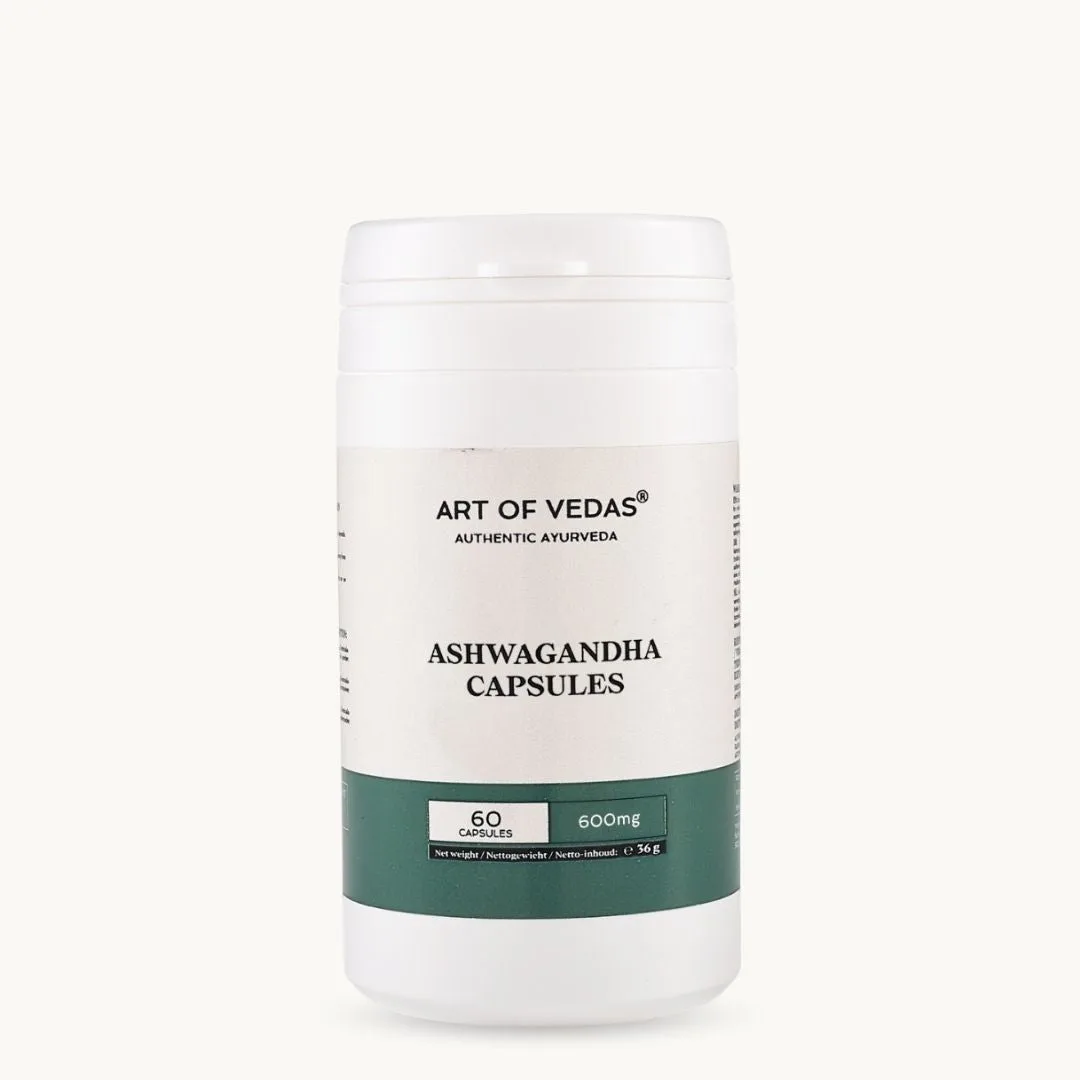
The supporting herbs in the formula include Ashwagandha (Withania somnifera), which reinforces the Vata-balancing and tissue-strengthening action of Bala; Dashamoola - the classical ten-root formula that is itself a complete Vata-pacifying compound; and a range of secondary herbs that contribute specific classical properties. The total herb count in the full classical formula varies between fifteen and twenty-five depending on the classical source and the manufacturer's fidelity to the original text, with some preparations adding additional herbs from the Sahasrayogam's extended formula.
Primary Applications: Postnatal Care
The Ashtanga Hridayam's most specific and detailed guidance on Dhanwantharam Thailam is in the context of postnatal recovery - Sutika Paricharya, the classical protocol for the care of a woman after childbirth. The text describes the period after delivery as one of significant Vata elevation: the physical effort of delivery, the movement and emptying involved, and the subsequent physiological changes all increase Vata dramatically. The classical texts describe this as the period when proper Vata management is most critical for the mother's long-term health.
Dhanwantharam Thailam is described in the Ashtanga Hridayam as the primary external preparation for this period - applied through daily Abhyanga to restore strength to the musculoskeletal tissues, nourish the nervous system, support the return to normal physiological function, and reduce the excess Vata created by delivery. The classical description of its postnatal use spans multiple chapters and includes specific guidance on timing, method, and duration that reflects the seriousness with which classical Ayurveda regarded this phase of a woman's life.
This classical indication makes Dhanwantharam Thailam particularly relevant for women in the postpartum period who are looking for traditionally grounded external care. The classical protocol involves daily warm oil massage beginning a few days after delivery, continuing through the first forty-two days - the period corresponding to the classical Sutika phase.
Abhyanga Application: The Daily Vata Practice
Beyond the specific postnatal context, Dhanwantharam Thailam is described in classical texts as an ideal oil for daily Abhyanga - the warm oil self-massage practice that the Charaka Samhita describes as fundamental to maintaining health in Vata-predominant individuals and in the Vata season of autumn and early winter.
The Charaka Samhita's Sutrasthana describes daily Abhyanga as producing soft, strong skin, supporting the musculoskeletal tissues, reducing excess Vata in the nervous system, delaying the appearance of ageing, and promoting sound sleep. Dhanwantharam Thailam's formula - sesame base with Bala, Ashwagandha, and Dashamoola - makes it particularly appropriate for full-body Abhyanga as a general Vata-management practice. Its warming potency nourishes the deeper tissues through the skin, and its classical formula provides benefits that plain sesame oil, while also useful, cannot fully replicate.
The correct method of Abhyanga with Dhanwantharam Thailam follows the classical guidance: warm the oil to body temperature or slightly above, apply from the head downward with long strokes on the limbs and circular strokes on the joints, allow at least fifteen to twenty minutes for absorption, and then bathe with warm (not hot) water. The classical texts emphasise applying the oil to the soles of the feet last and allowing extra time there, as the feet contain important marma points (vital energy points) whose stimulation is described as having systemic benefits. See our complete guide to Abhyanga at home.
Musculoskeletal and Neurological Applications
The Ashtanga Hridayam's descriptions of Dhanwantharam Thailam extend beyond postnatal care and general Abhyanga to specific conditions involving the musculoskeletal and nervous systems. The classical indications include Vata-related stiffness and reduced range of movement in the joints, weakness of the musculoskeletal tissues, neurological conditions arising from Vata imbalance, and the kind of generalised depletion and weakness that the Ashtanga Hridayam associates with severely elevated Vata.
The combination of Bala, Ashwagandha, and Dashamoola - all of which are independently classified in classical texts as having specific affinity for the musculoskeletal and nervous tissues - gives Dhanwantharam Thailam a particular depth of action in these systems that distinguishes it from simpler Vata-balancing oils. Dashamoola's ten roots include Bilva, Agnimantha, Shyonaka, Patali, Gambhari, Brihati, Kantakari, Shalaparni, Prishnaparni, and Gokshura - a classical combination specifically designed to address Vata across all its five subtypes (Prana, Udana, Vyana, Samana, and Apana Vata), making it perhaps the most systematically complete Vata-addressing formula in the classical pharmacopoeia.
For local application to specific areas of stiffness or tension, Dhanwantharam Thailam can be applied more concentrated to the affected area and allowed to absorb before gentle movement. Classical guidance for joint conditions typically involves local application twice daily alongside the general full-body Abhyanga.
How to Use Dhanwantharam Thailam
For general daily Abhyanga: warm a small amount of the oil and apply in the classical sequence - scalp, face, neck, shoulders, arms, chest, abdomen, back, legs, feet. Allow fifteen to thirty minutes before bathing. Daily practice provides cumulative benefits; consistency over weeks and months is described in classical texts as essential for Rasayana effects.
For postnatal care: begin under guidance after the immediate recovery phase. The classical protocol typically involves daily application, with particular attention to the abdomen, lower back, and lower limbs. Warmth - both of the oil and of the bathing water - is emphasised consistently in classical postnatal guidance.
For local musculoskeletal application: warm the oil and apply to the specific area with gentle massage for five to ten minutes. Allow absorption. For the lower back and joints, applying a warm compress after the oil increases absorption in classical Ayurvedic practice.
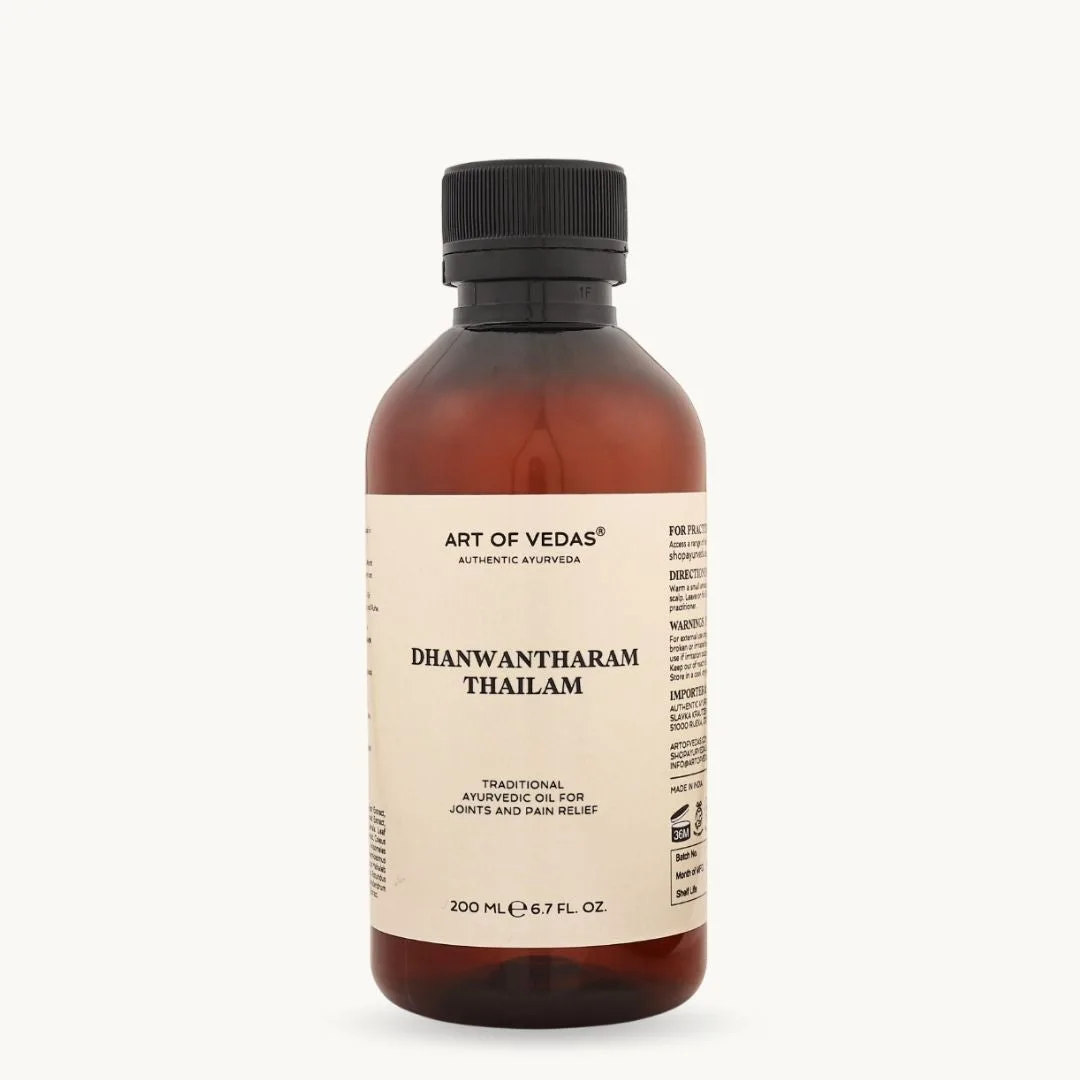
Browse the Art of Vedas Thailams collection for Dhanwantharam Thailam and related classical oils.
Frequently Asked Questions
What is Dhanwantharam Thailam used for?
Dhanwantharam Thailam is referenced in the Ashtanga Hridayam and Sahasrayogam as the primary oil for Vata conditions. Its main classical applications are postnatal recovery (Sutika Paricharya), daily Abhyanga for general Vata management, and local application for musculoskeletal conditions involving Vata-related stiffness and weakness. Its formula - sesame base with Bala, Ashwagandha, Dashamoola, and supporting herbs - addresses Vata across all its sites and manifestations.
What are the key herbs in Dhanwantharam Thailam?
The primary herb is Bala (Sida cordifolia) in sesame oil - classified in classical texts as Balya and Rasayana with specific affinity for musculoskeletal and nervous tissues. Supporting herbs include Ashwagandha and Dashamoola - the classical ten-root formula addressing all five Vata subtypes. The complete formula contains fifteen to twenty-five herbs depending on the classical source.
Can Dhanwantharam Thailam be used for Abhyanga?
Yes - the classical texts describe it as an ideal Abhyanga oil for Vata-predominant individuals and during the Vata season. The processed herbs add their specific actions to the base oil's Vata-balancing properties, making it more complete than plain sesame oil. Warm the oil, apply from head to feet, allow fifteen to thirty minutes absorption before bathing.
Is Dhanwantharam Thailam suitable for postnatal use?
It is specifically referenced in the Ashtanga Hridayam as the primary external preparation for Sutika Paricharya - the classical postnatal protocol. Daily Abhyanga with Dhanwantharam Thailam is described as foundational for restoring strength and reducing excess Vata during the forty-two day postnatal phase. Those postpartum should consult a qualified healthcare professional before beginning any practice.
Explore Dhanwantharam Thailam at Art of Vedas
Find Dhanwantharam Thailam and related classical oils in our Thailams collection. Related reading: Abhyanga at home, Vata imbalance guide, dry skin and Vata, and Ayurvedic joint and muscle care.
For external use only. Not a substitute for professional medical advice.