This article is part of our Eladi Thailam vs Kumkumadi Thailam: Which Classical Ayurvedic Face Oil Is Right for You? guide series.
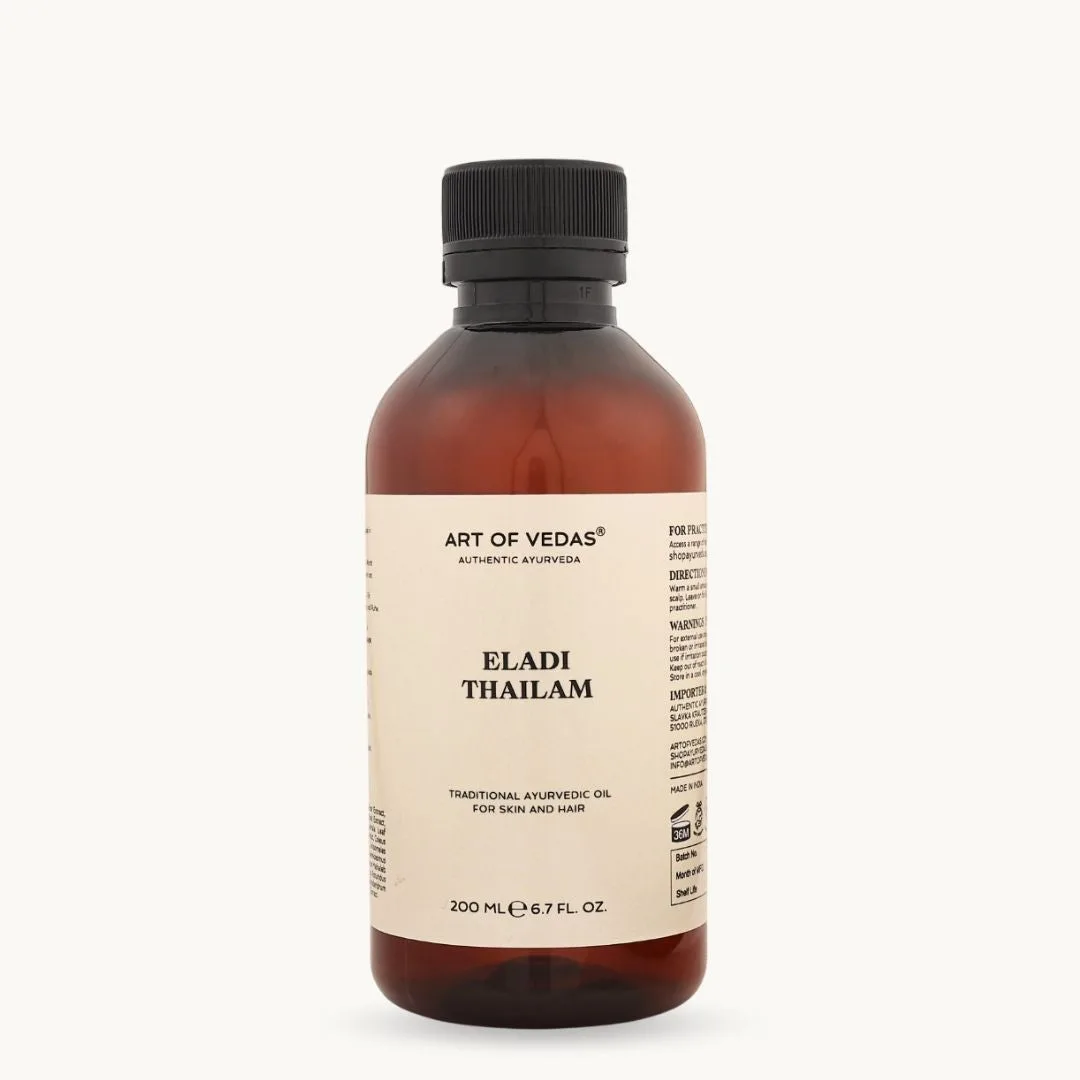
Important Disclaimer: Eladi Thailam is a traditional Ayurvedic wellness oil for external use only. It is not a medicine and does not treat, cure, or prevent any disease or medical condition. All benefits described here are traditional Ayurvedic indications and general skin wellness observations. For persistent skin conditions, infections, rashes, or any concern requiring medical attention, always consult a qualified healthcare professional. Shop Eladi Thailam here.
You have a bottle of Eladi Thailam. Now what?
This guide answers every practical question about how to use this classical Ayurvedic facial oil - from how much to use and when to apply it, to facial massage technique, skin type guidance, layering with other products, and what to realistically expect with regular use.
But this is not just a how-to guide. Eladi Thailam comes from a tradition where the ritual of application matters as much as the product itself. Ayurvedic Abhyanga (the practice of warm oil self-massage) is a cornerstone of dinacharya (daily self-care routine), and applying Eladi Thailam is an opportunity to do something genuinely nourishing for both your skin and your nervous system.
What Is Eladi Thailam Used For?
In classical Ayurvedic practice, Eladi Thailam is first and foremost a mukhabhyanga oil - a facial massage oil. The word mukha means face and abhyanga means oil massage, and this combination is one of the daily rituals traditionally recommended in Ayurvedic dinacharya for maintaining healthy, radiant skin.
Beyond mukhabhyanga, Eladi Thailam is used in the following traditional applications:
Daily facial care - applied morning or evening (or both) as the central step in an Ayurvedic facial routine, supporting skin nourishment, tone, and clarity.
Facial Abhyanga ritual - a more intentional, extended self-massage practice following specific marma point massage techniques, traditionally performed 2 to 3 times per week for deeper skin and nervous system support.
Scalp and hair care - classical texts describe Eladi being applied to the scalp and hair before washing, providing nourishment and aromatic benefit to both hair and the scalp.
Kansa Wand pairing - Eladi Thailam is an excellent companion oil for Kansa wand facial massage, where the oil allows the metal to glide smoothly across the skin. The combination of Eladi's herbs with the Kansa wand's traditional balancing properties creates one of the most enjoyable and effective Ayurvedic facial rituals you can do at home. Explore our Kansa wands here.
The Key Benefits of Eladi Thailam
These benefits reflect both classical Ayurvedic descriptions and modern research on the formula's ingredients. To understand the science behind these benefits in depth, see our science and research guide.
Supports skin clarity and an even complexion. The combination of varnya (complexion-brightening) herbs in Eladi - saffron, manjishtha, sandalwood, licorice - has been traditionally used to support a radiant, even skin tone. Regular use is associated with a gradually more luminous, clearer-looking complexion.
Calms reactive and sensitive skin. Eladi's cooling herbs, particularly sandalwood and green cardamom, have anti-inflammatory and soothing properties that make this formula especially well-suited to skin that tends toward redness, sensitivity, or heat-related concerns.
Provides deep nourishment without heaviness. Sesame oil is a deeply nourishing base that absorbs readily into the skin without leaving a heavy or greasy film when used in appropriate amounts. The skin feels moisturised and soft without being coated.
Supports healthy skin microbiome balance. Multiple ingredients in Eladi - cardamom, tuvaraka, daruharidra, musta - have antimicrobial properties that may support a balanced skin microbiome. The formula's selective antimicrobial activity targets potentially problematic organisms while remaining gentle enough for daily use.
Rich in natural antioxidant protection. Saffron, manjishtha, licorice, turmeric, sandalwood, and the sesame oil base all contribute antioxidant compounds that help support the skin against environmental stressors.
Supports the skin's natural barrier function. The lipid-rich sesame oil base, combined with ingredients that support natural moisture factor production, helps maintain the skin's protective outer barrier - keeping moisture in and environmental challenges out.
Is Eladi Thailam Right for Your Skin Type?
Vata Skin Types (Dry, Delicate, Prone to Fine Lines)
Eladi Thailam is an excellent match for vata-dominant skin. The deep nourishing and moisturising properties of sesame oil, combined with the formula's warming herbs, directly address the primary characteristics of vata skin - dryness, delicateness, tendency toward dehydration lines, and a dull complexion in colder months.
Best approach for vata skin: Use Eladi Thailam morning and evening. After cleansing, apply slightly more generously - 4 to 6 drops. Massage gently in upward strokes. Consider a warm towel compress after application to enhance absorption. In dry, cold weather, Eladi can serve as the primary moisturiser.
Pitta Skin Types (Sensitive, Reactive, Redness-Prone)
Eladi Thailam is particularly well-suited to pitta skin. This is where the formula's cooling herbs - sandalwood, saffron, green cardamom, licorice - shine. The combination of deep nourishment with cooling, anti-inflammatory properties makes Eladi an excellent choice for skin that tends toward redness, sensitivity, or reactive responses.
Best approach for pitta skin: Use Eladi Thailam in the evening primarily, or both morning and evening if skin is not overly oily. Use 3 to 4 drops - a lighter touch. Allow to absorb fully before applying anything else. Eladi works particularly well for this skin type as part of an evening ritual when the nervous system is winding down, enhancing the oil's calming effect.
Kapha Skin Types (Oily, Congestion-Prone, Combination)
Many people with kapha or oily-combination skin instinctively avoid facial oils, assuming that oil on oily skin will worsen congestion. This assumption is not always accurate. Eladi Thailam's formulation includes significant antimicrobial and clarifying herbs (cardamom, tuvaraka, daruharidra, musta) that address the kapha skin tendencies of congestion and excess sebum.
Best approach for kapha skin: Start with a light application - 2 to 3 drops maximum - in the evening only. Apply to clean, dry skin. Follow with a light, oil-free moisturiser if desired. Give it at least 4 to 6 weeks of consistent use before assessing results, as skin microbiome and sebum balance take time to shift. If congestion worsens significantly after 2 weeks, pause and consult an Ayurvedic practitioner.
Sensitive Skin
Eladi Thailam is generally considered one of the more sensitive skin-appropriate Ayurvedic facial oils, thanks to its cooling, anti-inflammatory herb profile. However, patch testing is always essential before full facial application of any botanical product - see instructions below.
How to Use Eladi Thailam: Step-by-Step
Daily Application - The Simple Method (5 Minutes)
Step 1 - Cleanse your face. Start with clean skin. Wash with a gentle, pH-appropriate cleanser. Pat dry with a clean cloth, leaving the skin slightly damp. The slight moisture helps the oil spread more evenly and, for some skin types, improves absorption.
Step 2 - Warm the oil. Pour 3 to 5 drops of Eladi Thailam into your palm (start with 3 drops and adjust based on your skin's needs). Rub your palms together gently for 5 to 10 seconds to warm the oil to skin temperature. This step activates the aromatic compounds and improves absorption.
Step 3 - Apply with gentle pressure. Press your warmed palms lightly onto your face - hold for a moment rather than rubbing immediately. This allows the oil to make initial contact across the full face. Then use your fingertips to distribute the oil with gentle, light strokes.
Step 4 - Massage in upward movements. Use the pads of your fingers (not nails) to massage the oil into the skin using gentle upward and outward strokes. Work from the centre of the face outward - from the nose toward the cheeks and temples, from the chin upward toward the ears, along the jawline. Avoid dragging or pulling the skin.
Step 5 - Allow to absorb. Allow 3 to 5 minutes for the oil to absorb before applying anything else over it. You can use this time for a brief meditation, breathing practice, or simply noticing the aroma and how your skin feels.
Step 6 - Follow with other products (optional). If using a moisturiser, serum, or SPF, apply after the oil has been absorbed. For morning use, always follow with SPF 30 or higher broad-spectrum sunscreen - Eladi Thailam does not provide UV protection.
The Full Mukhabhyanga Ritual (15 to 20 Minutes)
For a deeper, more intentional practice - recommended 2 to 3 times per week - the following technique draws on traditional Ayurvedic facial massage principles.
Preparation: Heat your Eladi Thailam slightly by placing the bottle in a bowl of warm (not boiling) water for 2 minutes. The warm oil activates aromatic compounds and significantly enhances the sensory and absorption experience. You will need 6 to 8 drops for a full mukhabhyanga.
Neck and décolletage: Begin below the face at the base of the neck. Apply oil here and massage gently upward along the neck, from collarbone to chin. Use slow, alternating upward strokes. This prepares the lymphatic channels before moving to the face itself.
Forehead: Apply oil to the forehead and use both thumbs or the pads of your index and middle fingers to make slow, firm strokes from the centre of the forehead toward the temples. Work from the hairline downward to the eyebrows. Repeat 5 to 7 times. Finish by pressing both palms flat on the forehead for a moment of gentle held pressure.
Temples (Shankha Marma): The temples contain an important marma point called Shankha. Apply gentle circular pressure with the pads of your middle fingers in slow clockwise circles - 10 to 15 circles on each side. This area often holds significant tension and responds well to gentle, attentive touch.
Around the eyes: Use only your ring finger (the lightest finger) around the delicate eye area. Never pull or drag the skin here. Apply the gentlest possible circular movements just below the eyebrow bone and along the orbital bone beneath the eye. Never apply pressure directly to the eyelid.
Cheeks and midface: Using the pads of your fingers, make broad, circular upward strokes across the cheeks - from the corners of the mouth upward toward the temples, from the nose toward the ears. Apply gentle, still pressure at the cheekbone marma points.
Nose and sinus area: Use your index fingers to stroke gently alongside the nose, from the bridge downward, and to apply gentle pressure at the junction of the nose and cheeks. This area corresponds to sinus points and responds well to gentle, sustained pressure.
Mouth and jaw: Massage along the jawline from chin to ear, alternating hands in a lifting motion. Gently massage the chin and the area just below the lower lip in slow circular movements.
Ears (Karna): The ears are rich in marma points. Gently pull the earlobe downward three times, then massage the outer rim of the ear gently between thumb and index finger. Finish with gentle pressure on the tragus (the small pointed flap in front of the ear canal).
Closing: Finish by pressing your palms gently against your face one more time. Take three slow, deep breaths, noticing the warmth, the aroma, and the quality of your skin. Remain still for a minute before continuing your routine.
Eladi Thailam with a Kansa Wand
One of the most enjoyable ways to use Eladi Thailam is as the companion oil for a Kansa wand facial massage. Apply 4 to 6 drops of Eladi Thailam to your face first, then using the rounded face of the Kansa wand, begin making gentle figure-eight movements across the forehead. Move to the cheeks in slow circular strokes, then to the jawline and neck. The Kansa wand applies slightly more consistent pressure than fingertips, making it effective for working along the jawline and cheekbones.
Explore our full range of Kansa facial massage tools designed specifically for this type of ritual.
How Much to Use
The most frequent mistake is using too much - which leaves the skin feeling greasy rather than nourished. As a general guide: 3 drops is sufficient for a light daily application or for oilier skin types. 4 to 5 drops is the standard daily application for most skin types. 6 to 8 drops is appropriate for a full mukhabhyanga ritual.
Practical test: After massaging in, your skin should feel comfortable and nourished - not greasy, not sticky, and without visible oil remaining on the surface after 5 minutes. If you regularly have visible oil remaining after 5 minutes, reduce the amount you use.
Morning vs. Evening Use
Evening use is generally recommended as the primary application time. The skin undergoes its primary repair and regeneration processes during sleep, so applying a nourishing facial oil in the evening provides support during this natural restoration period. The aromatic compounds in Eladi also have calming properties that support transition toward rest - making an evening mukhabhyanga a genuinely relaxing end-of-day ritual.
Morning use is appropriate for most skin types, particularly vata and pitta types. Apply before your SPF, allowing the oil to absorb for 3 to 5 minutes first. For oily or kapha skin types, morning use may feel heavy - in which case, evening use only is more appropriate.
Both morning and evening works beautifully for dry, mature, or vata-dominant skin - particularly in winter months when environmental dryness increases the skin's need for lipid support.
Layering Eladi Thailam with Other Skincare Products
Oil-first principle: Apply Eladi Thailam to clean skin before water-based products (serums, essences, moisturisers). Apply oil first, allow to absorb, then layer water-based products on top if desired.
With moisturiser: Apply Eladi first, wait 3 to 5 minutes, then apply a light water-based moisturiser. Alternatively, add 1 to 2 drops of Eladi to your moisturiser and mix before applying.
With SPF: Always apply sunscreen as the final step before leaving the house. Eladi does not provide any UV protection.
With retinoids or prescription treatments: If you are using prescription retinoids or other prescribed skin treatments, consult your dermatologist before adding Eladi Thailam.
With chemical exfoliants (AHAs/BHAs): Use Eladi Thailam and chemical exfoliants at separate times - for example, exfoliants in the morning and Eladi in the evening. Do not apply both at the same time.
With other Art of Vedas products: Eladi Thailam pairs beautifully with Kansa wand tools and complements Ayurvedic hair care oils for a complete Abhyanga practice.
What to Expect: A Realistic Timeline
The classical Ayurvedic approach emphasises building and maintaining balance over time. This is not a product designed to produce dramatic overnight changes.
First few days: The most immediately noticeable effect is sensory - the aroma of cardamom, sandalwood, and saffron, the feel of well-nourished skin after the massage. Skin will typically feel softer and more comfortable immediately after application.
First two weeks: Skin begins to feel consistently more comfortable. Reactive skin often shows reduced sensitivity and less redness. Dry skin feels more balanced throughout the day. You may notice the ritual itself becoming something you look forward to.
Four to six weeks: This is where most users begin to notice more visible changes. Complexion appears more even and luminous. Fine lines may appear softer, particularly those associated with dryness. Skin texture typically feels smoother.
Three months and beyond: The cumulative effects of consistent use over three months or more are where the classical concept of rasayana (rejuvenating, tissue-building) practice becomes most evident. Skin that has been consistently well-nourished over this period typically shows a noticeably healthier, more resilient quality.
These are general observations based on traditional use patterns and user experience. Individual results vary significantly based on skin type, age, overall health, diet, stress levels, and consistency of use.
Storage and Shelf Life
Store in a cool, dark place away from direct sunlight and heat. Always close the cap tightly after use to prevent oxidation. Avoid introducing water into the bottle - do not use the oil with wet hands. Properly stored, Eladi Thailam typically remains in optimal condition for 12 to 18 months from manufacture. If the oil develops a rancid or significantly changed smell, discontinue use.
Patch Testing
Before applying Eladi Thailam to your face for the first time, patch testing is always recommended. Apply a small amount to the inside of your forearm. Leave undisturbed for 24 to 48 hours. If no reaction (redness, itching, rash, swelling) occurs, proceed with facial use. If a reaction occurs, wash off immediately and discontinue use.
Frequently Asked Questions
Can I use Eladi Thailam as my only moisturiser? For dry and vata skin types, yes - many people find Eladi Thailam entirely sufficient as a standalone daily moisturiser, particularly in warm weather. In cold, dry conditions or for very dry skin, layering a water-based moisturiser beneath the oil may provide more complete hydration support.
Can Eladi Thailam be used on the body as well as the face? Yes. While it is specifically formulated as a facial and skin wellness oil, there is no reason it cannot be used on other areas of the body. For full-body Abhyanga, Art of Vedas offers a range of body-specific Ayurvedic Thailams better suited to that purpose.
How long will one bottle last? At 3 to 5 drops per application, a standard 100ml bottle typically lasts 8 to 12 weeks with daily use.
Can I use Eladi Thailam during pregnancy? Topical facial application of Eladi Thailam is generally considered appropriate during pregnancy for most people. However, every pregnancy is unique and sensitivities can change significantly during this time. Always consult your healthcare provider before introducing any new skincare product during pregnancy.
Is Eladi Thailam tested on animals? Art of Vedas does not conduct animal testing on any of its products.
Begin Your Eladi Ritual
Eladi Thailam is not just a skincare product - it is an invitation to bring a genuinely ancient, carefully crafted Ayurvedic practice into your daily life. The combination of 25 or more classical herbs in a beautifully prepared sesame oil base, the ritual of warm-oil facial massage, and the layered aroma of cardamom, sandalwood, and saffron creates an experience that is difficult to compare to any modern facial oil.
Shop Eladi Thailam - traditionally prepared, authentically formulated, ready for your ritual.
Continue Exploring