Before examining specific ingredients, it's essential to understand Ayurvedic formulation principles.
What Makes a Thailam Different from Infused Oil?
Simple Infused Oil:
- Herbs soaked in oil (cold or warm)
- Limited extraction of compounds
- Short preparation time
- Primarily aromatic properties transfer
Ayurvedic Thailam (Taila Paka Method):
- Herbs cooked with oil and liquid medium through precise heating cycles
- Complete extraction of fat-soluble compounds
- 12-24+ hour preparation process
- Chemical transformation through heat
- Synergistic effect beyond individual ingredients
The Concept of Prabhava (Specific Potency)
According to classical Ayurvedic theory, properly prepared thailams develop Prabhava - a specific therapeutic action that cannot be explained by the individual properties of ingredients alone. The Taila Paka process creates this through:
- Heat transformation (Agni Samskara)
- Time-based extraction (Kala)
- Precise proportions (Matra)
- Synergistic combination (Samyoga)
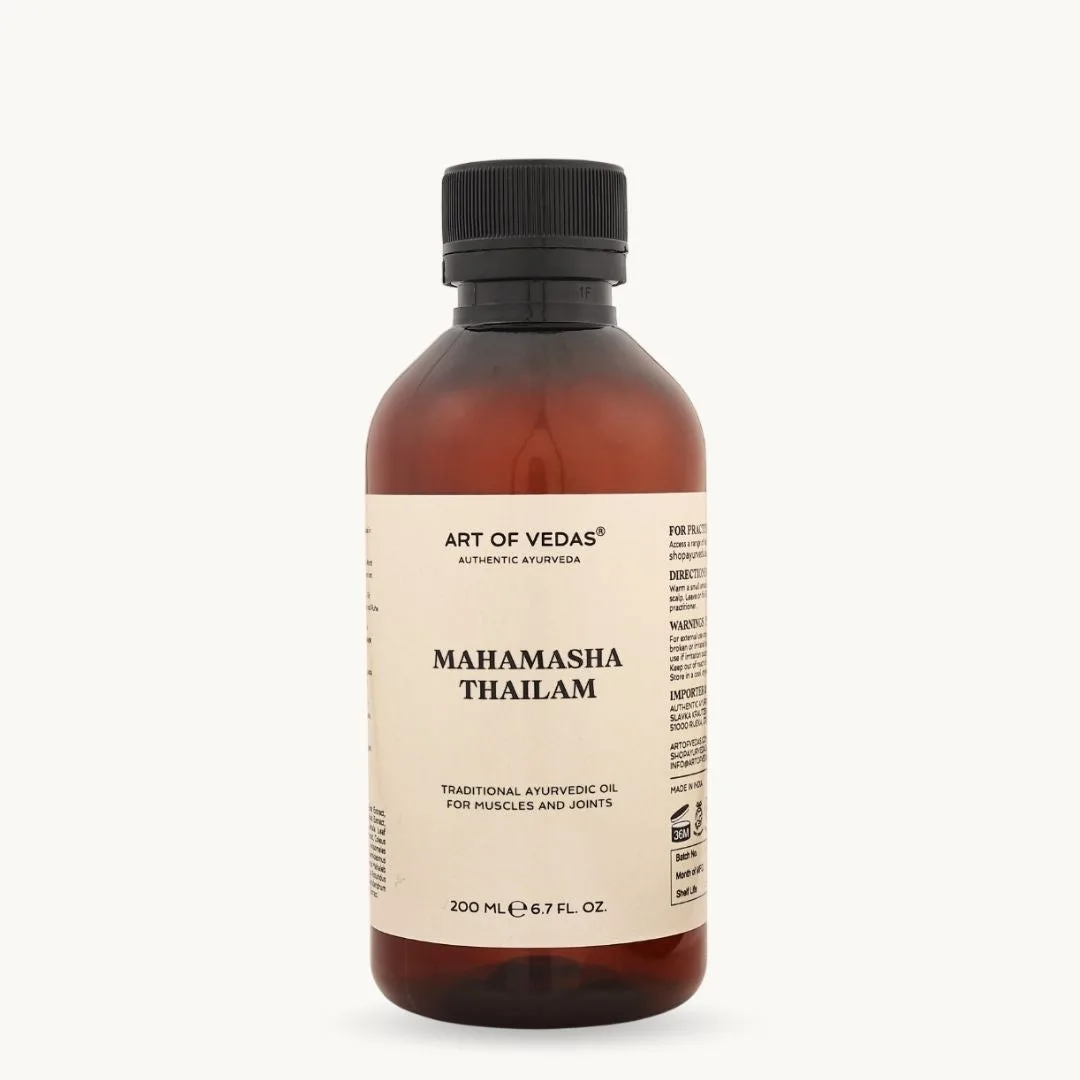
This is why authentic Mahamasha Thailam prepared traditionally is therapeutically superior to simply mixing black gram powder in sesame oil at home.
Three-Component Formula Structure
Traditional Ayurvedic oil formulations follow a structural principle:
1. Kalka (Herbal Paste):
- Finely ground herbs
- Provides properties
- For Mahamasha: Black gram + Dashamoola + other herbs
2. Drava (Liquid Medium):
- Water, or herbal decoctions
- Extracts water-soluble compounds
- Evaporates during cooking, leaving concentrated medicine
3. Taila (Oil Base):
- Sesame oil for Mahamasha
- Carries fat-soluble compounds
- Penetrates skin to reach deeper tissues
The classical ratio is typically 4 parts oil: 1 part herbs: 16 parts liquid (or 1:1/4:4), though specific formulas vary.
Primary Ingredient: Masha (Black Gram)
Black gram is not just an ingredient - it's THE defining component of Mahamasha Thailam.
Botanical and Traditional Names
Botanical Name: Vigna mungo (L.) Hepper
Synonyms: Phaseolus mungo (older classification), Phaseolus radiatus
Sanskrit/Ayurvedic Names: Masha, Masa, Krishna Mudga (black type of mung bean), Maasha
Regional Names:
-
Hindi: Urad, Urad dal
-
Tamil: Ulundu
-
Malayalam: Uzhunnu
-
Kannada: Uddina bele
-
English: Black gram, Black lentil
Properties According to Classical Texts
Charaka Samhita (Sutrasthana 27) describes Masha's properties:
Rasa (Taste): Madhura (sweet)
Guna (Qualities): Guru (heavy), Snigdha (unctuous/oily), Picchila (slimy/mucilaginous)
Virya (Potency): Ushna (heating)
Vipaka (Post-digestive effect): Madhura (sweet)
Dosha Effect:
- Strongly pacifies Vata
- Moderately increases Kapha (in excess)
- May aggravate Pitta (due to heating nature)
Dhatu (Tissue) Affinity:
- Majja Dhatu (nerve tissue/bone marrow) - PRIMARY
- Mamsa Dhatu (muscle tissue)
- Shukra Dhatu (reproductive tissue)
Why Black Gram for Nerve Health?
Traditional Reasoning:
1. Majja Vardakam (Increases Nerve/Marrow Tissue): Multiple classical texts identify Masha as one of the best foods for building Majja Dhatu. Bhavaprakasha Nighantu specifically lists black gram among "Majjajanana" substances.
2. Heavy-Nourishing Quality (Guru-Brimhana): The heavy, building quality directly opposes Vata's light, depleting nature. In conditions like muscle wasting, nerve depletion, or post-paralytic weakness, this building effect is essential.
3. Snigdha (Unctuous) Quality: Nerve tissue requires adequate "lubrication" or myelin covering. The unctuous quality of Masha supports this protective coating around nerves.
4. Heating Potency (Ushna Virya): Improves circulation to nerve tissue. Cold-type nerve conditions (numbness with coldness, reduced sensation) particularly benefit from this warming effect.
Nutritional Composition (Modern Understanding)
While Ayurveda doesn't traditionally think in terms of vitamins and minerals, modern analysis shows black gram contains:
-
Protein: ~25% (high-quality plant protein)
-
Fat: ~1.5% (minimal, but significant for nerve health)
-
Carbohydrates: ~60%
-
Fiber: Significant amounts
-
Minerals: Iron, calcium, magnesium, phosphorus, potassium
-
Vitamins: B-complex (especially B1, B2, B6), folate
-
Amino acids: Including those important for neurotransmitter synthesis
Note: Modern nutrition corroborates traditional use - B-vitamins and minerals support nervous system health.
Whole vs. Split Black Gram
Whole Black Gram (Sabut Urad):
- Black outer skin intact
- Higher fiber content
- More traditional for preparations
- Stronger properties
Split Black Gram (Urad Dal - White):
- Outer skin removed
- Easier to digest
- Still therapeutic but gentler
- Some modern formulations use this
Classical formulations likely used whole black gram for maximum therapeutic effect.
Dashamoola: The Ten Root Formula
Dashamoola is a foundational Ayurvedic formula appearing in nearly all major classical texts. In Mahamasha Thailam, it provides comprehensive Vata-pacifying support.
The Ten Roots Explained
Dashamoola divides into two groups:
Brihat Panchamoola (Five Large Roots)
1. Bilva (Aegle marmelos - Bael Tree)
-
Properties: Vata-Kapha pacifying, digestive
-
In Mahamasha: Provides structural Vata grounding
-
Parts used: Root bark
2. Agnimantha (Premna integrifolia/serratifolia)
-
Properties: Anti-inflammatory, analgesic
-
In Mahamasha: Supports pain relief
-
Parts used: Root
3. Shyonaka (Oroxylum indicum - Indian Trumpet Tree)
-
Properties: Anti-inflammatory, supports circulation
-
In Mahamasha: Enhances oil penetration to deep tissues
-
Parts used: Root bark
4. Patala (Stereospermum suaveolens)
-
Properties: Strengthening, Vata balancing
-
In Mahamasha: Adds strength-building quality
-
Parts used: Root bark
5. Kashmarya (Gmelina arborea - Beechwood)
-
Properties: Nourishing, rejuvenating
-
In Mahamasha: Supports tissue regeneration
-
Parts used: Root
Laghu Panchamoola (Five Small Roots)
6. Shalaparni (Desmodium gangeticum)
-
Properties: Anti-inflammatory, nerve calming
-
In Mahamasha: Specific nerve support
-
Parts used: Whole plant/root
7. Prishniparni (Uraria picta)
-
Properties: Strengthening, Vata pacifying
-
In Mahamasha: Complements Masha's muscle-building effect
-
Parts used: Whole plant/root
8. Brihati (Solanum indicum - Indian Nightshade)
-
Properties: Analgesic, anti-inflammatory
-
In Mahamasha: Pain relief for nerve/muscle pain
-
Parts used: Whole plant/root
9. Kantakari (Solanum xanthocarpum - Yellow-berried Nightshade)
-
Properties: Respiratory support, Vata-Kapha balancing
-
In Mahamasha: Clears channels (Srotoshodhana)
-
Parts used: Whole plant/root
10. Gokshura (Tribulus terrestris - Puncture Vine)
-
Properties: Rejuvenating, urinary support, strengthening
-
In Mahamasha: Adds vitality and strength
-
Parts used: Fruit with seeds/root
Why This Combination?
Synergistic Actions:
-
Five large roots: Provide deep, structural Vata pacification affecting bones, joints, major nerve pathways
-
Five small roots: Target peripheral areas, fine nerve endings, muscle tissue
-
Together: Cover both central and peripheral nervous systems in Ayurvedic understanding
Properties of Combined Dashamoola:
- Pacifies Vata without excessively increasing Kapha
- Anti-inflammatory (Shothahara)
- Analgesic (Vedana-sthapana)
- Channel-opening (Srotoshodhana)
- Strengthening (Balya)
Base Oil: Why Sesame (Tila Taila)?
The choice of base oil is deliberate and grounded in classical Ayurvedic pharmacology.
Properties of Sesame Oil
Botanical Name: Sesamum indicum
Ayurvedic Properties:
Rasa: Madhura (sweet), Tikta (slightly bitter)
Guna: Guru (heavy), Snigdha (unctuous), Sukshma (subtle/penetrating)
Virya: Ushna (heating)
Vipaka: Madhura (sweet)
Dosha Effect: Pacifies Vata, acceptable for Pitta in moderation, may increase Kapha
Why Sesame for Medicated Oils?
According to Ashtanga Hridayam and Charaka Samhita, sesame oil is preferred for medicated oils because:
1. Sukshma Guna (Subtle/Penetrating Quality): Sesame oil penetrates to the deepest tissues (reaching Majja Dhatu and even Shukra Dhatu). This makes it ideal for nerve-targeting formulations.
2. Yogavahi (Carrier Property): Carries properties of herbs to target tissues effectively. Acts as a vehicle without interfering with herbal actions.
3. Stability: Sesame oil remains stable during prolonged heating (Taila Paka process) without significant degradation.
4. Vata Pacifying: Inherently balances Vata, complementing the formulation's primary action.
5. Traditional Precedent: Texts like Sushruta Samhita state: "Of all oils, sesame is best for Sneha Karma (oleation therapy)."
Cold-Pressed vs. Refined Sesame Oil
Traditional (Cold-Pressed):
- Extracted without heat or chemicals
- Retains natural nutrients and subtle properties
- Maintains Prabhava (specific potency)
- Preferred in classical preparations
Modern (Refined):
- Heat and chemical processing
- More shelf-stable
- Clearer appearance
- Some manufacturers use for cost/consistency
Art of Vedas Standard: We prioritize traditionally-prepared Mahamasha Thailam using cold-pressed or minimally processed sesame oil to maintain therapeutic integrity.
Additional Traditional Ingredients
Beyond Masha, Dashamoola, and sesame oil, classical formulations may include:
Ksheera (Milk)
Type: or goat's milk
Role: Used as liquid medium (Drava) during Taila Paka
Purpose:
- Enhances nourishing (Brimhana) properties
- Adds cooling balance to prevent excessive heat
- Traditional belief: Milk's fat molecules assist in extracting certain herbal compounds
In Final Product: Evaporates during cooking, so may not appear in ingredient lists, but its influence remains.
Other Classical Additions
Some formulation variants include:
Eranda Taila (Castor Oil):
- Added in small quantities
- Enhances Vata-pacifying effect
- Improves penetration
Atmagupta (Mucuna pruriens):
- Nerve tonic properties
- Supports dopaminergic function (relevant for tremors, Parkinson's-like conditions)
Ashwagandha (Withania somnifera):
- Adaptogenic, nerve strengthening
- Some formulations add this to enhance nerve support
Note: Ingredient lists vary by manufacturer and which classical text reference they follow.
The Non-Vegetarian Ingredient Question
This is important for vegetarians and vegans to understand.
Classical Formulation Includes Goat Meat
Traditional Ingredient: Chaga Mamsa (Goat meat)
Texts: Some references in Sahasrayogam and other texts include goat meat
Purpose: In Ayurvedic theory, meat is considered one of the most powerful tissue-building (Brimhana) substances. For severe muscle wasting, post-paralytic recovery, or extreme debility, animal protein was traditionally included.
Amount: Typically small proportion relative to total formula
Modern Formulation Variations
Due to dietary preferences and ethical concerns, many modern manufacturers produce variations:
"Niramish" (Vegetarian) Versions:
- Replace goat meat with additional plant-based protein sources
- May add more Ashwagandha, Bala, or other strengthening herbs
- Still therapeutically effective for most purposes
How to Identify:
- Label will state "Niramish Mahamasha Thailam"
- Ingredient list won't include "Mamsa" or meat products
- Many major Ayurvedic companies now offer both versions
Art of Vedas Position
We transparently communicate whether our Mahamasha Thailam contains animal ingredients or is vegetarian. Check the specific product label or contact us directly for confirmation.
For Vegetarians/Vegans: Niramish versions are available and remain therapeutically valuable. The traditional use of meat was for extreme debility cases; for general nerve support, muscle nourishment, and Vata pacification, vegetarian formulations work excellently.
Classical Taila Paka Preparation Method
Understanding how Mahamasha Thailam is made illuminates why authentic preparation matters.
The Taila Paka Process Step-by-Step
According to Sharangadhara Samhita (Madhyama Khanda, Chapter 9), the classical oil preparation follows specific stages:
Stage 1: Kalka (Paste) Preparation
Process:
- All herbs (Masha, Dashamoola, etc.) are cleaned, dried properly
- Ground into fine paste using traditional stone grinders or modern mills
- Fineness matters: Finer paste = better extraction
- Paste consistency: Should be smooth, not too coarse
Quality Check: The Kalka should be free from large particles, uniformly ground.
Stage 2: Drava (Liquid) Preparation
Process:
- If using milk: Boiled and cooled to specific temperature
- If using water: Pure water or herbal decoctions prepared
- Mixed with Kalka in specific proportions
Classical Ratio Example:
- Kalka (herb paste): 1 part
- Taila (oil): 4 parts
- Drava (liquid): 16 parts
Note: Exact ratios vary by formulation and text reference.
Stage 3: Paka (Cooking/Heating)
This is the critical transformation stage.
Process:
Initial Phase (Mridu Paka - Mild Cooking):
- All three components combined in large vessel
- Gentle heat applied
- Continuous stirring to prevent burning
- Duration: Several hours
Middle Phase (Madhyama Paka - Medium Cooking):
- Heat gradually increased
- Liquid begins evaporating
- Oil takes on herbal color and aroma
- Duration: 6-12 hours typically
Final Phase (Khara Paka - Full Cooking):
- Most liquid evaporated
- Oil becomes thick, richly colored
- Specific tests determine completion
- Duration: Until tests show completion
Total Time: 12-24+ hours of continuous cooking, depending on batch size and specific formula.
Stage 4: Completion Tests (Siddhi Lakshana)
Classical texts describe specific tests to determine when oil is properly cooked:
1. Phenodgama Test (Froth Test):
- Drop of oil placed on lit cotton wick
- Should burn with clear flame, no sputtering
- Indicates water completely evaporated
2. Shabda Test (Sound Test):
- Oil dropped into water
- Should make crackling sound
- Indicates proper cooking stage
3. Varthi Test (Wick Test):
- Cotton wick dipped in oil should burn steadily
- No smoke or sputtering
- Clean, bright flame
4. Visual/Sensory:
- Proper color (golden to dark amber for Mahamasha)
- Characteristic herbal aroma
- Appropriate thickness
Stage 5: Filtration and Storage
Process:
- Oil cooled slightly (not completely cold)
- Strained through fine muslin cloth
- Herb residue (marc) discarded or used for other purposes
- Clear oil collected
- Bottled in dark glass containers
- Sealed and labeled
Storage: Protected from light, heat, and air to maintain potency.
Formulation Variations Across Texts
Different classical texts provide slightly different formulations, all called "Mahamasha Thailam."
Sahasrayogam Reference
Source: Sahasrayogam, Thaila Prakarana (Oil Chapter), Verse 14
Era: Compiled in 19th century, based on older oral traditions
Region: Specific to traditional Ayurvedic practice
Formula Emphasis:
- Masha as primary ingredient
- Dashamoola in full
- Milk as cooking medium
- May include goat meat
Indications Listed:
- Pakshaghata (hemiplegia)
- Gridhrasi (sciatica)
- Kampa (tremors)
- Supti (numbness)
Bhaishajya Ratnavali References
Source: Bhaishajya Ratnavali, various chapters on Vata Vyadhi
Era: 19th century compilation of classical formulas
Author: Attributed to Govind Das Sen
Variations:
- Some references include additional herbs beyond standard Dashamoola
- Proportions may differ slightly
- Similar therapeutic indications
Regional Variations
Traditional Variations: Different regions in India developed slightly adapted formulas:
- Some add local herbs with similar properties
- Proportions adjusted based on regional Vata patterns
- Cooking times may vary based on climate (longer in humid areas)
Modern Manufacturer Variations:
- Some simplify ingredient lists for ease of production
- Vegetarian versions substitute meat
- Standardized formulations for consistency
Which Version is "Authentic"?
All can be authentic if they:
- Include Masha (black gram) as primary ingredient
- Use sesame oil base
- Follow Taila Paka method properly
- Maintain therapeutic effectiveness
Art of Vedas Approach: We source from manufacturers who follow recognized classical references (primarily Sahasrayogam and Bhaishajya Ratnavali), maintaining traditional ingredient ratios and preparation methods.
Quality Standards and What to Look For
How do you know if Mahamasha Thailam is prepared properly?
Sensory Quality Markers
Appearance:
-
Color: Rich golden to dark amber (dark brown)
-
Clarity: May be slightly cloudy initially, clears on standing
-
Sediment: Small amount of natural settling is normal
-
Texture: Moderately thick, not watery
Aroma:
-
Herbal: Distinct earthy, herbal scent
-
Not rancid: Should smell fresh, not stale or sour
-
Sesame base: Underlying sesame oil smell
-
Not artificial: No synthetic fragrances
Consistency:
-
Not too thick: Should pour, not be solid
-
Not too thin: Thicker than plain sesame oil
-
Warm climate: May be more liquid
-
Cool climate: May be slightly thicker
Label Quality Markers
Essential Information:
- All ingredients listed clearly
- Manufacturer name and credentials
- Batch number and manufacturing date
- Expiration date (typically 2-3 years)
- Method of preparation mentioned ("prepared according to classical Taila Paka method")
Desirable Certifications:
- GMP (Good Manufacturing Practice)
- ISO certification
- Organic certification (if applicable)
- AYUSH approval (Indian government Ayurveda regulation)
Testing Methods (For Manufacturers)
Professional manufacturers should conduct:
1. Microbial Testing: Absence of harmful bacteria, safe microbial limits
2. Heavy Metal Testing: Lead, mercury, arsenic within safe limits. Especially important for Indian herbal products
3. Quality Consistency: Batch-to-batch standardization, consistent ingredient ratios
4. Shelf Life Studies: Proper expiration dating based on stability testing
Red Flags Indicating Poor Quality
Avoid products that:
- Have no ingredient list
- Are suspiciously cheap
- Smell rancid or off
- Are very thin/watery
- Have unclear manufacturer information
- Contain synthetic additives not traditional to formula
How Preparation Method Affects Therapeutic Action
Why does traditional preparation matter so much?
Heat Transformation (Agni Samskara)
Chemical Changes:
- Heat breaks down plant cell walls, releasing compounds
- Fat-soluble compounds dissolve into oil
- Water-soluble compounds dissolve into liquid medium (milk/water)
- Water evaporates, leaving concentrated medicine in oil
Ayurvedic Understanding: Heat (Agni) acts as transformer, changing raw materials into digestible, absorbable medicine. This is why cooked food is considered more digestible than raw in Ayurveda.
Synergy Creation
Prabhava Development: The combination + heat + time creates new therapeutic properties not present in individual ingredients:
- Individual herbs have their properties
- Combined, they complement each other
- Cooked together, they transform into something greater than the sum
Example: Black gram alone is nourishing. Dashamoola alone pacifies Vata. Sesame oil alone penetrates tissues. Together, prepared through Taila Paka, they specifically target nerve tissue in ways each individual component cannot.
Bioavailability Enhancement
Classical Perspective: Ayurveda recognized that certain substances become more absorbable through specific processing:
-
Bhavana (Trituration): Repeated grinding with liquid
-
Paka (Cooking): Heat processing
-
Samskara (Transformation): All processing methods collectively
Modern Correlation: Heat can increase bioavailability of certain phytochemicals, break down anti-nutritive factors, and improve absorption.
Stability and Shelf Life
Properly Prepared Oils:
- Remain stable for 2-3 years
- Don't require artificial preservatives
- Sesame oil itself has natural antioxidant properties
Improperly Prepared:
- Oxidize quickly
- Lose therapeutic potency
- May develop rancidity
Modern Manufacturing vs. Traditional Methods
Understanding differences helps appreciate authentic products.
Traditional Small-Batch Method
Characteristics:
- Small quantities (5-50 liters per batch)
- Manual stirring and monitoring
- Experienced vaidyas (physicians) oversee
- Wood or controlled gas fire
- Labor-intensive (1-2 people per batch)
- Time-consuming (24+ hours per batch)
Advantages:
- Careful attention to each batch
- Traditional knowledge applied
- Quality over quantity
- Maintains Prabhava
Disadvantages:
- Limited production capacity
- Expensive due to labor
- Batch-to-batch variation possible
- Not scalable
Modern Large-Scale Manufacturing
Characteristics:
- Large quantities (100-1000+ liters)
- Mechanical stirring
- Controlled heating elements
- Standardized processes
- Reduced labor requirements
- Faster production
Advantages:
- Consistent batches
- Cost-effective
- Scalable production
- Modern quality control
Disadvantages:
- May lack traditional expertise
- Risk of over-industrialization
- Potential shortcuts in preparation time
- May not develop full Prabhava
Hybrid Approach (Best Practice)
Ideal Modern Manufacturing:
- Uses modern equipment (controlled heating, mechanical stirring)
- BUT maintains traditional time frames, temperature cycles, and tests
- Combines efficiency with authenticity
- Overseen by qualified Ayurvedic experts
- Regular quality testing
Art of Vedas Partners: We work with manufacturers who use this hybrid approach - modern quality controls and equipment, but maintain classical preparation times, ingredient ratios, and traditional testing methods.
Frequently Asked Questions
1. What is the main ingredient in Mahamasha Thailam?
The primary ingredient is Masha (black gram/Vigna mungo), which gives the oil its name. "Maha" means great, "Masha" is black gram. This is combined with Dashamoola (ten roots) and prepared in sesame oil base through the classical Taila Paka method.
2. Does Mahamasha Thailam contain animal products?
Traditional classical formulations may contain goat meat (Chaga Mamsa). However, many modern manufacturers produce "Niramish" (vegetarian) versions that replace animal ingredients with additional plant-based strengthening herbs. Always check the product label or contact the manufacturer to confirm.
3. What is Dashamoola in Mahamasha Thailam?
Dashamoola is a classical Ayurvedic formula of ten roots: five large roots (Bilva, Agnimantha, Shyonaka, Patala, Kashmarya) and five small roots (Shalaparni, Prishniparni, Brihati, Kantakari, Gokshura). Together they provide comprehensive Vata pacification and support the oil's therapeutic effects.
4. Why is sesame oil used as the base?
Sesame oil has Sukshma (subtle/penetrating) quality, allowing it to reach deep tissues including Majja Dhatu (nerve tissue). It's also Yogavahi (excellent carrier of properties), stable during prolonged heating, and inherently Vata-pacifying. Classical texts identify sesame as the best oil for medicated preparations.
5. How is authentic Mahamasha Thailam prepared?
Authentic preparation follows the classical Taila Paka method: herbs are ground into paste (Kalka), combined with sesame oil and milk or water in specific ratios, then cooked for 12-24+ hours with continuous stirring. Specific tests (froth test, sound test, wick test) determine completion. This process cannot be rushed.
6. What makes traditional preparation better than simple infusion?
Traditional Taila Paka involves heat transformation over 12-24+ hours, extracting both fat-soluble and water-soluble compounds. The heat and time create synergies between ingredients (Prabhava) that simple cold infusion cannot achieve. This is why traditionally prepared oils are therapeutically superior.
7. How can I identify high-quality Mahamasha Thailam?
Look for: dark glass bottle, complete ingredient list (Masha, Dashamoola, sesame oil), reputable manufacturer with Ayurvedic credentials, mention of classical preparation method, proper batch/expiry dates, rich golden-to-amber color, characteristic herbal aroma, and appropriate consistency (thicker than plain sesame oil).
8. Are there different formulations of Mahamasha Thailam?
Yes, slight variations exist across classical texts (Sahasrayogam, Bhaishajya Ratnavali). Some include additional herbs beyond the core formula. Regional variations exist. Vegetarian vs. traditional (with meat) versions differ. All can be authentic if they maintain core ingredients and proper preparation method.
9. How long does Mahamasha Thailam last?
Properly prepared and stored (cool, dark place, tightly sealed), Mahamasha Thailam maintains quality for 2-3 years unopened. After opening, use within 12-18 months for best quality. Watch for signs of rancidity (off smell, color changes, separation).
10. What is the difference between cold-pressed and refined sesame oil in the formulation?
Cold-pressed sesame oil is extracted without heat or chemicals, retaining natural nutrients and subtle Ayurvedic properties (Prabhava). Refined sesame oil undergoes heat/chemical processing, making it more shelf-stable but potentially reducing some subtle properties. Traditional formulations prefer cold-pressed or minimally processed oil.
11. Can Mahamasha Thailam be made at home?
While you can infuse black gram and herbs in sesame oil at home, true Taila Paka requires specific equipment, precise temperature control, 12-24+ hours of continuous cooking, knowledge of completion tests, and experience. Home-made versions won't match the therapeutic potency of properly prepared traditional formulations.
12. Why does my Mahamasha Thailam have sediment at the bottom?
Small amounts of herbal sediment are normal and indicate traditional preparation. The oil is filtered after cooking, but fine particles may settle over time. This doesn't indicate poor quality - shake gently before use to remix. Excessive sediment or cloudiness that doesn't clear may indicate improper preparation or storage.
13. What should Mahamasha Thailam smell like?
It should have a distinct earthy, herbal aroma - characteristic of sesame oil with noticeable herbal notes. The smell should be fresh, not rancid, sour, or stale. You might detect subtle differences between batches due to natural variations in herbs. There should be NO artificial fragrances.
14. Do all manufacturers follow classical preparation methods?
No. Some manufacturers take shortcuts - reducing cooking time, using inferior ingredients, or employing modern extraction methods that don't match traditional Taila Paka. This is why choosing manufacturers with strong Ayurvedic credentials and transparent preparation methods matters. Look for those who mention "prepared according to classical Taila Paka method."
15. Where does Art of Vedas source its Mahamasha Thailam?
Art of Vedas sources from established traditional Ayurvedic manufacturers who follow classical Taila Paka preparation methods as documented in texts like Sahasrayogam and Bhaishajya Ratnavali. We prioritize manufacturers with decades or centuries of Ayurvedic heritage, quality certifications, and transparent ingredient sourcing. Our oils maintain traditional preparation standards while meeting modern quality and safety requirements.
Conclusion
Understanding Mahamasha Thailam's ingredients and preparation reveals why authentic, traditionally-prepared oils offer therapeutic benefits that simple herb-infused oils cannot match. From the carefully selected Masha (black gram) chosen specifically for its nerve-nourishing properties, to the Dashamoola formula providing comprehensive Vata pacification, to the sesame oil base that penetrates to the deepest tissues - every component serves a purpose grounded in centuries of clinical observation.
The classical Taila Paka preparation method transforms these raw materials through heat, time, and precise proportions into a medicine where the whole exceeds the sum of its parts. This is Ayurveda's concept of Prabhava - the specific therapeutic potency that emerges only through proper preparation.
At Art of Vedas, we honor this traditional wisdom by sourcing Mahamasha Thailam from manufacturers who maintain classical standards. We believe that preserving authentic preparation methods ensures you receive not just an aromatic oil, but a true Ayurvedic medicine with the therapeutic integrity described in ancient texts.
Experience authentically prepared Mahamasha Thailam:
Shop Authentic Mahamasha Thailam →
Disclaimer: This article provides educational information based on classical Ayurvedic texts and traditional preparation methods. It is not medical advice. Mahamasha Thailam is intended for external wellness use as part of Ayurvedic self-care practices. Consult qualified healthcare practitioners for medical concerns and Ayurvedic practitioners for personalized guidance on oil selection and use.