In brief: Oil consumption in a treatment room is governed by the procedure mix and the reuse policy, not by the number of clients, which is why two clinics with identical bookings can order very different quantities.
Plan in litres per room per week, not per client
A room running twelve Abhyanga (classical full-body oil massage) sessions a week uses less oil than a room running four Pizhichil (the warm oil stream poured over the whole body) sessions, and the second will run out first. Client numbers are the wrong unit. The figure that holds up is litres per treatment room per week, derived from the procedures actually on the plans.
This matters most in the first six months of a new Panchakarma (the classical five-action programme) room, while the therapy mix is still settling. A centre that adds Shirodhara in March can double its quarterly oil budget by April without one extra client in the book.
Working consumption figures per procedure
The ranges below are planning figures. Body size, skin condition and room temperature move them, so measure your own draw over four weeks before committing to a standing order.
- Abhyanga, full body, one adult: 100 to 150 ml of warm Thailam (herbal oil prepared by decoction into a fatty base). Larger bodies and very dry skin push this towards 200 ml.
- Shiro Abhyanga and localised work: 20 to 40 ml.
- Kati Basti, Janu Basti and Greeva Basti: 150 to 250 ml held in the dough ring, refreshed two or three times as the pool cools.
- Shirodhara, the continuous forehead stream: 1.5 to 2 litres in circulation for 30 to 45 minutes. The oil is caught and returned, so this is a standing charge rather than a per-session draw.
- Pizhichil: 3 to 5 litres, the heaviest single draw of the procedures listed here, and the one that decides whether you buy the 1 litre or the 5 litre format.
- Nasya (nasal administration): a few millilitres per session. Volume is negligible; hygiene and format govern the order.
Netra Basti sits on a separate line of the order because it takes Ghritham (clarified butter preparation) rather than Thailam, as does any Snehapana (internal oil taking) course. Udvartana takes Churnam (powder) by weight and should never be costed against the oil budget.
Reuse policy is the biggest single variable
Whether Shirodhara and Pizhichil oil is filtered and reused within one client's course, or discarded after each session, moves the annual figure more than any other decision you will take about the room. Where the policy is reuse within a course, the discipline is fixed: filter through fine cloth after every session, hold the oil in a labelled closed vessel under that client's name and date of first use, and discard at the end. Oil that has touched more than one person is never returned to a vessel.
Abhyanga oil is single use in every case, and Nasya oil should be dispensed so that no shared pipette is ever returned to the bottle. Settle the policy in writing before calculating anything: a figure built on one policy is worthless under the other.
Turning the mix into a par level
Take your weekly procedure count, multiply by the millilitre figure for each, and add ten to fifteen percent for what linen, hands and the warming vessel absorb. That allowance is easy to leave out of a first budget.
Then set cover. Classical oils are produced in batches and availability is not uniform across the year, so six to eight weeks of use is a prudent par level for the core list, four weeks for occasional items. Reorder when remaining cover equals lead time plus two weeks. A single-room clinic running mainly Abhyanga usually lands between 12 and 20 litres on the shelf; a room offering Pizhichil will hold considerably more.
How many different oils a room genuinely needs
New clinics tend to buy breadth, and the surplus ages on the shelf. A working core of four to six oils covers most of what walks through the door, with specialist items added as the client base declares itself.
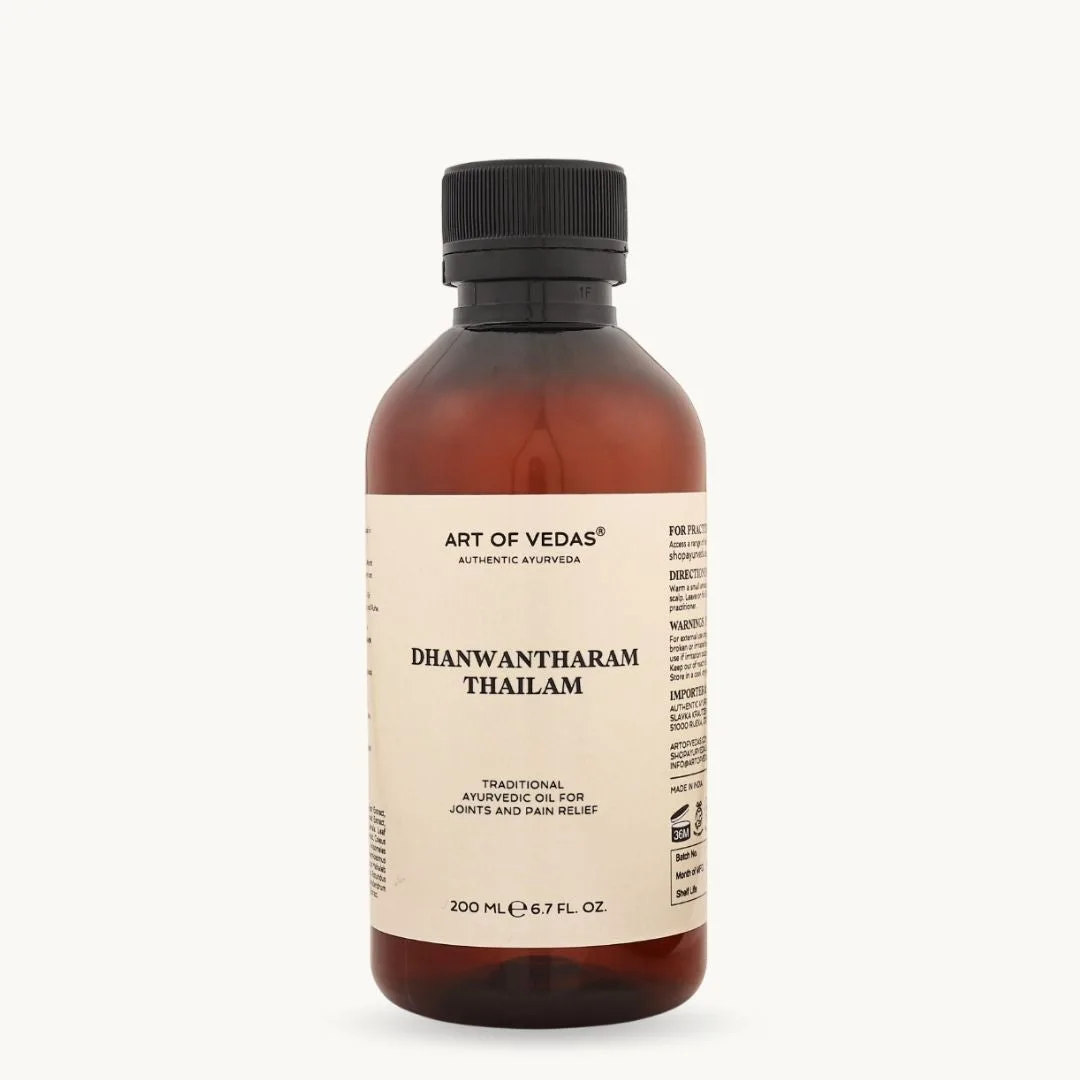
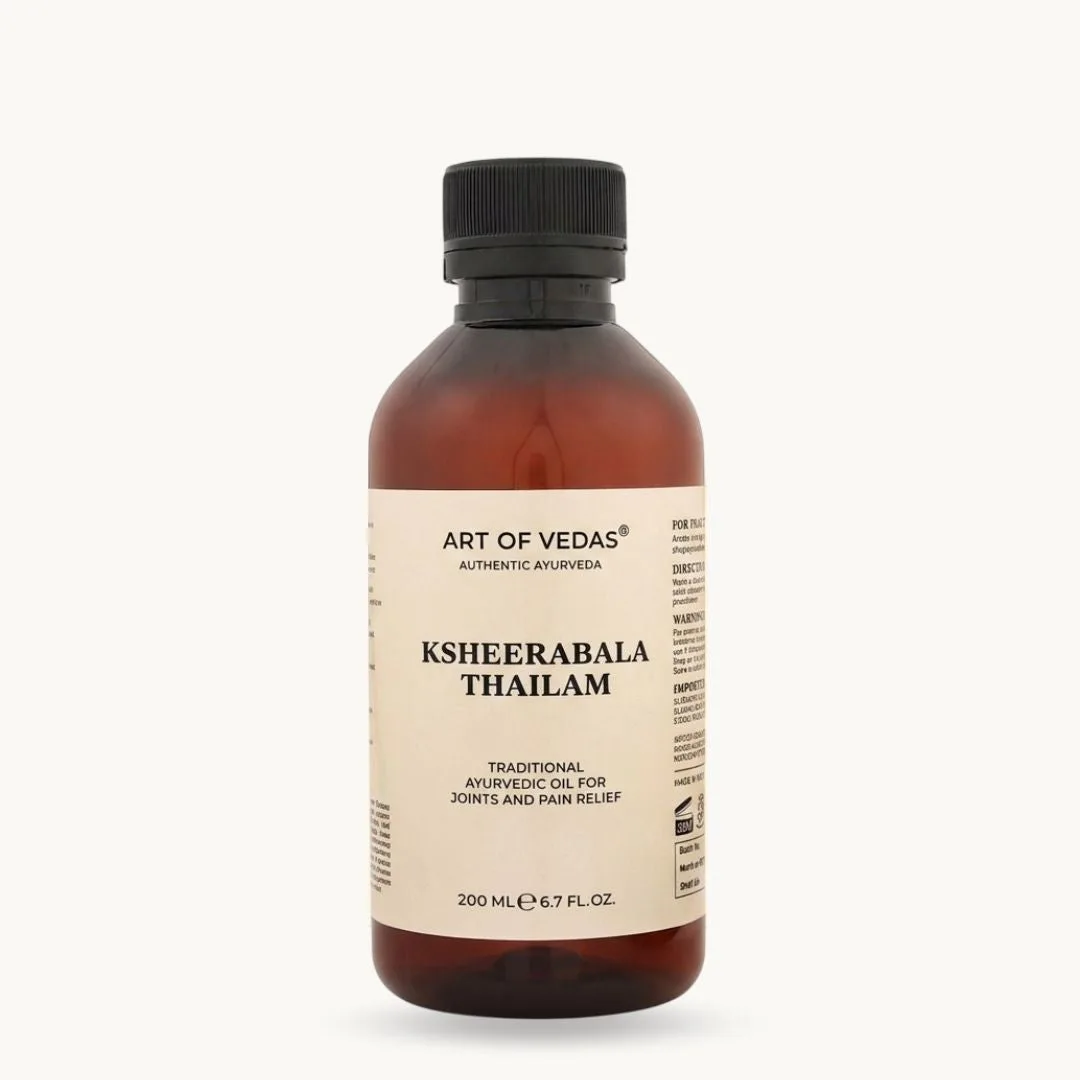
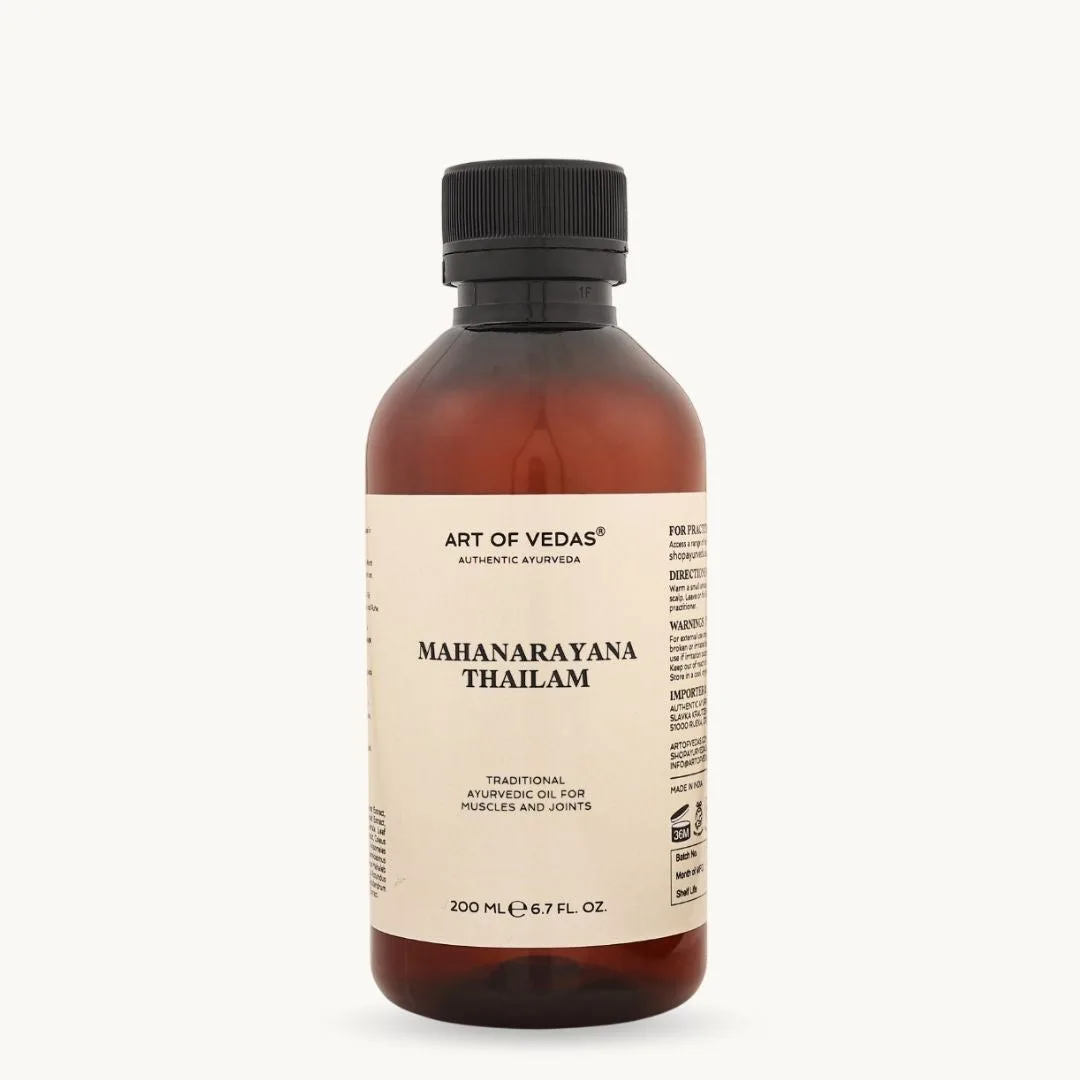
A practical core starts with Dhanwantharam Thailam, which the tradition directs towards Vata (the movement principle) and which is a common choice for general Abhyanga, and Mahanarayana Thailam where a heavier, more penetrating application is wanted. Ksheerabala Thailam is the lighter option where a heavier preparation would be too much, and it doubles for head and neck applications. Plain sesame oil belongs on every shelf: it is the classical base of many of these preparations, it dilutes a strong Thailam for a gentler first session, and it serves for table and linen work.
Beyond that core, add by evidence of demand rather than by catalogue. One cooling preparation and one warming preparation suited to Kapha (the heavy, stable principle) handle most of what the core does not. Our guide to building a starting range for a new clinic applies the same logic to powders and tools.
Format and decanting discipline
Choose the container you can finish while the oil is still good. Where an oil turns over steadily, say more than roughly two litres per quarter, the 5 litre format is the sensible purchase. Below that rate the smaller bottle is the better choice, because an oil standing half used for eighteen months is a loss however it was bought.
Where a 5 litre format is in use, decant the day's requirement into a working bottle and keep the master container closed and out of the light. Never return decanted, warmed or filtered oil to the master. Warm only what the session needs: repeated heating and cooling of a large volume is hard on an oil and shortens its useful life in a busy room.
Storage, rotation and records
Store below 25 degrees Celsius, away from direct light, lids fully closed. Label every container on arrival with the date received and every working bottle with the date opened, then rotate by that date rather than by what is nearest to hand.
Keep the batch number of the oil used against each client record. It is what makes a professional file defensible if a question is raised about a session.
Ordering and professional access
Once par levels are set, consolidate. A single quarterly order, timed against your slowest month rather than your busiest, is easier to check in and easier to plan around than a monthly scramble.
Art of Vedas supplies practitioners, clinics and Panchakarma centres through the professional platform at shopayurveda.eu, where professional pricing, bulk formats including 1 litre and 5 litre oils, and the wider classical range are open to verified accounts. If you are setting up a new room or moving an existing one onto a standing supply arrangement, see our notes on wholesale oils for European practitioners and bulk supply for treatment centres.
Questions practitioners ask before ordering
How much massage oil does a Panchakarma centre use per month?
A single room running mainly Abhyanga, around fifteen sessions a week, uses roughly 8 to 10 litres a month including wastage. One Shirodhara client on a fourteen day course adds about 2 litres. A room offering Pizhichil should plan on 15 to 25 litres a month.
Can Shirodhara oil be reused between clients?
No. Across clients it is never reused, whatever the filtration. Within one client's own course reuse is standard, and the vessel should not be topped up with fresh oil to stretch the course: begin a fresh vessel and log the date instead.
How long does an opened Thailam last in a clinic?
Plan to finish an opened working bottle within a few months. Sealed containers stored cool and dark hold considerably longer. Any oil whose smell has changed noticeably comes out of use, whatever the date says.
What changes when a second treatment room opens?
Not everything doubles. The per-room weekly figure still holds for Abhyanga and Pizhichil, but Shirodhara oil in circulation and plain base oil are shared, so those lines rise by less. What slips is decanting discipline: give each room its own working bottles and keep one master container, in one place, under one person's control.
Do I need a professional account to order bulk formats?
Yes. Bulk formats and professional pricing sit behind a verified practitioner or clinic account. Registration asks for evidence of qualification or of a registered treatment business.