In brief: Triphala is a fixed combination of three dried fruits, each of which the tradition directs at a different Dosha, which is why classical Ayurveda regards it as suitable for almost every constitution rather than for one type of person.
Three fruits, one formula
The name says exactly what it is. Tri, three. Phala, fruit. Haritaki (Terminalia chebula), Bibhitaki (Terminalia bellirica) and Amalaki (Emblica officinalis), dried, destoned and ground to a fine powder in fixed proportion. Only the pulp is used, the stones being separated before grinding, so a ratio on a label refers to processed pulp and not to whole fruit.
What makes the combination unusual in classical Ayurveda is its symmetry. Each of the three Doshas, the functional principles that Ayurveda uses to describe how a body behaves, has one fruit classically directed at it. Haritaki is the fruit the tradition directs at Vata, the principle of movement, dryness and lightness. Bibhitaki is directed at Kapha, the principle of structure, moisture and cohesion. Amalaki is directed at Pitta, the principle of heat and transformation. Each fruit works against the qualities of the Dosha it is aimed at rather than sharing them, which is why the Kapha fruit is itself dry and light. Weighting a formula towards one Dosha, and giving it to one kind of constitution, is the more usual pattern. Triphala is described as tridoshic, which in practice means a practitioner need not establish a person's Prakriti, their constitutional type, before suggesting it.
What each fruit contributes
Haritaki
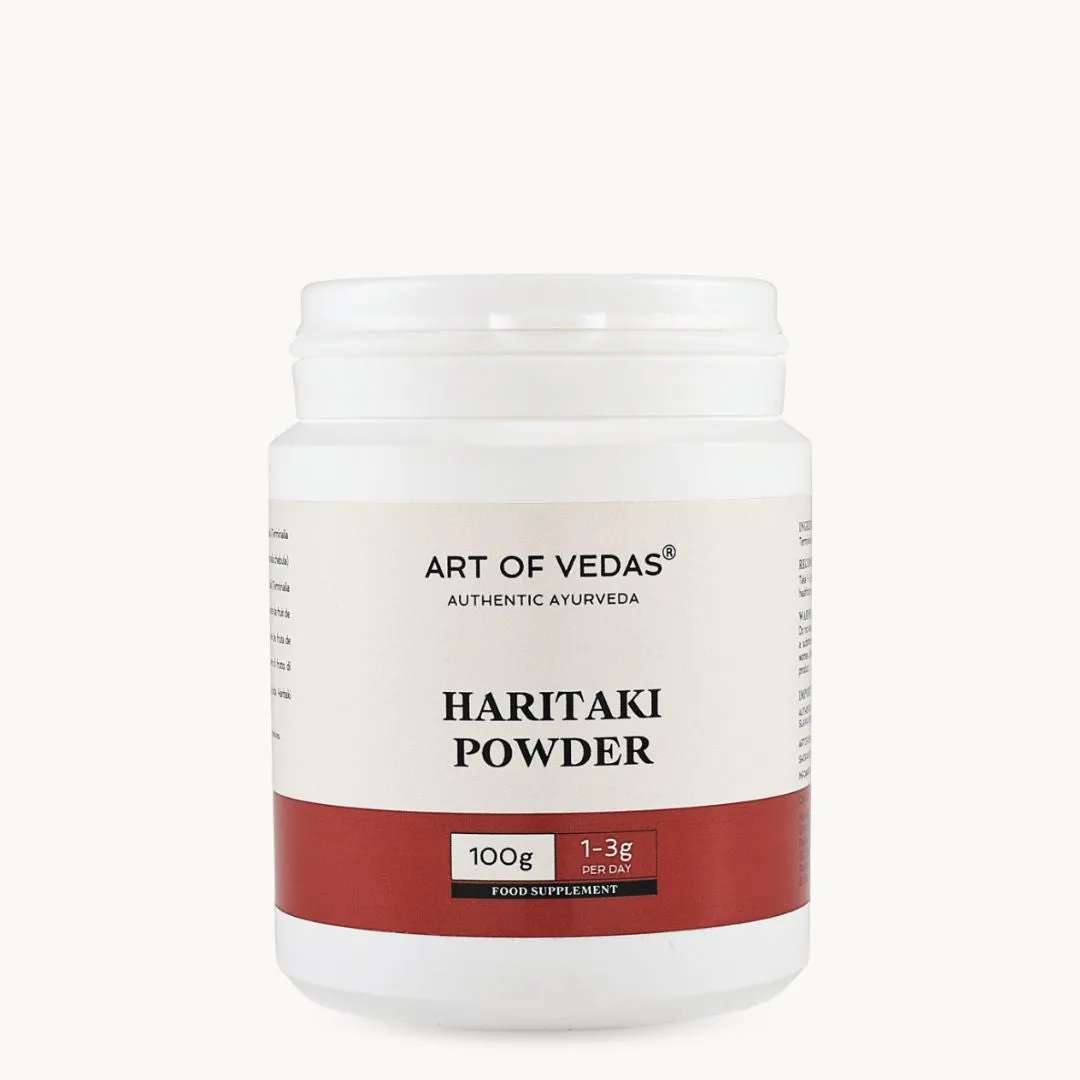
Classical texts place Haritaki first among the three and describe it as carrying five of the six tastes, everything except lavana, the salty taste. Its dominant taste is kashaya, astringent. It is ushna, warming, in potency. Haritaki is used as a single herb as well as within the formula, and is sold on its own as Haritaki Powder.
Bibhitaki
Where Haritaki carries several tastes at once, Bibhitaki is kashaya almost without qualification, and it gives Triphala much of its characteristic pucker. It is ushna, warming, in potency, and it resolves to a sweet taste once digested. Its classical qualities are dry and light, and it is the fruit the tradition directs at Kapha.
Amalaki
Amalaki, better known as Amla, is sour predominant and shita, cooling, in potency, which offsets the warmth of the other two. It appears repeatedly in the Rasayana chapters of classical literature, and like Haritaki it is also used alone, as Amla Powder. Rasayana is the category of preparations traditionally taken over long periods rather than occasionally, and the tradition places Triphala itself within it.
Astringent on the tongue, sweet after digestion
Ayurveda reads a substance on three axes: rasa, the taste registered immediately on the tongue; virya, its potency once it acts; and vipaka, the taste it resolves into after digestion. Triphala is interesting because the three readings disagree. On the tongue it is firmly astringent with a sour edge, yet its vipaka is madhura, sweet. A substance that tastes drying but resolves sweet is classically understood as nourishing rather than depleting, which is why Triphala sits in the Rasayana category and not among the purely drying preparations.
Because Haritaki and Bibhitaki are warming while Amalaki is cooling, the blended potency is mild rather than markedly hot or cold, which is what makes daily use sensible. Triphala has been taken in small quantity, over long stretches, as part of Dinacharya, the daily routine Ayurveda regards as more consequential than any occasional measure.
How Triphala is traditionally taken
The classical vehicle is warm water. Around three to six grams of the Churnam, the powdered form, is stirred into a cup of warm water and taken in the evening, an hour or two after the last meal of the day. Some practitioners prefer the morning on an empty stomach, and some steep the powder in water overnight and drink the strained liquid, which softens the astringency considerably.
The anupana, the substance a preparation is carried in, is chosen deliberately in Ayurveda and is not a matter of flavour. Warm water is the neutral choice. Honey is used where a lighter, more drying effect is wanted. Ghee is used where the opposite is wanted, and this is the logic behind Triphala Ghritham, in which the fruits are processed into a ghee base rather than presented as a dry powder. A Ghritham behaves differently from a Churnam even when the herbs are identical, because Ayurveda holds that the medium carries the preparation into different tissues. If ghee based preparations are new to you, our guide on choosing and buying Ghritham in Europe covers what to look for.
Powder or capsules
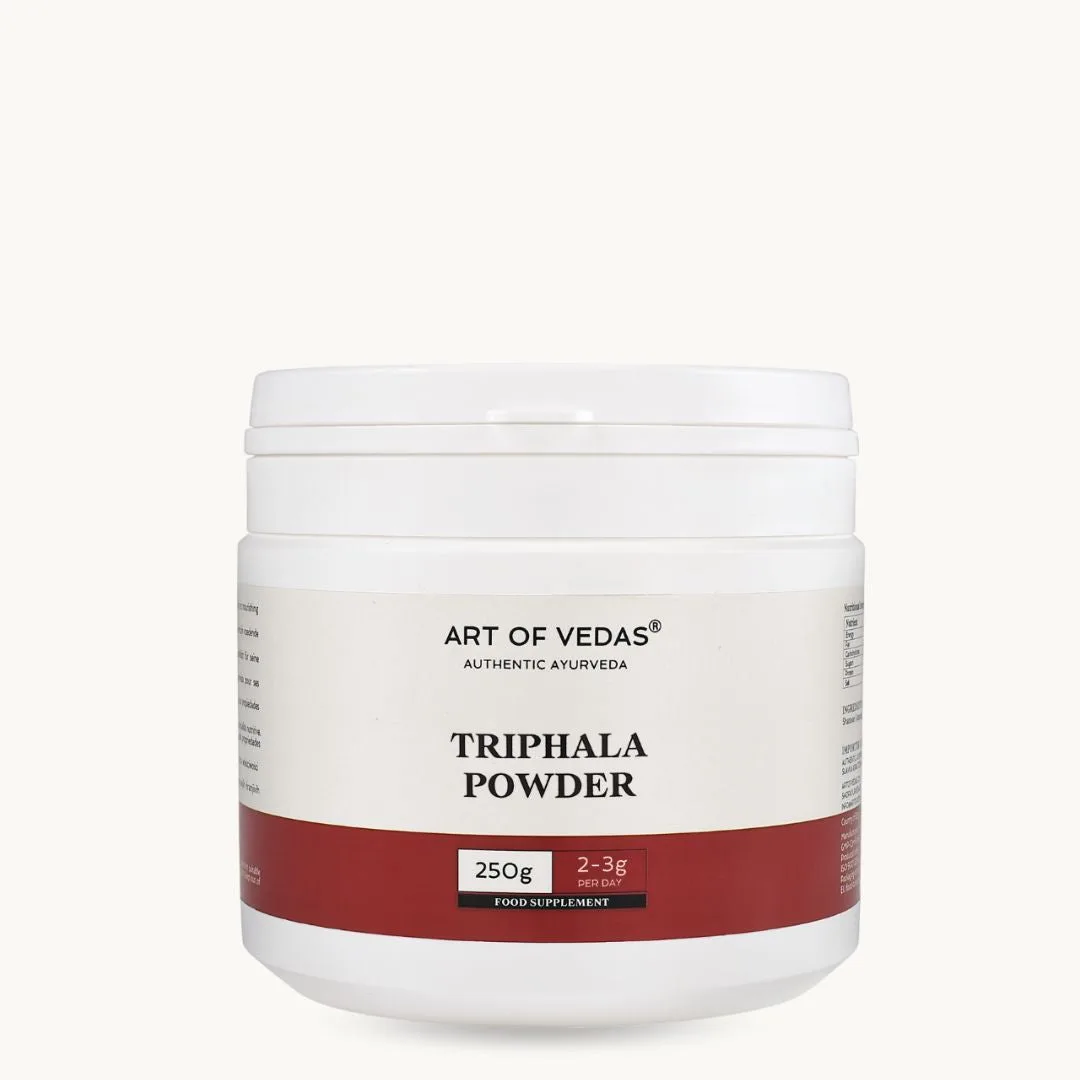
This choice is less trivial than it looks. Ayurveda holds that rasa, taste, is part of how a preparation acts, because the tongue registers a substance before the stomach does and Agni, the digestive fire, begins to respond at that moment. By that reasoning the powder is the more complete form. Triphala Powder gives the full astringent contact and lets you adjust the quantity by a pinch rather than by a whole unit.
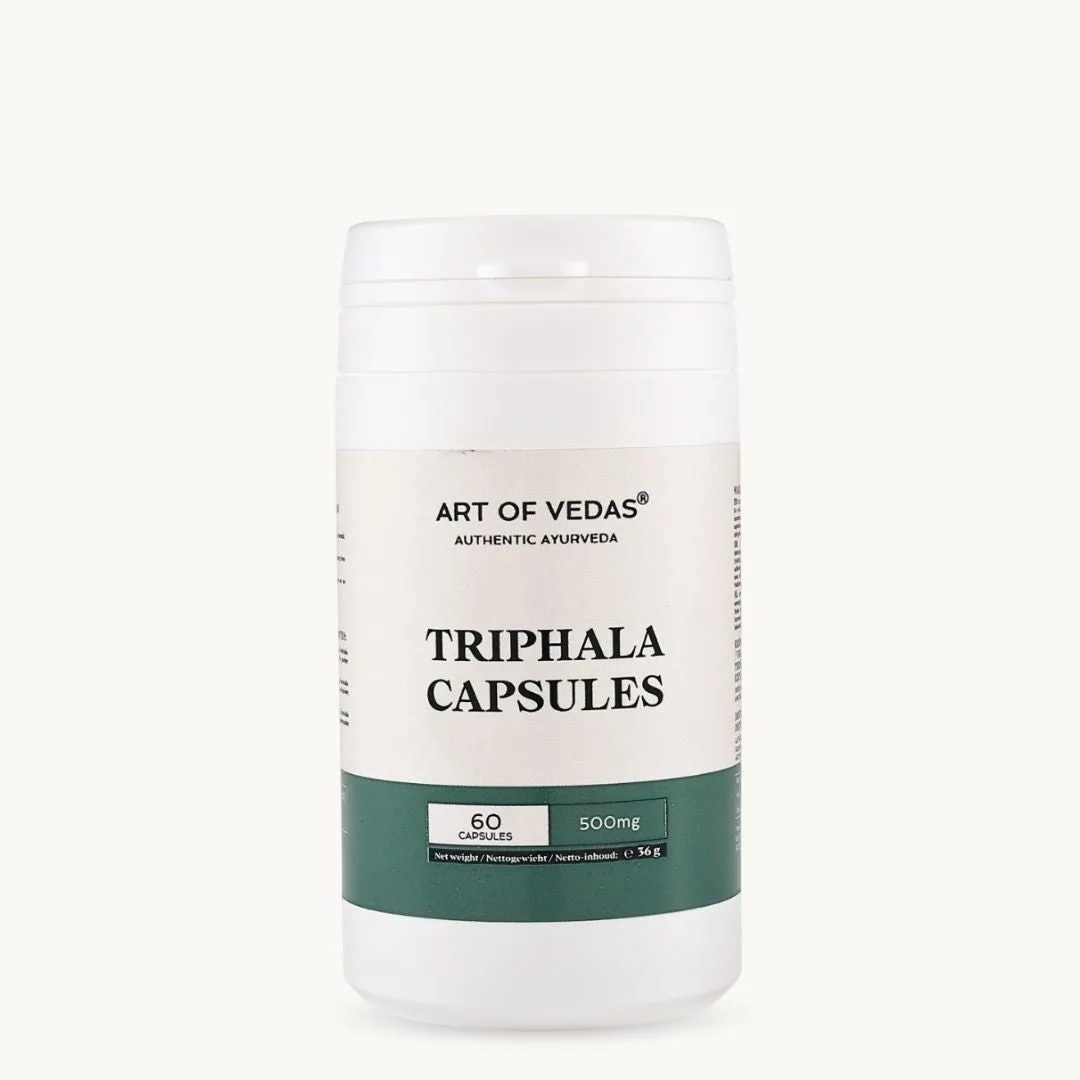
The honest counterargument is that a preparation nobody will actually swallow has no tradition behind it at all. Triphala Capsules hold a measured quantity and make the evening dose a matter of seconds. The practical reading: powder where someone will genuinely use it, capsules where they will not.
What separates a well made Triphala
The three fruits are commonly combined in equal parts by weight, although some traditions weight Amalaki more heavily. Either is defensible, but the ratio should be stated rather than left vague.
- Pulp only. Stone ground in with the pulp dulls both the colour and the taste.
- Colour. A good Churnam is a warm mid brown. Pale powder is worth questioning.
- Taste. It should be sharply astringent and slightly sour. A flat, dusty taste means the powder has been sitting too long.
- Grind. Fine and even, without visible fragments.
- Storage. Airtight, away from light and damp. Powdered fruit takes up moisture quickly and clumps once it has.
Practical cautions
Triphala is a food supplement and is not a substitute for medical advice. If you are pregnant or breastfeeding, take any medication, or have any ongoing medical condition, speak with your doctor or a qualified practitioner before beginning any new supplement. Start below the classical quantity and stay there for a week or two. A formula intended for years of use is not improved by taking twice as much in the first month.
Readers assembling a working Ayurvedic cabinet rather than trying a single preparation may find our guides to Haridra, the classical use of turmeric and to Brahmi a sensible next step, since both appear alongside Triphala in many traditional routines.
Frequently asked questions
What does Triphala taste like?
Strongly astringent with a sour undertone, closer to very strong black tea or unripe persimmon than to anything sweet. The astringency is the point rather than a defect. Warm water rather than cold makes it easier, as does steeping overnight and straining.
Does it matter if I take it at the same hour each day?
The tradition regards consistency as the more consequential half of the instruction, since Triphala belongs to the slow, repetitive side of Ayurveda rather than to anything taken as needed. A fixed hour that suits your day is worth more than the theoretically better hour you keep missing.
How much Triphala should I take?
Three to six grams of the Churnam daily is roughly a level teaspoon, taken as a single dose; capsules are dosed per unit on the label. Begin at the lower end, and where a practitioner has adjusted the quantity for an individual, that instruction takes precedence over any general figure.
Can Triphala be taken every day, and for how long?
Daily use over extended periods is the classical pattern rather than the exception, which is what distinguishes a Rasayana preparation from an occasional one. Traditional practice often works in blocks of two or three months with a pause between them. Anyone intending to use it continuously for longer should be working with a practitioner who knows their case.
Is Triphala Churna the same as Triphala powder?
Yes. Churnam, sometimes written churna, simply means a powdered preparation in Ayurveda. Triphala Churnam and Triphala Powder describe the same thing, and you will see both on labels.