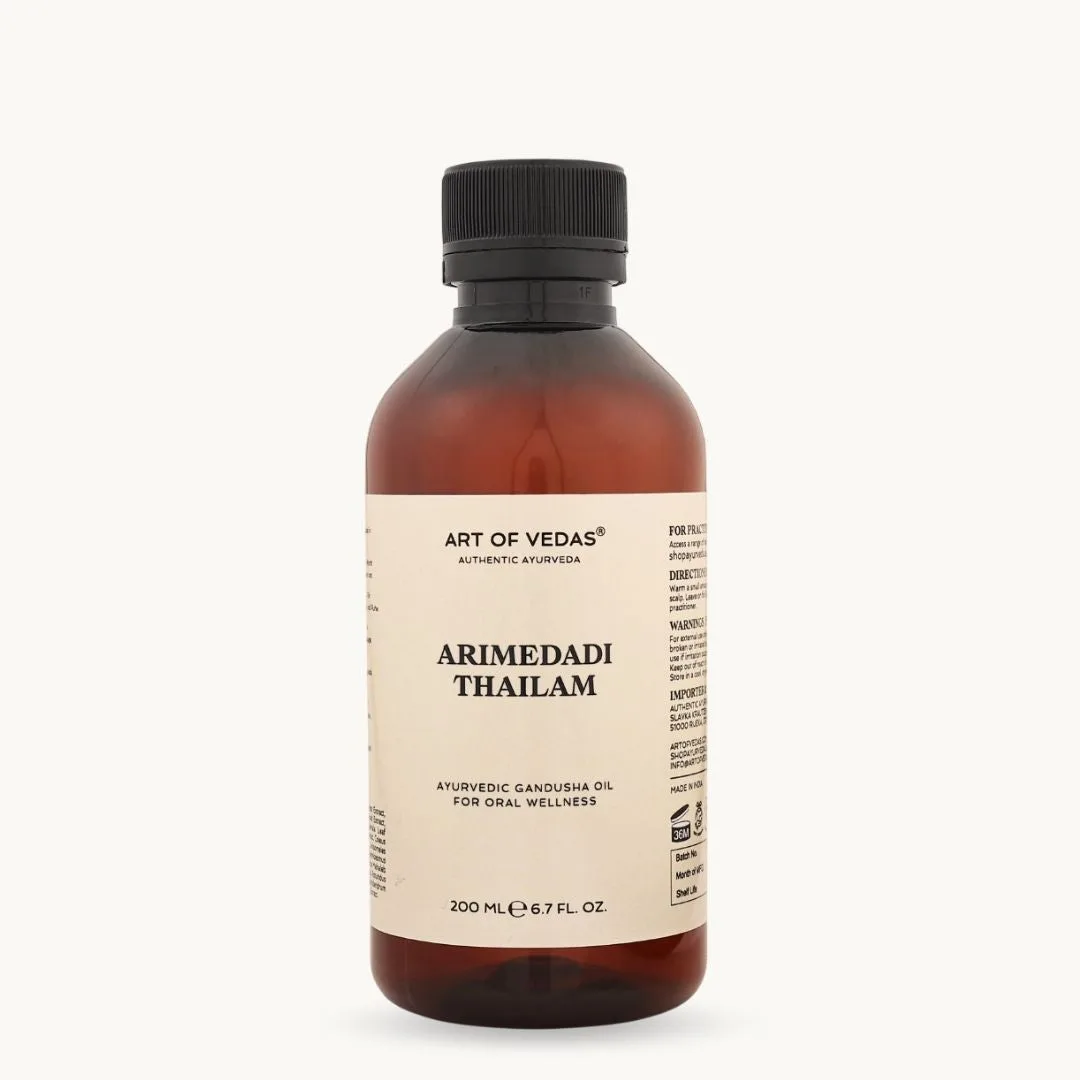
In brief: Arimedadi Thailam is a classical Ayurvedic medicated oil for Kavala and Gandusha, the oil pulling practices, in a sesame oil base. The Art of Vedas oil declares 29 plant ingredients, among them the barks of two Acacia species, Khadira and Arimeda, the Triphala fruits, Lodhra, liquorice, turmeric and warming spices such as clove, cinnamon, cardamom and nutmeg, plus shellac. This page lists every declared ingredient, grouped by what it is, with its Sanskrit and botanical name.
The declared ingredient list of Art of Vedas Arimedadi Thailam
The list below is the ingredient declaration of the Art of Vedas Arimedadi Thailam, as printed on the product page. It names the plant, the part used and the botanical name. Arimedadi Thailam is also written Arimedadi oil, Arimedadi Taila, Arimedadi Thailam or Arimedadi Tail; the spelling changes, the formula does not.
Base and finishing ingredients
- Sesame seed oil (Tila Taila, Sesamum indicum): the oil base in which all the plants are cooked
- Shellac (Laksha): a resin that the classical recipe adds to the cooking oil
- Camphor oil (Karpura, Cinnamomum camphora): added at the end for its aroma
- Sugarcane extract (Ikshu, Saccharum officinarum)
The two Acacia barks that give the oil its name
Arimedadi means starting with Arimeda. Two Acacia species head the declared list:
- Arimeda, white babul (Acacia leucophloea), extract
- Khadira, catechu or cutch tree (Acacia catechu), extract
Astringent fruits, barks and wood
- Haritaki (Terminalia chebula), fruit
- Bibhitaki, bahera (Terminalia bellerica), fruit
- Amalaki, amla (Emblica officinalis), fruit
- Lodhra (Symplocos racemosa), bark
- Nyagrodha, banyan (Ficus benghalensis), bark
- Katphala, box myrtle (Myrica esculenta), bark
- Padmaka, wild Himalayan cherry (Prunus cerasoides), bark
- Wild cherry (Prunus avium), fruit
- Patanga, sappanwood (Caesalpinia sappan), wood
Haritaki, Bibhitaki and Amalaki together form Triphala, the three fruits of the classical texts.
Roots, flowers and whole plants
- Yashtimadhu, liquorice (Glycyrrhiza glabra), root
- Haridra, turmeric (Curcuma longa), root
- Manjishtha (Rubia cordifolia), root
- Musta, nutgrass (Cyperus rotundus), root
- Hrivera (Coleus vettiveroides), root
- Ushira, vetiver (Vetiveria zizanioides), root
- Vrishchikali, Indian stinging nettle (Tragia involucrata), root
- Nagakesara (Mesua ferrea), flower
- Dhataki, fire flame bush (Woodfordia fruticosa), flower
- Lajjalu, sensitive plant (Mimosa pudica), extract
Warming spices and aromatics
- Lavanga, clove (Syzygium aromaticum), flower oil
- Twak, cinnamon (Cinnamomum zeylanicum), bark oil
- Tamalapatra, Indian bay leaf (Cinnamomum tamala), leaf oil
- Ela, cardamom (Elettaria cardamomum), seed oil
- Jatiphala, nutmeg (Myristica fragrans), seed
- Kankola, cubeb (Piper cubeba), fruit
Naturally present fragrance components
Cinnamal, eugenol, isoeugenol, linalool, limonene, coumarin and benzyl benzoate are declared at the end of the list. They are not added fragrances. They occur naturally in clove, cinnamon, bay leaf, cardamom, nutmeg and the other aromatic plants, and EU cosmetics rules require them to be named once they pass a set concentration, so that people who react to them can see it.
How the ingredients go into the oil
A Thailam is not a mixture of oil and powder. In the classical method, called Taila Paka, the tougher barks and fruits are first simmered into a decoction (Kashayam), the softer plants are ground to a paste (Kalka), and both are cooked slowly into the sesame oil until the water has gone and the paste meets the traditional finishing tests. Camphor is stirred in only after the oil has come off the heat, so its aroma is kept. The practice itself is described in our Arimedadi Thailam oil pulling guide.
Because every plant is cooked into the base, the finished oil has one character rather than the separate characters of thirty plants. In Ayurvedic terms its taste is described as Kashaya and Tikta, astringent and bitter, which is the taste you notice during Kavala. That is also why the same oil is never reproduced by adding a few drops of essential oil to plain sesame oil.
Classical recipe and declared list: why the lists differ
The Ashtanga Hridayam and the Sahasrayogam set out Arimedadi Thailam with a list that names, among others, neem, Patha and the Trikatu spices. A product sold in Europe declares what is actually in the bottle, and some classical items are left out today for reasons of availability or of regulation, while others appear under their botanical names. The declared list above is therefore the reference for the Art of Vedas oil, and a list that differs from the classical text is not a sign of a lesser oil. When you compare oils from different makers, compare their declared lists rather than their claims about how many herbs they contain.
Frequently asked questions about the ingredients
How many ingredients does Arimedadi Thailam contain? The Art of Vedas oil declares 29 plant ingredients in a sesame oil base, plus shellac. The seven fragrance components named at the end of the label are not extra ingredients; they occur naturally in the spices already on the list.
What is the base oil of Arimedadi Thailam? Sesame seed oil (Tila Taila). All the plants are cooked into it by the classical Taila Paka method; no other carrier oil is declared.
Is Arimedadi Thailam vegan? No. Shellac, a resin of insect origin that the classical recipe adds to the cooking oil, is on the declared list. All other declared ingredients are plant materials.
Does Arimedadi Thailam contain nuts or sesame? It contains sesame: sesame seed oil is the base. Nutmeg is a seed, not a tree nut. No tree nuts or peanut are declared. Anyone who reacts to sesame should not use it.
Why are cinnamal, eugenol, isoeugenol, linalool, limonene, coumarin and benzyl benzoate on the label? They occur naturally in clove, cinnamon, bay leaf, cardamom, nutmeg and the other aromatic plants in the oil. EU rules require them to be named above a set concentration so that sensitive people can check for them. They are not added perfume.
Which Acacia is the Arimeda of the name? In the classical texts Arimeda is the white babul, Acacia leucophloea; Khadira, the catechu tree, is Acacia catechu. The Art of Vedas oil declares both, so the name-giving plant and its close relative are each in the bottle.
Does the Art of Vedas oil contain the neem or the Trikatu spices named in the old texts? No. The declared list above is complete for our oil. Several items of the classical recipe are not used in a product sold in Europe, and the declaration on the label is the reference.
Where can I check the exact list before buying? On the product page, which carries the same declaration as the label, and on the label of the bottle. If you have a known sensitivity, show the list to your doctor or pharmacist first. The oil is held in the mouth and spat out; it is not swallowed.
Read further