This article is educational and describes traditional Ayurvedic concepts and self-care practices. It is not medical advice and is not intended to diagnose, treat, cure or prevent disease. If you are pregnant, taking medication, managing a health condition, or unsure whether a practice is appropriate for you, speak with a qualified healthcare professional or Ayurvedic practitioner.
In brief: To choose an Ayurvedic oil, answer five questions in order: which base oil suits your skin and climate, which practice the oil is actually made for, what the Dosha language (the Vata, Pitta and Kapha framework) on the page really means, whether the formula suits the season, and whether the label gives you full ingredient, batch and responsible business information. The loudest marketing claim is never the answer.
What people mean by "Ayurvedic oil"
Search for an Ayurvedic oil and you meet a shelf of bottles that look alike and behave very differently. Some are single pressed oils. Some are classical preparations carrying a long botanical list. Some are thick enough to need warming between the palms. Work out which of these you are looking at before you compare prices.
Thailam
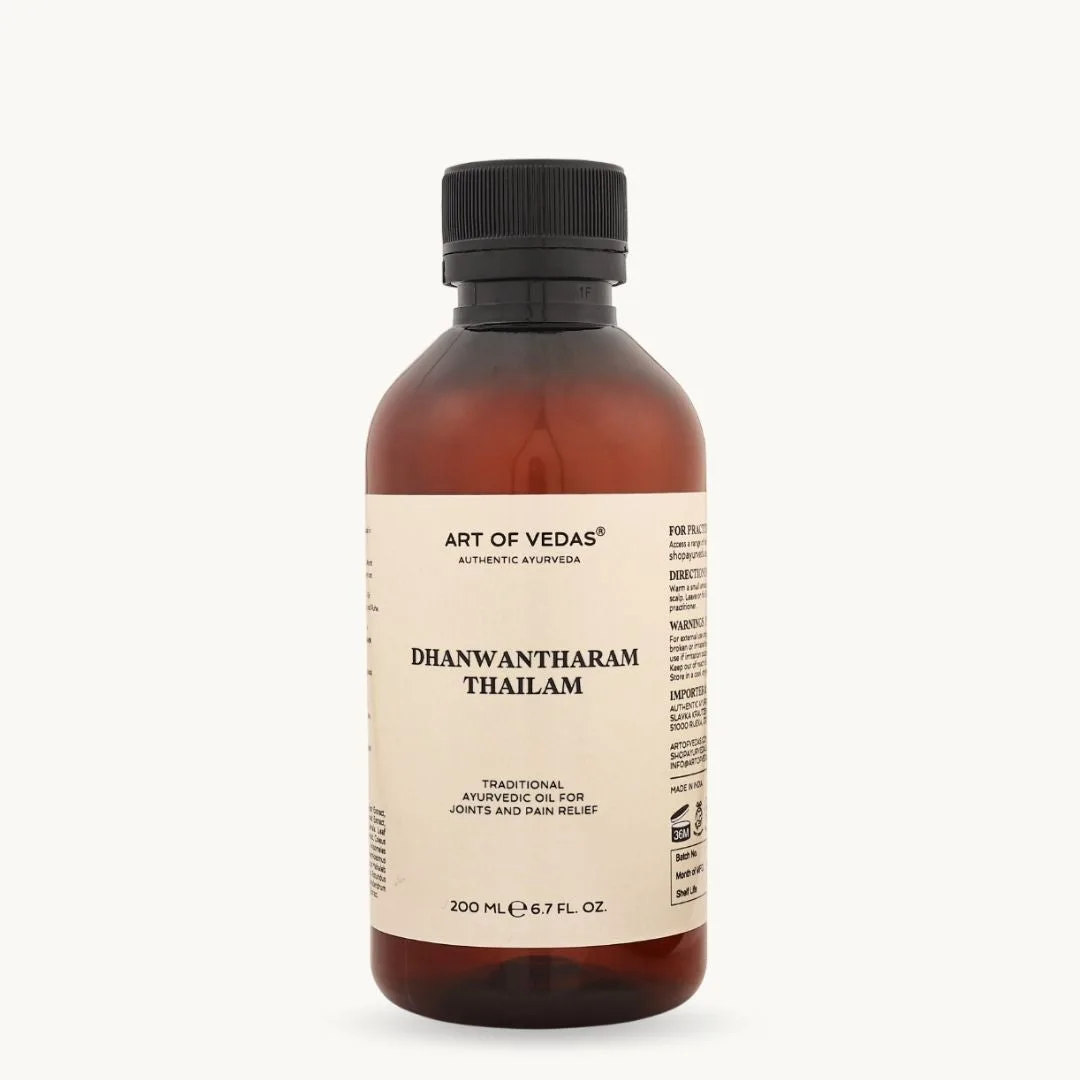
Thailam (a classical medicated oil in which botanicals are processed into an oil base over many hours) is the format most people picture. Classical compendia including the Ashtanga Hridayam and the Sahasrayogam set out the method: a herbal decoction and a herbal paste are combined with the base oil and reduced under controlled heat until only the oil remains. The finished preparation carries the character of the botanicals, not merely their scent. Our guide to what a Thailam is covers the process.
Kuzhambu
Kuzhambu (a denser oil preparation, often semi solid at room temperature) follows a similar method taken further, so the finished preparation sets firmer. Practitioners choose it where a heavier, slower application is wanted. In a cool room it needs a moment between the hands before it spreads.
Ghritham
Ghritham (a preparation made in a ghee base rather than an oil base) belongs in a separate category again. Some Ghritham preparations are intended for internal use and some are strictly external. The directions on the pack settle that question, never the format.
Plain base oils
Plain sesame oil and plain coconut oil are sold without added botanicals. They are genuine Ayurvedic materials in their own right and often the correct starting point for a beginner. They are also the most affordable way to practise daily Snehana (oleation, the classical practice of applying oil to the body).
How to choose an Ayurvedic oil: five questions that matter
The fastest way to choose an Ayurvedic oil is to answer five questions in sequence. Each one narrows the shelf. By the fifth you are usually deciding between one or two products rather than forty.
- Which base oil suits your skin and your climate?
- Which practice is the oil actually made for?
- What is the Dosha language on the page telling you?
- Does the formula suit the season you are in?
- Does the label give you everything you need?
Keep to that order. Starting at the ingredient list and working backwards leaves you comparing products that were never intended for the same use, which is how most people end up with a bottle they never finish.
Question one: which base oil suits you
Almost every classical oil preparation rests on a base, and the base sets the character of the finished product more than any single botanical in it. Decide the base first.
Sesame
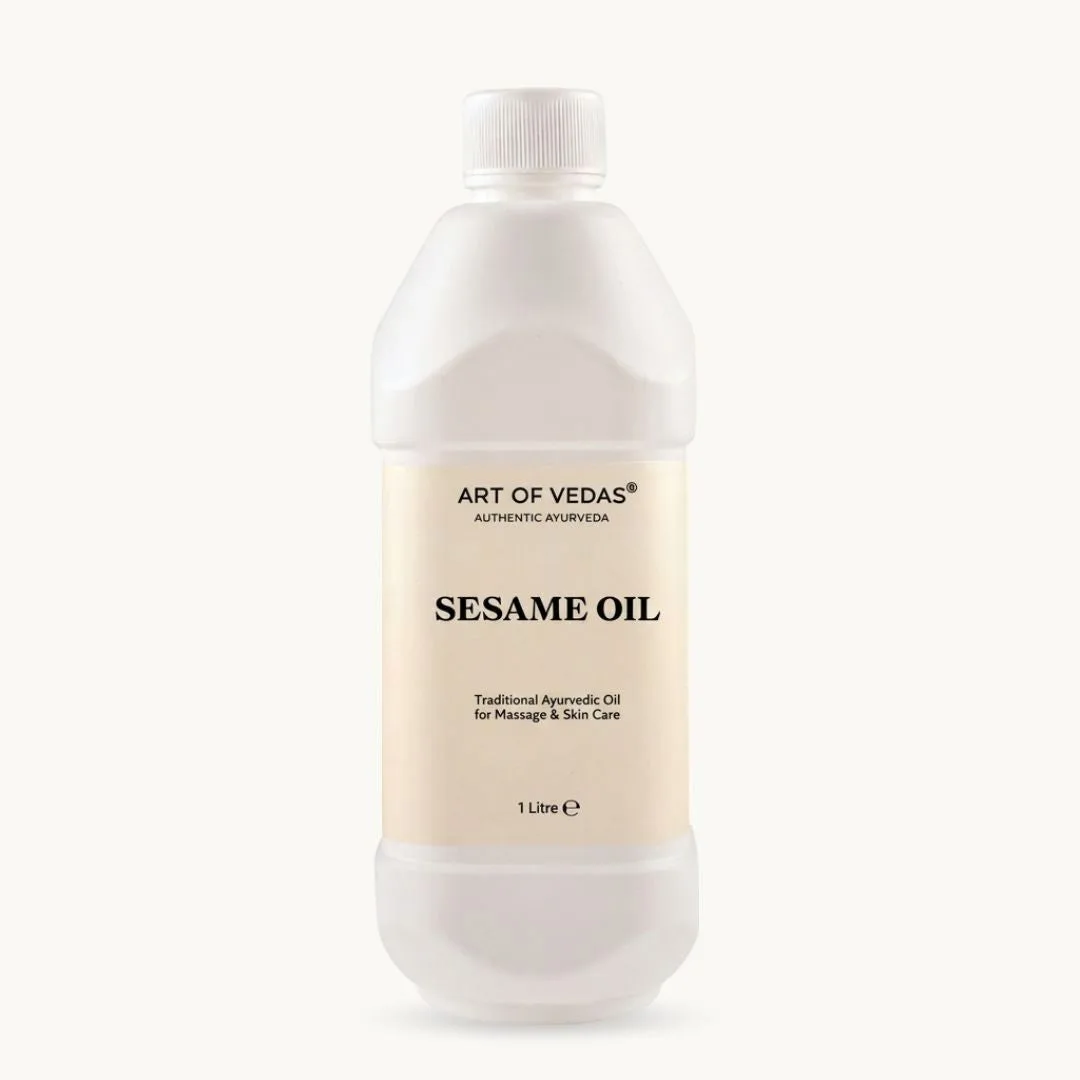
Sesame is the most widely used base in classical Ayurveda and is known for its warming, heavy and penetrating qualities. In classical terms it is described as ushna Virya (heating potency, one of the properties Ayurveda uses to classify a substance). It suits cooler weather and skin that feels dry and rough to the touch. It has a definite aroma, it marks fabric, and it takes longer to absorb than a light cosmetic oil. That slowness is part of how the practice is meant to work, not a fault. Our sesame oil guide covers the classical view.
Coconut
Coconut is the usual choice where a cooling character is wanted. It is lighter on the skin, it absorbs faster, and most people find it more comfortable in warm weather or in a heated room. Preparations built on a coconut base are commonly described as suited to Pitta (the Dosha associated with heat and transformation). Below roughly twenty degrees it sets solid in the bottle, which is normal. The coconut oil guide sets out the classical view.
Ghee and milk processed preparations
Some preparations are processed with milk or finished in ghee. These feel richer, they are usually reserved for particular practices rather than daily whole body use, and the cost per millilitre is higher. The price reflects the work involved rather than a premium for the name.
A practical test
If you cannot decide, buy a small quantity of plain sesame oil and a small quantity of plain coconut oil and use each for a week. Your own skin answers the question faster than any product description. Note how long each takes to absorb, how the aroma sits through the day, and how your skin feels next morning.
Question two: which practice is the oil for
An oil sold for the scalp and an oil sold for the face are not interchangeable, even when their ingredient lists overlap. Match the product to the practice before anything else.
Abhyanga
Abhyanga (the classical full body oil self massage) uses volume. You will get through far more oil than you expect, so format and price per litre matter here in a way they do not elsewhere. Warming, heavier preparations are the traditional choice for this practice in cool weather. If you have not done it before, begin with the Abhyanga method and a simple base oil rather than a specialised classical formula.
Shiro Abhyanga
Shiro Abhyanga (head and scalp massage) uses a much smaller quantity and normally a preparation chosen for hair and scalp. Body oils are usually too heavy here and they are difficult to wash out, which puts people off the practice quickly.
Padabhyanga
Padabhyanga (foot massage, classically performed in the evening) also uses very little oil. Many households keep a small bottle beside the bed for this alone.
The face
Facial preparations are formulated for thinner, more reactive skin and they are sold in small volumes for good reason. Do not substitute a body oil on the face because it worked out cheaper per millilitre.
Nasya
Nasya (the classical practice of applying oil in the nostrils) uses preparations made specifically for that purpose. Never improvise here with a body or hair oil. If a product does not state that it is intended for Nasya, then it is not.
Question three: what the Dosha language is telling you
Most Ayurvedic product pages describe an oil in terms of Vata, Pitta and Kapha (the three Doshas, the functional principles Ayurveda uses to describe constitution and imbalance). This language is genuinely useful. It is also widely misread.
A phrase such as "suited to Vata" does not mean the product is reserved for one kind of person. It means the qualities of the preparation, warm, heavy and moist, run opposite to the qualities Ayurveda associates with Vata (the Dosha associated with movement, dryness and cold). Ayurveda works by opposites. A dry, cold, mobile state is met with something warm, heavy and steady.
Two further terms are worth knowing. Prakriti (your constitution, the pattern you were born with) does not change. Vikriti (your present state) shifts with weather, workload, sleep and food. A product chosen for your Vikriti is usually more useful day to day than one chosen for your Prakriti alone, which is why the same person reasonably owns more than one oil. Our introduction to the three Doshas explains the distinction.
If a page tells you an oil suits everyone in every season, read that as marketing rather than classical guidance.
Question four: does the formula suit the season
Ritucharya (the classical seasonal regimen) is among the most practical parts of Ayurveda, and it changes the answer to this question several times a year. The same person sensibly wants different oils in February and in July.
In cold, dry, windy weather, warming and heavier preparations on a sesame base are the classical choice, applied generously and given time to settle. In hot weather, lighter and cooling preparations on a coconut base are more comfortable, and most people reduce the quantity they apply. In the damp, heavy weeks of late winter and early spring, lighter preparations are traditionally preferred, and dry powder massage sometimes replaces oil altogether.
Buying a five litre container of a single warming preparation in May is a common and expensive mistake. Our Ritucharya guide sets out the seasonal pattern in full.
Dinacharya (the classical daily routine) matters as much as the season. An oil used every morning before a shower has different practical requirements, absorption speed, aroma, staining, from one used twice a week in the evening.
Question five: what the label tells you
By this point you hold a short list, and the label decides between the candidates. Check the following before you pay.
- Full ingredient information. A cosmetic product should carry a complete INCI list. An ingredient line that stops at "herbal extracts" tells you nothing.
- Stated intended use. The pack should say plainly whether the product is for external use, and a product taken internally should be labelled as a food supplement.
- Directions and warnings. Specific, practical directions show that a named business took responsibility for the product.
- Net content. Compare price per 100 ml rather than price per bottle. Bottle sizes vary more than shoppers expect, and a cheaper bottle is often a smaller one.
- Batch number and date of minimum durability. Both belong on the pack itself, not only on the outer carton.
- Responsible business details. A named company with a real postal address, not a brand name floating on its own.
- Storage guidance. Oil preparations keep best away from light and heat. A clear bottle standing in a sunny window is a poor choice whatever is inside it.
When several of these are missing, the low price is not the bargain it appears to be. Our notes on identifying genuine Ayurvedic products go further into what deserves attention.
Mistakes that lead to the wrong bottle
- Buying by ingredient count. A longer botanical list is not a better preparation. Classical formulas have fixed compositions, and adding to one does not improve it.
- Buying the largest size first. Buy a small bottle, use it for a month, then commit to volume.
- Reading traditional language as a medical claim. Classical descriptions of warming, cooling, heavy or light qualities describe the substance itself. They do not replace advice from a qualified professional.
- Combining preparations. Mixing two classical formulas does not produce a third. Each was composed as a whole. Ask a qualified practitioner before combining specialised preparations.
- Ignoring the aroma. You will not keep using an oil whose smell you dislike, however well chosen it is on paper.
- Ignoring allergy. Sesame is a common allergen and several classical formulas are built on it. Patch test on the inner forearm and wait a day before a full application.
A sensible starting shelf
For most people beginning at home, three products cover nearly everything: a plain warming base oil for whole body Abhyanga, a preparation made for the scalp, and a small bottle kept for the feet. Add a facial preparation once the routine is established. You can browse Ayurvedic oils to see how the classical preparations are grouped.
Frequently asked questions
Which oil is best for Abhyanga?
There is no single best oil for Abhyanga. The sensible choice depends on the base that suits your skin, the weather where you live, the quantity you will realistically use, and the directions on the pack. Many people begin with a plain warming base oil, practise for a month, and move to a classical preparation once they know what they want from it. If you work with a qualified practitioner, ask before changing to a specialised formula.
Is sesame oil always suitable?
No. Sesame is the most widely used classical base and it is known for warming qualities, but that does not make it universal. Sesame is a recognised allergen, its warming character can feel uncomfortable in hot weather or in a heated room, and some skin simply prefers a lighter base. Patch test first, and regard coconut or another base as an equally legitimate classical choice rather than a compromise.
What is the difference between a Thailam and a plain oil?
A Thailam is a prepared formula with a defined botanical composition, made by processing a decoction and a herbal paste into a base oil under controlled heat until only the oil remains. A plain oil has one main ingredient and no added botanicals. The practical differences show up in aroma, colour, texture and price. The plain oil is often the better starting point, because it lets you learn the practice before introducing a specific formula.
Can I mix different Ayurvedic oils together?
It is better not to. Classical preparations were composed as complete formulas with fixed proportions, and combining two of them does not produce a stronger third. Mixing also makes it impossible to tell which product suited you. Use each product as directed on its own pack, and speak with a qualified practitioner before combining specialised preparations.
Should I warm the oil before applying it?
Warming is traditional and most people find it more comfortable, particularly with heavier preparations and with Kuzhambu, which is semi solid at room temperature. Stand the closed bottle in a bowl of hot water for a few minutes rather than heating the oil directly, and never use a microwave, which heats unevenly. The oil should feel pleasantly warm on the inside of the wrist and never hot.
How long should one bottle last?
That depends on the practice. A whole body Abhyanga uses a generous quantity, so a 200 ml bottle may cover only a handful of sessions, while the same bottle used for the feet in the evening can last for months. Work out your weekly use before buying a large format, and check the period after opening printed on the pack.