Classical Ayurveda does not treat the hair as a cosmetic concern that begins and ends at the scalp surface. The classical texts situate hair health within the Dhatu (tissue) framework that underlies the entire Ayurvedic understanding of physiology - specifically within Asthi Dhatu (bone tissue) whose mala (metabolic by-product) is Kesha (hair and nails). This means that in the classical view, hair quality is a direct reflection of the health of the bone tissue channel, and hair loss, brittleness, premature greying and scalp conditions are not primarily cosmetic problems but clinical signals about the state of Asthi Dhatu and the Vata Dosha that governs it.
This framework changes both the approach to hair care and the selection of remedies. Rather than treatments applied at the surface to produce a surface effect, the classical Ayurvedic approach works from the tissue level outward - nourishing the Asthi Dhatu channel, pacifying Vata excess that depletes the hair follicle's nourishment, and addressing the scalp as the terminal end of the channels governing Rasa Dhatu (plasma), Rakta Dhatu (blood) and the Pitta-governed blood circulation that feeds the follicle.
Art of Vedas offers a dedicated range of classical Ayurvedic hair and scalp oils in the Hair and Scalp (Kesh Charya) collection, alongside the scalp-specific Kansa tools and copper instruments that the classical texts describe for scalp care. The full hair oil range is also available in the Ayurvedic Thailams for Hair and Scalp collection and the Hair Oils collection.
Kesha and Asthi Dhatu: The Classical Framework
The Charaka Samhita, Sutrasthana Chapter 28, describes hair as an upadhatu (secondary tissue) of Asthi Dhatu - the bone tissue system. In the classical seven-Dhatu sequence, Asthi Dhatu is the fifth tissue level, nourished by the transformation of Meda Dhatu (fat tissue) before it. The hair follicle, nail root and the connective tissue that anchors the hair shaft in the scalp are all considered expressions of Asthi Dhatu quality at the surface.
This anatomical framework has a direct practical implication: Vata - the Dosha that governs and can deplete Asthi Dhatu - is the primary Doshic factor in most hair and scalp conditions involving dryness, brittleness, excessive hair fall and scalp dryness. Vata's dry (Ruksha), cold (Sheeta), rough (Khara) and light (Laghu) qualities are directly counter to the moist, heavy, warm and nourished state that supports healthy Kesha production. When Vata aggravates in the Asthi Dhatu channel, the hair reflecting it at the surface becomes dry, rough, brittle, prone to breakage and eventually prone to excess fall.
Pitta, when aggravated in the Rakta Dhatu (blood) that supplies the scalp and follicle, produces a different category of hair and scalp presentations - the Pitta-type signs of premature greying (Palitya), scalp inflammation, heat and sensitivity, thinning from inflammatory follicle disruption, and the characteristic Pitta-red or inflamed scalp presentation that responds to cooling rather than the warming approach appropriate for Vata.
Kapha accumulation in the scalp channels produces yet another pattern: the heavy, oily, sluggish quality of Kapha excess in the head channels produces oily dandruff, scalp congestion and a heavy quality to the hair that lacks the lightness and movement of healthy Kesha.
The Classical Practice of Shiro Abhyanga
Shiro Abhyanga (shee-roh uhb-yahn-gah) - head and scalp oil massage - is described in the Ashtanga Hridayam's Dinacharya chapter as a foundational daily or weekly practice with benefits extending well beyond the hair itself. The text describes Shiro Abhyanga as producing Dridha Moola Kesha (firmly rooted hair), preventing premature hair loss, promoting sound sleep, calming the nervous system and supporting the clarity of the sensory organs - all through the combined action of oil nourishment of the scalp Srotas (channels) and stimulation of the head Marma (vital energy) points.
The three primary head Marma points emphasised in the classical texts for scalp massage are:
Adhipati Marma - at the crown of the head, described as the master point of the head channel network and the point most directly connected to Prana Vata governance of consciousness and the upper body system. Sustained circular massage at the crown during Shiro Abhyanga is the most consistently described specific technique in the classical literature.
Sthapani Marma - at the third-eye centre between the eyebrows, accessible through the hairline. Associated in the classical texts with mental clarity, vision and the channels of Alochaka Pitta.
Krikatika Marma - at the base of the skull, where the neck meets the occiput. The classical texts describe stimulation of Krikatika as releasing tension from the cervical region and supporting the free downward flow of Prana through the neck channels.
The Three Classical Hair Oils: How They Differ
Neelibhringadi Thailam - The Foundational Pitta Hair Oil
Neelibhringadi Thailam is one of the most classically celebrated hair oils in the Ayurvedic tradition - described in the Sahasrayogam and consistently recommended classical practice for a range of hair and scalp presentations. Its name reflects its two primary herbs: Neeli (indigo, Indigofera tinctoria) and Bhringaraj (Eclipta alba), both of which have a classical specific affinity for the hair and scalp channels.
Bhringaraj - known in Sanskrit as the "King of Hair herbs" - is described in the Charaka Samhita as the pre-eminent Keshya (hair-nourishing) herb in the materia medica. Its Madhura (sweet) rasa, Sheeta (cooling) Virya and specific Pitta-pacifying action in the Rakta Dhatu channel of the scalp make it directly indicated for the Pitta-type hair presentations: premature greying (Palitya), thinning associated with scalp heat, and hair loss associated with Pitta-Rakta aggravation in the head channels.
Neeli (indigo) contributes its classical cooling and Pitta-reducing properties alongside a specific hair-darkening and strengthening action described in the Ayurvedic texts. The combination of these two cooling, Pitta-specific herbs in a sesame oil base makes Neelibhringadi Thailam the classical recommendation for premature greying, scalp heat and inflammation, and Pitta-type hair thinning - as well as being appropriate as a general Shiro Abhyanga oil for Pitta-dominant constitutions.
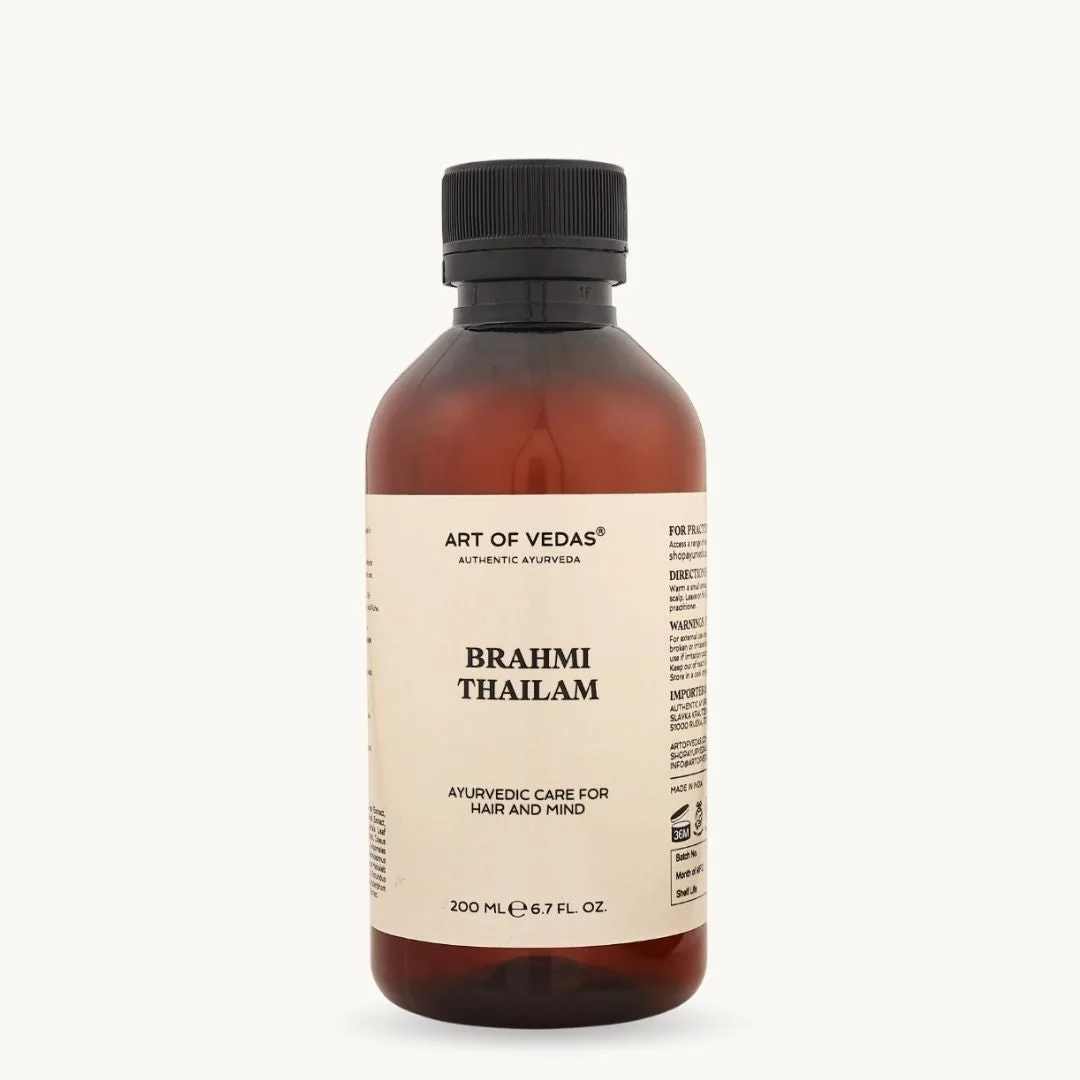
Brahmi Thailam - The Mind and Scalp Oil
Brahmi Thailam - not to be confused with the Brahmi Thailam formulated for Shiro Abhyanga for mental clarity - centres on Brahmi (Bacopa monnieri), the classical Medhya herb that also has a significant hair and scalp affinity in the classical tradition. The Charaka Samhita describes Brahmi as one of the primary herbs for Shiro Abhyanga for both its Medhya and Keshya (hair-nourishing) dimensions simultaneously.
Brahmi Thailam is particularly appropriate for Shiro Abhyanga in those whose hair and scalp presentations are accompanied by the mental dimension of Pitta or Vata-Pitta excess - stress-associated hair thinning, hair loss associated with mental overwork and Pitta mental intensity, and scalp tension accompanied by mental stress. The oil addresses both the scalp tissue (through its Keshya properties) and the mental channel dimension (through Brahmi's Medhya action) in a single preparation - reflecting the classical understanding that the scalp channels and the mental channels of the head are interconnected.
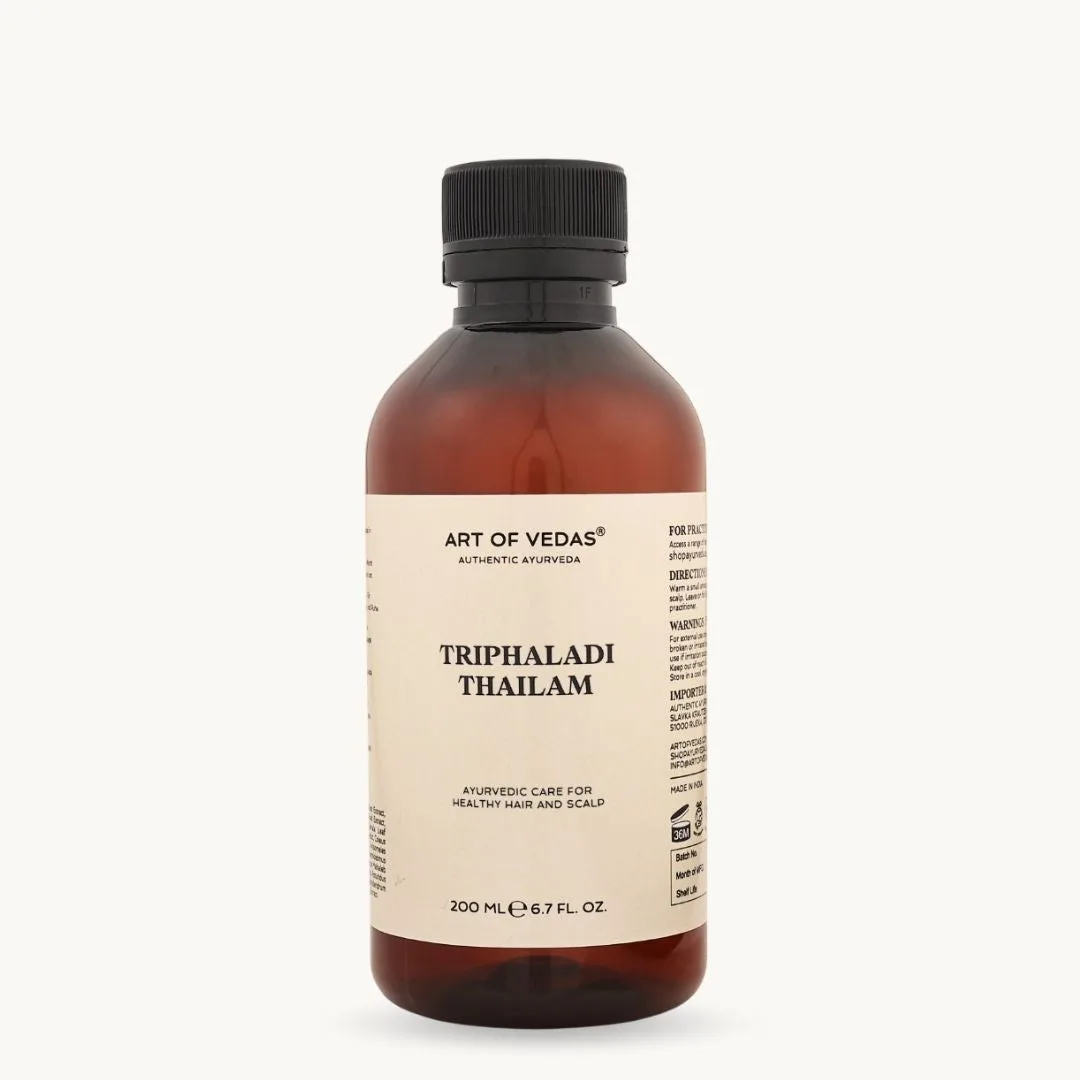
Triphaladi Thailam - The Kapha-Clearing Scalp Oil
Triphaladi Thailam is formulated around Triphala - the three-fruit combination of Haritaki (Terminalia chebula), Vibhitaka (Terminalia bellirica) and Amalaki (Phyllanthus emblica) that is among the most classically revered combinations in the entire Ayurvedic materia medica. Triphala's three-fold classical action - Shodhana (cleansing), Brimhana and Rasayana - makes it unusual as a base for a hair oil: most hair oils are primarily nourishing (Brimhana) in character, while Triphaladi's Shodhana (cleansing) dimension makes it specifically appropriate for scalp presentations with accumulation.
For Kapha-type scalp presentations - oily scalp, heavy dandruff with an oily quality, sluggish scalp circulation with a sense of thickness and congestion - Triphaladi Thailam is the classical most appropriate choice. Where Neelibhringadi provides cooling and Pitta-clearing for the hot, sensitive scalp, and Brahmi Thailam provides the mental-scalp connection for stress-related presentations, Triphaladi provides the cleansing, mobilising action for the accumulated, congested Kapha scalp.
Kansa Tools for Scalp and Hair Care
The Kansa tools in the Art of Vedas range have a specific and classical application in scalp care - the Kansa alloy's combination of copper (warming, activating) and tin (cooling, Pitta-pacifying) properties is Tridoshahara in its scalp application, making the tools appropriate across all constitutional types for different techniques.
The Kansa Wand Scalp and Body is the primary tool for Shiro Abhyanga - its broad dome and extended handle allow sustained circular movements across the entire scalp with the warmth-and-friction activation of the Kansa metal. Applied after Shiro Abhyanga oil has been distributed across the scalp, the Kansa Scalp Wand's dome stimulates the scalp Marma points and Srotas with a combined oil-and-metal action that neither the oil nor the tool produces alone. The scalp and body tools are featured in the Head and Scalp Massage collection and the Kansa Body and Scalp Massage collection.
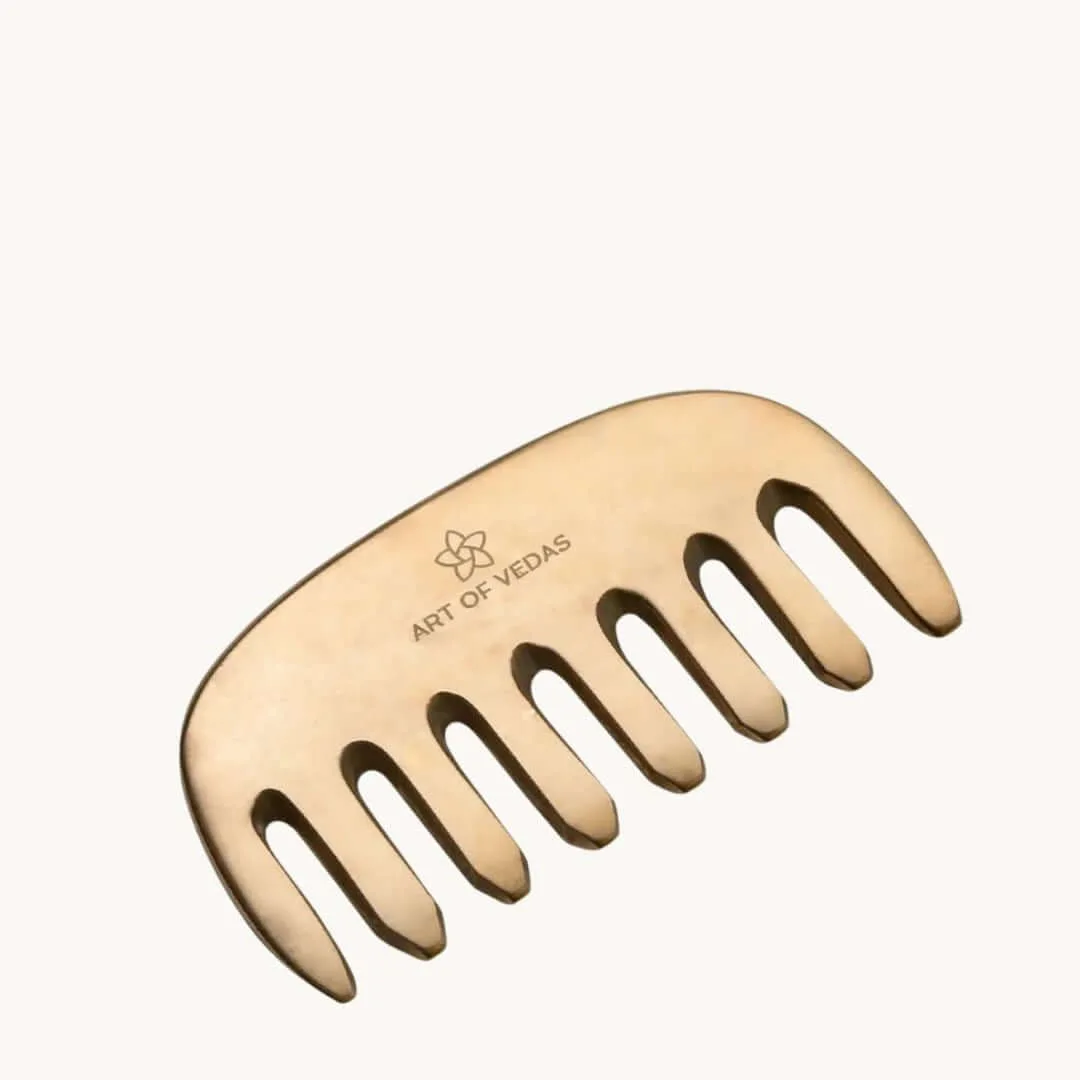
The Kansa Comb provides a different dimension of scalp stimulation - combing with the classical Kansya metal delivers the metal's properties along each stroke of the teeth through the hair and against the scalp, stimulating the follicle openings and scalp channels through the repeated light contact of combing. The classical texts describe regular combing (Keshprasadhana) as a standard component of daily hair care, and the Kansa metal transforms this simple daily act into a pharmacologically active scalp practice.
How to Perform Classical Shiro Abhyanga
For a full classical Shiro Abhyanga with the Art of Vedas hair oils and Kansa tools:
Select your oil: For Pitta-type scalp presentations (heat, sensitivity, premature greying), Neelibhringadi Thailam. For stress-associated presentations with mental tension, Brahmi Thailam. For oily, congested Kapha-type scalps, Triphaladi Thailam. Warm your chosen oil gently in warm water before applying.
Apply oil to the scalp: Part the hair into sections and apply the warmed oil directly to the scalp with the fingertips, working through the sections systematically until the entire scalp is covered. For short hair, the oil can be distributed with the palm directly across the scalp surface.
Scalp massage: Use the fingertips with firm circular movements across the entire scalp - spending particular time at Adhipati (crown), working outward from the crown in all directions. For deeper stimulation, use the Kansa Scalp and Body Wand after the oil is distributed, with sustained circular movements of the dome across each scalp area. Continue for 10 to 15 minutes for a full Shiro Abhyanga.
Rest period: Allow the oil to penetrate for a minimum of 30 minutes - ideally 1 to 2 hours or overnight. The classical texts describe overnight oil retention as particularly beneficial for deep scalp nourishment, with the hair wrapped in a clean cloth to prevent oil transfer to bedding.
Washing: Wash with a mild, gentle shampoo - the classical alternative is a Triphala decoction used as a final rinse after washing. Avoid overly harsh shampoos that strip all oil from the scalp and reverse the nourishing effect of the practice.
Frequency: The Ashtanga Hridayam describes Shiro Abhyanga as a practice to be performed "at least once a week" in the daily routine context - more frequently for those with significant Vata or Pitta scalp presentations. Even a weekly Shiro Abhyanga performed consistently produces meaningful improvement in hair quality over 4 to 8 weeks.
Frequently Asked Questions
Which hair oil is best for hair fall?
This depends on the character of the hair fall. If accompanied by scalp heat, sensitivity, or occurring alongside life periods of high stress and Pitta mental intensity - Neelibhringadi Thailam's Bhringaraj-based cooling and Keshya action is the classical indication. If accompanying mental stress and tension without significant scalp heat - Brahmi Thailam's dual mental-Keshya action is appropriate. The classical texts describe hair fall as primarily a Pitta-Vata-in-Asthi-Dhatu presentation, and the Dosha assessment can help identify the primary constitutional driver.
Can the Kansa comb replace oil for daily scalp care?
The Kansa Comb provides valuable daily scalp stimulation through the metal's properties and the mechanical combing action, but the classical texts are clear that regular scalp oil application is the primary Keshya (hair-nourishing) practice and the combing is a complementary daily act. Together they provide the most complete classical daily hair care routine - combing daily, oil and full Shiro Abhyanga weekly or more frequently according to constitution and presentation.
Is it normal for the Kansa scalp wand to leave a grey mark on the scalp?
Yes - as with the facial Kansa wand described in the Kansa Wand guide, the grey smudge from the Kansa Scalp Wand on the scalp reflects the same Pitta-drawing mechanism through the copper-sulphur compound reaction. It is harmless and wipes off, and typically reduces with regular practice. Those with higher scalp Pitta may notice a more pronounced smudge initially.
Should I apply hair oil before or after washing?
The classical Shiro Abhyanga practice always applies oil to the dry scalp before washing - the purpose is to allow the oil's pharmacological properties to penetrate the scalp tissues during the rest period, and then to wash off the surface excess. Applying oil after washing to the wet scalp produces surface coating rather than penetration and does not achieve the classical nourishing action described in the texts.
The hair oils and tools in this guide are traditional Ayurvedic preparations for external use. They are not intended to diagnose, treat, cure or prevent any medical condition. For significant hair loss, scalp conditions requiring medical attention, or hormonal causes of hair change, consult a qualified healthcare or Ayurvedic practitioner.
Explore more in this series