This article is part of our Abhyanga Oil: How to Choose the Right Ayurvedic Oil for Your Dosha guide series.
One of the questions that comes up consistently when people begin an Ayurvedic self-care practice is this: there are dozens of classical oils listed - how do I know which one to use? The names are unfamiliar, the classical indications are written in a vocabulary that takes time to learn, and the marketing language that has grown up around Ayurvedic products in the European market often makes everything sound vaguely equivalent ("nourishing," "balancing," "traditional").
The classical Ayurvedic system of oil selection is not arbitrary or interchangeable. Each Thailam (classical Ayurvedic oil) is a specific formulation built around a base oil (most often sesame), one or more decoctions (kashaya) of classical herbs, and one or more herbal pastes (kalka), processed together through the Sneha Paka method until the water is fully evaporated and the herbal properties are integrated into the oil. The formula is designed with a specific profile of Dosha action, tissue affinity, and therapeutic direction.
Choosing the right oil is the difference between a practice that consistently supports your wellbeing and one that delivers generic benefit. This guide gives you the classical framework for making that choice.
Step One: Identify the Primary Dosha You Are Addressing
The first question in classical oil selection is not "what condition do I have?" but "which Dosha is elevated or depleted?" This is because classical Ayurveda treats the Dosha as the mechanism - the pathway through which imbalance develops - and oils are selected primarily for their Dosha action.
Vatahara oils (Vata-pacifying) are the largest category of classical massage oils and the most broadly applicable. Vata governs movement, the nervous system, the joints, skin dryness, and the distribution of Prana through the body. When Vata is elevated - whether constitutionally, seasonally (autumn/winter), through stress, irregular lifestyle, excessive activity, or aging - a Vatahara oil is the appropriate choice for Abhyanga. Most people benefit from a Vatahara oil for their primary massage practice.
Pittahara oils (Pitta-pacifying) are indicated when Pitta is the primary concern: heat in the body or skin, inflammation, intensity and irritability in the mind, excessive metabolic drive. They tend to be more cooling in their formula than Vatahara oils. They are less commonly needed for full body daily Abhyanga (since Abhyanga itself is primarily a Vata-balancing practice) but are important for specific Pitta presentations.
Kaphahara oils are less commonly used in classical full body Abhyanga - Garshana (dry massage) is the more classical Kapha-mobilising physical practice, and when oil is used for Kapha conditions, lighter, more stimulating preparations are appropriate. Kaphahara oils exist in the classical pharmacopeia but are a smaller category than Vatahara in the context of daily Abhyanga.
Most classical Thailams are primarily Vatahara - this reflects the classical understanding that Abhyanga itself is a Vatahara practice, and most people seeking daily oil massage are doing so in the context of Vata care. The differences among Vatahara oils are in their specific indication profile: which tissue layer they primarily reach, whether they have secondary Pitta or Kapha action, and how warming versus cooling they are.
The Vata guide, Pitta guide, and Kapha guide cover each Dosha's manifestation in the body and the clearest signs of elevation.
Step Two: Match the Oil to Your Specific Pattern
Within the Vatahara category, the different Thailams have distinct profiles that make them more or less appropriate for different people and situations. The following covers the primary classical oils and their specific indications:
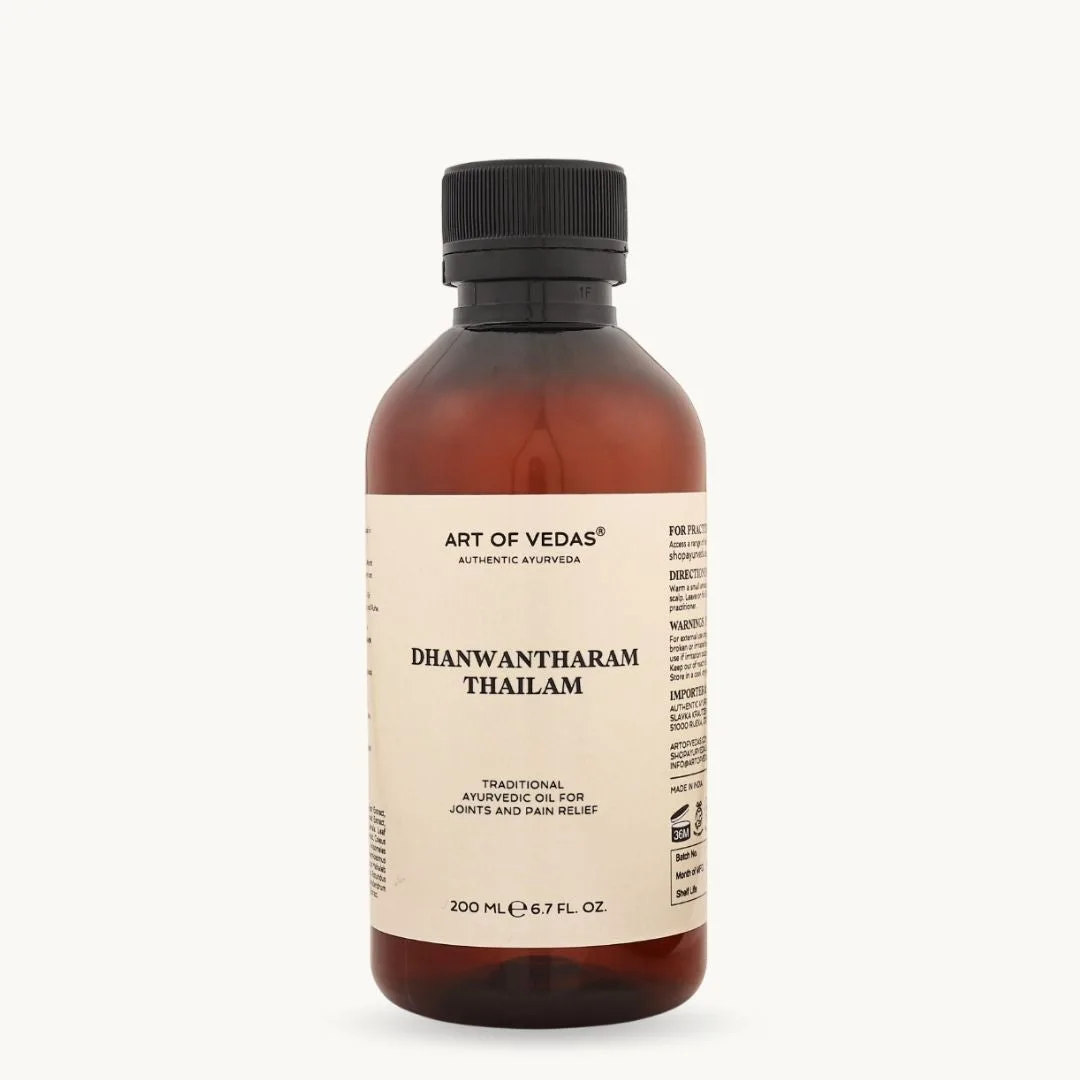
Dhanwantharam Thailam - The Foundational General-Purpose Oil
Dhanwantharam is the most widely applicable classical Vatahara oil for daily Abhyanga. Its formula is broad-spectrum: named after Dhanvantari (the classical deity of Ayurvedic medicine), it is documented in multiple classical texts with an extensive list of classical Vata indications spanning the nervous system, musculoskeletal tissue, and general body nourishment. It is not the most intensely warming oil in the classical repertoire, nor the most deeply penetrating - it occupies the middle ground that makes it appropriate for most people as a daily whole-body practice.
Best for: Daily full body Abhyanga for most constitutions. Vata constitutions as their primary oil year-round. General Vata elevation in any constitution. Beginning an Abhyanga practice without knowing your specific constitution in detail - Dhanwantharam is the classical default recommendation.
Less ideal for: Situations where a more specifically targeted oil is needed (musculoskeletal focus, deeper tissue penetration, post-exertion recovery). Not the primary choice when Pitta is significantly elevated.
The complete Dhanwantharam guide covers the formula and full indication profile.
Ksheerabala Thailam - Tissue-Building and Musculoskeletal Nourishment
Ksheerabala is a Ksheera Taila - a milk-processed oil, meaning milk is used alongside water as the liquid medium in the Sneha Paka process, producing a qualitatively different preparation. The Bala root (Sida cordifolia) gives the oil its primary character: deeply nourishing, strengthening, and building to the musculoskeletal tissues. Where Dhanwantharam pacifies and settles Vata, Ksheerabala actively nourishes and builds the tissue that Vata has depleted.
Best for: Musculoskeletal Vata - joint stiffness, discomfort, and reduced mobility from Vata in the joints; muscle weakness, fatigue, or sense of depletion; recovery from exertion; post-illness or post-surgery rehabilitation under appropriate guidance; those who feel consistently depleted in their musculoskeletal system rather than simply tight. Also classically recommended for scalp and Shiro Abhyanga for Vata-related nervous system support and sleep.
Less ideal for: Standalone daily Abhyanga when musculoskeletal concern is not the primary issue (Dhanwantharam or another broader-spectrum Vatahara oil would serve better). Very elevated Pitta states where the warming milk-processed quality may be excessive.
The Ksheerabala guide covers the milk-processing distinction and full indication profile.
Mahanarayana Thailam - Intensive Warming Penetration
Mahanarayana is the most intensely warming and penetrating of the primary classical Vatahara oils. Its formula is built around warming, penetrating herbs - Bilva, Rasna, Shatavari, Ashwagandha, and several others - and the sesame base's natural Ushna (warming) quality is amplified rather than moderated by the formula. Classical texts describe Mahanarayana as indicated for pronounced Vata conditions: significant joint pain, deep muscle tension, cold Vata conditions where the tissue needs aggressive warming and penetration rather than gentle nourishment.
Best for: Local application to specific areas of concern rather than full body daily Abhyanga for most people. Significant musculoskeletal Vata - pronounced joint stiffness, deep muscle tension, cold and painful joints in winter. Those who run cold constitutionally and find gentler oils insufficient. Evening application to the lower back, joints, or other specific areas of Vata accumulation.
Less ideal for: Daily full body Abhyanga for most constitutions (the intensity is more than needed for maintenance). Any Pitta elevation or inflammation - the warming intensity will aggravate Pitta. Summer season for Pitta-Vata types.
The warming oils guide compares the warming classical oils across their indication profiles.
Ashwagandha Bala Thailam - Strength and Rasayana
The combination of Ashwagandha (Withania somnifera) and Bala (Sida cordifolia) as the primary herbs in a sesame base produces one of the classical Rasayana-oriented massage oils - focused on building strength, resilience, and tissue quality rather than simply pacifying Vata. Ashwagandha is the most well-known classical Balya (strength-giving) and Rasayana herb; Bala shares the Brimhana character. Together they make an oil specifically suited to states of depletion, weakness, or the need for genuine Ojas-building through the skin and muscular channels.
Best for: Recovery and rebuilding after illness, excessive exertion, significant stress-induced depletion, or post-partum (under appropriate guidance). Athletes and those in physically demanding lifestyles. Anyone whose primary experience is not simply tension or dryness but genuine tissue weakness and depletion. Rasayana practice focused on muscular and structural tissue.
Less ideal for: Active inflammation or Pitta elevation (Ashwagandha is warming). Kapha constitutions where building and strengthening would add to Kapha's already heavy and accumulative tendency.
Step Three: Consider the Season
Even if your constitution is established and an oil is working well for you, seasonal adjustment is part of the classical Ritucharya framework:
Autumn and winter (Vata season): Use your primary Vatahara oil consistently and generously. Consider supplementing daily Abhyanga with a warming targeted oil (Mahanarayana or Ksheerabala) on areas of joint or muscle vulnerability. This is the peak season for consistent daily oil practice. The autumn guide covers the full seasonal oil practice.
Summer (Pitta season): Abhyanga continues but the choice may shift toward less intensely warming oils. If using Mahanarayana or a similarly intense Vatahara oil through summer, consider switching to Dhanwantharam or Ksheerabala for the warm season. Allow the oil to cool to room temperature rather than warming it significantly before application.
Spring (Kapha season): This is the season to consider reducing Abhyanga frequency slightly and supplementing with Garshana (dry silk massage) - the Ruksha quality of Garshana counteracts Kapha's naturally Snigdha/heavy qualities. When oil is used in spring, lighter application and lighter-formula oils are more appropriate.
Step Four: Local vs. Full Body Application
Not every classical oil is intended for full body daily Abhyanga. Some are specifically designed for local application to particular regions or conditions:
-
Head and scalp (Shiro Abhyanga): Ksheerabala and Dhanwantharam are classically appropriate. Brahmi-based oils are specifically designed for head application.
-
Joints and local Vata conditions: Mahanarayana and Ksheerabala are the classical local application oils. Apply to the specific joint or muscle region, massage in thoroughly, and allow 20, 30 minutes' absorption time before bathing.
-
Face (Mukha Abhyanga): Classical face oils (Kumkumadi, Eladi) are specifically formulated for facial tissue and should not be replaced by body Thailams.
-
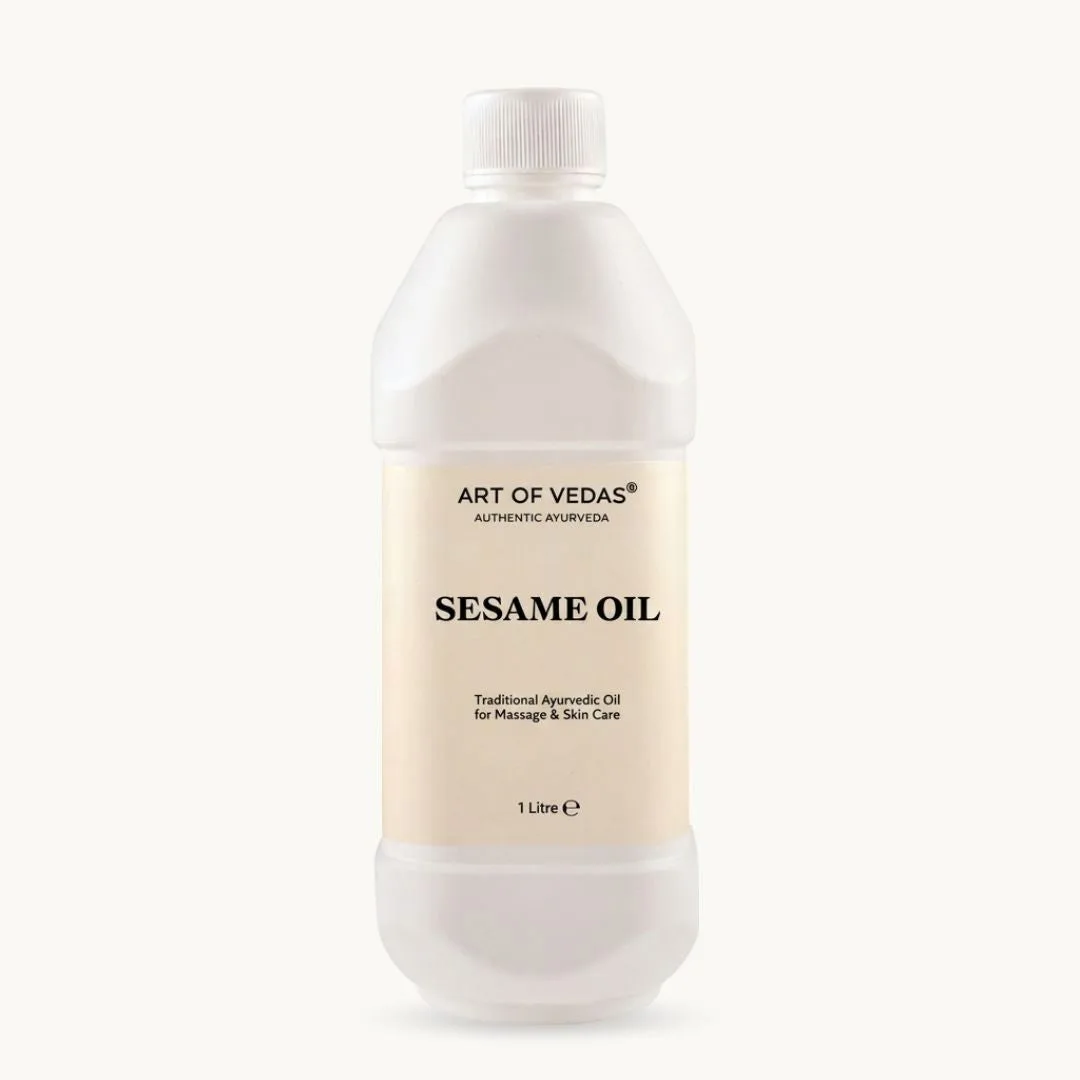
Feet (Pada Abhyanga): Any primary Vatahara Thailam is appropriate. Sesame oil alone is the simplest classical recommendation for foot oiling if a Thailam is not available.
Identifying a Genuine Classical Thailam
The quality of the oil matters as much as the selection. A poorly prepared Thailam - blended rather than processed through proper Sneha Paka, made with insufficient herbs or short processing time - will not deliver the classical effects regardless of the correct label. The guide to identifying genuine Ayurvedic products covers the markers of authentic classical preparation.
The complete Thailam guide covers the full range of classical oils, the Sneha Paka preparation method, and the broader classical pharmacology framework.
Starting Simply
If you are beginning an Abhyanga practice and the range of options feels overwhelming, the classical starting point is clear: Dhanwantharam Thailam for daily full body Abhyanga. It is the most broadly applicable, the most classically documented for general Vata care, and the most forgiving of constitutional uncertainty. Once you have established a consistent daily practice with Dhanwantharam and have developed a sense of what it does for your body, you will have the experiential reference point to understand whether a more specific oil is needed.
For a personalised oil recommendation based on a complete classical assessment of your constitution and current state, an Ayurvedic consultation with one of our AYUSH-certified Ayurvedic doctors provides the most precise classical guidance.
This guide presents classical Ayurvedic knowledge for educational purposes. The information is not medical advice and is not intended to diagnose, treat, cure or prevent any disease. For personalised guidance, consult a qualified Ayurvedic practitioner.