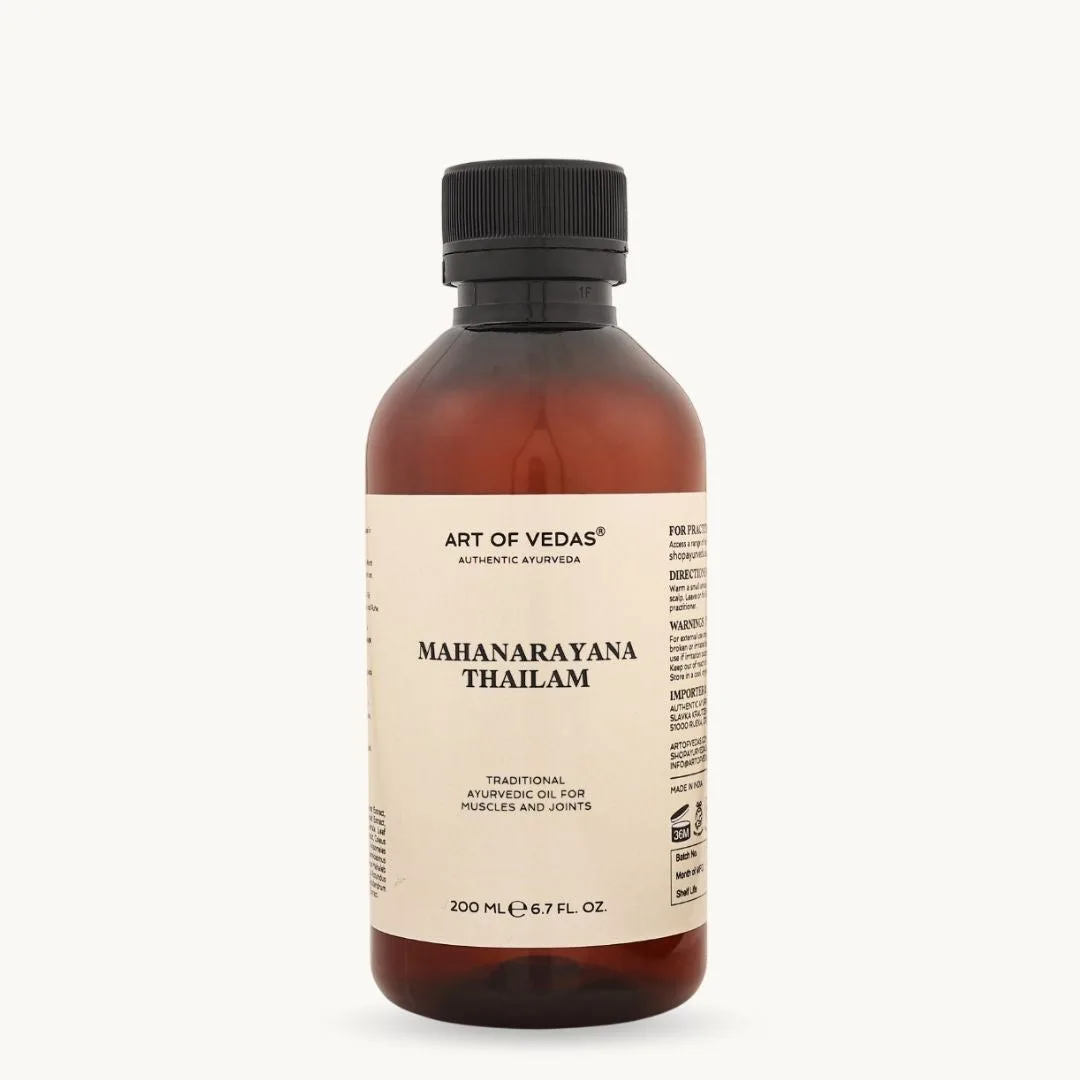
In brief: Mahanarayana Thailam (also written Mahanarayan oil, Mahanarayana Taila or Mahanarayan Tel) is a classical Ayurvedic massage oil: a long list of herbs, among them the Dashamoola roots, Ashwagandha, Bala and Shatavari, cooked into sesame oil by the Sneha Paka method. Described in the Bhaishajya Ratnavali and the Sahasrayogam, it is warming, classically placed with Vata, and traditionally used for Abhyanga of the muscles and joints. This guide covers what it is, how it is made, how to warm and apply it, and how it compares with Dhanwantharam and Ksheerabala Thailam.
Therapies & Oils
Mahanarayana Thailam: Complete Guide
Reviewed by Dr. Anu Joy, MD (Ayurveda), Ayurvedic doctor of Art of Vedas
What is Mahanarayana Thailam?
Mahanarayana Thailam (also written as Mahanarayan oil, Mahanarayana taila, or Mahanarayan tel) is a classical Ayurvedic medicated oil traditionally used for Abhyanga (warm oil massage) and various external applications. The name itself reveals its significance: "Maha" means great or augmented, "Narayana" is an epithet of the deity Vishnu often associated with preservation and vitality, and "Thailam" or "Taila" means oil in Sanskrit.
The formulation belongs to the category of medicated oils known as Taila Kalpana - complex preparations where herbs are cooked into an oil base using specific methods to extract and preserve their qualities. Unlike simple herb-infused oils or essential oil blends, Ayurvedic medicated oils undergo a multi-day preparation process that fundamentally transforms the oil's character.
Mahanarayana Thailam is primarily known in Ayurvedic tradition for supporting joint comfort, muscle relaxation, and overall Vata balance. It is valued for its deeply nourishing qualities and its association in tradition with the body's natural mobility and flexibility as part of a regular self-care routine.
Classical Origins: A 300-Year Textual Lineage
Understanding where Mahanarayana Thailam comes from requires tracing its path through Ayurvedic scholarly literature, a lineage that reveals both its antiquity and its continued relevance.
Bhaishajya Ratnavali: The Primary Source
The most frequently cited classical reference for Mahanarayana Thailam is the Bhaishajya Ratnavali, an 18th-century Ayurvedic compendium authored by Kaviraj Govinda Das Sen. This text systematically organizes hundreds of formulations by traditional category. Mahanarayana Thailam appears in the Vatavyadhi Rogadhikara chapter (the section on Vata-related patterns), specifically in verses 151, 162.
These verses provide the complete ingredient list, proportions, and preparation method. The Bhaishajya Ratnavali also documents the parent formulation, Narayana Taila (verses 140, 150 of the same chapter). The relationship between the two is important: Narayana Taila is the foundational formula, while Mahanarayana Thailam represents an augmented version with additional herbs - specifically the rare Ashtavarga group of eight Himalayan plants known in tradition for their rejuvenative qualities.
Sahasrayogam: The South Indian Tradition
In the South Indian tradition of Ayurveda, Mahanarayana Thailam appears in the Sahasrayogam, a classical compendium that serves as a primary reference for traditional Ayurvedic manufacturers. This text represents the South Indian lineage of the formulation, which has been preserved through centuries of Panchakarma practice and traditional oil preparation in Ayurvedic institutions.
The traditional method emphasizes meticulous attention to herb quality, traditional copper vessel preparation, and precise heat management throughout the multi-day cooking process. Art of Vedas sources its Mahanarayana Thailam from traditional manufacturers who follow these classical preparation methods.
The Ayurvedic Formulary of India
In modern times, Mahanarayana Thailam has been standardized in the Ayurvedic Formulary of India (AFI), the government-published compendium that provides official formulations for Ayurvedic preparations. This inclusion confirms its status as a recognized classical preparation with documented composition and preparation standards.
Earlier References and the Concept of Medicated Oils
While the specific Mahanarayana formulation dates to the 18th century, the broader tradition of medicated oil preparation is far older. The Charaka Samhita (compiled around 1st, 2nd century CE) discusses the principles of Sneha Kalpana (oil and ghee preparations) and provides foundational methods for extracting herbal properties into oil bases. The Ashtanga Hridayam by Vagbhata (7th century CE) further develops these principles.
Mahanarayana Thailam represents the culmination of these ancient principles applied to a specific traditional purpose: supporting the body's structure, mobility, and Vata balance.
The 57-Ingredient Architecture: What Makes This Oil Unique
The complexity of Mahanarayana Thailam lies in its precisely orchestrated combination of 57 ingredients, each selected for specific qualities and all working together synergistically. The formulation follows a three-layer structure that reflects the sophisticated understanding of Ayurvedic pharmacy.
The ingredient declaration of the Art of Vedas oil, plant by plant with botanical names, is on its own page: Mahanarayana Thailam ingredients. The section below describes the classical recipe as the texts set it out.
The Base: Oil, and Juice
The foundation consists of three liquid media:
Sesame oil (Tila Taila) - approximately 6 kg - serves as the primary carrier. Sesame oil is chosen for its natural affinity for the skin, its balancing effect on Vata dosha, and its ability to extract both fat-soluble and certain water-soluble plant constituents during the cooking process.
Goat's milk (Aja Kshira) - approximately 6 liters - acts as a secondary medium. In Ayurvedic pharmacy, milk serves multiple functions: it helps extract water-soluble constituents, moderates the heating quality of certain herbs, and adds nourishing properties. Goat's milk is traditionally preferred for Vata conditions due to its lighter quality compared to.
Shatavari juice (Shatavari Swarasa) - approximately 6 liters - provides additional extractive power and contributes its own rejuvenative and nourishing qualities. Shatavari (Asparagus racemosus) is one of Ayurveda's primary Rasayana herbs.
Layer One: The Decoction Herbs (Kwatha Dravya)
Thirteen herbs are prepared as a decoction (Kwatha) by boiling them in approximately 98 liters of water, which is then reduced through slow simmering to one-quarter of the original volume. This concentrated decoction contains the water-soluble constituents of these herbs:
The Dashamoola Group - "Ten Roots" that form the backbone of many Vata-pacifying formulations:
- Bilva (Aegle marmelos) - Bael tree root
- Agnimantha (Premna integrifolia) - Headache tree root
- Shyonaka (Oroxylum indicum) - Indian trumpet tree root
- Kashmari (Gmelina arborea) - Beechwood root
- Patala (Stereospermum suaveolens) - Trumpet flower root
- Brihati (Solanum indicum) - Indian nightshade root
- Kantakari (Solanum xanthocarpum) - Yellow-berried nightshade root
- Shalaparni (Desmodium gangeticum) - Sal-leaved desmodium root
- Prishniparni (Uraria picta) - Painted-leaved uraria root
- Gokshura (Tribulus terrestris) - Puncture vine root
Additional Decoction Herbs:
- Ashwagandha (Withania somnifera) - Indian ginseng, one of Ayurveda's most respected adaptogens
- Bala (Sida cordifolia) - Country mallow, valued for strengthening and nourishing properties
- Punarnava (Boerhavia diffusa) - Hogweed, traditionally used to support natural cleansing processes
Each of these roots contributes plant constituents traditionally associated with comfort and connective tissue, along with Vata-balancing properties. The decoction method extracts water-soluble plant chemicals including alkaloids, glycosides, and polyphenols.
Layer Two: The Paste Herbs (Kalka Dravya)
Thirty-eight herbs are finely ground into paste form and added to the oil during the cooking process. The paste serves two purposes: it provides ingredients for extraction during the oil-cooking phase, and it acts as a moisture control mechanism (a key indicator in traditional oil preparation is when the paste becomes completely dry and crisp).
The Ashtavarga Group - Eight rare Himalayan herbs that distinguish Mahanarayana from many other formulations:
- Jivaka (Malaxis acuminata)
- Rishabhaka (Malaxis muscifera)
- Meda (Polygonatum verticillatum)
- Mahameda (Polygonatum cirrhifolium)
- Kakoli (Fritillaria roylei)
- Ksheera Kakoli (Lilium polyphyllum)
- Riddhi (Habenaria intermedia)
- Vriddhi (Habenaria edgeworthii)
These eight plants grow at high altitudes in the Himalayas and are traditionally considered to have powerful rejuvenative qualities. Their inclusion marks Mahanarayana as a premium formulation. Due to their rarity, some commercial preparations substitute them with more readily available herbs, though traditional manufacturers source them specifically.
Nervine and Calming Herbs:
- Tagara (Valeriana wallichii) - Indian valerian
Warming and Cleansing-Associated Herbs:
- Haridra (Curcuma longa) - Turmeric
- Daruharidra (Berberis aristata) - Indian barberry
- Manjishta (Rubia cordifolia) - Indian madder
Nutritive and Rejuvenative Herbs:
- Yashtimadhu (Glycyrrhiza glabra) - Licorice
- Shatavari (Asparagus racemosus) - Wild asparagus
- Mudgaparni (Phaseolus trilobus) - Wild green gram
- Mashaparni (Teramnus labialis) - Wild black gram
Aromatic and Warming Herbs:
- Devadaru (Cedrus deodara) - Himalayan cedar
- Ela (Elettaria cardamomum) - Cardamom
- Twak (Cinnamomum zeylanicum) - Cinnamon
The complete paste also includes Atibala (Abutilon indicum), Nagabala (Grewia hirsuta), Eranda (Ricinus communis), Prasarini (Paederia foetida), Rasna (Pluchea lanceolata), Saindhava (Rock salt), Sarjarasa (Vateria indica), Musta (Cyperus rotundus), Shati (Hedychium spicatum), and several others, each contributing its own traditional qualities.
Layer Three: Final Aromatic Additions (Prakshepa Dravya)
After the oil cooking is complete, three precious ingredients are added:
Karpura (Camphor) - approximately 48 grams - provides a cooling, penetrating quality and pleasant aroma
Kumkuma (Saffron) - approximately 48 grams - adds rejuvenative properties and a golden color
Kasturi (Musk) - approximately 48 grams - traditionally included for its penetrating and stabilizing properties (note: most modern commercial preparations omit or substitute musk due to wildlife conservation concerns)
These final additions are incorporated after cooling begins to preserve their volatile aromatic compounds.
The Traditional Preparation: Taila Paka Vidhi
What transforms these 57 ingredients from a simple mixture into Mahanarayana Thailam is the preparation method itself - a multi-day process called Taila Paka Vidhi (the method of oil cooking). This ancient pharmaceutical technique is what differentiates Ayurvedic medicated oils from herb-infused oils or essential oil blends.
The Three-Stage Cooking Process
The preparation begins by adding the sesame oil, goat's milk, and Shatavari juice to a large vessel (traditionally copper). The paste of 38 herbs is added, followed by the concentrated decoction of the 13 root herbs. This mixture is then cooked over a carefully controlled fire.
Stage One: Mrudu Paka (Soft Stage) - In the initial phase, the mixture is heated gently. Water begins to evaporate from the milk and juice. The oil temperature remains relatively moderate. This stage can last several hours.
Stage Two: Madhyama Paka (Medium Stage) - As cooking continues, more water evaporates. The temperature rises. The herbal paste begins to dry. The mixture thickens. This is the most critical phase, requiring constant attention to prevent burning while ensuring complete extraction.
Stage Three: Khara Paka (Hard Stage) - In the final phase, all free water has evaporated. The herbal paste becomes completely dry and crisp. The oil has absorbed the extracted constituents. Specific completion tests are performed.
Traditional Completion Tests
Ayurvedic texts describe several tests to determine when the oil is properly prepared:
Varti Pariksha (Wick Test) - A cotton wick dipped in the oil should burn with a clear, steady flame without crackling (crackling indicates remaining moisture).
Shabda Pariksha (Sound Test) - A drop of the oil on fire should produce no crackling sound (again indicating complete moisture removal).
Phenodgama (Froth Test) - The oil should produce minimal froth when stirred, indicating that aqueous content has been removed.
These traditional tests reflect a sophisticated understanding of the physical chemistry of oil preparation. The goal is complete extraction of herbal constituents while removing all water content, creating a stable, shelf-stable medicated oil.
Why This Method Matters
The multi-day cooking process with water-containing media (milk and juice) allows for extraction of both water-soluble and fat-soluble plant constituents into the oil. The heat facilitates chemical transformations. The paste acts as a filter and concentration mechanism. The final product is molecularly different from simply mixing herbs into oil - it contains compounds that have been transformed through heat, extracted through the aqueous phase, and concentrated through evaporation.
This is why authentic Ayurvedic medicated oils like Mahanarayana Thailam cannot be replicated through simple infusion or essential oil blending. The preparation method is inseparable from the character of the oil.
How Mahanarayana Thailam Works: Ayurvedic Principles
To understand why this formulation has been valued for centuries, it helps to understand the Ayurvedic framework through which it was designed.
Dosha Theory: Primarily Vata-Pacifying
In Ayurvedic physiology, Vata dosha governs movement, circulation, nerve impulses, and the spaces within the body. When Vata becomes excessive or imbalanced, it is traditionally described as dryness, coldness, irregularity, and discomfort in movement. Mahanarayana Thailam is designed to pacify excess Vata through several principles:
Snigdha (Unctuous/Oily) Quality - Directly counters Vata's dry nature. The oil provides external lubrication and, according to Ayurvedic understanding, supports the body's natural lubrication processes.
Ushna (Warming) Quality - Counters Vata's cold nature. The warming herbs and the warming method of application (massage with warm oil) help balance coldness in the body.
Guru (Heavy) Quality - Counters Vata's light, mobile nature. The nourishing, substantive quality of the oil provides grounding.
The formulation also has secondary Pitta-pacifying properties due to the inclusion of cooling herbs like Shatavari, Yashtimadhu, and certain Ashtavarga members, creating a balanced formula suitable for most constitutions when used appropriately.
Dhatu Support: Nourishing Deep Tissues
Ayurveda describes seven tissue layers (Dhatus) in the body, each progressively deeper. Mahanarayana Thailam is understood in tradition to nourish five of these layers:
- Rasa Dhatu (Plasma/Lymph) - The first tissue layer, responsible for nourishment distribution
- Rakta Dhatu (Blood) - The second tissue layer, responsible for oxygenation and vitality
- Mamsa Dhatu (Muscle Tissue) - The third tissue layer, providing structure and movement
- Asthi Dhatu (Bone Tissue) - The fifth tissue layer, providing support and structure
- Majja Dhatu (Marrow and Nerve Tissue) - The sixth tissue layer, responsible for nervous system function and bone marrow
Traditional Ayurvedic understanding holds that regularly applied medicated oils, especially those with multiple Rasayana herbs, are associated with these deeper tissue layers when applied through Abhyanga massage, particularly when done over time as part of a consistent routine.
Srotas: Channel Systems
The formulation is understood in tradition to work through specific channel systems (Srotas):
- Asthivaha Srotas - Channels that nourish and maintain bone tissue
- Majjavaha Srotas - Channels that nourish nerve and marrow tissue
- Mamsavaha Srotas - Channels that nourish muscle tissue
According to Ayurvedic physiology, the oil is traditionally associated with natural circulation through these channels, helping maintain healthy structure and function.
Traditional Uses and Classical Indications
The Bhaishajya Ratnavali and other classical texts list specific patterns for which Mahanarayana Thailam was traditionally described. These terms are Sanskrit designations from classical Ayurvedic nosology and are presented here for educational and historical context only:
- Sandhigata Vata - literally "Vata in the joints," a traditional designation relating to joint comfort and ease of movement
- Gridhrasi - a traditional designation describing a pattern of the lower back and legs
- Pakshaghata - a traditional designation describing one-sided weakness of the body
- Ardita - a traditional designation describing the face
- Pangutva - a traditional designation relating to ease of limb movement
- Manya Stambha - a traditional designation relating to neck comfort and ease
- Kati Graha - a traditional designation relating to lower back comfort
- Asthi Bhagna - a traditional designation relating to bone tissue
- Jara - a traditional designation relating to vitality and the aging process
It is important to understand that these are traditional Ayurvedic terms describing patterns recognized in classical texts. In modern European context, Mahanarayana Thailam is used as a supportive wellness oil for general joint comfort, muscle relaxation, and daily self-care, not as treatment for diagnosed medical conditions.
Traditional Application Methods
Classical texts describe several application methods:
- Abhyanga - Full-body or localized warm oil massage, the most common use
- Kati Basti - A specialized treatment where warm oil is retained over the lower back area using a dough dam
- Janu Basti - Similar treatment for the knee area
- Anuvasana Basti - Oil enema (performed only under professional supervision in clinical Panchakarma settings)
- Nasya - Nasal administration (performed only under professional guidance)
For home use in Europe, Abhyanga (warm oil massage) is the primary application method, providing an accessible way to incorporate this classical preparation into daily or weekly wellness routines.
Modern Applications: Using Mahanarayana Thailam in Europe
While respecting its classical origins, modern use of Mahanarayana Thailam focuses on general wellness, self-care, and supporting the body's natural comfort and mobility.
Primary Modern Uses
Joint Comfort and Mobility - Regular massage with Mahanarayana Thailam is valued for supporting natural joint comfort and flexibility, particularly appreciated by those experiencing stiffness from cold climates, desk work, or physical activity.
Muscle Relaxation - The warming, nourishing properties make it valued for muscle tension, post-exercise recovery, and general relaxation.
Vata-Season Support - In European climates, the autumn and winter months correspond to Vata season in Ayurveda - cold, dry, windy conditions that can aggravate Vata imbalances. Regular oil massage during these months supports balance.
Circulation Support - The massage application itself, combined with the warming properties of the oil, is valued for supporting healthy peripheral circulation, particularly appreciated in colder months.
Stress Relief and Grounding - The ritual of warm oil massage provides a calming, grounding practice, valued for supporting relaxation.
Healthy Aging Support - As a Rasayana formulation with multiple rejuvenative herbs, it is valued as part of healthy aging practices.
EU Regulatory Context
In Europe, Mahanarayana Thailam is classified as a cosmetic product for external use under the EU Cosmetics Regulation (EC) No 1223/2009. It is not marketed or sold as a medicine or treatment for medical conditions. All claims made about the product focus on cosmetic benefits - supporting skin appearance, providing nourishment, and offering a sensory experience of warmth and comfort during massage.
This regulatory framework means that while we can describe traditional uses and classical indications from Ayurvedic texts, modern applications in Europe are positioned as wellness and body care rather than medical treatment.
Who Benefits Most?
Mahanarayana Thailam is particularly valued by:
- Individuals with Vata-predominant constitutions (those who tend toward dry skin, variable digestion, creative and active minds, sensitivity to cold)
- People experiencing joint stiffness or muscle tension from sedentary work, cold climates, or physical activity
- Those seeking a warming, deeply nourishing oil for autumn and winter seasons
- Practitioners of yoga, meditation, or Ayurvedic lifestyle practices
- Anyone interested in traditional Abhyanga practice
- Those in physically demanding occupations or active lifestyles who want support for muscle and joint comfort
How to Use Mahanarayana Thailam: Basic Guidelines
While detailed application protocols are covered in our separate guide on Abhyanga practice with Mahanarayana Thailam, here are the essential guidelines for getting started.
Frequency
- Daily use: Suitable for those with strong Vata constitutions or during Vata seasons (autumn and winter in most European climates)
- 2-3 times weekly: A balanced frequency for most people as part of regular self-care
- Weekly: Minimum frequency to enjoy the practice, suitable during warmer months or for those with predominantly Pitta or Kapha constitutions
Quantity
- Full-body Abhyanga: Approximately 60-100 ml (1/4 to 1/2 cup) for adequate coverage
- Localized application: 10-30 ml depending on the area (knees, lower back, shoulders, feet, etc.)
Warming the Oil
Always warm the oil before application. Vata responds best to warmth. Place the desired amount in a small glass bottle and warm in a bowl of hot water for 5-10 minutes until comfortably warm (test temperature on your inner wrist).
Application Method
Apply the warm oil with smooth, flowing strokes. For joints, use circular motions. For long bones, use lengthwise strokes. The massage should be firm enough to stimulate circulation but gentle and relaxing. Allow the oil to remain on the skin for 15-45 minutes before bathing.
Best Times
- Morning: Traditionally recommended, particularly before bathing. Provides grounding energy for the day.
- Evening: Also suitable, particularly for relaxation and promoting restful sleep.
- Pre-bath or pre-shower: The traditional method involves oil massage followed by warm bathing.
European Lifestyle Adaptations
For apartment living with small bathrooms, consider:
- Keep a dedicated towel for oil massage that you don't mind staining
- Massage in the bathroom before showering to contain any oil
- Use a yoga mat or old towel on the floor if needed
- Consider focusing on localized areas (feet, legs, lower back, shoulders) rather than full-body if space is limited
Seasonal Adjustments
- Autumn and Winter (Vata Season): Use more frequently, focus on warming and grounding
- Spring (Kapha Season): Reduce frequency, consider lighter application
- Summer (Pitta Season): Use less frequently, apply cooler (room temperature rather than warmed), or alternate with lighter oils
Quality, Authenticity, and What to Look For
Not all Mahanarayana Thailam products are created equal. The character of this oil depends heavily on ingredient quality, completeness of formulation, and traditional preparation method.
Key Quality Markers
Complete Ingredient List - Authentic Mahanarayana Thailam should contain all or most of the classical 57 ingredients. Some commercial versions simplify the formula, omitting rare ingredients like the Ashtavarga group. Check whether the product label or website lists the complete formulation.
Classical Preparation Method - Look for products that explicitly mention traditional Taila Paka Vidhi or multi-day cooking process. Mass-produced versions that simply mix herbs into oil do not have the same character.
Source and Manufacturing - Products carefully made by traditional Ayurvedic pharmacies with (Good Manufacturing Practice) certification tend to have higher fidelity to classical preparation. Traditional manufacturers often maintain the highest standards.
Sesame Oil Base - Authentic formulations use sesame oil as the base, not other carrier oils.
Transparency - Manufacturers who provide detailed ingredient lists, classical references, and preparation methods demonstrate commitment to authenticity.
Why Art of Vedas Sources from Traditional Manufacturers
Art of Vedas partners with established Ayurvedic manufacturers in India who:
- Follow classical Taila Paka Vidhi preparation methods
- Source herbs from verified suppliers with attention to quality and sustainability
- Operate carefully made facilities
- Maintain traditional copper vessel preparation for premium formulations
- Provide complete ingredient transparency and classical references
The oils are then tested and verified upon arrival in Europe to ensure they meet EU cosmetic regulations and quality standards.
Understanding Price Variations
Genuine Mahanarayana Thailam is more expensive than simple herb-infused oils for several reasons:
- 57 ingredients, some quite rare (Ashtavarga group, Saffron, etc.)
- Multi-day preparation process requiring skilled labor
- Herb-to-oil ratios that reflect the classical formulation
- Traditional methods vs. industrial production
If you encounter very inexpensive "Mahanarayana oil," it is likely a simplified version or prepared through faster, less traditional methods.
Mahanarayana Thailam in the European Context
Using a classical Indian Ayurvedic preparation in European climates and lifestyles requires some contextual understanding.
Climate Considerations
European climates differ significantly from the Indian subcontinent where Ayurveda originated. Most of Central and Northern Europe has:
- Colder winters with less sunlight
- More pronounced seasonal variation
- Generally lower humidity (particularly indoors with heating)
- Longer cold seasons
These conditions actually make regular oil massage more relevant, not less. Cold, dry, windy conditions are classic Vata-aggravating factors. The warming, moisturizing practice of Abhyanga with Mahanarayana Thailam provides excellent seasonal support.
Winter months (November through March in most of Europe) are ideal for regular Mahanarayana Thailam use. The oil's warming nature helps counter the cold, and the practice itself provides grounding and comfort during darker months.
Transition seasons (September-October and March-April) are also valuable times, as Vata tends to increase during seasonal changes.
Lifestyle Integration
Modern European lifestyles - often sedentary with prolonged desk work, computer use, and limited movement - create specific patterns that Ayurveda would recognize as Vata-aggravating:
- Long hours sitting (stiffness in hips, lower back, shoulders)
- Screen time (eye strain, neck tension, mental overstimulation)
- Indoor heating (dryness)
- Irregular meal times and sleep schedules (irregularity being a classic Vata trait)
Regular Mahanarayana Thailam massage can help counter these modern stressors by:
- Addressing physical stiffness from sedentary work
- Providing a grounding, screen-free ritual
- Supporting joint and muscle comfort
- Creating a regular, calming practice that supports routine
Combining with European Wellness Traditions
Mahanarayana Thailam integrates well with existing European wellness practices:
- Sauna traditions (common in Nordic countries, Germany, Austria): Apply the oil after sauna for deep absorption into warmed skin
- Bathing rituals: The traditional Ayurvedic practice of oil massage followed by bathing aligns with European bathing culture
- Sports and fitness: Use as pre-workout preparation (warming) or post-workout recovery (muscle relaxation)
- Massage traditions: Can be incorporated into partner massage or professional massage therapy sessions
Comparing Mahanarayana Thailam to Other Ayurvedic Oils
Understanding how Mahanarayana Thailam relates to other classical Ayurvedic oils helps in choosing the right oil for your needs.
Mahanarayana vs. Narayana Taila: Narayana Taila is the parent formulation with fewer ingredients. Mahanarayana ("great" Narayana) includes additional herbs, particularly the Ashtavarga group, making it more comprehensive. For general joint and muscle support, Mahanarayana is traditionally preferred.
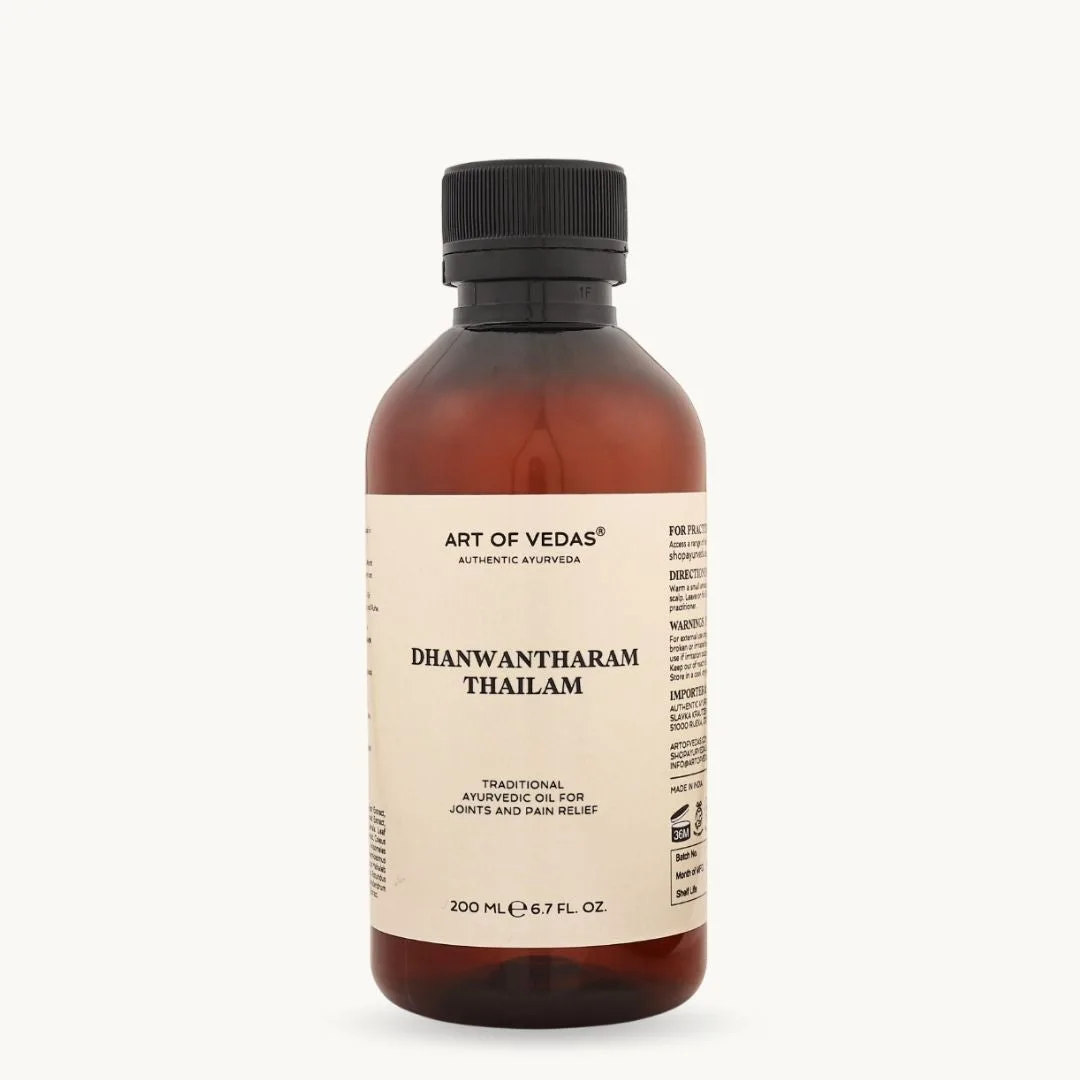
Mahanarayana vs. Dhanwantharam Thailam: Both are classical Vata-pacifying oils with overlapping uses. Dhanwantharam is particularly valued for post-pregnancy recovery, nourishment, and full-body rejuvenation. Mahanarayana has stronger focus on joints, muscles, and structural support. Many people use Dhanwantharam for full-body Abhyanga and Mahanarayana for targeted joint/muscle application.
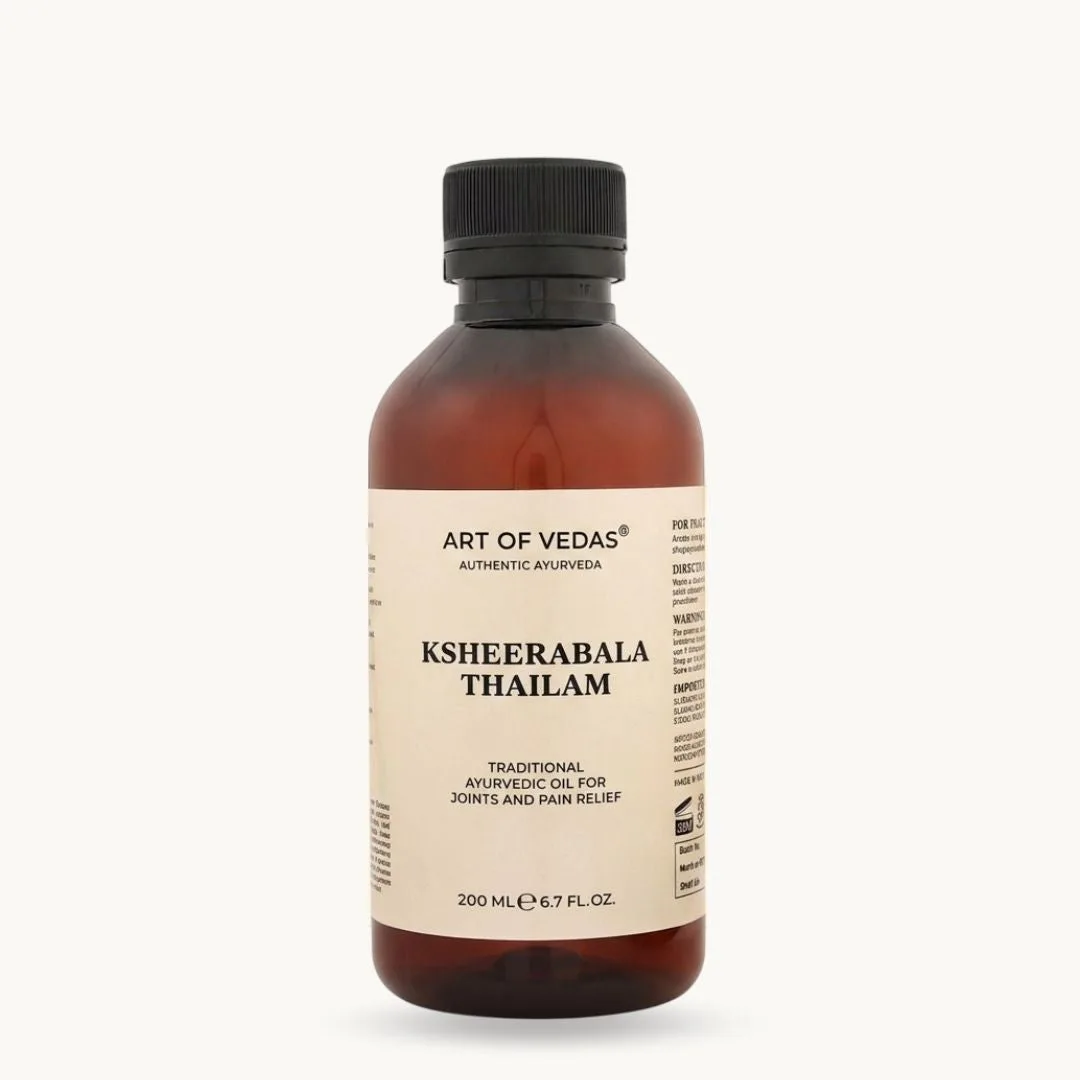
Mahanarayana vs. Ksheerabala Thailam: Ksheerabala contains only 2 ingredients (Bala herb and milk-processed sesame oil). It is lighter, simpler, and more suitable for sensitive individuals, children, and Pitta conditions. Mahanarayana is far more complex and warming.
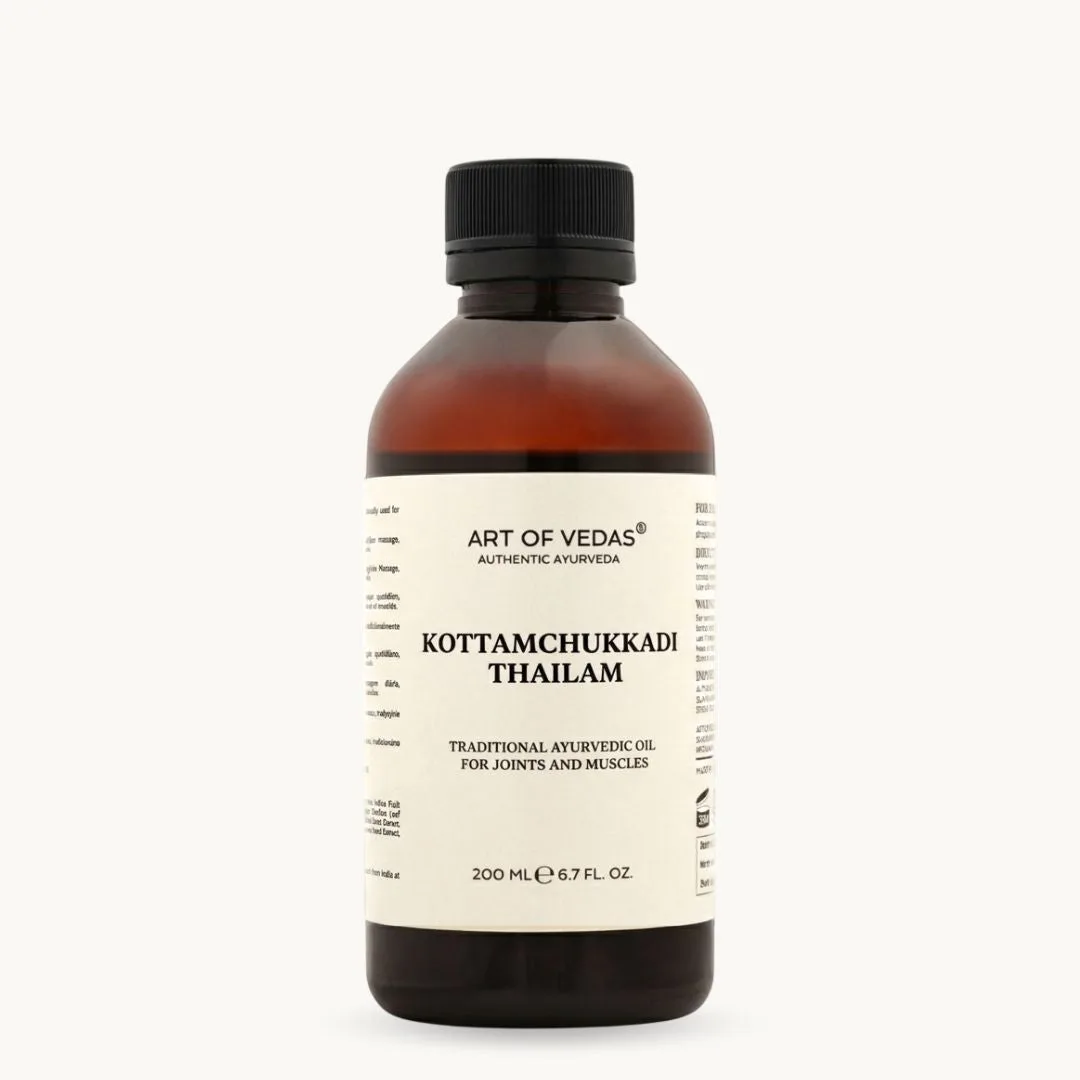
Mahanarayana vs. Kottamchukkadi Thailam: Kottamchukkadi is a specialty formulation for specific joint applications with stronger warming properties. Mahanarayana offers broader systemic support with gentler warming.
For detailed comparisons and guidance on choosing between Ayurvedic oils, see our comprehensive Ayurvedic Oil Comparison Guide.
Safety, Precautions, and When to Consult a Professional
Mahanarayana Thailam is generally well-tolerated for external use, but certain precautions apply.
General Safety Guidelines
- Patch test: Apply a small amount to the inner forearm and wait 24 hours to check for sensitivity before first use.
- External use only: Unless under the direct supervision of a qualified Ayurvedic practitioner, use only externally.
- Avoid broken skin: Do not apply to open wounds, cuts, or broken skin.
- Eye contact: Avoid contact with eyes. If contact occurs, flush with cool water.
- Staining: The oil may stain clothing and linens. Use dedicated towels or old linens you don't mind staining.
Special Populations
- Pregnancy and breastfeeding: While traditional Ayurvedic practice includes oil massage during pregnancy, consult your healthcare provider before using new products. Some herbs in the formulation may have contraindications.
- Children: Can be used for children under adult supervision, though simpler, milder oils like Ksheerabala may be more appropriate for young children.
- Sensitive skin: The complex formulation includes heating and potentially sensitizing herbs. Start with a patch test and smaller amounts.
Medication Interactions
While topical application has minimal systemic absorption, the oil contains herbs with biological activity. If you are on medication or have a diagnosed medical condition, inform your healthcare provider about all products you use, including traditional oils.
When to Seek Professional Guidance
- Panchakarma therapies: Internal use (Anuvasana Basti) and certain specialized treatments (Kati Basti, Janu Basti) should only be performed under qualified practitioner supervision.
- Chronic conditions: If you have ongoing joint issues, mobility limitations, or chronic pain, seek proper medical evaluation rather than relying solely on self-care products.
- Uncertain constitutional type: For personalized dosha assessment and oil selection, consult a qualified Ayurvedic practitioner.
- Adverse reactions: If you experience skin irritation, rash, or any unexpected reaction, discontinue use and consult a healthcare provider.
Frequently asked questions about Mahanarayana Thailam
What is Mahanarayana Thailam? A classical Ayurvedic massage oil in which a long list of herbs, among them the Dashamoola roots, Ashwagandha, Bala and Shatavari, is cooked into sesame oil. It is described in the Bhaishajya Ratnavali and the Sahasrayogam and is also written Mahanarayan oil, Mahanarayana Taila or Mahanarayan Tel.
What is Mahanarayana Thailam used for? For Abhyanga, the Ayurvedic oil massage, over the whole body or on the muscles and joints of one area. It is warming and classically placed with Vata. Art of Vedas sells it as an oil for external use.
How do you use Mahanarayana Thailam? Warm the oil, apply it generously with long strokes along the limbs and circular strokes around the joints, leave it on the skin for 15 to 20 minutes, then take a warm shower or bath. For one area, massage a small amount in until it is absorbed.
How often can you apply Mahanarayana oil? Daily, as the classical daily routine (Dinacharya) describes, or two to three times a week. Daily use suits autumn and winter best; a lighter rhythm fits the warmer months. Ask a qualified Ayurvedic practitioner what suits you.
Do you need to warm Mahanarayana Thailam before use? Yes. Stand the closed bottle in a bowl of warm water for a few minutes until a drop feels pleasantly warm on the inner wrist. Do not use a microwave.
What is the difference between Mahanarayana and Narayana Thailam? Narayana Thailam is the older, shorter recipe; Mahanarayana Thailam, the great Narayana oil, is the expanded version with a longer list of herbs. Both are warming sesame-based oils for Abhyanga; Narayana is lighter on the skin, Mahanarayana fuller and warmer.
Mahanarayana or Dhanwantharam Thailam: which one? Both are classical sesame-based Vata oils for Abhyanga. Dhanwantharam Thailam is mildly warming and suits a gentle, regular daily routine; Mahanarayana Thailam is warmer and richer and suits a focused massage of the muscles and joints.
Can Mahanarayana Thailam be used in pregnancy or for children? Ask your doctor or a qualified Ayurvedic practitioner first. It is for external use only; do a small skin test on the inner forearm before the first full application, and keep it away from the eyes and broken skin.
Conclusion: A Classical Formulation for Modern Wellness
Mahanarayana Thailam represents the sophistication of classical Ayurvedic pharmacy - a carefully designed formulation with 57 ingredients, traditional preparation methods unchanged for centuries, and a proven place in Ayurvedic practice. For those in Europe seeking authentic Ayurvedic body care, it offers a way to experience the depth of this ancient tradition through daily or weekly self-care.
The oil is particularly valuable in European climates, where cold, dry seasons create the exact conditions that Ayurveda recognizes as Vata-aggravating. Regular massage with warm Mahanarayana Thailam provides grounding, warmth, and nourishment - supporting joint comfort, muscle relaxation, and overall vitality through seasonal changes and the stresses of modern life.
Understanding what makes this oil unique - the classical textual lineage, the multi-layered ingredient architecture, the traditional preparation method, and the Ayurvedic principles behind its use - helps you appreciate both its historical significance and its practical value for contemporary wellness.
Whether you are new to Ayurvedic oils or experienced with Abhyanga practice, Mahanarayana Thailam offers a time-tested formulation worthy of exploration.
Continue Your Journey with Mahanarayana Thailam
Ready to experience this classical Ayurvedic oil? Explore Art of Vedas Mahanarayana Thailam - carefully selected, prepared following classical methods, and available throughout Europe.
Curious about which Ayurvedic oil is right for you? See our comprehensive comparison: Comparing Ayurvedic Oils: Which Thailam Is Right for You?
Shop our complete Thailam collection →
Disclaimer: This article is intended for educational purposes and general wellness information. The content describes traditional Ayurvedic uses and classical references but does not constitute medical advice. Mahanarayana Thailam is sold in Europe as a cosmetic product for external use. It is not intended to diagnose, treat, cure, or prevent any disease. Always consult qualified healthcare providers for medical conditions.