In brief: Narayana Thailam (also written Narayana Thailam, Narayana Taila or Narayana oil, and in southern India Vatha Narayana or Cheriya Narayana Thailam) is a classical Ayurvedic massage oil: Shatavari, Ashwagandha, Bala and roots of the Dashamoola group cooked into sesame oil. Described in the Ashtanga Hridayam, the Charaka Samhita and the Sahasrayogam, it is warming, classically placed with Vata, and traditionally used for Abhyanga of the muscles and joints. It is the shorter recipe from which Mahanarayana Thailam was later expanded. This guide covers what it is, who should and should not use it, how to warm and apply it, pregnancy and children, storage, and how it compares with Dhanwantharam Thailam.
Narayana Thailam Safety and Correct Use: The Complete Guide
Reviewed by Dr. Anu Joy, MD (Ayurveda), Ayurvedic doctor of Art of Vedas
The declared ingredient list of the Art of Vedas oil, plant by plant with botanical names, is on its own page: Narayana Thailam ingredients: the declared list, plant by plant.
What Narayana Thailam Is: The Classical Foundation
Narayana Thailam is a classical medicated oil described in the Ashtanga Hridayam, Chikitsa Sthana, Chapter 21 - the chapter on Vata Vyadhi (Vata disorders). It is also referenced in the Charaka Samhita and several later texts including the Sahasrayogam. The formulation contains a large number of classical herbs - classical descriptions mention upwards of 30 ingredients - processed in sesame oil with a milk-based decoction base.
The principal ingredients include Ashwagandha (Withania somnifera), Shatavari (Asparagus racemosus), Bala (Sida cordifolia), Bilva (Aegle marmelos), various Panchamula (five root) herbs, and a range of classical Vata-pacifying herbs from the Dashamula group. The formulation is one of the most complex in the classical Vata oil pharmacopoeia - its breadth of ingredients reflects the broad spectrum of Vata conditions it is intended to address.
In the Ashtanga Hridayam, Narayana Thailam is described as a Sarva Vata Hara - a formulation that addresses all forms of Vata disturbance. This breadth is both the formulation's strength and the reason it requires more careful consideration of appropriateness than a more narrowly targeted oil like Prasarini Thailam or Dhanwantharam Thailam.
Art of Vedas stocks both Narayana Thailam and Mahanarayana Thailam - the latter being an extended version of the same classical formula with additional herbs for broader systemic Vata support. For the complete guide covering composition, classical history and full range of indications, Art of Vedas has published a complete Narayana Thailam guide which provides that foundation. This guide focuses specifically on the safety and appropriate use dimensions.
Internal Use: What the Classical Texts Say
One of the things that distinguishes Narayana Thailam from most other oils in the classical Vata pharmacopoeia is that the classical texts describe both external (massage) and internal use. Specifically, the Ashtanga Hridayam describes its use in the context of Sneha Pana - internal oleation, the practice of consuming medicated oil as part of a Panchakarma preparatory protocol.
This requires immediate clarification for anyone considering self-administration: internal use of Narayana Thailam, or any classical medicated oil, should only occur under the direct supervision of a qualified Ayurvedic physician. Sneha Pana is a clinical procedure with specific dosing, timing and dietary protocols that must be followed precisely. It is not a practice to undertake independently based on reading.
Art of Vedas supplies Narayana Thailam as an external massage oil for home use. The internal oleation use case belongs exclusively to clinical Panchakarma settings with qualified practitioner oversight. This is not a cautionary exaggeration - it reflects the classical texts themselves, which describe Sneha Pana protocols with detailed dosing and contraindication guidance that makes clear this is a supervised clinical procedure.
External Use: Who Should Use Narayana Thailam and Who Should Not
For external massage use, Narayana Thailam is a warming, Vata-pacifying formulation with a broad therapeutic scope. The safety profile for external use is generally favourable, but there are specific contexts where it is not appropriate.
Those with Pitta-predominant constitutions or acute inflammatory conditions: Narayana Thailam has a warming Virya (potency) as a consequence of its herb composition. In constitutions where Pitta is already elevated - or in conditions characterised by acute inflammation, redness, heat and swelling - applying a warming oil directly to the affected area can aggravate the Pitta component. The classical texts describe Pitta-aggravating conditions as contraindications to Ushna (warming) oleation therapies. For those with strong Pitta or acute inflammatory joint or muscle conditions, cooling oils such as Pinda Thailam or Ksheerabala Thailam are the classically appropriate alternatives. You can explore these and the full range in the Art of Vedas Ayurvedic Thailams collection.
Open wounds, broken skin and skin infections: Narayana Thailam, like all classical medicated oils, should not be applied over broken skin, open wounds or areas of active skin infection. The penetrating nature of medicated oils means they reach below the skin surface, and applying any oil to compromised skin disrupts the normal barrier function. This is standard guidance for all medicated oils.
Fever and acute illness: The Ashtanga Hridayam specifically lists fever (Jwara) and acute febrile illness as contraindications to oil massage in general. During active fever, the body's thermoregulatory system is under significant stress, and the stimulating and warming quality of a medicated oil massage is described in the classical texts as potentially aggravating. Oil massage should be suspended during any acute febrile illness and resumed after recovery.
Ama-dominant conditions: Ama - the classical concept of undigested metabolic waste - is an important contraindication for oil therapy in general, and for potent formulations like Narayana Thailam specifically. The Ashtanga Hridayam Sutrasthana describes Snigdha (unctuous) therapies as contraindicated when Ama is present in large quantities because the oil can further obstruct the channels already blocked by Ama. Signs of significant Ama in classical terms include heavy, coated tongue, loss of appetite, dullness in the body, and a general sense of heaviness and sluggishness. If these signs are prominent, addressing the Ama first through dietary simplification and appropriate Ayurvedic support before beginning intensive oil therapy is the classical recommendation.
Kapha-dominant constitutions with Kapha aggravation: While Narayana Thailam does have some Kapha-pacifying properties, the overall profile of a heavy, complex oil formulation is primarily Vata-targeting. For individuals with significantly elevated Kapha - marked by heaviness, congestion, excess mucus, sluggish digestion - the unctuousness of medicated oil therapy may not be appropriate as a primary approach without first addressing the Kapha excess. A qualified Ayurvedic practitioner can guide the sequencing of therapies appropriately.
Pregnancy: A Critical Contraindication
The classical texts are specific: certain potent formulations in the Vata Vyadhi category - those containing herbs like Bilva, specific Panchamula constituents and other strongly penetrating herbs - are contraindicated during pregnancy. Narayana Thailam falls into this category for internal use, and the standard recommendation for external use during pregnancy is also to exercise significant caution and proceed only under qualified practitioner guidance.
Art of Vedas strongly recommends that pregnant women do not use Narayana Thailam without the specific approval and supervision of a qualified Ayurvedic physician or healthcare provider. This applies to both the external massage application and any form of internal use. The post-partum period - after childbirth and once the practitioner has confirmed it is appropriate - is a different context, but even there the specific guidance of a qualified practitioner on timing and protocol should be followed. For post-partum Abhyanga, Dhanwantharam Thailam is the most widely classically recommended oil under practitioner guidance.
Narayana Thailam and the Scalp: A Common Question
Narayana Thailam is sometimes recommended in classical contexts for scalp conditions involving Vata - dry scalp, hair thinning with a Vata pattern, scalp tension or discomfort. The classical logic is that the scalp and the pathways leading to it from the lumbar and cervical spine are all governed by Vata, and the Sarva Vata Hara (addressing all Vata forms) property of the formulation extends to this dimension.
For scalp and hair use, however, there are more specifically formulated classical oils - Neelibhringadi Thailam, Bhringadi Coconut Oil, and the classical Kera Taila (coconut base) formulations - that are designed specifically for the scalp environment and the hair tissue (Kesha). Narayana Thailam on the scalp is a classical option in specific contexts, but it is not the first-line recommendation for general hair care. The Ayurvedic hair care guide provides a complete framework for classical hair oil selection.
Dosing, Frequency and Duration: Classical Guidance for External Use
For external use in the context of general Abhyanga or localised application, classical guidance on Narayana Thailam follows the standard principles of Snehana (oleation) therapy:
A small amount of oil, warmed to body temperature or slightly above, is appropriate for application. Narayana Thailam is a complex, potent formulation - the classical approach is always to use the minimum effective quantity rather than large amounts. A few millilitres warmed in the palms is sufficient for localised application to joints, the lumbar region, or specific areas of Vata accumulation.
Frequency: For daily home Abhyanga as part of Dinacharya, classical guidance supports daily use for those with strong Vata constitutions. For more targeted therapeutic use, daily or every-other-day application for a defined period - typically several weeks to a couple of months - followed by reassessment is the classical protocol.
Duration of contact: The classical texts describe 30 to 45 minutes as the minimum time for a medicated oil to achieve meaningful tissue penetration after application. Allow the oil to remain on the skin before bathing.
The complete protocol for classical oil self-massage, including the full classical Abhyanga technique, is described in the Art of Vedas Abhyanga guide.
Interactions and Combinations with Other Formulations
Classical Ayurvedic practice frequently combines multiple formulations - an internal supplement, an external oil and a dietary protocol - as a coordinated therapeutic approach. For those already using other Vata-pacifying oils or internal formulations, understanding how Narayana Thailam fits into a broader regimen is relevant.
Using Narayana Thailam externally alongside internal Vata-pacifying formulations - such as Ashwagandha preparations, Bala Arishtam or other classical Vata rasayanas - is generally a coherent classical approach and not contraindicated in principle. The external and internal routes are complementary in the classical framework. However, the overall constitution and current condition should guide the selection. Art of Vedas offers a range of classical internal supplements in the Herbs and Formulations collection that can be used alongside Narayana Thailam as part of a classical Vata-pacifying protocol.
What to Expect When You First Use Narayana Thailam
The aroma of Narayana Thailam is strong and distinctive - the combination of Ashwagandha, multiple Panchamula roots and sesame oil creates a characteristic herbal scent that is quite different from modern cosmetic oils. This is an indicator of authentic classical preparation rather than a defect. The aroma fades after the oil is absorbed and after bathing.
The warming sensation after application is also characteristic. Unlike cooling oils such as Ksheerabala Thailam or Pinda Thailam, Narayana Thailam produces a perceptible warmth on the skin. This is consistent with its classical Ushna Virya and confirms that the formulation is performing as described in the classical texts.
For those new to medicated Ayurvedic oils, starting with a localised application to the lower back, knees or the soles of the feet - key classical sites for Vata accumulation - and observing the individual response before moving to a full-body application is a sensible approach that aligns with the classical principle of gradual introduction of new therapies.
Storing Narayana Thailam Correctly
Classical Ayurvedic oils should be stored away from direct sunlight and heat, with the cap sealed tightly after each use. Narayana Thailam, like all sesame-based medicated oils, can oxidise if repeatedly exposed to air and warmth. Store at room temperature in a cupboard or drawer. The shelf life of classically prepared Narayana Thailam is typically two to three years from the date of manufacture when stored correctly.
The full range of classical Ayurvedic oils from Art of Vedas, including Narayana Thailam and Mahanarayana Thailam, is available in the Ayurvedic Thailams collection.
Frequently Asked Questions
Is Narayana Thailam safe for daily use as a massage oil?
For those with Vata-predominant constitutions experiencing chronic Vata conditions, daily external use of Narayana Thailam as a massage oil is consistent with classical Ayurvedic protocols. The key safeguards are: no fever or acute illness, no open wounds, no strong Pitta aggravation or acute inflammation in the area being massaged, and not during pregnancy without qualified practitioner guidance. For constitutions without a strong Vata indication, daily use of a broad-spectrum oil like Narayana Thailam may be excessive - a qualified Ayurvedic practitioner can guide the appropriate frequency for your specific constitution and condition.
Can Narayana Thailam be used for children?
Classical Ayurveda does describe specific therapeutic oil protocols for children, but these are distinct from adult formulations and dosing. Narayana Thailam is a complex, potent formulation primarily designed for adult Vata Vyadhi presentations. For children, any medicated oil use should only proceed under the guidance of a qualified Ayurvedic practitioner who can assess the child's constitution and recommend the appropriate formulation and quantity.
What are the classical contraindications for Narayana Thailam?
The Ashtanga Hridayam identifies several contraindications for Snehana (oleation) therapy in general that apply to Narayana Thailam: fever (Jwara), significant Ama accumulation, active Kapha excess conditions, pregnancy (particularly for internal use and with caution externally), and acute Pitta conditions with heat and inflammation. For external use, additional contraindications include broken skin, open wounds and active skin infections.
Can Narayana Thailam aggravate Pitta?
Yes, in certain contexts. Narayana Thailam has a predominantly warming (Ushna) Virya. Applied to an area with active Pitta aggravation - acute joint inflammation with heat, redness and swelling, or to skin with Pitta-type sensitivity - the warming property can aggravate rather than relieve. This does not mean Pitta types cannot use Narayana Thailam at all, but it means the application context matters. For actively inflamed areas, the cooling Pinda Thailam is the classical alternative.
How does Narayana Thailam compare to Dhanwantharam Thailam for safety?
Both are classical Vata-pacifying oils with broadly similar safety profiles for external use. Dhanwantharam Thailam is somewhat more narrowly focused - primarily on musculoskeletal nourishment and post-partum recovery - while Narayana Thailam is described as Sarva Vata Hara (addressing all Vata forms), making it broader in therapeutic scope and correspondingly requiring more care in ensuring it is the appropriate formulation for the specific presentation. Dhanwantharam Thailam is generally considered the safer and more widely applicable daily Abhyanga oil for Vata constitutions. A full comparison is available in the Art of Vedas guide to comparing classical Ayurvedic massage oils.
Can Narayana Thailam be used for Nasya (nasal application)?
The classical texts describe specific oils formulated for Nasya - nasal oleation - which is a precise practice involving very small amounts of oil in the nasal passages. Narayana Thailam is not typically among the first-line classical oils for Nasya. The most widely referenced classical Nasya oil is Anu Thailam (Nasya Oil) from Art of Vedas. Using a broad-spectrum formulation like Narayana Thailam for Nasya without specific practitioner guidance is not recommended. The complete Nasya guide from Art of Vedas explains the correct oils and protocol for classical nasal oleation.
For external use only unless specifically prescribed for internal use by a qualified Ayurvedic physician. Narayana Thailam is a traditional Ayurvedic medicated oil preparation. It is not intended to diagnose, treat, cure or prevent any disease and is not a substitute for professional medical advice. Always consult a qualified healthcare provider before beginning any new therapeutic regimen.
Frequently asked questions about Narayana Thailam
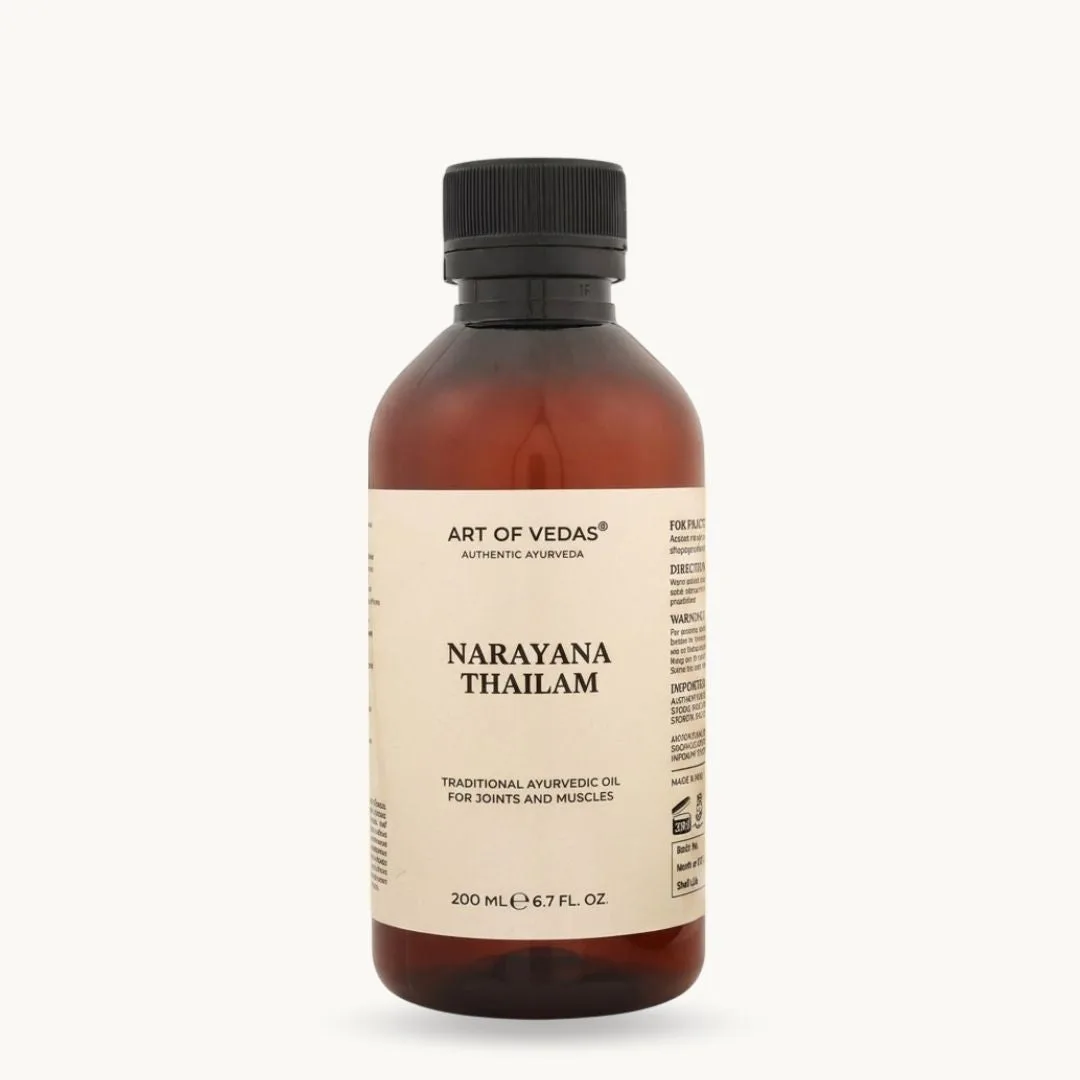
What is Narayana Thailam? A classical Ayurvedic massage oil in which Shatavari, Ashwagandha, Bala and roots of the Dashamoola group are cooked into sesame oil. It is described in the Ashtanga Hridayam, the Charaka Samhita and the Sahasrayogam, and is also written Narayana Thailam, Narayana Taila or Narayana oil. Art of Vedas sells it in a 200 ml bottle for external use.
What is Narayana Thailam used for? For Abhyanga, the Ayurvedic oil massage, over the whole body or on the muscles and joints of one area such as the lower back, the knees or the soles of the feet. The Ashtanga Hridayam places it in its chapter on Vata and describes it as Sarva Vata Hara, an oil for Vata in all its forms. Art of Vedas sells Narayana Thailam as an oil for external use.
How do you use Narayana Thailam? Warm a small amount of Narayana Thailam in the palms, apply it with long strokes along the limbs and circular strokes around the joints, and massage until it is absorbed. Leave it on the skin for 15 to 20 minutes, then take a warm shower or bath. For one area, a few millilitres are enough. Keep it away from the eyes and broken skin.
How often can you apply Narayana oil? Daily, as the classical daily routine (Dinacharya) describes, or every other day for a set period of several weeks followed by a pause. Narayana Thailam is a warming oil, so daily use suits autumn and winter best, with a lighter rhythm in the warmer months. A qualified Ayurvedic practitioner can advise what suits your constitution.
Is Narayana Thailam a warming oil? Yes. The classical texts describe Narayana Thailam as Ushna Virya, warming in potency, and a gentle warmth on the skin after application is characteristic. Warm it before use: stand the closed bottle in a bowl of warm water for a few minutes until a drop feels pleasantly warm on the inner wrist. Do not use a microwave.
Why is it also called Vatha Narayana or Cheriya Narayana Thailam? The names describe the same oil. Vatha Narayana, also spelt Vadha Narayana, puts the word Vata in front, the dosha the oil is classically placed with. Cheriya means small in Malayalam: Cheriya Narayana Thailam is the shorter classical recipe sold by Art of Vedas, while Valiya Narayana, the big Narayana, is Mahanarayana Thailam, the expanded version with a longer list of herbs.
What are the ingredients of Narayana Thailam? The Art of Vedas Narayana Thailam declares 24 plant ingredients in a sesame seed oil base: Shatavari, Ashwagandha, Bala, Atibala, Punarnava, Gokshura, nine plants of the Dashamoola group, Indian coral tree bark, Prasarini, stone flower, two mung beans, and the aromatics Indian dill, deodar, cardamom and galangal, with rock salt. The full list, with botanical names, is on the product page.
Can Narayana Thailam be used in pregnancy or for children? Ask your doctor or a qualified Ayurvedic practitioner first; the classical texts ask for particular care with this oil in pregnancy. Narayana Thailam is for external use only. Do a small skin test on the inner forearm before the first full application, keep it away from the eyes and broken skin, and do not use it on a day of acute illness.