Important Disclaimer: Saffron-based skincare products are for external use only. They are not medicines and do not treat, cure, or prevent any disease or medical condition. All references to traditional Ayurvedic indications are descriptions of classical use, not medical claims. For any skin condition requiring medical attention, please consult a qualified healthcare professional.
Saffron is having a moment in modern skincare. Dermatologists are writing about it. K-beauty brands are formulating with it. Clean beauty consumers are searching for it. The interest is real - but here is what the marketing rarely mentions: Ayurvedic physicians were formulating with saffron for the skin more than 2,000 years ago.
They called it Kumkuma. They classified it among the most important varnya herbs in the classical pharmacopoeia - varnya being the Sanskrit term for herbs that support the brightness, clarity, and radiance of the complexion. And they embedded it into classical medicated oil and serum preparations that are still being made today using methods unchanged from the original formulas.
Modern research has spent the last two decades catching up to what classical Ayurveda already knew. This article covers both: what the classical tradition understood about saffron and skin, what contemporary science has confirmed, and - most importantly - how to actually use saffron for your skin in a way that delivers the benefits the ingredient is genuinely capable of.
What Is Saffron? A Brief Introduction
Saffron (Crocus sativus) is the dried stigma - the thread-like reproductive structure - of the saffron crocus flower. Each flower produces only three stigmas, each of which must be hand-harvested at precisely the right moment of the flower's bloom. The labour intensity of this process is why saffron has been, for millennia, one of the most expensive substances in the world by weight.
The active compounds in saffron relevant to skin care are primarily three: crocin and crocetin (the carotenoid pigments responsible for saffron's distinctive deep orange-red colour and much of its antioxidant activity) and safranal (the volatile compound responsible for saffron's characteristic complex aroma, with its own documented biological activity).
These compounds are not evenly distributed across all saffron products. The concentration of active compounds in a given saffron preparation depends critically on the quality of the saffron used, how it has been processed, and how it has been incorporated into the final product - a crucial point when evaluating which saffron-based skincare products are actually worth using.
Saffron in Classical Ayurvedic Texts
The Varnya Classification
In classical Ayurvedic medicine, herbs were classified by their primary therapeutic actions. One of the most important action categories for skin-related herbs was varnya - literally "that which improves varna." Varna in classical Sanskrit encompasses both the evenness of skin tone and the overall luminosity and vitality of the complexion.
The classical Ayurvedic texts - including the Charaka Samhita, Sushruta Samhita, and Ashtanga Hridayam - consistently list Kumkuma (saffron) among the foremost varnya herbs in the Ayurvedic pharmacopoeia. This classification was based on empirical observation accumulated over centuries of clinical practice: Ayurvedic physicians observed consistently that saffron-containing preparations produced improvements in complexion brightness, evenness, and overall radiance that other herbs could not match.
Saffron is described in classical texts as having a complex Rasa (taste profile - sweet and pungent), a warming Virya (potency), and Pitta-reducing, Vata-balancing properties - making it particularly appropriate for the complexion concerns most associated with Pitta imbalance: uneven skin tone, lack of radiance, and the darkening effects of accumulated ama (metabolic waste) in the skin tissue.
Saffron in Classical Formulas: The Kumkumadi Tradition
The most direct expression of classical Ayurvedic saffron use for the skin is the Kumkumadi formula, literally "the preparation that begins with Kumkuma". Kumkumadi is a classical Ayurvedic formula of the Varnya (complexion) tradition.
In this formula, saffron is not one ingredient among many but the central component around which the whole recipe is built.
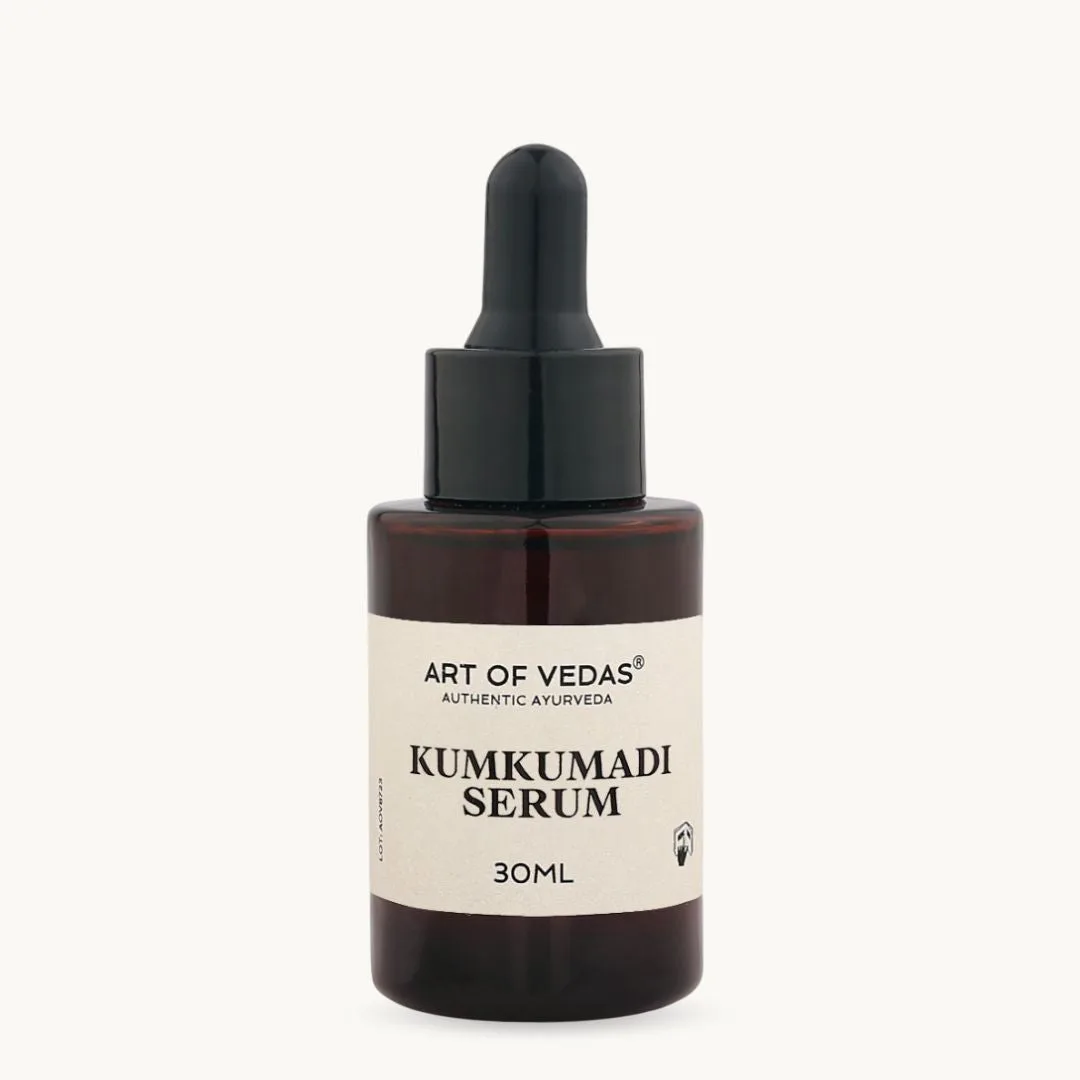
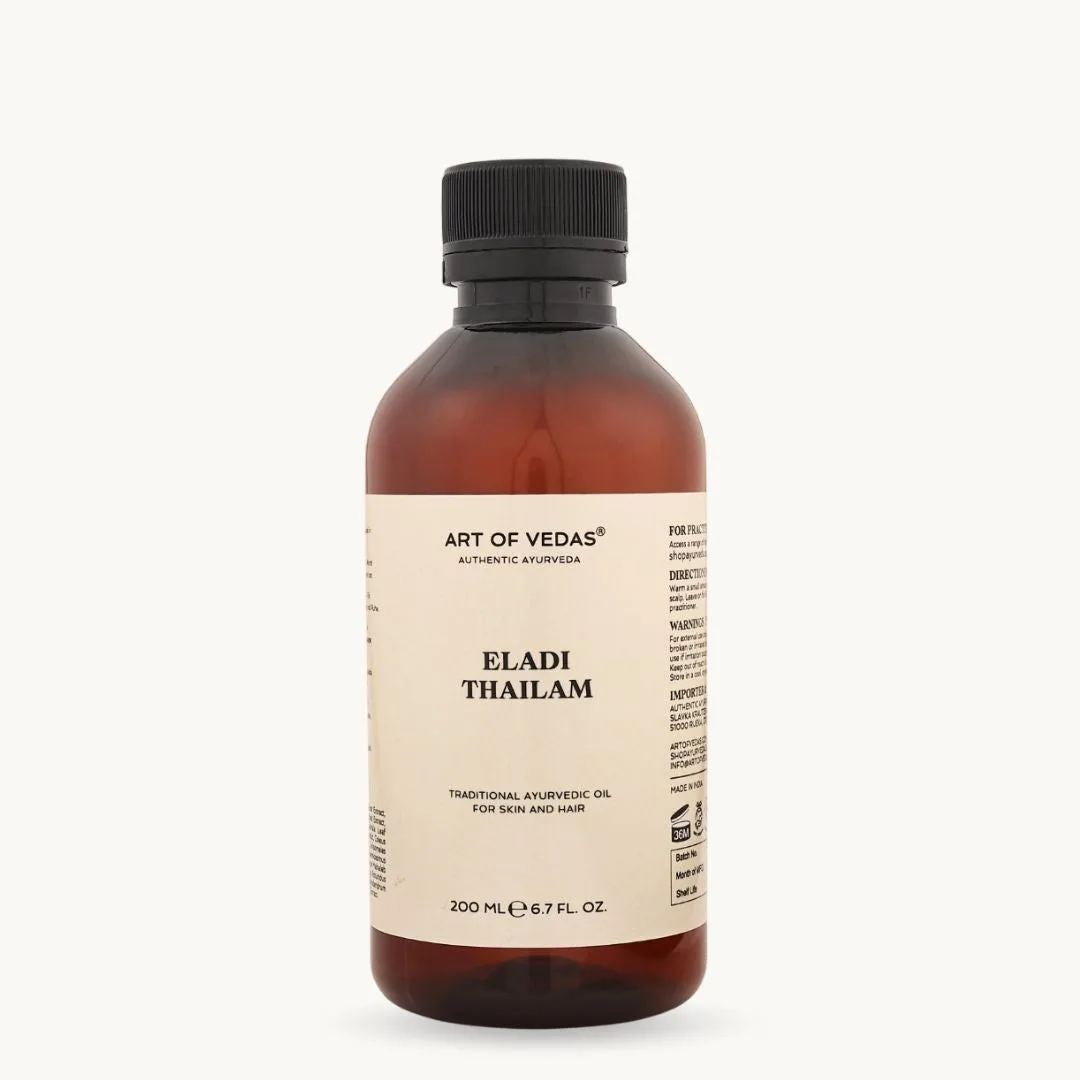
Art of Vedas offers this tradition in our Kumkumadi Serum: saffron with liquorice, lotus, Manjishtha, turmeric, fig-tree bark, blue lotus and rose water in sesame oil. Saffron is also part of our Eladi Thailam.
What Modern Research Says About Saffron for Skin
Antioxidant Activity
Crocin and crocetin - the primary active carotenoids in saffron - have been consistently demonstrated to have strong free radical scavenging (antioxidant) activity in laboratory studies. Free radical damage is one of the primary mechanisms of skin aging, responsible for DNA damage, collagen degradation, and the accumulated oxidative stress that manifests as dullness, uneven tone, and loss of skin elasticity.
In the context of topical application, saffron's antioxidant compounds provide a layer of protective activity against the oxidative stressors that reach the skin from UV radiation, pollution, and other environmental sources. This is the modern biochemical explanation for what classical Ayurveda described empirically as saffron's capacity to maintain and restore varna - skin brightness and clarity - in the face of environmental exposure.
Skin Tone and Complexion Support
Several clinical studies have investigated saffron-containing preparations for their effects on skin tone, hyperpigmentation, and overall complexion evenness. Research published in the Journal of Cosmetic Dermatology examined a saffron-containing cream formulation over several weeks of use and found statistically significant improvements in skin tone evenness and luminosity compared to placebo, with a strong safety profile and no adverse effects reported.
Other research has examined the specific mechanism by which saffron's active compounds produce complexion-supporting effects, with some studies suggesting that crocin may inhibit certain enzymatic processes involved in melanin synthesis - the process by which dark spots and uneven pigmentation develop in response to UV exposure and inflammation. This proposed mechanism aligns closely with the classical Ayurvedic understanding of saffron as a vyanga-reducing herb.
Anti-Inflammatory Properties
Safranal - the volatile aromatic compound responsible for saffron's characteristic scent - has demonstrated anti-inflammatory activity in several laboratory studies, showing capacity to inhibit certain inflammatory signalling pathways. For skin, this anti-inflammatory activity is relevant to the redness, reactivity, and inflammatory hyperpigmentation that characterise Pitta-type skin concerns. It may also contribute to saffron's traditional classification as a Pitta-shamana (Pitta-pacifying) herb - a classification that, when viewed through the lens of modern research, describes what appear to be genuine anti-inflammatory effects.
The Art of Vedas Kumkumadi Serum: Classical Formula, Modern Form
Within the Art of Vedas range, saffron is at the centre of our Kumkumadi Serum, an evening face oil based on the classical Kumkumadi formula.
What Is in Our Kumkumadi Serum
Kumkumadi is the classical saffron-led face oil of the Varnya (complexion) tradition. Our Kumkumadi Serum contains saffron with liquorice, lotus, Manjishtha, turmeric, fig-tree bark, blue lotus and rose water in sesame oil. More on the formula: what Kumkumadi oil is.
Who Is the Kumkumadi Serum For?
Our Kumkumadi Serum is suitable for all skin types. It is often chosen in these situations:
Care for the complexion. Kumkumadi belongs to the classical Varnya (complexion) tradition, the preparations used for an even-looking, radiant complexion.
Vata and Pitta skin types. The warming, complexion-supporting properties of saffron are most directly relevant to Vata skin (which tends toward dullness from dryness and poor circulation) and Pitta skin (which tends toward uneven tone from inflammatory pigmentation). For a deeper guide on matching oils to your dosha, see our Ayurvedic skincare by dosha guide.
Those who already use a daily face oil. Kumkumadi Serum can be added as an evening face oil, a few drops, usually two to four, on clean skin, without changing the rest of your routine.
Kumkumadi Serum vs. Kumkumadi Oil: What Is the Difference?
You may come across both "Kumkumadi Serum" and "Kumkumadi Thailam" (or Kumkumadi oil). Both are rooted in the same classical formula; Thailam is the Sanskrit word for a herbal oil. Our Kumkumadi Serum is a face oil in a 30 ml bottle, made for evening use on the face rather than on the body. More in our guide: what Kumkumadi oil is.
Kumkumadi Serum vs. Eladi Thailam: Choosing Between Them
Both our Kumkumadi Serum and our Eladi Thailam contain saffron as a key ingredient and are classical sesame-based medicated facial oils. The key distinctions:
Kumkumadi Serum: saffron is the leading herb, with liquorice, lotus, Manjishtha, turmeric, fig-tree bark, blue lotus and rose water in sesame oil. An evening face oil of the Varnya (complexion) tradition, a few drops, usually two to four. Suitable for all skin types.
Eladi Thailam - cardamom (Ela) is the lead ingredient; saffron is one of 25+ botanical components. Formula is comprehensive: simultaneously varnya (brightening), krimighna (antimicrobial), and pitta-shamana (anti-inflammatory). Suited to daily morning and evening use as your primary facial oil. Compatible with all skin types.
Some people use both: Eladi Thailam as a daily face oil and Kumkumadi Serum as an evening face oil. Our Eladi Thailam vs Kumkumadi comparison explains the differences in full.
How to Use the Kumkumadi Serum
On its own: In the evening, warm a few drops, usually two to four, of Kumkumadi Serum between your fingertips and press them over the clean face and neck, avoiding the eyes. Work the oil in with light upward strokes following the facial Abhyanga (mukhabhyanga) technique, leave it on overnight and wash your face in the morning.
Together with Eladi Thailam: Apply a few drops, usually two to four, of Kumkumadi Serum first and let it absorb for a few minutes. Then apply Eladi Thailam and perform the mukhabhyanga ritual over the top.
With a Kansa wand: Apply your Kumkumadi Serum first, then massage immediately with our Kansa wand, using broad sweeping strokes across the cheeks, forehead and jawline.
Morning or evening? Kumkumadi Serum is used in the evening and left on overnight; wash your face in the morning. Saffron can tint skin and fabric slightly, so let the oil absorb before lying down.
The Saffron-Sandalwood Combination: The Heart of Classical Varnya Therapy
One of the most important insights of classical Ayurvedic skin formulation is the synergy between saffron and sandalwood. Both are among the most important varnya herbs in the classical pharmacopoeia - but their mechanisms differ in ways that make them powerfully complementary.
Saffron is warming in Virya (potency) - it stimulates circulation, activates the tissues, and drives its brightening compounds into the deeper layers of the skin through that warming, penetrating quality. Sandalwood is cooling in Virya - it calms inflammation, soothes reactive tissue, and provides a counterbalancing quality that prevents the warming quality of saffron from tipping into pitta aggravation for sensitive skin.
Together, they provide a balanced varnya formula: saffron stimulates and brightens; sandalwood calms and maintains homeostasis.
Saffron in Your Routine: Practical Guidance
Start with consistency. The benefits of saffron-based skincare are cumulative. The carotenoid antioxidants and varnya herbs work gradually, supporting the skin's own renewal processes. Most people notice initial improvements in skin texture and hydration within the first 2 to 3 weeks. Changes in complexion evenness and overall radiance become more visible after 4 to 8 weeks of consistent use.
Pair with the mukhabhyanga ritual. The complete facial Abhyanga ritual dramatically enhances the effect of any saffron-based facial oil or serum. The warm oil, the massage technique, the enhanced circulation, and the skin's increased receptivity after the parasympathetic shift that the ritual produces - all of these factors increase the absorption and efficacy of the saffron compounds in a way that simple application without massage cannot match.
Always use SPF in the morning. This is true for any active facial oil or serum. SPF is the single most effective topical intervention for long-term skin health - no facial oil or serum replaces it.
Build the complete practice. Our Kumkumadi Serum fits into a broader Ayurvedic face ritual: Kumkumadi Serum in the evening, Eladi Thailam as a daily face oil, a Kansa wand for the massage and Nasya for the traditional head-care practice.
Frequently Asked Questions About Saffron for Skin
How much saffron does a product actually need to be effective?
Many mass-market products use concentrations far below the threshold demonstrated to produce meaningful skin effects - enough to list saffron on the ingredient label, not enough to produce the effects that saffron research demonstrates. Our Kumkumadi Serum contains saffron together with liquorice, lotus, Manjishtha, turmeric, fig-tree bark, blue lotus and rose water in sesame oil.
Is saffron suitable for all skin types?
Saffron's primary traditional indication is for Vata and Pitta skin types - particularly for the complexion concerns associated with those types. All skin types can use saffron-containing products safely; the difference is in how specifically the ingredient addresses each type's primary concerns. See our Ayurvedic skincare by dosha guide for a full guide to matching oils to your skin type.
How is saffron in a traditional Ayurvedic serum different from synthetic saffron extract?
Genuine saffron stigmas contain hundreds of biologically active compounds in their naturally occurring ratios and forms. Synthetic saffron extracts typically isolate one or two of these compounds (usually crocin) at defined concentrations, losing the complex synergistic effects of the full botanical spectrum. Traditional preparations using whole saffron stigmas preserve this full compound complexity - which is why classical Ayurvedic preparations often outperform single-compound synthetic alternatives despite lower concentrations of any one specific marker compound.
Can saffron skincare cause any adverse reactions?
Pure saffron at cosmetic concentrations has an excellent safety profile in published literature. As with any botanical product, individual sensitivities are possible; always perform a patch test on the inner forearm for 24 hours before full facial application with any new product. If you are pregnant or breastfeeding, consult your healthcare provider before beginning any new skincare routine.
Continue Exploring