In brief: This page answers the questions people most often search for about Abhyanga (Ayurvedic warm oil massage), in their own words. Each answer says what the practice is, names the matching Art of Vedas product and points to a longer guide.
The answers are short on purpose. The longer Art of Vedas guides are listed at the end of the page.
What is Abhyanga, the Ayurvedic self-massage?
Abhyanga is the Ayurvedic massage of the whole body with warm oil, usually done by yourself at home before bathing. When warming oils are heated and massaged into the body, this is the practice meant. Classical Ayurveda places it in Dinacharya (the daily routine).
Abhyanga and Abhyangam are two spellings of the same word.
What is Ayurvedic massage?
Ayurvedic massage is the collective name for the classical ways of applying oil, herbal powder or warm herbal bundles to the body. Abhyanga is the form most people mean. In every form the oil is chosen for the person's Prakriti (constitution) and the season.
What are the types of Ayurvedic massage?
There are three groups. With oil: Abhyanga for the whole body, Shiro Abhyanga for the head, Mukha Abhyanga for the face and Pada Abhyanga for the feet, plus Shirodhara (warm oil poured over the forehead) and Pizhichil (over the whole body), both carried out by practitioners. Dry: Udvartana with herbal powder and Garshana with raw silk gloves. With warm herbal bundles: Kizhi.
Snehana vs Abhyanga: what is the difference?
Snehana is the wider term: oleation, the classical use of oil and fat, on the skin or within a practitioner's programme. Abhyanga is one form of it, the external one in which warm oil is massaged over the skin.
Related terms: Bahya Sneha is external oleation, Udvartana is the massage with herbal powder, and Kshalana means washing or rinsing.
How do you do Abhyanga at home?
Warm the oil by standing the bottle in warm water for a few minutes. Apply it with long strokes on the limbs, small circles at shoulders, elbows, knees and ankles, and clockwise circles on the abdomen. Leave it on for 15 to 20 minutes, then take a warm shower or bath.
Start with the upper body or the feet? The usual order in our product directions is from the scalp down to the soles. A cold shower after Abhyanga? The directions say warm water.
Is there a classical Ayurveda reference for Abhyanga twice daily?
Not one we can show. The references named in our product data, the Charaka Samhita (Sutra Sthana, Dinacharya) and the Ashtanga Hridayam (Sutra Sthana), place Abhyanga in the daily routine, so it is a daily practice. They are not cited for a twice-daily one.
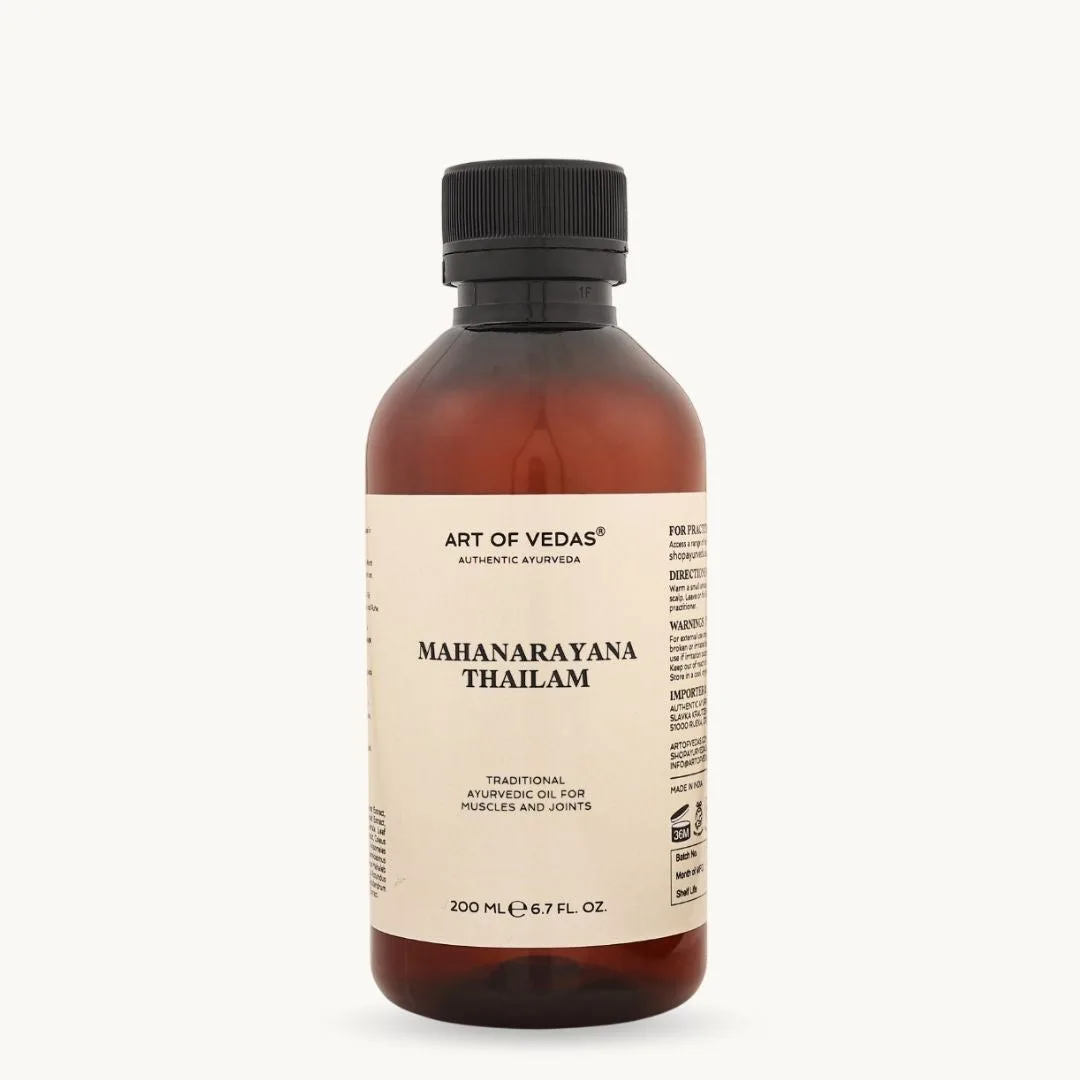
How many times can you apply Mahanarayana oil? The directions for Mahanarayana Thailam name daily application as traditional and two to three times a week as a regular rhythm.
How do you choose an Abhyanga oil?
Choose by your Prakriti, described through the three Doshas (Vata, Pitta and Kapha), the season and the part of the body. Sesame is the classical warming base, coconut the cooling one. If you do not know your constitution, take the Dosha test or start with the oil made for all three Doshas.
- Vata, also autumn and winter: warming oils, such as the three named in the answers below.
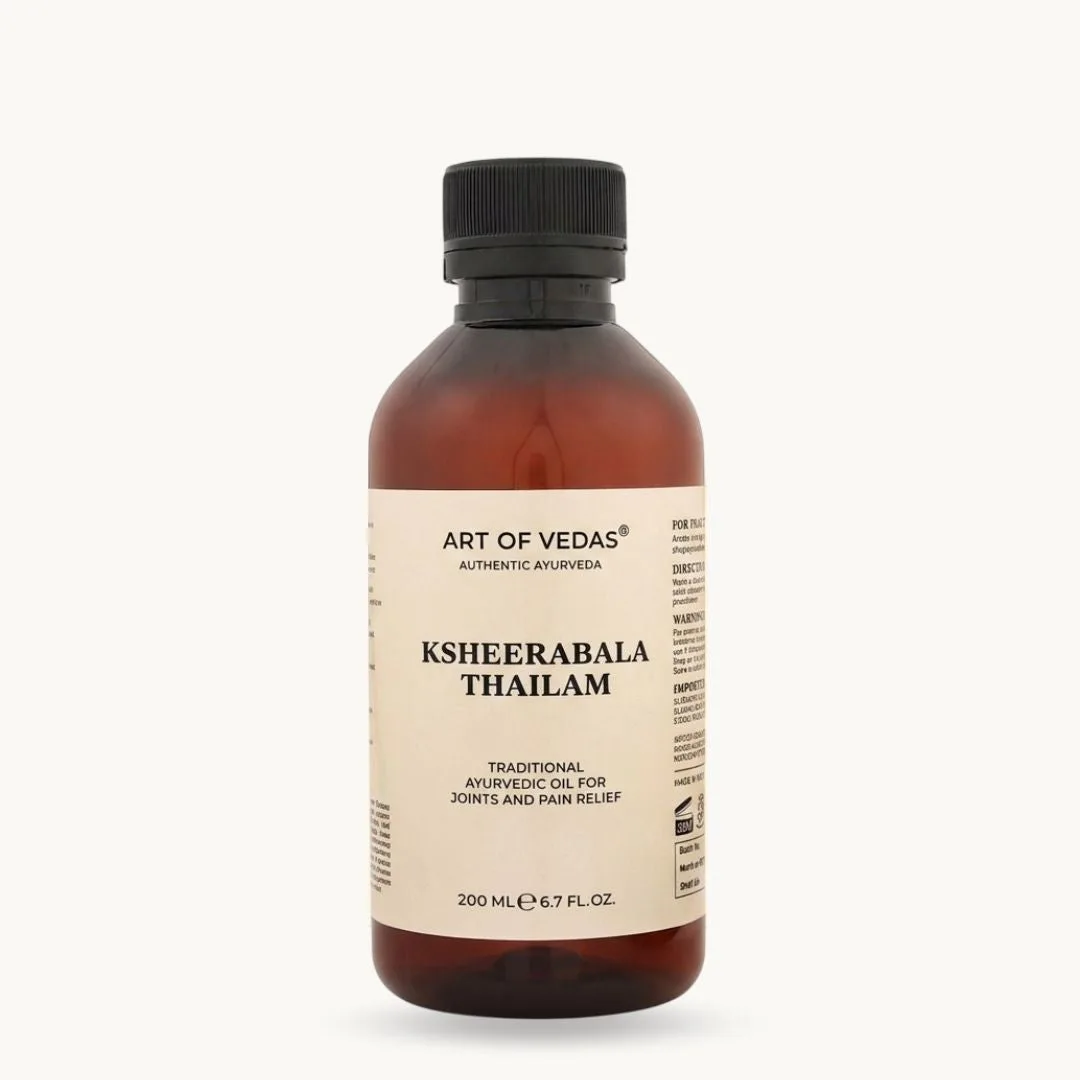
- Vata with Pitta (Vata-Pitta Prakriti): Ksheerabala Thailam, which its product data classes as cooling and associates with Vata first and Pitta second.
- All three Doshas, or not sure: Tri Dosha Massage Oil, neither strongly warming nor cooling.
- Pitta, a warm summer, or Kapha: the oil selection guide listed below names the cooling and the lighter choices.
Which oils are used for Abhyanga massage?
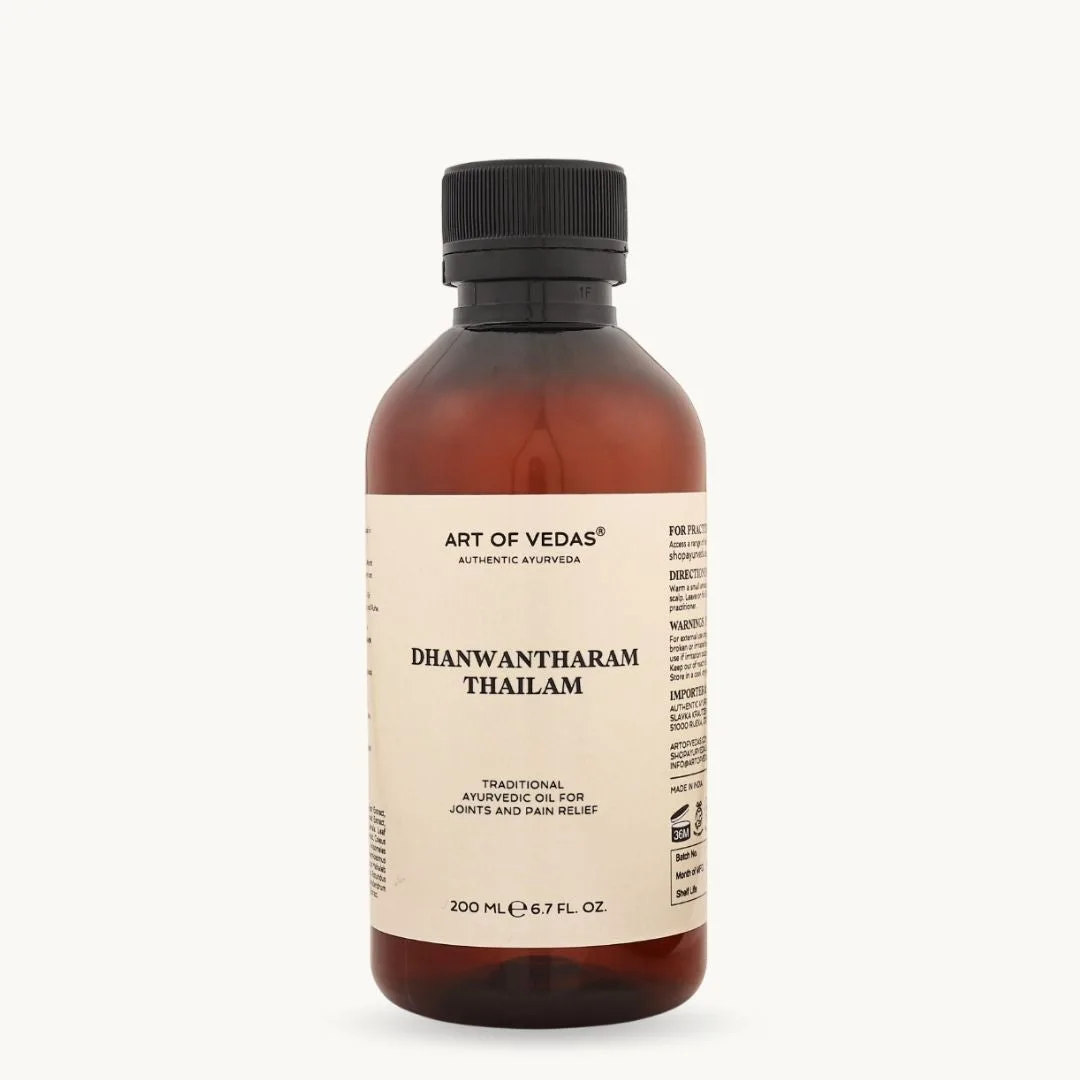
No single oil suits everyone, and no single Ayurvedic Thailam is the right one for massaging every body. The classical answer depends on constitution and season. Three Thailams (classical herbal oils) are set side by side in our guides: Dhanwantharam Thailam, mildly warming and made for daily Abhyanga; Mahanarayana Thailam, warmer; and Ksheerabala Thailam, cooling.
Which oil for Abhyanga for Vata in autumn?
A warming one. In Ayurveda autumn and early winter are the Vata season, and the oils classically associated with Vata are warming. Vata Massage Oil is the Art of Vedas blend made for it, on almond, jojoba and olive oil.
For sesame oil in Vata Abhyanga, Mahanarayana Thailam and Dhanwantharam Thailam are both sesame-based.
What is Shiro Abhyanga, and how do you choose the right oil for it?
Shiro Abhyanga is the Ayurvedic massage of the head: warm oil is applied to the crown and moved outwards across the scalp in slow circles, down to the temples and the base of the neck, for 10 to 15 minutes. Choose an oil composed for the head, such as Shiroabhyanga Oil, which carries Amla, Bhringraj and Brahmi in a sesame base.
It differs from Abhyanga only in the area covered. Sesame oil can be used for head massage, and Brahmi can go into it, as this oil shows.
What is a Mukha Abhyanga massage?
Mukha Abhyanga is the Ayurvedic face massage. A few drops of face oil are massaged into clean skin with light pressure, from the centre of the face outwards, with the fingertips or a bronze Kansa wand.
A Marma point facial massage routine, step by step: oil first, then the wand over cheeks, forehead and jawline, then temples and brow, and last a pointed wand held on single Marma points (points mapped in classical Ayurveda). The routine is the same for a round face, and we make no claim about face shape.
What is the dry powder massage called?
It is called Udvartana. A dry herbal powder is rubbed over the body in firm upward strokes, from the feet towards the heart, on dry skin or after a light application of oil, and a warm bath follows. It is classically associated with Kapha.
For classical references: the product data of Kolakulathadi Churnam, an Udvartana powder, names the Ashtanga Hridayam (Sutra Sthana) and the Sahasrayogam (Churna Prakarana). The dry massage without powder is Garshana: with Garshana Gloves of raw silk, stroke completely dry skin from the feet upwards for 3 to 7 minutes, then shower or continue with Abhyanga.
What is Kansa wand massage?
Kansa wand massage is oil massage done with a tool of Kansa, the traditional bronze of copper and tin, instead of the hands alone. A wand is used on the face and body, a bowl on the soles of the feet. Oil always goes on first, so that the metal glides.
It is a ritual of classical custom, and Art of Vedas makes no claims for it.
Kansa bowl foot massage: how do you choose the finish?
Choose by feel: a smooth dome glides, an uneven hand-cast surface follows the contours of the sole. The Ayurveda Kansa Vatki is a hand-cast bowl with an uneven surface, held in the palm. A bowl mounted on a hardwood handle gives more control of angle and pressure.
Pada Abhyanga yourself: warm a little oil and massage both feet in slow circles over soles, heels, arches and toes, ideally before bed.
Which oils are commonly used in Pizhichil?
Pizhichil is a procedure for practitioners: warm herbal oil is poured over the whole body in a continuous stream. It is not a home practice. The oils are classical Thailams associated with Vata: the product data of Ksheerabala Thailam names Pizhichil among its uses, and our Pizhichil guide adds Dhanwantharam Thailam and others.
The justification is classical: the Dosha each oil is associated with, and whether it is warming or cooling.
Products mentioned on this page
- Tri Dosha Massage Oil: blend for all three Doshas.
- Vata Massage Oil: warming blend for Abhyanga.
- Dhanwantharam Thailam: mildly warming classical Thailam on a sesame base.
- Mahanarayana Thailam: warming classical Thailam on a sesame base.
- Ksheerabala Thailam: cooling classical Thailam with Bala.
- Shiroabhyanga Oil: head oil with Amla, Bhringraj and Brahmi.
- Garshana Gloves: raw silk gloves for dry massage.
- Ayurveda Kansa Vatki: hand-cast bronze bowl, for the feet.
Read further
More questions answered
For external use only. Not a substitute for professional medical advice.