In brief: Short answers to the questions people ask about Marma points: what they are, how many the classical texts count, where they lie and how they are touched in massage. Every count and location of the points follows the existing Art of Vedas guides, linked below.
The answers keep to what the classical tradition names and to how the points are touched during an oil massage. They make no statement about any effect on the body.
What are the Marma points of Ayurveda?
Marma points are specific places on the body that classical Ayurveda names and maps. The Art of Vedas guides describe them as places where several tissues of the body are said to meet, and as points that are touched with respect and a light hand. In English the word Marma is usually given as vital point.
At home the points are not pressed one by one: the slow strokes of the daily oil massage pass over them. The complete guide to Marma points covers the full map.
Where are the Marma points in the body?
Marma points are spread over the whole body. The Art of Vedas guides give the classical count by region: 37 in the head and neck, 22 in the arms and hands, 22 in the legs and feet, 12 in the trunk and 14 in the back.
How does the Sushruta Samhita classify the 107 Marma points, and what are the five types?
Classical Ayurveda counts 107 Marma points. According to the complete Marma guide, the Sushruta Samhita sorts them into five types by the tissue found at each site: Mamsa, Sira, Snayu, Asthi and Sandhi Marma.
- Mamsa Marma, in the flesh: 11
- Sira Marma, at the vessels: 41
- Snayu Marma, at ligaments or tendons: 27
- Asthi Marma, at the bones: 8
- Sandhi Marma, where bones meet: 20
What is the classical Ayurvedic conceptual framework of Marma points?
The framework is called Marma Vigyan, the science of Marma points. The complete Marma guide places it in the Sushruta Samhita, one of the three foundational classical texts of Ayurveda, and describes it as an anatomical map drawn up in a surgical context. The map is ordered by the tissue at each point and by the region of the body.
What is the importance of Marma points in Ayurveda?
In the classical texts their importance is practical. Sushruta describes them in a surgical text, as places a surgeon had to know, and the guides describe them as points to be touched with respect and a light hand. In massage they give the sequence its order: the hands follow a map.
What are the Marma points of the face?
On the face the Art of Vedas guides name Sthapani between the eyebrows, Apanga at the outer corner of each eye, Shankha at the temples, Phana at the sides of the nostrils and Hanu at the jaw and chin. A facial massage with a Kansa Wand passes over these places, always on oiled skin and with very little pressure.
The seven point face routine rests the tool lightly at each of its places and makes small circles. The product data of the Ayurvedic Face Oil gives 3 to 4 drops on clean skin and describes the oil as compatible with the Kansa Wand.
What is the Ayurvedic term for the periocular Marma points?
The point that the guides name at the eye is Apanga, at the outer corner of each eye. Sthapani, between the eyebrows, lies close to it. The guides name no further points around the eye, so none are added here.
Around the eye the guides ask for the lightest pressure of the whole face, and the tool stays away from the eye itself.
Which is the most important Marma point on the head?
According to the complete Marma guide it is Adhipati, at the crown of the head: the single point that the classical texts describe as the most important Marma of the head. The name means ruler. Shiroabhyanga, the classical head massage, begins there.
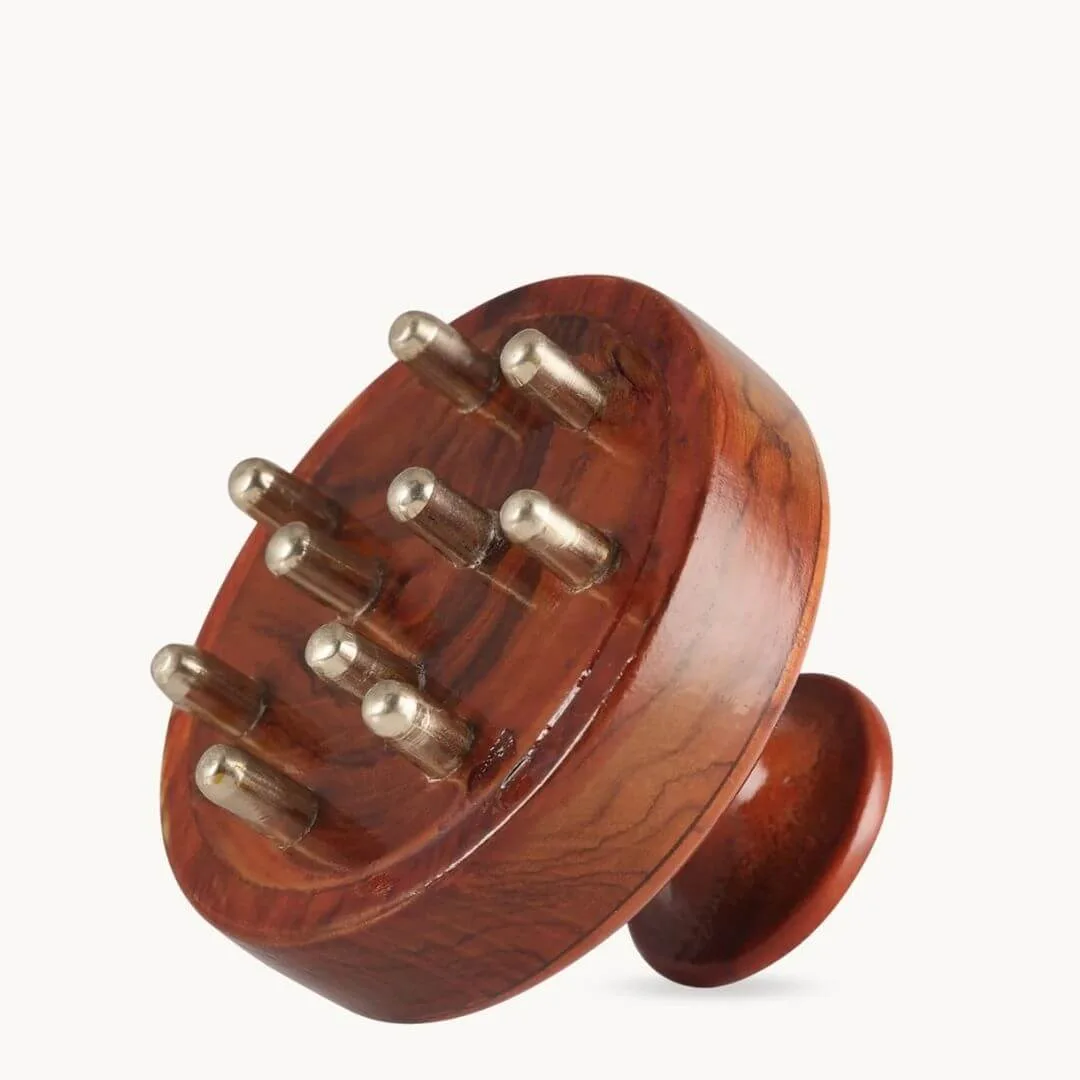
The guide to the Marma points of the head adds Shankha at the temples and Krikatika where the skull meets the neck. The Shiroabhyanga Oil is applied along the same route, from the crown to the temples and the neckline, and the Kansa Scalp & Body Wand covers a broad area of the scalp with its seven rounded nodes.
Where are the Marma points in the neck and the back of the neck?
The guides count the neck together with the head: 37 points for both. At the back of the neck they name Krikatika, on both sides where the skull meets the neck. The head massage finishes there.
Which Marma points are in the upper limb according to Sushruta?
The Art of Vedas guides give the count of the Sushruta Samhita for the upper limbs: 22 points in the arms and hands, placed mainly at the shoulders, elbows, wrists and fingers. They name one of them: Talahridaya, in the palm. The guides list no other names for the arm, so none are given here.
What is the Ayurveda Marma point in the middle of the palm?
The Marma point of the palm is called Talahridaya. The name means the heart of the palm or sole, and the guides use it for the palm of the hand and for the centre of the sole of the foot. The Kansa Marma Wand product data lists the hands, with Talahridaya, among its usual places of use.
Where are the Marma points in the foot?
On each foot the guides name Talahridaya at the centre of the sole, Kshipra in the web between the first and second toes, Kurcha at the ball of the foot and Gulpha at the ankle. The classical map places further points at the heel and at the individual toes.
In Padabhyanga, the classical foot massage, warm oil and slow circles of the thumbs cover the whole sole, as the guide to the Marma points of the feet explains. The Padabhyanga Oil is composed for this massage, and the Ayurveda Kansa Vatki is a Kansa bronze bowl with a textured surface that is moved across the sole.
Is there a Marma points chart or diagram with the names?
This page has no drawing. It gives the Marma map in words, from Adhipati at the crown of the head down to the points of the foot. The list holds points that the guides name together with their place; it is not the complete classical list.
- Adhipati: the crown of the head
- Sthapani: between the eyebrows
- Shankha: the temples
- Apanga: the outer corner of each eye
- Phana: the sides of the nostrils
- Hanu: the jaw and chin
- Krikatika: where the skull meets the neck
- Hridaya: on the sternum
- Nabhi: the navel
- Talahridaya: the palm of the hand and the centre of the sole
- Janu: the knees
- Gulpha: the ankles
- Kurcha: the ball of the foot
- Kshipra: the web between the first and second toes
How do Marma points and the Kansa Wand go together?
A Kansa Wand is a massage tool with a dome of Kansa, a bronze of copper and tin, on a handle. It is moved over oiled skin in slow circles and strokes, and on the face the sequence passes over points the guides name: Sthapani, Apanga, Shankha and Hanu. The pressure stays light throughout, and the tool is kept off broken skin.
The double sided Kansa Wand has two domes: according to its product data the larger one is for cheeks, forehead and jawline, the smaller one for temples, brow, under-eye and the edges of the nose. The whole range is in the Kansa tools collection.
What is a Marma wooden stick?
The Art of Vedas range has no stick made of wood alone. Its tool for single Marma points is the Kansa Marma Wand: a tapered tip of Kansa bronze on a hardwood handle. According to the product data, a little oil goes on the area first, then the tip rests on the point with gentle, steady pressure for 10 to 30 seconds before it moves on.
Products mentioned on this page
- Kansa Marma Wand: tapered tip of Kansa bronze on a hardwood handle, for one Marma point at a time.
- Kansa Wand, Double Sided: two domes for the face; the product data describes the metal as cooling, a quality classically associated with Pitta.
- Kansa Scalp & Body Wand: seven rounded Kansa nodes on a carved hardwood handle, for Shiroabhyanga and for single Marma points on the body.
- Ayurveda Kansa Vatki: Kansa bronze bowl with a textured surface for Padabhyanga, the classical foot massage.
- Ayurvedic Face Oil: face oil, 30 ml; 3 to 4 drops on clean skin, compatible with the Kansa Wand.
- Padabhyanga Oil: oil for the evening foot massage, 200 ml. Not recommended during pregnancy or while breastfeeding: consult a doctor first.
- Shiroabhyanga Oil: oil for the Ayurvedic head massage, 200 ml. Not recommended during pregnancy or while breastfeeding: consult a doctor first.
Read further
More questions answered
For external use only. Not a substitute for professional medical advice.