In brief: This page answers the questions people search for about Nasya, the classical Ayurvedic practice of applying oil at the nostrils, and about the oils named for it. Each answer says what the practice or the product is and where a longer guide or a practitioner should be consulted.
The questions come from real searches and are kept close to the wording people use. The answers describe and make no promise of an effect.
What is Nasya in daily Ayurvedic self-care?
Nasya is the classical Ayurvedic practice of applying oil at the nostrils. The word comes from the Sanskrit nasa, which means nose. In Dinacharya, the classical daily routine, it is one of the morning practices, next to tongue scraping, oil pulling and Abhyanga.
The classical texts describe a gentle daily form, Pratimarsha Nasya, and stronger forms that belong to Panchakarma and are carried out by a trained practitioner. The complete Nasya guide sets out that framework.
What is Nasya oil, and what is it used for?
Nasya oil is a herbal oil named after the practice it is classically associated with: Nasya, the application of oil at the nostrils. The classical Nasya oil is Anu Thailam. Art of Vedas lists its Anu Thailam as Nasya Oil and offers it as a head, scalp and Marma massage oil for external use.
The product page describes Nasya itself as a practice to be undertaken with the guidance of a qualified Ayurvedic practitioner.
What is Shadbindu Thailam?
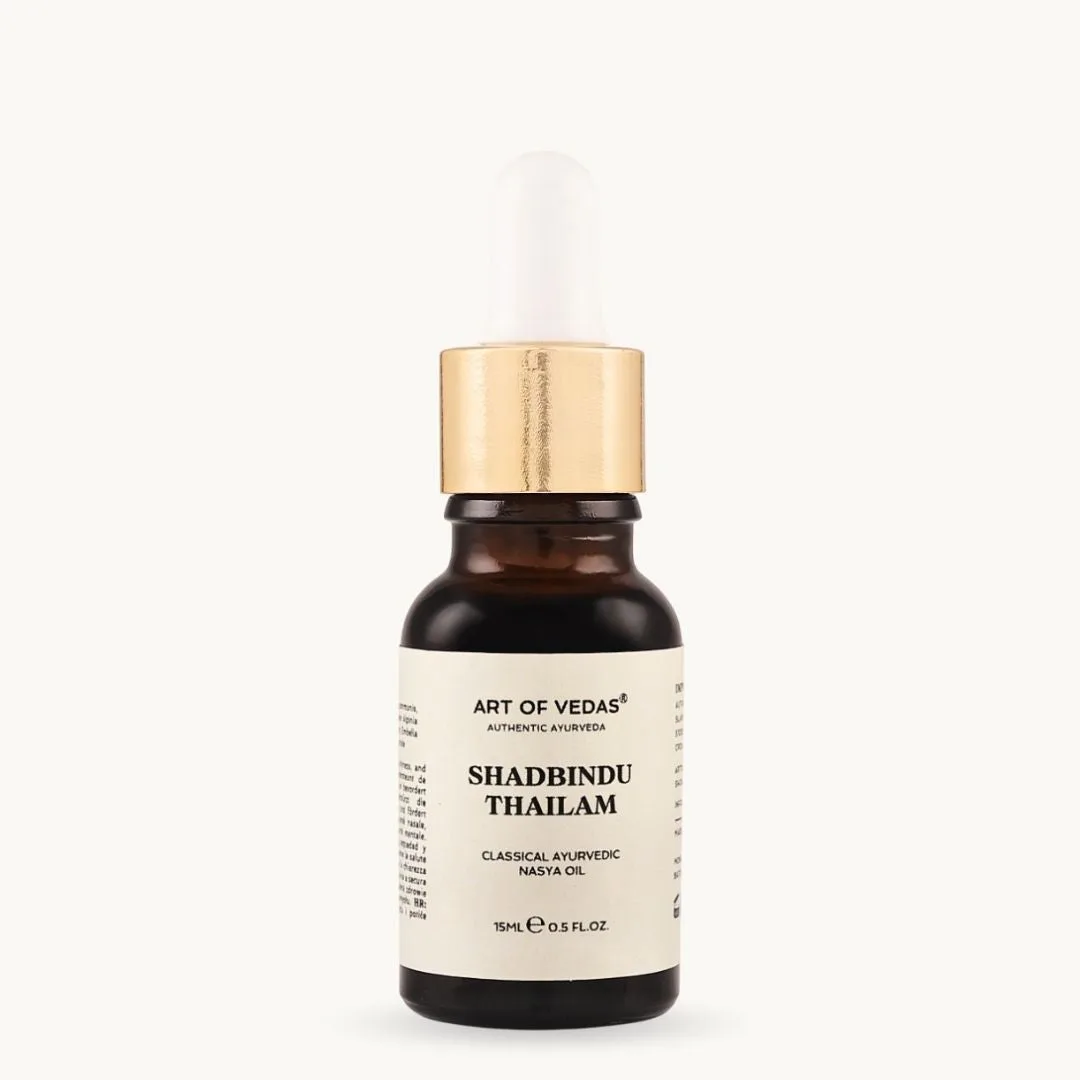
Shadbindu Thailam is a classical Ayurvedic herbal oil in a sesame oil base, classically associated with Nasya. The name is Sanskrit: shad means six and bindu means drop. Art of Vedas offers it in a 15 ml bottle as a head, scalp and Marma massage oil for external use.
Its ingredient list includes ten herbs, among them Bhringraj, licorice, ginger, cinnamon and dill. The product page gives the Bhaishajya Ratnavali as the source text and associates the oil with Kapha and Vata.
Which Nasya nasal oil is recommended for the Ayurveda practice?
The Art of Vedas guides name an oil and give no ranking. They call Anu Thailam the classical Nasya oil and the one the classical texts reference most often. The second classical oil associated with Nasya is Shadbindu Thailam, and which of the two suits a person is a question for a qualified Ayurvedic practitioner.
Customer reviews of the Nasya Oil are shown on its product page.
How do you choose a Nasya nasal oil?
Look at four things: what the oil is, the size, how it is meant to be used, and whether you should ask a practitioner first. Art of Vedas offers two classical oils associated with Nasya, both in a sesame oil base and both for external use. They are listed in the nasal care collection.
- What it is: Nasya Oil is Anu Thailam in a sesame oil base. Shadbindu Thailam has ten herbs in the same base.
- Size: Nasya Oil comes in 15 ml and 50 ml, Shadbindu Thailam in 15 ml.
- Use: both are offered as head, scalp and Marma massage oils.
- Ask first: if you are pregnant or breastfeeding, take medication, or are choosing for a child, speak to a qualified practitioner or a doctor before use.
What are the alternatives to Nasya nasal oil?
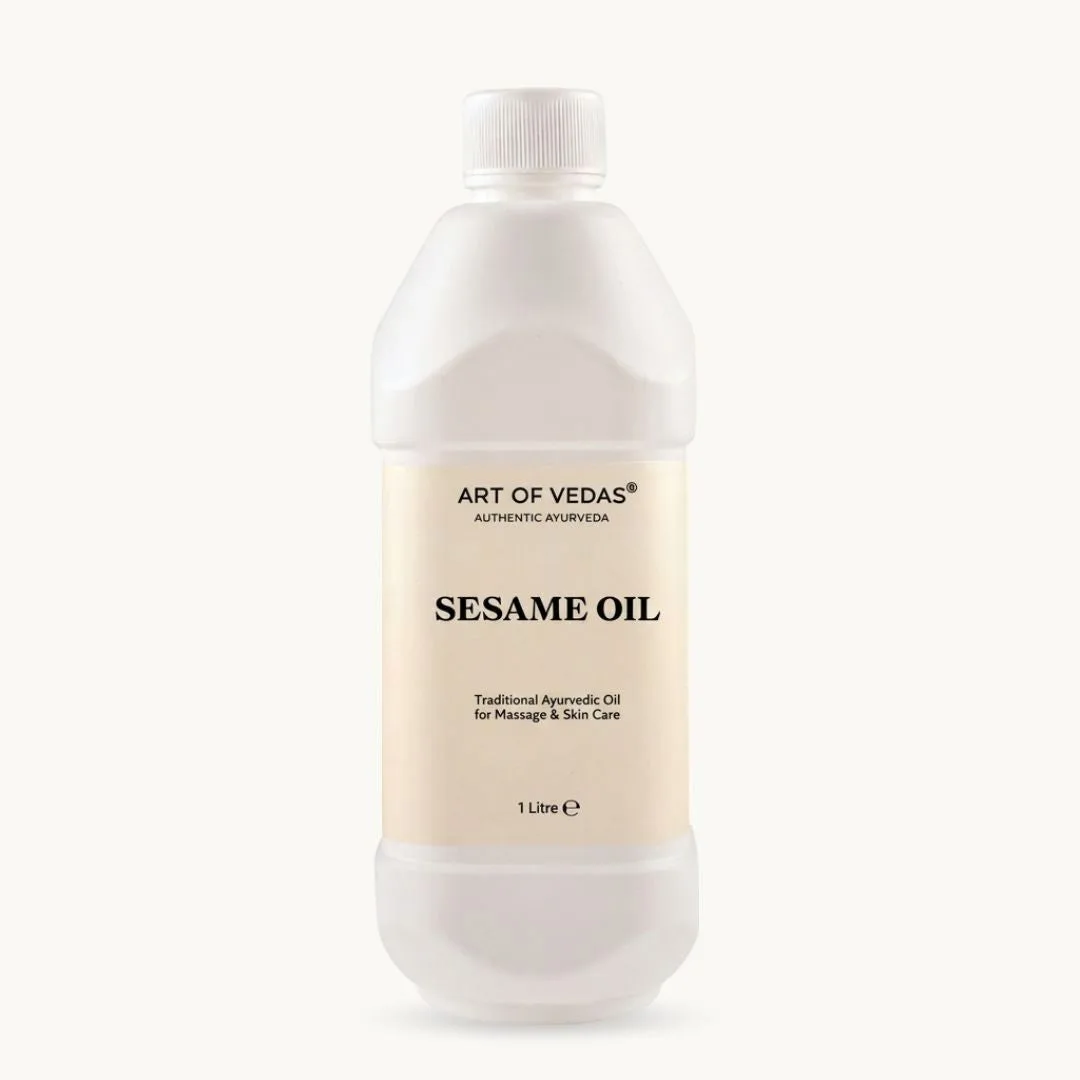
The Art of Vedas guides mention three. Plain sesame oil or plain ghee is named as the simple alternative to a prepared Nasya oil. Shadbindu Thailam is the other classical oil associated with Nasya. A nasal rinse with warm salt water, called Jala Neti, is a separate practice and does not replace the oil.
Anyone who prefers not to apply oil at the nostrils can use the same oil as its product page describes it: as a massage oil for the head, the scalp and the Marma points.
Is Nasya nasal oil worth it, and what are the pros and cons?
That depends on what you are looking for, because Art of Vedas makes no promise of an effect. What can be compared are practical points: what the oil is, how it is used and who should ask a practitioner first.
- In favour: a classical preparation with a named formula and a published ingredient list, used a few drops at a time.
- To consider: the oil is offered for external use, and Nasya itself calls for the guidance of a qualified Ayurvedic practitioner.
- Ask first: if you are pregnant, unwell or taking medication, or choosing for a child, speak to a practitioner or a doctor first.
How is Nasya oil used, and what is the Nasya technique?
Art of Vedas offers its Nasya Oil for external use: a few drops are warmed between clean fingertips and massaged into the scalp, the temples and the forehead. Nasya itself, the classical application at the nostrils, should be undertaken with the guidance of a qualified Ayurvedic practitioner.
The guides place this in the morning, not directly after a meal or a bath. The Anu Thailam guide describes the classical method in full.
How do beginners start with the Nasya nasal oil practice?
The Art of Vedas guides suggest starting slowly: Pratimarsha Nasya, the gentle daily form, on three or four mornings a week at first, and daily once it is a habit. They suggest adding it only after simpler morning steps, such as tongue scraping, are in place. If the practice is new to you, ask a qualified Ayurvedic practitioner to show you the technique.
Should you do Nasya before or after a shower?
Before. In the classical morning order set out in the Art of Vedas guides, Nasya comes after the teeth are cleaned and the tongue is scraped, and before Abhyanga and the bath. Several guides state that it should not be done directly after bathing.
Gandusha and Kavala, the classical forms of oil pulling, belong to the same part of the morning. The Dinacharya guide gives the full order.
How long is the Nasya procedure continued?
That depends on the form. Pratimarsha Nasya, the gentle form, is described in the Art of Vedas guides as an ongoing daily practice. For Nasya given by a practitioner, the Art of Vedas guide for practitioners describes a standard course of seven consecutive days and longer courses of 14 or 21 days.
The guide for practitioners puts a single session at 30 to 45 minutes including preparation. How long a course runs for one person is for the practitioner to decide.
Which Ayurvedic tools are used for nasal care, and what is a nasal rinse?
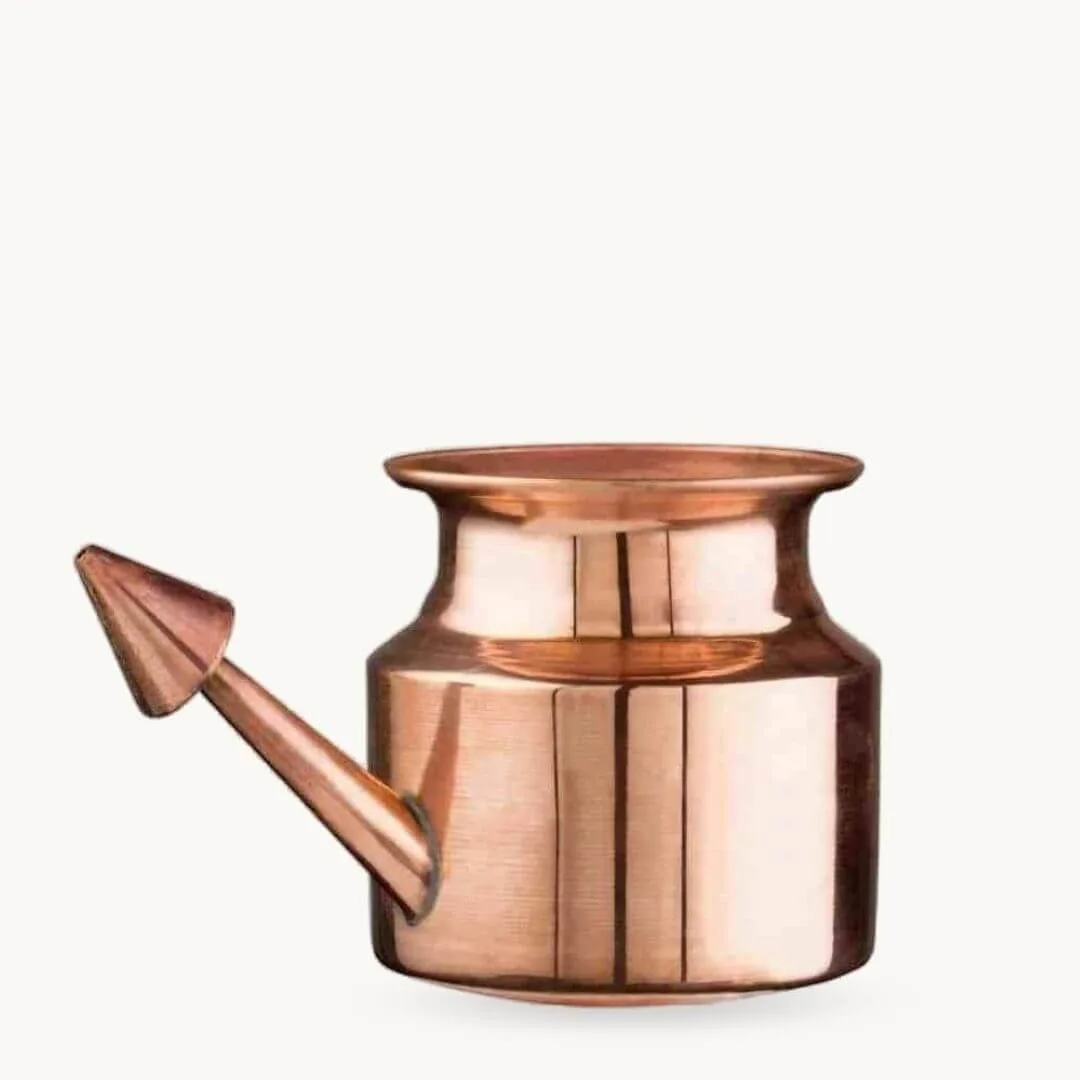
The Neti pot is used for Jala Neti, the Ayurvedic practice of rinsing the nasal passages with warm salt water, and Art of Vedas offers a Copper Neti Pot for it. The Gokarna is a small brass vessel in which practitioners warm the oil for Nasya.
A rinse and an oil are different practices. Where both are done, the product page gives the classical order: the rinse first, the oil afterwards.
Which Nasya oil is associated with Kapha, and which with Pitta?
Both oils at Art of Vedas are classically associated with Kapha and Vata: Shadbindu Thailam with Kapha first, and Nasya Oil, which is Anu Thailam, with Vata first. Neither has Pitta as its first association. For Pitta, one Art of Vedas guide notes the warming character of sesame-based oils and mentions plain ghee as the alternative in summer.
The Dosha test gives a first indication of your constitution. A qualified Ayurvedic practitioner can confirm it.
What are Navana Nasya and Shodhana Nasya?
Both terms come from the classical classification of Nasya. Navana Nasya is the oil-based form, in which oil or ghee is used. Within it the texts distinguish Snehana, a word that means oiling, and Shodhana, a word that means cleansing.
Our guides describe Shodhana Nasya as part of clinical Panchakarma, carried out by a trained practitioner and not a home practice.
Which herbs are used in Nasya?
That depends on the oil. Art of Vedas Nasya Oil, which is Anu Thailam, combines herbs in a sesame oil base, among them vetiver, cedarwood, cinnamon, cardamom, licorice and Shatavari. Shadbindu Thailam has ten herbs, among them Bhringraj, ginger, dill and licorice.
The complete ingredient lists are on the product pages. The Nasya Oil page names the Ashtanga Hridayam as the classical source for Anu Thailam.
What does Nasya oil smell like?
The Art of Vedas guide to Anu Thailam describes the oil as warm and aromatic, and clearly different from plain sesame oil. It names cinnamon, cardamom and nutgrass (Cyperus rotundus) as the herbs that shape its scent. All three are on the ingredient list of the Nasya Oil.
Products mentioned on this page
- Nasya Oil: Anu Thailam in a sesame oil base, in 15 ml and 50 ml.
- Shadbindu Thailam: a classical herbal oil in a sesame oil base, in 15 ml.
- Copper Neti Pot: a copper pot for Jala Neti, the rinse with warm salt water.
Read further
More questions answered
For external use only. Not a substitute for professional medical advice.