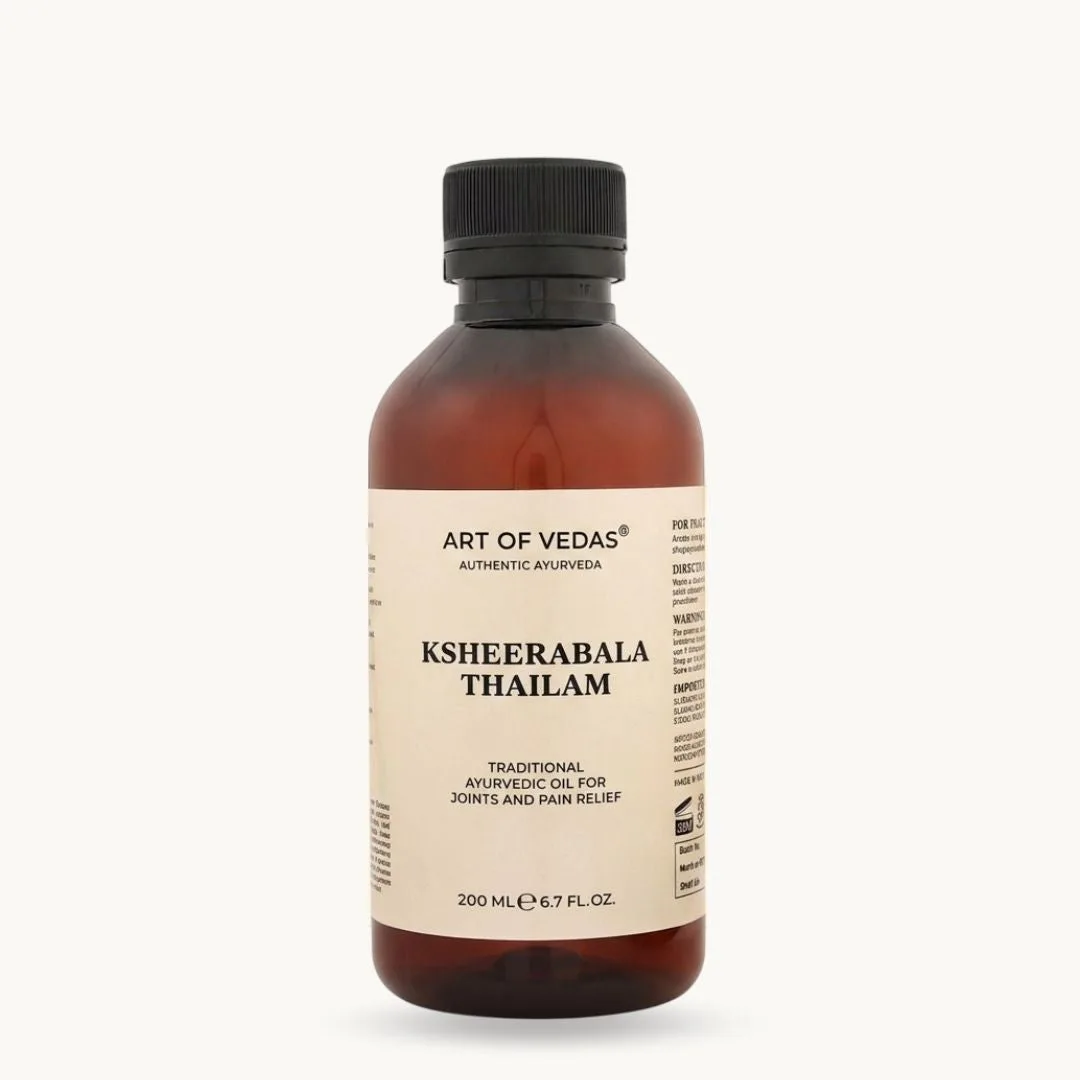
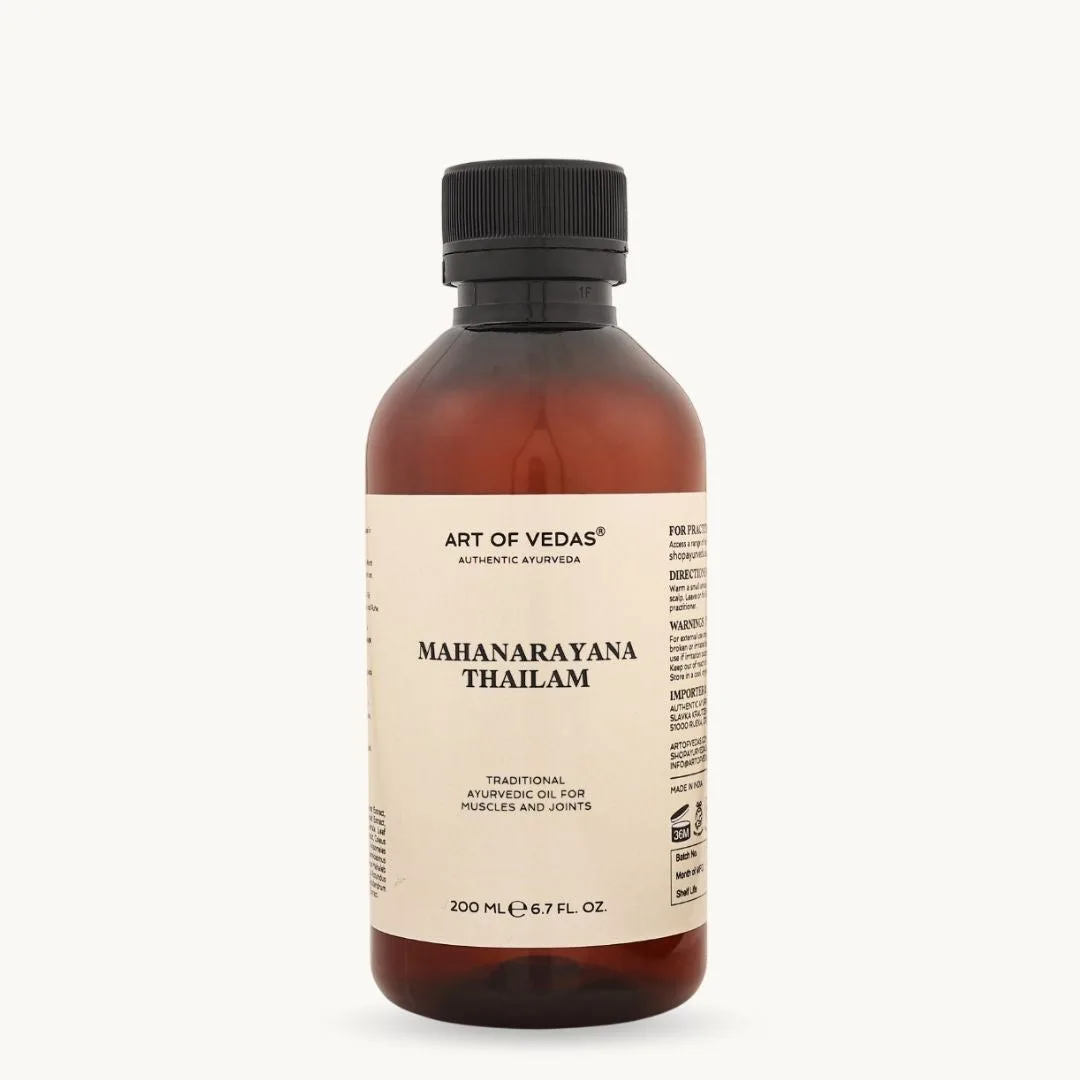
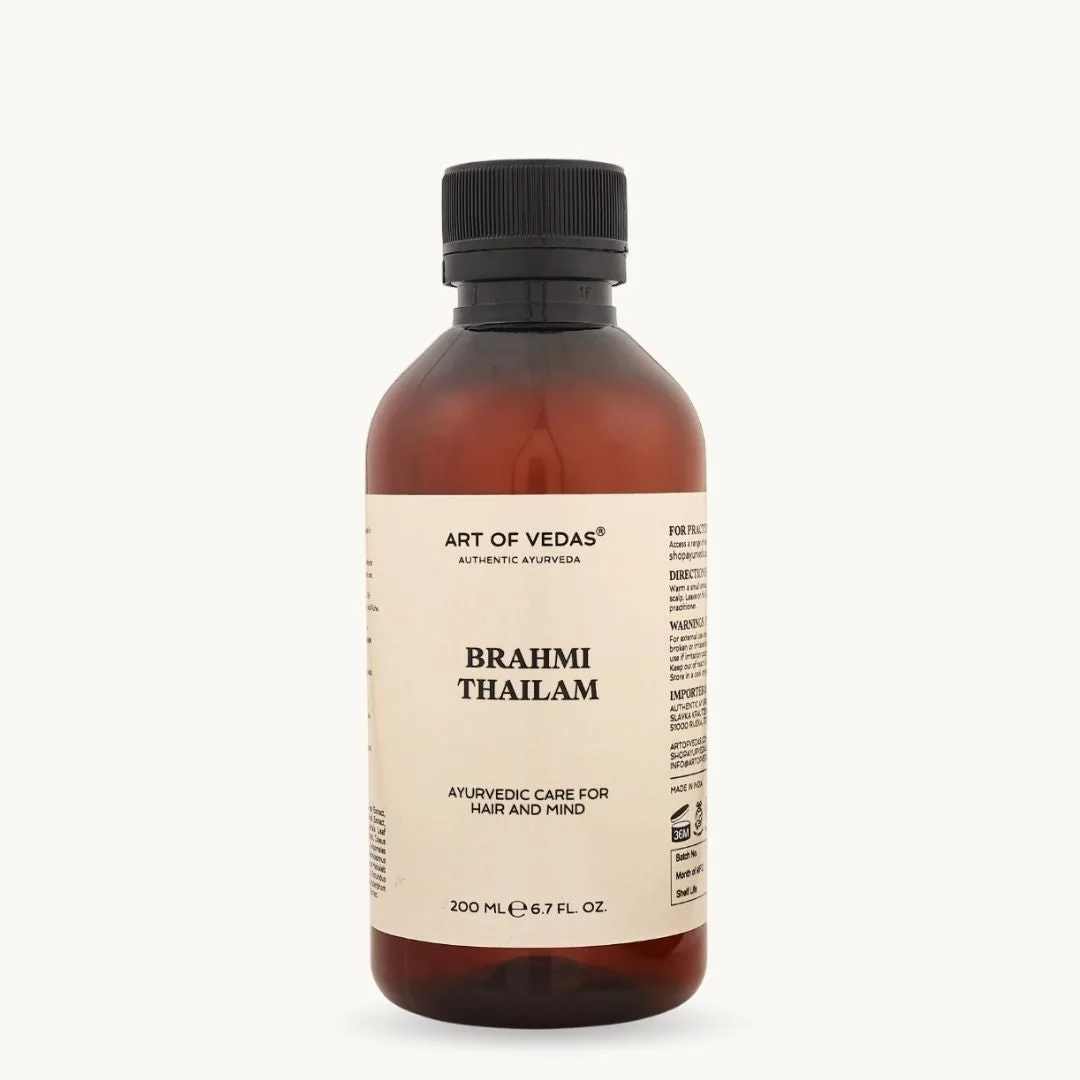
In brief: This page answers the questions people search most often about Shirodhara, the classical practice in which warm oil is poured in a steady stream over the forehead: what it is, what the vessel is called, how the oil is chosen and which equipment it takes. It also explains Panchakarma, Dravya, Greeva Basti and Netra Basti, and names the matching Art of Vedas instruments and oils.
One point applies throughout: Shirodhara is carried out by a trained practitioner. This page describes the practice. It does not teach it. Longer Art of Vedas guides are listed at the end.
What is Shirodhara, the head oil pouring practice?
Shirodhara is a classical Ayurvedic practice in which warm oil is poured in a thin, steady stream over the forehead. The name is Sanskrit: Shiro means head and Dhara means stream, so an oil Dhara on the forehead is called Shirodhara. The person lies on a table, the oil runs from a vessel hung above the forehead, and a trained practitioner guides the stream.
What is the Shirodhara oil vessel, the Dhara pot, called in Ayurveda?
The classical name is Dhara Patra: Dhara is the stream and Patra is the Sanskrit word for vessel. In English it is a Shirodhara pot or Dhara pot. It has a small opening in its base, from which the oil runs in an even stream.
Art of Vedas has two: the Traditional Shirodhara Brass Pot, which holds two litres, hangs on a chain and has a valve to set the flow, and the Stainless Steel Shirodhara Pot.
What equipment does a Shirodhara setup need?
A Shirodhara setup consists of the vessel, a stand that holds it at the right height above the head, a table from which the oil runs off and is collected, and a way to keep the oil warm. Smaller items are cotton wicks that regulate the stream and a rolled cotton band that keeps oil away from the eyes.
The classical wooden table with a channelled surface is the Dhroni, also written Droni. The smaller instruments are in the Panchakarma Instruments collection.
What do you need to buy for Shirodhara head oil pouring?
Besides the stand and the table, choose the vessel and the oil with care. For the vessel, our guides name four points: a fine, unbroken stream, enough capacity for a whole session, a shape that hangs firmly from your stand, and a surface that washes clean. For the oil, they reckon with about 1.5 to 2 litres a session.
Brass, the traditional material, is polished now and then. Stainless steel needs only washing, which suits a room with several sessions a day.
How do you choose the head oil for Shirodhara?
The oil is chosen for the person, not from a ranking: the practitioner selects it according to the person's constitution, Prakriti. Each classical oil is described by its character, warming or cooling, and by the Dosha it is classically associated with. As a pattern, a warming sesame-based oil is associated with Vata and a cooling oil with Pitta.
What temperature should the oil be for Shirodhara, and how is it kept warm?
The oil should be comfortably warm and never hot: around body temperature or slightly above, which our guides put at about 38 to 40 degrees Celsius. The practitioner checks it before it touches the forehead. It is kept warm with a thermostat oil warmer, a water bath, or a pump that returns the collected oil through a warming element.
The shop lists the vessels. Warmers, stands and tables are covered in the equipment guide.
What are the basic techniques of Shirodhara head oil pouring?
There are two ways of pouring. In the first, the vessel stays still and the stream falls on one point at the centre of the forehead. In the second, the vessel is swung gently, so that the stream sweeps from temple to temple. In both, the stream is thin and unbroken, and guiding it is a practitioner's skill.
When should you eat before Shirodhara?
Eat lightly beforehand and do not arrive with a full stomach. Our guides advise a light meal in place of a heavy one, and one of them suggests leaving out caffeine and alcohol before the session. They give no fixed number of hours, so ask the practitioner who carries out the session.
Is Shirodhara head oil pouring suitable for beginners, and are there alternatives?
A first Shirodhara belongs with a trained practitioner, whether you are a beginner or not. Our guides are plain: it is not something a person does alone, because placing the stream and keeping the oil warm need a second, trained person. As a home practice they name something different: Shiro Abhyanga, the oil massage of the scalp.
Speak to a qualified practitioner or a doctor first if you are pregnant, if the skin of the scalp or forehead is broken, or if the session is for a child.
How long has Shirodhara been used?
No Art of Vedas guide puts a number of years on it, and this page does not guess one. The guides speak of centuries of practice and place Shirodhara among the head oil practices that the Ashtanga Hridayam, one of the classical Ayurvedic texts, describes as Murdha Taila: Murdha means head and Taila means oil.
What does Panchakarma mean, and can it be done at home?
Panchakarma means five actions: Pancha is five and Karma is action. The word names a classical set of five procedures: Vamana, Virechana, Basti, Nasya and Raktamokshana. They are carried out under the supervision of a qualified Ayurvedic physician, not at home. Shirodhara is not one of the five: our guides count it among the preparatory practices, Purvakarma.
How is the Dravya for Panchakarma selected, and what is the classical source?
Dravya is the Sanskrit word for substance: in Panchakarma, the oil, Ghritham or other preparation used in a procedure. Our guides state the principle: the practitioner selects it for each person after assessing Prakriti, the constitution, and Vikriti, the present state. As classical sources for Panchakarma they name the Charaka Samhita, the Sushruta Samhita and the Ashtanga Hridayam.
Where is Panchakarma offered in Europe?
Panchakarma is offered in Europe by a growing number of Ayurvedic centres and by qualified Ayurvedic physicians. Our guides describe it as a supervised programme of one to several weeks, not a single appointment. When you compare programmes, they suggest asking who supervises it and whether it includes all three phases: the preparation (Purvakarma), the main procedures (Pradhanakarma) and the phase afterwards (Paschatkarma).
Art of Vedas supplies oils and instruments. This page is not a directory of centres.
What is Greeva Basti?
Greeva Basti is a classical practice in which warm oil is held in a small pool over the back of the neck. Greeva is the Sanskrit word for neck, and Basti here means holding something inside. The person lies face down, and the practitioner forms a rim on the skin, classically of black gram dough, and fills it with warm oil.
The Greeva Basti Yantra is a reusable four-sided frame for this, sealed to the skin with flour paste. It holds about 200 to 300 ml of oil and is intended for trained practitioners.
Which tools and instruments are used for Basti and Netra Basti?
Two different things share these words. Netra Basti, with Netra meaning eye, is a practice in which lukewarm Ghritham is held over each eye inside a small sealed rim. Basti Netra and Basti Putaka are the tube and the bag of the Basti Yantra, the classical instrument for the internal Basti of Panchakarma, which belongs only with a qualified practitioner or a doctor.
The Netra Basti Yantra is a pair of clear acrylic rims, one for each eye, made for trained practitioners. For anything that concerns the eyes, speak to a doctor first.
Which oils are used for Veshtana in Ayurveda?
Veshtana is a Sanskrit word for wrapping or binding with cloth. Art of Vedas has no product description and no guide that names oils for it, so this page names none. The choice depends on the person and is a matter for a qualified Ayurvedic practitioner.
Products mentioned on this page
Read further
More questions answered
For external use only. Not a substitute for professional medical advice.