In brief: This page answers the questions people type into a search engine about Mahanarayana Thailam, in their own words. Each answer says what the oil is, what it contains and how it is used, and points to the product and to our longer guides.
Mahanarayana Thailam is also written Mahanarayan tel, Maha Narayana Thailam, Mahanarayana Taila or simply Mahanarayana oil. The answers rest on our product information and published guides. They describe the oil and the practice it belongs to, and make no statement about any effect on the body.
What is Mahanarayana Thailam?
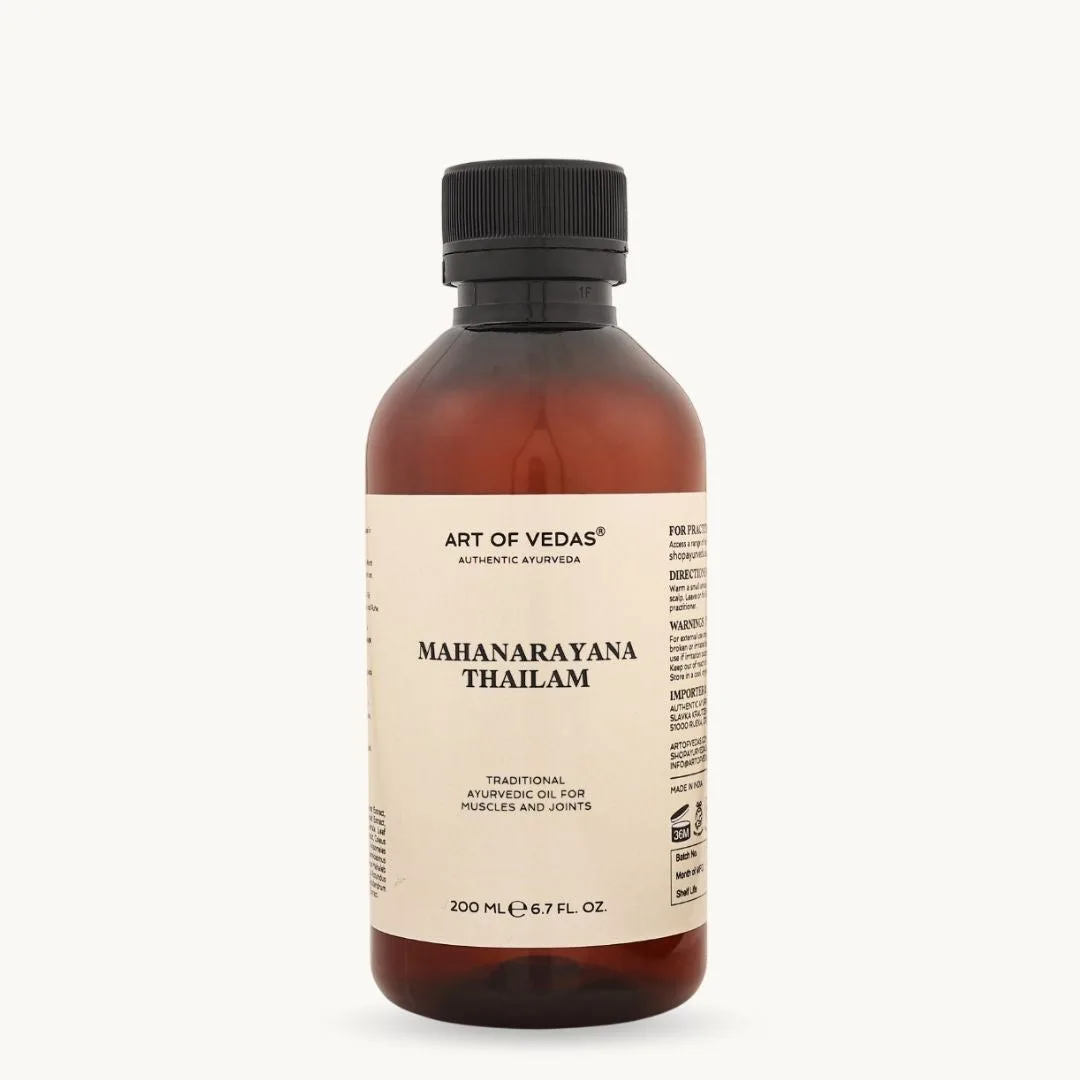
Mahanarayana Thailam is a classical Ayurvedic massage oil: a long list of herbs prepared in a sesame oil base and used for Abhyanga, the Ayurvedic oil massage. Its character is described as warming and heavy, and it is classically associated with Vata. Art of Vedas offers Mahanarayana Thailam as an oil for external use.
The name is Sanskrit. Maha means great, Narayana is a name of Vishnu, and Thailam, also written Taila, means oil.
What are the uses of Mahanarayana Thailam?
Mahanarayana Thailam is used for Abhyanga, the self-massage with warmed oil that the classical texts count among the practices of Dinacharya, the daily routine. It is applied to the skin, either over the whole body or on one chosen area. Art of Vedas sells it as a cosmetic oil for external use only and describes the practice, not an outcome.
What is the composition of Mahanarayan oil: which ingredients and herbs does it contain?
The base of Mahanarayana Thailam is sesame oil, and a long list of plants is prepared into it. The list declared for the Art of Vedas oil includes Withania somnifera (Ashwagandha), Sida cordifolia (Bala), Asparagus racemosus (Shatavari), Cedrus deodara (deodar cedar), Aegle marmelos (bael), Curcuma longa (turmeric), Elettaria cardamomum (cardamom) and Cinnamomum verum (cinnamon). The complete ingredient list is printed on the product page and on the label.
There is no single active ingredient. A Thailam is a compound preparation, and every plant in it belongs on the ingredient list.
What is the official or traditional Ayurvedic source for Mahanarayan Thailam, its ingredients and uses?
Our product information names two classical texts for Mahanarayana Thailam: the Bhaishajya Ratnavali and the Sahasrayogam. Our longer guide adds that the formulation is also set out in the Ayurvedic Formulary (AFI), the government-published compendium of official Ayurvedic formulations. For the oil we sell, the ingredient list on the product page and on the label is the reference.
The texts are described in Mahanarayana Thailam: Complete Guide.
What are the application methods for Maha Narayana Thailam?
Our product information gives two application methods for Mahanarayana Thailam: full-body Abhyanga and use on one chosen area. For Abhyanga the warmed oil is applied generously to the whole body with long strokes along the limbs, then left on the skin for 15 to 20 minutes before a warm shower or bath. For one area, a small amount is massaged in gently until absorbed.
- Warm the oil by standing the bottle in warm water for a few minutes. Do not use a microwave.
- Massage the abdomen gently in a clockwise direction, and include the scalp, the ears and the soles of the feet.
- Take care in the shower afterwards, as oil makes surfaces slippery.
- The full sequence is in How to Use Mahanarayana Thailam (Abhyanga).
How many times can you apply Mahanarayana oil?
Our product information and our guides give the same two rhythms for Mahanarayana Thailam: daily, which is the traditional practice, or two to three times a week. Abhyanga belongs to Dinacharya, the daily routine, and the classical texts place it in the morning, before bathing. How often suits you personally is a matter for a qualified Ayurvedic practitioner.
Our guides add that daily use is most at home in autumn and winter, and that a lighter rhythm, down to once a week, fits the warmer months.
Why does Mahanarayana oil feel cold on the skin?
A cool first impression from Mahanarayana oil has two likely causes. Oil taken straight from the shelf is cooler than the skin. The oil itself is classed as warming, and classical practice warms every Thailam before use.
Stand the closed bottle in warm water for a few minutes, until a drop feels pleasantly warm on the inside of the wrist. How an oil feels also differs from person to person.
Which Mahanarayana tel should you choose when you compare all factors?
Art of Vedas does not rank one Mahanarayana tel against another, but the factors to compare are the same for every bottle. Read the label first: the full ingredient list including the base oil, the batch number and date, the net content, and the directions and precautions. Then look at the test results for the batch, and only after that at aroma, colour and consistency.
For our own oil the base is sesame oil, the full list is on the product page, and the bottles hold 200 ml or 450 ml. Our how-to guide reckons two to three tablespoons for a full Abhyanga and a teaspoon or two for one area, which helps in choosing between the two sizes. The complete list of checks is in How to Judge a Classical Ayurvedic Oil.
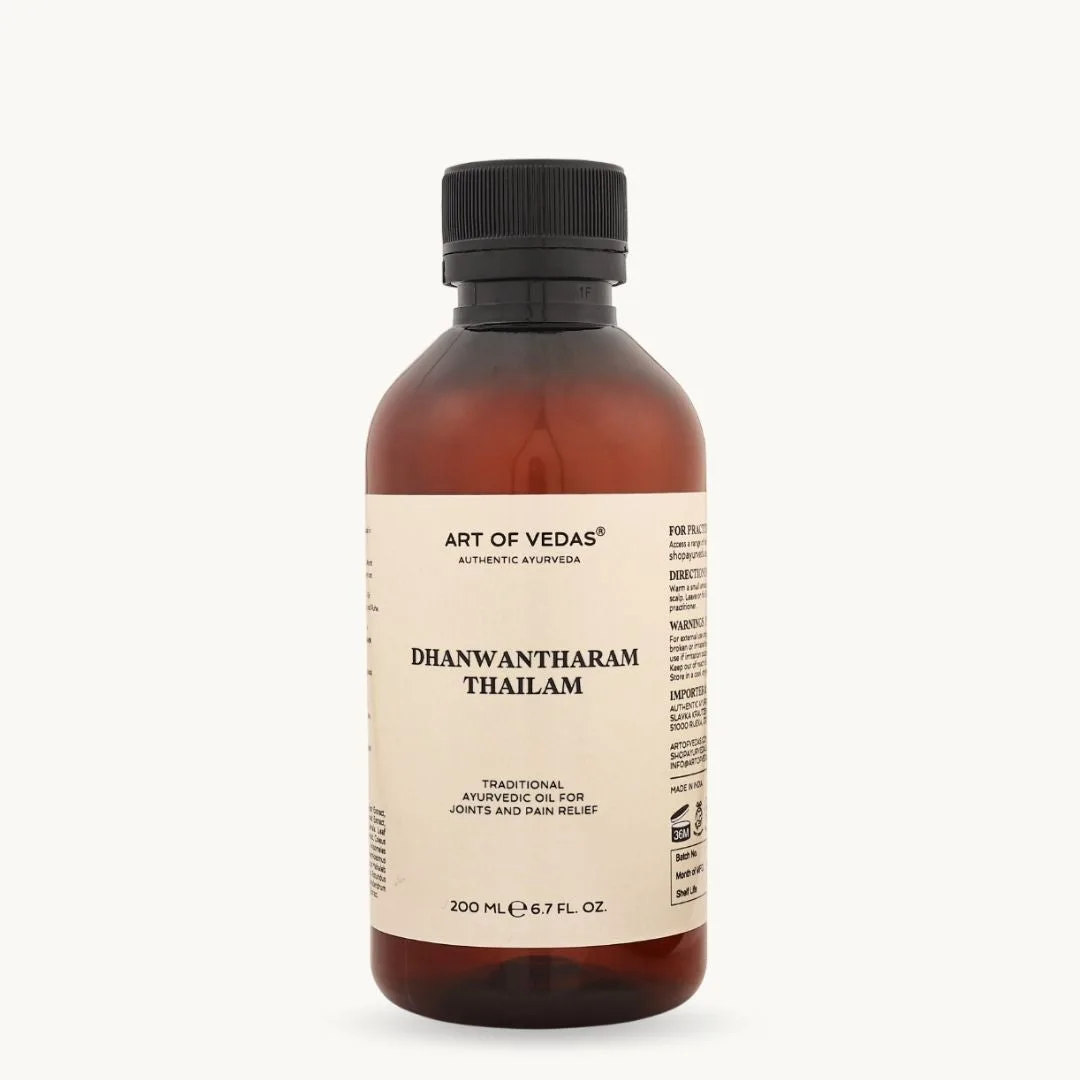
What is the difference between Dhanwantharam Thailam and Mahanarayana oil?
Dhanwantharam Thailam and Mahanarayana Thailam are both classical sesame-based oils for Abhyanga, and both are classically associated with Vata. They differ in character: our product information classes Mahanarayana Thailam as warming and Dhanwantharam Thailam as mildly warming. Our comparison guide describes Dhanwantharam as the oil for a gentle, regular daily routine and Mahanarayana as the one for a richer, warmer massage.
The two are set side by side in Dhanwantharam vs Mahanarayana Thailam.
Narayana Thailam vs Mahanarayana Thailam: what is the difference?
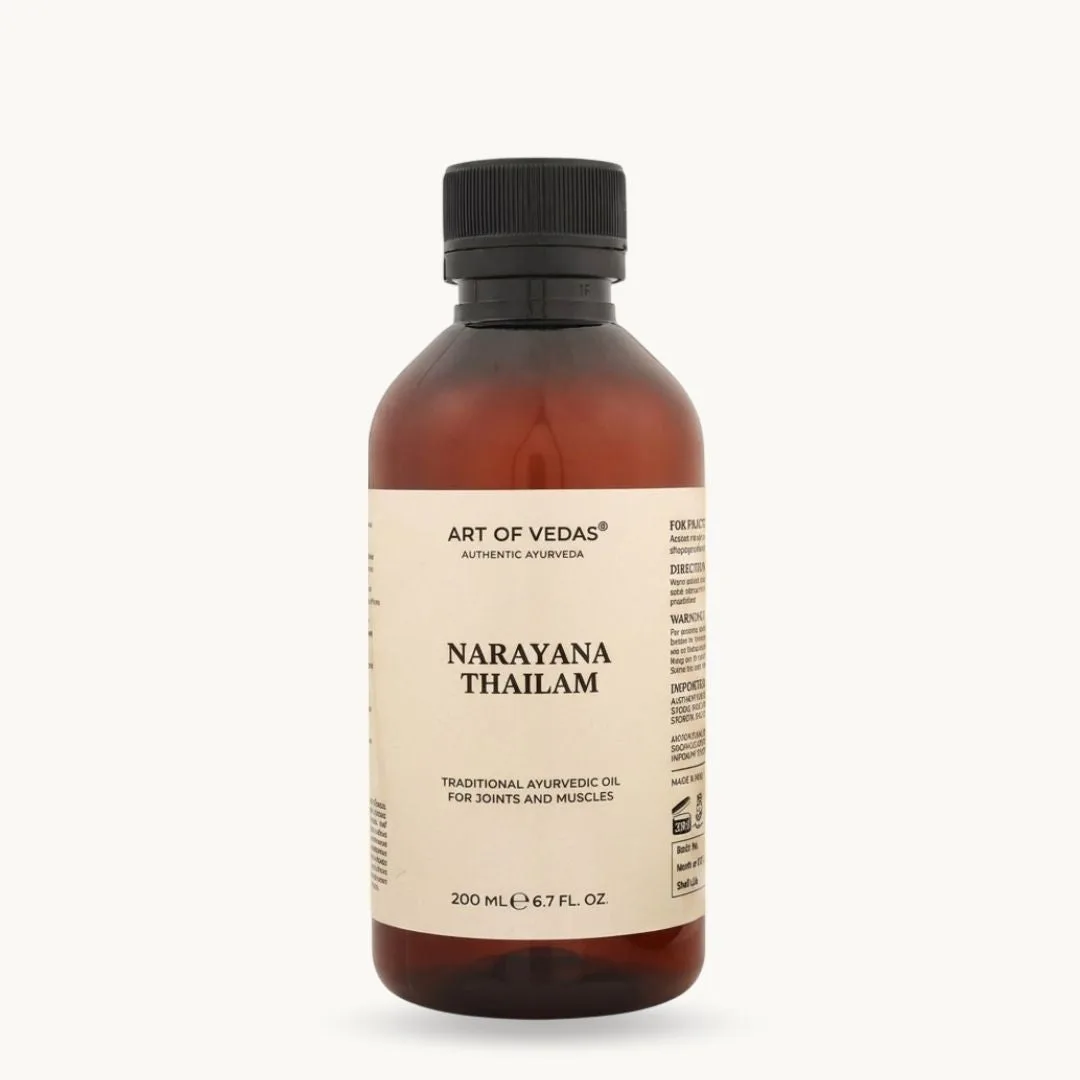
Narayana Thailam is the older and simpler recipe. Mahanarayana Thailam, literally the great Narayana oil, is the expanded version with a longer list of herbs. Both are warming sesame-based oils for Abhyanga, and our guide describes Narayana Thailam as lighter on the skin and Mahanarayana as fuller and warmer.
The naming and the two formulas are explained in Mahanarayana vs Narayana Thailam.
Valiya Narayana Thailam vs Maha Narayana Thailam: is it the same oil, and what is it for?
Valiya is the Malayalam word for large and Maha is the Sanskrit word for great, so both names mark the larger Narayana formula with the fuller list of herbs. The smaller formula is called cheriya. Our naming guide places Valiya Narayana Thailam closest to the Mahanarayana formula, but naming customs differ from label to label, so compare the ingredient lists. Either way it is a massage oil for Abhyanga.
Karpuradi Thailam and Maha Narayana Thailam: how do you combine them?
Karpuradi Thailam and Maha Narayana Thailam are not mixed. Our how-to guide is clear that blending oils in one bowl is not the classical way, because each preparation is complete in itself. They can be kept side by side and used at different times, each in its own moment.
Karpooradi Thailam, as the name is written in our shop, is a much simpler preparation: Karpura (camphor) and Ajamoda in sesame oil. Which of the two suits which occasion is a question for a qualified Ayurvedic practitioner.
Can Mahanarayana Thailam be applied in a foot massage?
Yes, Mahanarayana Thailam can be applied to the feet. The soles of the feet are part of the Abhyanga sequence in our product information, and our how-to guide ends the massage there, taking time over the soles. Whether a foot massage suits your personal situation is a question for a doctor or a qualified Ayurvedic practitioner, not for a product page.
Warm a small amount of oil first, and mind smooth floors afterwards, because oiled feet are slippery.
Is Mahanarayana Thailam safe to drink?
No. Art of Vedas Mahanarayana Thailam is a cosmetic massage oil for external use only, and it must not be drunk or taken internally. Keep it away from the eyes and out of the reach of children. Anyone who has read about internal uses of classical oils should speak to a qualified Ayurvedic practitioner or a doctor and not try them at home.
The same care applies during pregnancy, with children and on broken skin: speak to a qualified practitioner or a doctor before use.
Products mentioned on this page
- Mahanarayana Thailam: classical massage oil on a sesame base for Abhyanga, warming, classically associated with Vata. 200 ml and 450 ml.
- Dhanwantharam Thailam: classical sesame-based oil for Abhyanga, mildly warming, classically associated with Vata. 200 ml and 450 ml.
- Narayana Thailam: the older and simpler Narayana recipe on a sesame base, warming. 200 ml.
- Karpooradi Thailam: classical oil with Karpura (camphor) and Ajamoda in sesame oil, warming. 200 ml and 450 ml.
Read further
More questions answered
For external use only. Not a substitute for professional medical advice.